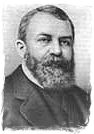
 Dwight Lyman Moody was born at Northfield, U.S.A., on Feb. 5th, 1837.
The manner in which he was converted had an effect upon his own future methods. He was once asked: "Mr. Moody, what is the way to reach the masses with the Gospel? To which he characteristically replied, "Go for them! " Mr. Kimball was his Bible class teacher, and evidently young Moody had been specially laid on his heart. Accordingly he went to the shoe shop in which Moody was employed, to talk to Moody about his soul. The record is very simple— "There, in the back of that store in Boston, he gave himself and his life to Christ." Mr. Kimball went after Moody, and Moody adopted that method in a variety of ways in later life.
Moody's life has been divided into four sections, viz., (1) A Sunday School worker; (2) The organiser of a church for the people; (3) An evangelist on both sides of the Atlantic; and ( 4) An educator of youth.
How much could be written about the Moody Bible Institute in Chicago and its influence for good since the days of Moody! Then we think of Northfield and its many and varied activities, but we are principally interested in this article with his work in the British Isles.
In business D. L. Moody had all the marks of a pushing and successful young man. His business life was eventually in Chicago, and while there he was very busily engaged in the service of the Lord in connection with Sunday School work. He made up his mind to save a certain amount of money, and then to go out into the Lord's work and maintain himself as long as the money lasted.
Later on, and quite suddenly, he made up his mind to visit England. His reasons for so doing were for the sake of his wife's health, and that he might meet the well-known workers, C. H. Spurgeon and George Muller. Practically unknown in England, he was asked to attend the Annual Meeting of the Sunday School Union in Exeter Hall in 1867.
It was allotted to him to move a vote of thanks to the Earl of Shaftesbury for presiding. The opening of his speech must have produced quite a sensation. From his reply it can be imagined how the chairman introduced him. Moody said: "The chairman has made two mistakes. To begin with, I'm not the 'Reverend' Mr. Moody at all. I'm plain Dwight L. Moody, a Sunday School worker. And then I'm not your 'American cousin.' By the grace of God I'm your brother, who is interested with you in our Father's work for His children."
In these, his introductory remarks in his first public address in London, we can discern several marks of the character of the man.
During that visit he went to Dublin and there met Harry Moorhouse, and, in his casual way, invited Moorhouse to visit him when in America. It was about this time that he heard these words, uttered by Henry Varley: "The world has yet to see what God will do, with, and for, and through, and in, and by, the man who is fully and wholly consecrated to Him." Moody remarked: "I will try my utmost to be that man." That proved to be the great turning point in the experience of Moody.
The meeting with Moorhouse was destined to have a great influence upon him. The story is well-known how Moorhouse, making for Chicago, reminded Moody of his invitation. He was just then leaving home but arranged that Moorhouse should preach in his church. For seven consecutive nights Moorhouse preached with fervour from the inexhaustible text, John 3:16. Blessing attended this preaching. Soon Moody returned, and was impressed then with the need of making known the love of God, and this altered his preaching. Henceforth he was to declare the love of God wherever he went.
Yet another event was used in shaping Moody's preaching. On October 8th, 1871, he preached in Chicago from the words: "What shall I do then with Jesus which is called Christ?" (Matt. 27:22).
That was on a Sunday night. At the close of the address Moody told the people to take the text home and think over it, and to return the following Sunday when he would deal with the answer. That week the great Chicago fire took place, his church was burned down, and many of his audience were taken away. Moody determined ever after to preach for immediate results.
In June, 1872, Moody came to England in order to learn more of the Bible from English Bible students. During that time he was asked to preach in a church in North London. This service was very much blessed, and he continued to preach. One or two other places were also visited.
He returned to America. Some time previously he had met Ira D. Sankey. Sankey's singing capabilities had impressed Moody, and they arrange to join forces in the work of the Gospel. In 1873 Moody and Sankey visited England and began preaching in York, moving from there to Sunderland, and then to Edinburgh, followed by Glasgow, next over to Belfast, and then to London. No one who has conversed with those who remember these stirring days will doubt that Moody was God's chosen vessel. Pages could be filled with interesting items of these great revival times.
In 1881 these two brethren paid another visit to England, commencing at Newcastle-on-Tyne, and in London there was a long and fruitful time.
It may be interesting to quote some estimates of the man by those who knew him.
Joseph Cook wrote: "A man of prayer, a man of the Book, a man of the soundest evangelical faith, a man of extraordinary practical sagacity, organising power, and aptness for leadership, a man of combined courage and tenderness, a man endowed by unusual powerful, but balanced, emotions with greatness of character, a man of commanding spiritual manliness, a man of remarkable business and executive talent, a man working easily with associates."
Henry Drummond wrote: "In largeness of heart, in breadth of view, in single-eyedness and humility, in teachableness and self-obliteration, in goodness of love, none can stand beside him."
Ira D. Sankey said: "Amid all that has been said about what has made Mr. Moody so great a man, I want to say that one of the greatest influences of his life came from his wife. She has been the brake upon an impetuous nature, and she, more than any other living person, is responsible for his success."
Alexander Stewart was very fond of recalling his visit to Moody and Northfield, and he used aptly to sum him up as "a big chunk of humanity."
We conclude our record of a great, good, and much loved evangelist, by quoting his last words, ere he was promoted to Glory on December 22nd, 1899—"Earth is receding and Heaven opening. God is calling me."
From Twelve Famous Evangelists by James Stephen. London: Pickering & Inglis, [19--].
>> More D. L. Moody