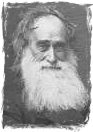
 A
story of sacrifice, of privation, of dangers, and of unceasing but
successful work for God is the story of Robert Moffat and Mary, his
wife.
A
story of sacrifice, of privation, of dangers, and of unceasing but
successful work for God is the story of Robert Moffat and Mary, his
wife.
Little thought those sturdy Scotch parents, as they welcomed tiny Robert to their home circle that December day in 1795, that their son would become one of the greatest of missionaries to Africa. And when, a few years later, in the parish school of Carronshire, he laboriously plodded through the shorter catechism, with the occasional aid of the master's rod, he still gave no promise of future greatness. His love for study was small, his love for the sea was great, and at last he ran away from home to try a sailor's life. But after several thrilling experiences when he narrowly escaped being severely injured, and perhaps killed, he decided that he had had enough of the sea, and was content to remain at home.
Again he entered school, and this time took more of a liking to his studies. Only six months were spent there however, and this completed his schooling. But even in this short time he had acquired knowledge that was of inestimable value to him in later years.
And other knowledge was gained during those early years that was of even greater value, for his pious parents instructed him in God's Word. His mother was much interested in missions and during the long winter evenings, while both the boys and girls were learning to sew and knit, she read to them of missionaries who were willing to live on tallow, that they might preach Jesus to the Greenlanders. "Ay, but they were holy men; would God all my boys might be like them!" the mother said.
At fourteen Robert was apprenticed to John Robertson, and while with him learned gardening and the blacksmith trade, and also learned to play the violin. When a missionary in the wilds of Africa all this was of much value to him.
At sixteen he went to England to take the position of under-gardener to Mr. Leigh, of Cheshire. Before he parted from his mother, she obtained from him the promise to read a chapter of the Bible morning and evening. "O Robert, my son," she said in parting, "read much in the New Testament. Read much in the gospels — the blessed gospels. Then you cannot well go astray. If you pray, the Lord Himself will teach you."
With his new employer young Moffat was very pleasantly situated, and while there he had a chance to continue his studies.
When about twenty, the prayers of his father and mother for his conversion were answered, though perhaps not just as they wished, for it was with the despised Methodists he found salvation, which was a sore trial to his Calvinistic parents.
After his conversion Moffat's desire was to point other souls to God, and it was painfully surprising to him to find so many who rejected the Savior he loved so ardently.
One day a placard announcing a missionary convention arrested his attention, and from that time his mind was occupied with one question — how he might help the cause of missions. That he might ever be a missionary himself he hardly dared hope, as his education he deemed insufficient. Yet at last he offered himself, and was finally accepted.
In order that he might better prepare himself for the work, he had taken a position with a Mr. Smith, near Manchester. This led to his making the acquaintance of Mr. Smith's daughter, Mary, who later became his wife, and a truer one he could not have found. It had long been the hope of her heart to work for the heathen, and she longed to accompany her beloved Robert to Africa. Her parents would have consented to their marriage if they had been willing to remain in England, but they could not bear to think of their only daughter's crossing the seas to a land like Africa.
Hard as was the thought of parting, Robert never for a moment considered abandoning his missionary work, and he and Mary parted, leaving all in God's hands, and trusting that He would some day open the way for her to join him in Africa.
It was on October 18, 1816, Moffat sailed for Cape Town, South Africa, arriving there January 17. He expected to go at once to Namaqualand but was hindered. The time was not lost however; while waiting, Moffat spent some time familiarizing himself with the Dutch language, which would be useful in dealing with the rich Dutch farmers who lived near the Cape.
"And what do you get for it, man alive? How much gold do they send you from rich England?" asked one of these farmers as Moffat stopped at his house on his way to Namaqualand.
"I can't say," Moffat replied; "I came out to Africa, not to seek gold, but souls."
"Do you know what sort of a country you are going to?" the Dutchman asked.
"Yes; not a garden of Eden, of course."
"A garden of misery, you mean! You'll find nothing but sand and stones, few people, and each suffering from awful thirst; plains and hills roasted like a burnt leaf under the scorching rays of a cloudless sky! And the chief of the country, Africaner, will set you up as a mark for his boys to shoot at; or mayhap make a drinking cup of your skull, or make a drum of your skin, to dance to." Moffat however was undaunted.
The farmer requested him to hold a service in his house, but scorned the idea of bringing in the black servants. "Hottentots! Let me go to the mountains, or call the baboons; or, stop! I have it! William, call the dogs in, they'll make as good a congregation as the blacks."
Moffat said nothing, but commenced the service. He read the story of the Syro-Phoenician woman and selected as a text: "Truth, Lord: yet the dogs eat of the crumbs which fall from their master's table." In a few minutes the Dutchman interrupted him and asked him to wait until the servants could be called in. "Who hardened your hammer to give me such a blow?" he asked after the service. "I will never object to preaching to the blacks again."
It was in Namaqualand, at a station known as Africaner's Kraal (pronounced "crawl") that Moffat settled, during the last of January, 1818.
The chief of this part of the country, Africaner, had been one of the wildest of wild men, the terror of all the country round about. One hundred pounds sterling had been offered by the government for his head. But under some of the few missionaries who had preceded Moffat Africaner had been converted, and the transformation was marvelous.
Soon after Moffat's arrival, Africaner directed his women to build a house for the new missionary. The erection of a house in that country was a very simple matter, for in half an hour the structure was finished. It was constructed of poles and mats, and shaped like a beehive. Although it did not provide protection from dust or rain or serpents, Moffat made it his home for several months.
For a year he saw no white person. But when lonely he would sometimes seat himself upon a rock with his violin, and thus find comfort. His mother's favorite hymn was the one he sang most often—
"Awake, my soul! in joyful lays,
To sing the great Redeemer's praise."
Africaner's growth in grace under the instruction of the new missionary was remarkable. In the evenings he would sit at the door of Moffat's humble hut and ask questions about God. After conversing for some time he would say, "I have heard enough; I feel as if my head were too small and as if it would swell with these great subjects."
The chief did all he could to help Moffat. Two cows which he gave him were greatly appreciated. His entire income was twenty-five pounds a year, so we may be sure he did not live in luxury.
One interesting circumstance of these days was Moffat's trip to Cape Town, accompanied by Africaner. At the first suggestion of this the chief questioned, "Are you in earnest? Are you sure you are not joking?"
"I'm not joking; I really mean it. Do come with me," the missionary said.
"Nay, father, but I thought you loved me; would you wish me to be hung up as a spectacle to justice? Don't you know that I am an outlaw, and a thousand rix-dollars [old silver coins] have been offered for this poor head?"
"But no harm will come to you, friend. You are now a changed man. There is no danger."
"Well, I will deliberate, and roll my way upon the Lord. He, I know, will not leave me."
He decided to go, and those who had known of him as the savage chief, the dread of all, marveled at God's power to save.
On the journey Moffat stopped to see the farmer at whose house he had preached on his way to Namaqualand. The farmer saw him coming and at once said, "It's Moffat's ghost! Don't come near me! I knew Africaner would kill you."
"But I am not dead yet; feel my hands," said Moffat.
The Dutchman, still unconvinced, next asked, "Then when did you rise from the dead? A man told me he had seen your bones; that Africaner had killed you."
Moffat at last convinced him that he had not been killed, but when he told him of Africaner's conversion he replied, "Moffat, I can believe almost anything you say, but that I cannot credit. Never! It would be the eighth wonder." At last he said, "Well, if it's true, there's only one wish I have before I die, and that is to see this man. He killed my own uncle, but if he is really a Christian, I should like to see him."
"Should you? then, there he is," pointing to the chief. This seemed hardly possible, but at last, no longer skeptical, the farmer looked toward Heaven, exclaiming, "Almighty God, what a miracle of Thy power! What cannot Thy grace accomplish!"
While at the Cape, Moffat had the joy of welcoming Mary Smith to share his African home and toil with him, her parents having given their consent, daring no longer to withhold her from the work God had for her to do.
After their marriage, it was decided that they should go to Bechwanaland, instead of returning to Namaqualand. Moffat was reluctant to leave Africaner's people, whom he dearly loved, but after carefully considering the matter, it seemed advisable. Africaner himself advised him to make this move, promising to take the missionary's belongings to him, and to remove there with his people soon. The goods reached the new station soon after the Moffats' arrival, but death overtook the chief before he was able to move there with his people.
At Kuruman the Moffats settled among a people terribly degraded, and hostile to missionary work. Missionaries, in their opinion, were criminals who had fled to that far-away land to escape justice.
If the efforts of their "rainmaker," in whom they placed great confidence, failed, it was the fault of the missionaries. Moffat's long black beard, or perhaps his white face, frightened away the clouds, they said.
One day he was confronted by a number of armed men who told him the people had determined that they should leave the country.
"We love you, are anxious to serve you, and cannot leave you in your distress," said Moffat. "Here, thrust your spear into my bosom, and then my companions will know that it is time for them to retreat; but we will not leave you unless we are compelled."
Then the chief dropped his spear and said to his companions, "These men have nine lives, they are so fearless of death; there must be something in immortality."
There was no more hostility manifested by the natives, but the work progressed very slowly. To live among these people "required a strong stomach as well as a warm heart," Moffat said, so filthy and degraded did he find his poor neighbors to be.
Mastering the native language was very difficult, as they had no system of writing; and learning from the natives was also difficult. Sometimes they purposely taught them the wrong words, just for the fun of hearing them use absurd expressions.
But in spite of every discouragement the faithful workers toiled on, assured that some day the time of reaping would come.
When Mr. Moffat had sufficiently mastered the language, he compiled a spelling-book -- the beginning of a printed language. A catechism and portions of the Scripture were also translated. Thus 1826, though a year of trial, was one of progress.
Through the long years of patient sowing, Robert and Mary Moffat never doubted that the reaping day would come some time. A friend in England had written to them, asking in what way she could assist them. Though there was not a native convert then, nor any outward prospect of any, Mrs. Moffat answered, by faith, "Send us a communion set; we shall want it some day." And by the time the communion set arrived in 1829 it was needed, for men and women with broken hearts had been confessing their sins and looking to God for salvation. The change was marvelous. Moffat himself confessed his surprise. God had given "exceeding abundantly" above all they asked or thought.
Native customs gave way to civilized practices. Men as well as women visited Mrs. Moffat to learn how to make proper clothing. Women were anxious to become better wives and mothers and housekeepers. They began to put furniture into their houses. The sick were cared for and the dead were buried in a proper manner. Meetings for prayer and praise were held by the natives. And in that wild country sprang up a church composed of men and women with black faces, but with hearts made white in the blood of the Lamb.
Far-away tribes began to hear of the wonders wrought among the Bakwains, and sent delegates to investigate. Mosilikatse, a cruel tyrant living nearly seven hundred miles away, sent two men, who were welcomed, clothed, and kindly entertained by the Bakwains.
When they returned to their own country Moffat accompanied them, and Mosilikatse became greatly attached to him.
Having never seen such things as wagons, the ignorant king was stricken with fear at the sight of them. He supposed them to be some kind of living monsters, until one of his men told him he had seen one being made.
During his stay with Mosilikatse Moffat talked very plainly with him concerning his deeds of cruelty. Never before had any one dared to mention the sinfulness of his course. So seared by sin was his heart that Moffat hardly thought the truth could make any impression on it. Yet it had its effect. One day a prisoner was tried before him, and the king who never before had pronounced any sentence but that of death, for the sake of "Moshete," as he called his new friend, showed some leniency.
When twenty-three years had been spent away from England, the way opened for their return. Mr. Moffat had translated the entire New Testament into the language of the Bakwains, and their principal object in going to England was to get this printed.
After a long, sad voyage, during which a baby girl was born, and a six-year-old son died, they reached England and were warmly welcomed. Sometimes Moffat had felt that the people at home did not fully appreciate his work. But this feeling vanished when he reached England and saw the interest that was manifested.
Afterward some one wrote to him:
"Your visit to us we can never forget. Our little children are already in their infantile chronology, beginning to date from the time Mr. Moffat spoke to them. And believe me, to many of us, in riper years, the time when you spoke to us will be as a sunny spot on the dusty and troubled road along which we journey... You have opened before us a new page of human society and character, and have confirmed our attachment to the missionary cause, by showing that there is no tribe too degraded for the Gospel to elevate; no heart too polluted for Christianity to purify."
The Moffats had received a loving welcome in England; and no less loving was the welcome the natives gave them on their return. Some of these — their children in the Gospel — went as far as one hundred fifty miles to meet them, and help them with such things as they could provide to make the journey less trying.
Soon after their return, their oldest daughter, Mary, was united in marriage to David Livingstone, who had recently been sent to Africa, and they were stationed about two hundred miles from the headquarters, at Kuruman. This accorded with the wish of the Moffats — that all their children should become missionaries. In 1861 they had the satisfaction of seeing five of their children carrying on the work to which they had given their lives.
Moffat was growing old. Robert, the oldest son, whose broken health had prevented his becoming a missionary, had gone on to his reward. Mary — the daughter whom Mr. Moffat had given to Africa — in 1862 was called Home. But the father was spared, and labored still. In 1867 the translation of the entire Bible was completed, and this was a work that would remain long after the missionaries had ceased their toil.
By his side labored his own son, and when the time came for the parents to take a final leave of the land they loved, it was this son who remained to carry on the work.
It was hard to leave Africa, and it was long before Mr. Moffat could be convinced that he no longer was able to do the work of a missionary. "This is my home more than any spot on earth," he said, as he took his last farewell. "Here my children were born; here some of them are buried. Would I could lay my dust here with theirs." As they left the village, there arose a bitter wail from the people whose friends and instructors they had been so long.
It was not very long after their arrival in England that a separation came to the loving couple who for over fifty years had borne together the joys and sorrows of life. Very suddenly Mrs. Moffat was summoned to her eternal reward, without time for even a word of farewell to her loving husband. "Mary, my dear, only one word," he pleaded, but his request could not be granted. "For fifty-three years I have had her to pray for me; who will thus pray for me now? I have no more home below. Mother is gone, Jeanie, and I too, shall soon be flitting."
And yet he lived many years, never idle, but always doing all in his power for his loved Africa.
Christ grew more and more precious to him as he neared the time when he should see Him face to face. "How delightful Jesus Christ is, whether you muse upon His character or upon His works; His promises or His attributes; it is equally the same. Wonderful Christ! Wonderful love!" he said to his daughter. "When I used to lie awake weary nights in Africa, how real He was to me, and what delight I had in His society. But it is even more so now. Then I used to lean upon Him for strength and comfort; now it seems as if wave after wave of loving kindness flows in upon my soul."
August 10, 1883 the noble life came to an end, and the faithful missionary who had done so much for Africa joined the loved ones gone before, and entered the presence of Him for whom he had given his life.
"My album is the savage breast,
Where darkness reigns and tempests wrest.
To write the name of Jesus there
And point to worlds both bright and fair,
And see the savage bow in prayer
Is my supreme delight."
—Moffat.
From Hearts Aflame by Florence Huntington Jensen. Waukesha, Wisc.: Metropolitan Church Assn., ©1932.
>> More Robert Moffat