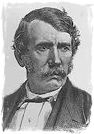
 David Livingstone (1813-1873), African missionary and explorer, was born at
Blantyre, Lanarkshire, [Scotland] on 19 March 1813. His great-grandfather
fell at the battle of Culloden fighting for the Stuarts. His grandfather
was a small farmer at Ulva in the Hebrides, who, finding his farm insufficient
to support a numerous family, moved in 1792 to Blantyre in Lanarkshire,
about seven miles from Glasgow, where he found employment in the cotton
factory of H. Monteith & Co. His sons became clerks in the same
factory, but, with the exception of Neil, all entered either the army
or navy during the war with France. Neil, after serving an apprenticeship
to David Hunter, a tailor, married in 1810 his daughter Agnes, eventually
became a small tea-dealer, and spent his life at Blantyre and Hamilton.
He was a religious man, and for the last twenty years of his life held
the office of deacon of an independent church at Hamilton. He had five
sons and two daughters, and set them a consistent example of piety,
while the mother, a delicate woman, with a flow of good spirits, did
her best to make the two ends meet.
David Livingstone (1813-1873), African missionary and explorer, was born at
Blantyre, Lanarkshire, [Scotland] on 19 March 1813. His great-grandfather
fell at the battle of Culloden fighting for the Stuarts. His grandfather
was a small farmer at Ulva in the Hebrides, who, finding his farm insufficient
to support a numerous family, moved in 1792 to Blantyre in Lanarkshire,
about seven miles from Glasgow, where he found employment in the cotton
factory of H. Monteith & Co. His sons became clerks in the same
factory, but, with the exception of Neil, all entered either the army
or navy during the war with France. Neil, after serving an apprenticeship
to David Hunter, a tailor, married in 1810 his daughter Agnes, eventually
became a small tea-dealer, and spent his life at Blantyre and Hamilton.
He was a religious man, and for the last twenty years of his life held
the office of deacon of an independent church at Hamilton. He had five
sons and two daughters, and set them a consistent example of piety,
while the mother, a delicate woman, with a flow of good spirits, did
her best to make the two ends meet.
David was Neil Livingstone's second son, and at the age of ten was sent to the cotton-factory as a "piecer." With his first earnings be purchased Ruddiman's "Rudiments of Latin," and for some years studied at an evening school, and at home until late at night, although he had to be at the factory at six o'clock in the morning. He thus mastered Virgil and Horace, and read all that came in his way. He contrived to read in the factory by placing his book on the spinning-jenny so that he could catch sentences as he passed at his work. He studied botany, zoology, and geology, and spent his few holidays in scouring the country with his brothers in search of scientific specimens. Although Neil Livingstone duly instructed his children in the doctrines of Christianity, David positively disliked religious reading until he met with Dick's "Philosophy of Religion" and "Philosophy of a Future State," and it was not until his twentieth year that he became conscious of strong religious convictions. As he himself relates, "In the glow of love which Christianity inspires I soon resolved to devote my life to the alleviation of human misery." An appeal by Charles Gutzlaff, the medical missionary to China, drew his thoughts to that country, and he determined to obtain a medical education to qualify himself for work there.
At nineteen he had become a cotton-spinner, and his wages were large enough to support him while attending the medical class in Anderson College, the Greek class in Glasgow University in winter, and the divinity lectures of Dr. Wardlaw in summer. While attending the university session of 1836-7 he, in company with Lyon (now Lord) Playfair and the brothers James and William Thomson (now Lord Kelvin), was instructed in the use of tools by Mr. James Young, assistant to the professor of chemistry. In the course of his second session at college Livingstone offered his services to the London Missionary Society, which he selected on account of its unsectarian character. In September 1838 he went to London, passed a preliminary examination, and was sent with Joseph Moore (afterwards missionary at Tahiti, and a friend and correspondent of Livingstone) to the Rev. Richard Cecil at Chipping Ongar in Essex for some months' probation. On its completion he returned to London and devoted himself to medical and scientific study. He placed himself under the guidance of J. Risdon Bennett (afterwards president of the Royal College of Physicians), and walked the hospitals. While pursuing his studies in London he acquired the friendship of Professor Owen and George Wilson.
The opium war prevented Livingstone from going to China, and meeting Dr. Robert Moffat, the South African missionary, in London, he was led to select that country for his labours. He was admitted a licentiate of the Faculty of Physicians and Surgeons in Glasgow University in the beginning of November 1840; on 20 Nov. he was ordained a missionary in Albion Chapel, London; and on 8 Dec. he embarked in the ship George, under Captain Donaldson, for the Cape of Good Hope. He put in at Rio de Janeiro, where he had his only glimpse of the American continent. The captain instructed him in the use of the quadrant and in taking lunar observations. After a detention of a month at Cape Town he proceeded to Algoa Bay, and landed in Port Elizabeth in May. On 31 July 1841 he arrived by wagon at Kuruman, in the Bechuana country, the most northerly station of the society in South Africa, and the usual residence of Dr. Moffat, who was still absent in England; and in accordance with his instructions, he turned his attention to the formation of a new station further north. Before the end of the year he made a journey of seven hundred miles with a brother-missionary, which confirmed his opinion as to the necessity of native labour in attempting to Christianize so vast a field, and which resulted in a visit to the chief Setshele at Shokwane and the selection of a station 250 miles north of Kuruman as the most suitable spot for fresh operations.
On 10 Feb. 1842 Livingstone set out on a second journey into the interior, and went to Litubaruba, now Molepolole, in Bechuanaland. He secluded himself from Europeans, in order to acquire a knowledge of the native languages and to gain an insight into the life and habits of the Ba-kwena. He took with him two native members of the Kuruman church, and two other natives to look after the wagon. He established friendly relations with several tribes, mastered one dialect, and commenced learning another. He investigated the geology, botany, and natural history of the country he traversed, which included part of the Kalahari desert, and returned in June to Kuruman. Here he remained for some months, journeying among the neighbouring tribes and taking part in the routine work of the station, such as preaching, printing, prescribing for the sick, and building a chapel. In February 1843 he again set out on a journey of four hundred miles among the tribes he had previously visited (Ba-katla, Ba-kwena, and others), journeying without knowing it to within a short distance of Lake Ngami, and returning in June to Kuruman. In accordance with directions at length received from the society at home to found a new settlement in the interior, Livingstone set out in August 1843 with a brother-missionary and three English sportsmen, one of whom, Captain (afterwards Sir) Thomas Steele, proved a very constant friend. After a fortnight's journey they arrived at Mabotsa in the Bakatla country, which Livingstone had previously selected for the station, and where he had placed a native agent named Mebalwe. A large hut was erected and the new station started as a base for operations in the interior. Unfortunately, the "charming valley" Livingstone had selected for his new home was infested by lions; they attacked the herds in open day, and leaped into the cattle-pens by night. Livingstone encouraged the faint-hearted people to destroy them, and accompanied them in a lion-hunt. Having wounded a lion within thirty yards, it sprang upon him and brought him to the ground, crushing the bone of his left shoulder before it was dispatched. For the rest of his life the use of his left arm was restricted in consequence, and the wound caused him occasional suffering.
In 1844 [Jan. 1845] he married Mary, eldest daughter of Dr. Moffat, and took her to Mabotsa. She had been born and brought up in the country, was an expert in all household duties, and of cultured tastes. At Mabotsa she took charge of the infant school, but owing to a disagreement with the missionary who had accompanied them, Livingstone in 1846 gave up the house he had built, the garden he had made, and the station he had organized with much trouble and expense, and moved to Tshonuane, forty miles further north, and the headquarters of the Bechuana chief, Setshele, who showed an intelligent interest in Christianity. From Tshonuane Livingstone made a long journey eastwards to the Kashane Mountains, or Magaliesberg, through the heart of what is now the Transvaal State. On his return to Tshonuane his eldest son, Robert, was born. When Livingstone had finished the erection of a school, and had organized systematic instruction under native teachers, he again travelled east, accompanied by his wife and infant son. On his return in 1847, drought at Tshonuane compelled him again to change his station, and he induced Setshele and his Ba-kwenas to accompany him forty miles to the westward to the river Kolobeñ, where he taught them to irrigate their gardens by runnels from the river. For the third time he built a house for himself. A native smith had taught him to weld iron, Dr. Moffat had taught him carpentry and gardening, and he had become handy at most mechanical employments. His wife made candles, soap, and clothes, and efficiently performed all domestic work within doors.
One of the difficulties of the mission was the proximity of the Boers of the Cushan Mountains. These men had fled from English law, and resenting the emancipation of their Hottentot slaves, had moved to distant localities, where they could enslave the natives without molestation. Livingstone had, twice visited the Boers, and had tried to plant native teachers in their territory; but Heindrick Potgeiter, the Boer leader, threatened to attack any tribe which received a native teacher. More than ever impressed with the necessity for native agents to reach such large heathen masses, Livingstone determined that, his primary duty was to explore and open out, the country, teaching as he went, but not settling down. His sojourn at Kolobeñ had been a busy one. He made a grammar of the Sichuana language, and was incessantly teaching. In after-life he looked back with pleasure to the time spent among the Ba-kwenas, and mentioned that his only regret was that, while spending all his energy on the heathen, he had not devoted an hour each day to play with his children.
Early in 1849 Livingstone prepared to cross the desert in search of Lake Ngami. He communicated his intention to Captain Steele, who made it known to two sportsmen, Messrs. Oswell and Murray. These gentlemen on 1 June 1849 left Kolobeñ with Livingstone, and travelled along the north-east border of the great Kalahari desert, to cross which many unsuccessful attempts had been made; and even the Griquas had found the absolute want of water an insuperable difficulty. On 4 July Livingstone and his party came to the beautiful river Zuga, running N.E. On 1 Aug. they reached the north-east end of Lake Ngami, and for the first time this fine sheet of water, too broad to see across, was viewed by Europeans. Livingstone wished to visit Sebituane, the great chief of the Makololo, who lived some two hundred miles beyond the lake; but Letshulatebe, chief of the lake tribe of the Bamangwato, would give him no assistance and the season being well advanced the party started south again, Mr. 0swell volunteering to go to the Cape and bring up a boat. The discovery of the river and lake was communicated by Livingstone to the London Missionary Society, and to his friend Captain Steele, and extracts from his letters were forwarded to the Royal Geographical Society, who in 1849 voted Livingstone twenty-five guineas "for his successful journey with Messrs. Oswell and Murray across the South African desert, for the discovery of an interesting country, a fine river, and an extensive inland lake," while the president ascribed the success of Livingstone to the influence he had acquired over the natives as a missionary.
Livingstone remained at Kolobeñ until April 1850, when, with his wife and three children, he again started for the north to visit Sebituane. He took the more eastern route, through the Bamangwato and by Letloche, the chief Setshele accompanying him to the Zuga. He travelled along the woody northern bank of that river to its confluence with the Tamunakle, where the activity of the dangerous tsetse fly compelled him reluctantly to recross the Zuga. Here he learnt that a party of Englishmen, who had come to the lake in search of ivory, were ill with fever, and he hastily travelled some sixty miles to their succour. Alfred Ryder, a young artist, died before he arrived, but the others recovered under Livingstone's nursing. When Livingstone was ready to resume his journey, two of his children and three of his servants were seized with fever. He therefore abandoned his journey for that year and returned to Kolobeñ, where a fourth child was born, but only lived a few weeks. Mrs. Livingstone being seriously ill, they went to stay with Dr. Moffat at Kuruman to recruit her health.
Accompanied by his wife and children and Mr. Oswell, to whose pecuniary assistance he was greatly indebted, Livingstone in April 1851 succeeded in visiting Sebituane, who received him with kindness, but a fortnight later died of inflammation of the lungs. The chieftainship devolved upon his daughter, Ma-mochisane, who lived twelve days' march to the north, at Na-liele. She gave Livingstone and Oswell leave to visit any part of her territory, and they made an expedition 130 miles to the north-east through Linyanti. They travelled by a more easterly route than they had hitherto tried, and crossed the network of rivers, streams, and marshes called Tshobe. At the end of June they were rewarded by the important discovery of the Zambesi at Sesheke, in the center of the continent. Setting out on 13 Aug., the party proceeded slowly homeward. On 15 Sept. Livingstone's son, William Oswell, was born on the journey, while his son Thomas was down with fever. They reached Kolobeñ safely in October.
As there was no hope that the Boers would allow the instruction of the natives to proceed peaceably, a strong desire moved Livingstone to explore to the north; so in the spring of 1852, after a short stay with the Moffats at Kuruman, he took his family to Cape Town, and on 23 April, assisted by Oswell's liberality, he sent them to England. Livingstone's uvula had long been troublesome, and he seized this opportunity to have it excised. While staying at Cape Town, among other occupations, he put himself under the instruction of the astronomer-royal, Mr. (afterwards Sir) Thomas Maclear, who became one of his most esteemed friends, and Livingstone named after him Cape Maclear, the most striking promontory on Lake Nyasa. Under Maclear's instructions he perfected himself in astronomical observations, and acquired in this respect a skill and accuracy which few subsequent travellers have possessed in a like degree.
After procuring stores, he left Cape Town on 8 June 1852, and arrived at Kuruman about the end of August. Here a broken wheel detained him for a fortnight, and this detention probably saved his life, for the Boers had attacked the Ba-kwena at Kolobeñ, sacked the place, and, gutting Livingstone's house, destroyed his personal property and manuscripts. He made a formal representation of his losses both to the Cape and the home authorities, but never received any compensation. The country was so unsettled that it was not until 20 Nov. that he was able to secure servants, and in company with George Fleming, a trader, to leave Kuruman. He skirted the Kalahari desert, giving the Boers a wide berth. On 31 Dec. he reached Litubaruba, and on 23 May 1853 arrived at Linyanti, the capital of the Makololo. Mamochisane had made over the chieftainship to her brother, Sekeletu, who received them most cordially. Here Livingstone had his first attack of fever, and he spent a month in preparing for his exploration northwards, while at the same time he assisted Fleming to establish himself as a trader.
At the end of June 1853, accompanied by Sekeletu, Livingstone proceeded to Sesheke, where a fleet of thirty-three canoes and 160 men was collected to ascend the Zambesi as far as the confluence of the Kabompo and the Liba. But in all this district the tsetse fly prevailed. They ascended the Liba to the confluence of the Loeti, and returned to Linyanti in September, having failed to discover a suitable and healthy site for a station. Livingstone now determined to open a path to the west coast. He sent back his Kuruman servants, who had had frequent relapses of fever, and induced Sekeletu to assist him with twenty-seven men and canoes, with the hope of opening up trade between the Makololo and the Portuguese colonies. Having committed his wagon and goods to the care of Sekeletu, he started on 11 Nov. 1853, with a very modest outfit, for his journey to the west coast. Although Livingstone travelled with so little baggage, he was always careful to maintain personal neatness and cleanliness, and considered that any other appearance lowered a man in the eyes of savages. He descended the Tshobe, and then turned round and ascended the Liambai, or main Zambesi. At Libonta, the last village of the Makololo kingdom, he stayed to collect fat and butter for presents further on. From Libonta he journeyed on to the confluence of the Liba and Kabompo. He ascended the Liba for some distance, but in passing through the Lunda country he had some difficulty in averting a hostile reception; with his usual tact and patience, however, he explained away the natives' apprehensions and won their friendship. Queen Nyamoana objected to his proceeding further up the Liba, and dispatched him on the back of a riding-ox to the supreme chief, Shinte, and sent her daughter, Manenko, as guide and protectress. He arrived at the town of Shinte on 16 Jan. 1854, and found himself unmistakably in west central Africa, denoted by banana groves, great trees, straight streets, and rectangular houses. Shinte gave him a royal reception. The heavy rains and the drunkenness of the people delayed Livingstone for ten days, and then he travelled in a northerly direction parallel to the Liba, the main stream of which he crossed near its confluence with the Lukalueje affluent, which, with a number of little tributary streams, flows through the great Luvale flat and renders it a vast sodden marsh. In the middle of this swampy prairie is the little Lake Dilolo, about twenty-eight miles in extent, near which is the straggling village of Katema. Here Livingstone and several of his party were ill with fever, and had to stay some days. Obtaining guides from Katema, he pursued a north-west course across the Kifumaji and Dilolo flats to the banks of the Kasai, one of the great affluents of the Congo. He discovered that the swampy plain he had crossed was the watershed between the Congo and the Zambesi, and described the Kasai as a beautiful river resembling the Clyde. He crossed the Kasai, and going due west entered the extensive country of Kioko. The Va-Kioko were an ill-conditioned people, who put many obstacles in Livingstone's way. The party were now in want of food, and Livingstone had to draw on his stock of beads to purchase meal and manioc. They were in a country where no animal food could be obtained, and their guide rejoiced in catching a mole and two mice for his supper. From this time their difficulties increased. Hitherto, whatever had been the physical impediments to their progress, they had been generally cordially received and supplied with food. Now everything had to be paid for; the stock of beads was small, and beads were not the current means of exchange. Tolls were demanded, and Livingstone had to part with some of his clothes, and his men with their ornaments. Moreover, Livingstone suffered incessantly from attacks of fever, brought on by crossing streams and daily getting wet up to the waist. All these difficulties began to have a bad effect. The morale of Livingstone's followers suffered, and a mutiny was only repressed by his firm and vigorous action. On 4 March they reached the territory of the Chiboque, and were only saved from collision with the chief by Livingstone's suavity and firmness. They found the natives to the westward familiar with the visits of slave-dealers, and Livingstone struck away to the north north-east, hoping to find at a point further north an exit to the Portuguese settlement of Kasanji. They crossed many swollen streams, and spent Sunday, 26 March, on the banks of the Quilo, where the scenery was fine; but fever prevented its enjoyment. They now met many parties of native traders, but had nothing to barter with them, and, depressed by sickness and want of food and clothing, Livingstone arrived at the Quango on 3 April "glad to cower under the shelter of my blanket, thankful to God for His goodness in bringing us thus far without the loss of one of the party." Here a Portuguese sergeant of militia, Cypriano de Abreu, in charge of a detachment, entertained them, and supplied them with meal to carry them to Kasanji, where they arrived on 13 April. They were hospitably treated by Captain Neves, who sent a black militia corporal to escort them for the three hundred miles remaining of their journey to Loanda. At Kasanji Livingstone received every kindness from the Portuguese. "May God remember them," he writes, "in their day of need!" They left Kasanji on 21 April, and were hospitably received at the different stations on the way to the coast; but the journey was rough, and Livingstone was ill with dysentery, and on reaching the highlands of Golungo-Alto he rested a few days to recover his strength. On 21 May he started on his descent to the coast, and arrived in Loanda on 31 May 1854, where he was hospitably welcomed by Mr. Gabriel, the English commissioner for the suppression of the slave-trade and consul for Angola; by the Bishop of Angola, who was at the time acting-governor-general and by the leading Portuguese of the place.
The captains of H.M.'s ships Pluto, Philomel and Polyphemus, coming shortly after into port, offered to take Livingstone either to St. Helena or home; but he would not leave his Makololo followers to return without his assistance, now that he knew the difficulties of the journey and the hostilities of the tribes on the Portuguese frontier. He suffered much from dysentery. It was not until 20 Sept. that he started on his return journey, well supplied with stores, and with the good wishes of the officials. He passed round by sea to the mouth of the river Bengo, and ascending the river arrived at Kalung-wembo on the 28th, and made a detour to visit the town of Massango and the country at the confluence of the rivers Lucalla and Coanza. On returning to Golungo-Alto he visited the remains of the old Jesuit settlements, and wrote in terms of intelligent approbation of the work of the Jesuits. Several of his men were here laid up with fever, and it was not until the end of November that Livingstone was able to resume his journey, making another detour to visit the famous rocks of Pungo Andongo. Soon after his arrival he received news of the total loss off Madeira of the mail steamer Forerunner, by which he had sent off dispatches and maps describing his journey from Cape Town to Loanda. He stayed for about a fortnight at Pungo Andongo with Colonel Manoel Antonio Pires, a wealthy Portuguese merchant and farmer, and set doggedly to work to write out a fresh description from his notes and from memory, and sent it home before proceeding further inland. The narrative of this journey excited much interest at home, and the Royal Geographical Society, on the motion of Sir Roderick Murchison, awarded Livingstone its gold medal.
On 1 Jan. 1855 Livingstone left Pungo Andongo, and reached Kasanji in a fortnight and the Quango on the 28th, and crossing that stream passed without difficulty through the country of the previously hostile Bashinje. As he was about to enter the Kioko country the heavy rains and the swampy condition of the land brought on a severe attack of rheumatic fever. Fortunately, Senhor Pascoal, a half-caste Portuguese, arrived in his camp when he was at the worst, and by the application of leeches saved his life. When convalescent and moving on to join Pascoal, who had preceded him to procure food, Livingstone's party were attacked from behind by quarrelsome natives. Livingstone got off his riding-ox, and in spite of his weak health presented a six-barrelled revolver at the chief's stomach. This prompt action at once converted him to a friend. Livingstone and Pascoal travelled together through the gloomy forests of Kioko and southern Lunda as far as Kabango, where they parted company in June. Livingstone collected considerable information about the Kasai and the rivers joining it, which later knowledge has shown to be singularly correct.
Livingstone and his Makololo were received with rejoicing by their old friend Katema near Lake Dilolo, and by Shinte further south. Everywhere they were greeted with affection by the Ba-lunda people of the Upper Liba; but unfortunately, on returning to the Zambesi Valley they had returned to the tsetse fly, and Livingstone lost his riding-ox "Sinbad," which had carried him all the way from the Barotse country to Angola and back again. When the party reached the town of Libonta on 27 July, and were back in the Makololo country, they were received with extravagant demonstrations of joy, and their progress down the Barotse Valley was a continuous triumph. On his arrival at Sesheke letters informed him that Sir R. Murchison had already formulated the same theory of the dish-like contour of the African continent as Livingstone had arrived at independently from his own observations. On arrival at Linyanti in September, Livingstone found the wagon and stores he had left there with Sekeletu in November 1853 perfectly safe. A meeting of the Makololo people was called to receive Livingstone's report and the presents he had brought from Loanda, and these and the experience of his followers produced so good an impression that many Makololo volunteered to accompany him to the East Coast, whither he was now bound.
On 3 Nov. 1855 Livingstone left Linyanti, accompanied by Sekeletu and two hundred Makololo. The chief supplied him with twelve oxen, a number of hoes and other trade goods, and plenty of butter and honey. They arrived at Sesheke on the 13th, and Livingstone, with some of the party, sailed down the Zambesi, while the rest drove the cattle along the banks. In following the course of the Zambesi Livingstone discovered the Victoria Falls, where a water-channel a mile wide is suddenly contracted to thirty yards, with a drop of 320 feet, and continues for some thirty miles the bed of a roaring torrent. On 20 Nov. Sekeletu bade farewell to Livingstone at the falls, leaving him a company of 114 men to escort him to the coast. Passing through the Batoka country and the southern borders of the land inhabited by the Bashukulombwe, he managed with his usual tact to appease the suspicions of these people, who had not seen a white man before. On 14 Jan. 1856 he reached the confluence of the Loangwa and the Zambesi, and arrived at Zumbo next day. He reached Tete on 3 March, having nearly got into difficulties with a powerful chief called Katolosa, whom he bought off with some ivory tusks. Major Tito Sicard, the Portuguese commandant of Tete, showed Livingstone every attention, and did everything in his power to restore his health, which had been much injured by his exhausting journey. He spent, sometime resting at Tete, and arranged to leave his Makololo followers there with Major Sicard while he paid a visit to England. He left Tete on 22 April, and journeying down the Zambesi as far as the Mazaro, a little below the African Lakes Company's modern station at Vicente, he crossed overland to the Kwa-Kwa river, and descended the stream to Quilimane, which he reached on 22 May 1856, very nearly four years after he quitted Cape Town for the Zambesi. He had been three years without hearing from his family. H.M.S. Frolic had called at Quilimane for him the previous November, and had left wine and quinine for him. But Livingstone's pleasure at reaching the coast was sadly marred by learning that Commander Maclure, Lieutenant Woodruffe, and five men of H.M.S. Dart had been lost on the bar of the river in coming to make inquiries for him. He had to remain at Quilimane, which is very unhealthy, for six weeks, when H.M.S. Frolic again arrived, and took him and his best Makololo headman, Sekwebu, to Mauritius. Sekwebu, however, was so unbalanced by the strangeness of life at sea that he went mad and drowned himself at Mauritius.
After some stay at Mauritius Livingstone came home by way of the Red Sea, arriving in London on 12 Dec. His eminent achievements were awarded fitting recognition. On 15 Dec. there was a special meeting of the Royal Geographical Society to welcome him, with Sir Roderick Murchison in the chair. Both Captain Steele and Mr. Oswell were present, and the gold medal that had been awarded to him was presented. Meeting succeeded meeting. The London Missionary Society received him, with Lord Shaftesbury in the chair, and there was a public demonstration at the Mansion House. He received the freedom both of the city of London and of the town of Hamilton. The prince consort granted him an interview, and he received testimonials and addresses from many public bodies. A sum of 2,000£ was raised by public subscription in Glasgow, and presented to him in the autumn. In Dublin he was feted at a meeting of the British Association, and in Manchester at the Chamber of Commerce. Oxford conferred on him the degree of D.C.L., Glasgow made him a LL.D., and the Royal Society made him a fellow. At Cambridge he received a warm reception, and delivered a lecture which inaugurated the Universities' Mission to Central Africa.
In November 1857 he published his missionary travels, a book which thoroughly reflects the man and is delightful reading. A second edition was called for before the first of twelve thousand copies was issued, and the generous conduct of John Murray, the publisher, made the work a small fortune for Livingstone, who spent most of the money on exploration.
Livingstone gently severed his connection with the London Missionary Society in the autumn of 1857; but although the society realized that his work in future would be on a larger scale than could be covered by their means and in spite of Livingstone's protestations that he remained a missionary, there was much hostile criticism from narrow-minded people. In February 1858 Livingstone was appointed H.M. consul at Quilimane for the East Coast of Africa to the south of the dominions of Zanzibar, and for the independent districts in the interior, as well as commander of an expedition to explore Eastern and Central Africa. A paddle-steamer of light draught was procured for the Zambesi, and was called the Ma-Robert, the name given to Mrs. Livingstone by the African natives after -- according to their custom -- her firstborn son. The staff of the expedition consisted of Commander Bedingfield, R.N.; Dr. (now Sir John) Kirk, physician and naturalist; Mr. Richard Thornton, surveyor; Mr. George Rae, engineer; and Livingstone's brother Charles as secretary. Lord Clarendon, the foreign minister, threw himself heart and soul into the preparations for the expedition, and Livingstone was received by the queen before leaving, and was entertained by 350 friends at dinner at the Freemasons' Tavern. Livingstone left Liverpool with his party in H.M.S. Pearl on 10 March 1858. Mrs. Livingstone and her youngest child accompanied them, but were left at the Cape with the Moffats, who had come down to meet them. Livingstone arrived off the Zambesi delta on 15 May. Inside the Luawe bar the sections of the steam-launch Ma-Robert were put together, and the Pearl departed, carrying in her Commander Bedingfield, who had resigned owing to a disagreement with Livingstone in connection with landing stores on Expedition Island. Livingstone consequently had to take charge of the Ma-Robert as well as of the expedition. The propriety of his conduct in the matter was established to the satisfaction of the admiralty and of Lord Clarendon.
The expedition reached Tete on 8 Sept., and Livingstone received an enthusiastic welcome from the Makololo. From Tete three visits were paid to the Kebra-basa rapids, which were found to be an insuperable bar to the continuous navigation of the Zambesi at all seasons of the year. The Ma-Robert turned out a failure, and was nicknamed the "Asthmatic," and an application was made to the government for a more suitable vessel. Pending her arrival Livingstone determined to explore the Shire river, and search for the great lake reputed to be at its source. The first trip up the Shire was made early in 1859, and after two hundred miles of navigation Livingstone and Kirk found themselves effectually stopped by impassable rapids and cataracts and by hostile natives. Livingstone named the cataracts after his friend Sir Roderick Murchison, and returned to Tete. In March Livingstone and Kirk again started for the Shire and, leaving the steamer near Katunga, proceeded on foot. The journey resulted in the discovery of Lake Shirwa, a salt lake to the east of the Shire highlands. They returned in the Ma-Robert to Tete on 3 June. In the middle of August another start was made up the Shire river; they landed as before, and with thirty-six Makololo porters and two native guides ascended the Shire highlands, passed round by Mount Zomba and Lake Shirwa, and then rejoined the Shire river, the left bank of which they followed till they came to the small lake Pamalombwe, and arrived on 16 Sept. 1859 on the southern shores of Lake Nyasa, in that south-eastern gulf whence flows the river Shire. David and Charles Livingstone, John Kirk and Edward Rae, were the first white men to gaze on this magnificent water. They did not remain long, as they were anxious about the men left in the steamer, and, hurrying back, reached it on 6 Oct. Livingstone took the boat down to the Kongoni mouth, where it had again to be beached for repairs, and after sending Mr. Rae home to advise the admiralty in the construction of the new vessel, himself returned to Tete. On 15 May 1860 he started up the Zambesi to the Makololo country with his brother Charles and Dr. Kirk. Nothing of note occurred on this journey except that a more, thorough examination was made of the Victoria Falls, and they arrived at Sesheke on 18 Aug. Here they found Sekeletu ill with leprosy, and Livingstone and Kirk were able to give him some relief. Livingstone left Sesheke on 17 Sept. on their return journey, which was made mainly by water in canoes bought from the Batoka. They passed the Kariba rapids with little difficulty. At the Karivua rapids they had considerable difficulty, but escaped with a wetting to their goods. At the Kebra-basa rapids, near the confluence of the Loangwa, Dr. Kirk was nearly drowned and valuable instruments and notes lost, and the party, landing there, walked to Tete, where they arrived on 23 Nov., having spent six months on the journey. Livingstone left in the Ma-Robert for the Kongoni on 3 Dec. After many difficulties with the steamer she grounded on 21 Dec. on a sandbank and filled. Most of the property of the expedition was saved, but Livingstone and his party had to spend Christmas encamped on the island of Tshimba, a little above Sena, until the Portuguese sent canoes and took them to the Kongoni mouth. They arrived there on 4 Jan. 1861, and lodged in the newly built Portuguese station.
On 31 Jan. 1861 the long-expected new steamer for the Zambesi, the Pioneer, arrived from England, and at the same time two of H.M.'s cruisers brought Bishop Mackenzie and six missionaries sent by the Universities' Mission. By this time Livingstone knew the Shire river well, and he had learnt that, whatever personal hospitality had been shown to him by the Portuguese, a water-way under their jurisdiction was not the best on which to place a mission to reach Lake Nyasa. He had, moreover, received instructions from home to explore the Rovuma, and as the Pioneer drew too much water for the Shire at this season, it seemed desirable to take the mission up the Rovuma, and plant it at Lake Nyasa, or as near as a suitable place could be found. The mission party were accordingly conveyed to the island of Johanna, in the Comoro group, to wait there while Livingstone and the bishop explored the Rovuma. They left the mouth of the Rovuma on 11 March, but were only able to ascend thirty miles, as the water was rapidly falling and the rainy season was over. On their return they rejoined the missionaries at Johanna, and with them re-entering the Zambesi through the Kongoni mouth, passed up to the Shire. The Pioneer still drew far too much water for the Shire. The toil and time spent in ascending was excessive, and it was only after great difficulty that Tshibisa's, near Katunga, was reached in the middle of July. Here they heard of raids of the Wa-yao or A-jawa on the Mañanja to procure slaves for the Portuguese. Livingstone and the bishop, however, resolved to explore the Shire highlands to select a site for a mission station, and on their way they encountered several slave parties and liberated the slaves, who attached themselves to the mission. A place called Magomero was chosen and the bishop was invited by the Mañanja chief to settle there. While Livinqstone and the missionaries were on their way they were attacked by the Wa-yao slave raiders. In self-defense they had to fire a volley from their rifles, which dispersed the enemy, but they decided not to pursue the Wa-yao and release the Mañanja captives they had taken, and proceeded to Magomero. After the mission was safely established, Livingstone turned with his expedition to the west, and leaving the Pioneer at Tshibisa's, engaged porters, carried the gig round the Murchison Cataracts, and on 2 Sept. 1861 sailed into Lake Nyasa. He explored the western coast, rounding the mountain promontory which he had named Cape Maclear. He found the slave-trade flourishing on shore, and horrible cruelties accompanying it. By the end of October their goods were exhausted and no provisions were procurable; so they had to return, and reached the Pioneer on 8 Nov., having suffered more from hunger than on any previous journey. They were visited by Bishop Mackenzie, who reported favourably of the mission, and it was arranged that the Pioneer should bring up the bishop's sister, Miss Mackenzie, who was expected with Mrs. Livingstone from the Cape, and an appointment was made for January 1862 at the mouth of the Ruo, where the bishop was to meet them. The Pioneer was stranded for five weeks on a shoal, and only reached the Zambesi on 11 Jan. On the 30th she met H.M.S. Gorgon at the Luabo mouth with Mrs. Livingstone, Miss Mackenzie, Mrs. Burrup, and other members of the mission, and a new boat, the Lady Nyassa, ordered by Livingstone at his own cost. The party at once, with Captain Wilson of the Gorgon, made for the Ruo, and not finding the bishop there, went on to Tshibisa, where they heard of his death and that of Mr. Barrup, his companion. The next few weeks were occupied in conveying to the Gorgon the ladies and all the mission party, except Horace Waller and Hugh Rowley, who decided to remain. On 4 April 1862 the Gorgon sailed with the mission party, and on 11 April Livingstone and his wife and party left for Shupanga with further sections of the Lady Nyassa. The season was unhealthy, and about the middle of the month Mrs. Livingstone was prostrated with fever, and in spite of every attention from her husband and Dr. Kirk, died on the 27th, and was buried under the large baobab tree at Shupanga.
Greatly overcome by this calamity, Livingstone worked on with resignation and dogged determination. On 23 June the Lady Nyassa was launched on the Zambesi, but as the waters of the Shire had fallen too low to allow of ascending, Livingstone made another attempt to ascend the Rovuma, leaving Kongoni in the Pioneer on 6 Aug. He navigated the river for 160 miles, and finding that it was navigable no further, he returned to the Zambesi at the end of November, and reached Shupanga on 19 Dec., leaving again on 10 Jan. 1863 with the Lady Nyassa in tow. All up the Shire they saw the most sickening scenes of destruction due to slave-raids. On arrival at the Murchison Falls the Lady Nyassa was unscrewed and the party began to make a road by which to transport the pieces over the forty miles round the falls. But neither native labour nor supplies were obtained. Dysentery attacked the party, and Kirk and Charles Livingstone were ordered home; but when they were about to start David Livingstone fell ill and Kirk remained till he was convalescent. Kirk finally left on 9 May 1863. Livingstone, hoping to find the boat he had left above the falls, on his return from the lake, went with Rae, who had rejoined the expedition, to the Upper Shire, but found the boat had been burned by the Mañanja three months before. On returning to the Pioneer on 2 July 1863 he found a dispatch awaiting him from Lord Russell, ordering the withdrawal of the expedition. On receiving this dispatch Livingstone wrote to Mr. Waller: "I don't know whether I am to go on the shelf or not. If I do, I make Africa the shelf." As it was impossible for the Pioneer to reach the sea until the floods of December, Livingstone arranged to have the Lady Nyassa screwed together again, and while this was doing to have a boat carried past the cataracts; but by the carelessness of his men the boat was wrecked. Livingstone then organized a little expedition from the crew of the Pioneer, and eventually reached Kota-Kota, on the shores of Lake Nyasa, where they were kindly received by the Arabs. During a short stay they collected information about the slave-trade, and then, going due west along the great route to Central Africa which leads to Lake Bemba or Bangweolo and the Upper Congo, reached a place called Tshimanga, in the vicinity of the Loangwa river, where Livingstone was truly told that he was only ten days' journey from Lake Bangweolo. But as the pay of his men was positively to cease on 31 Dec. Livingstone felt that, great as the temptation was to go on, it would be unfair to the men, and he retraced his steps to Lake Nyasa, which he reached on 8 Oct., and regained the Pioneer on 1 Nov. The river, however, did not rise sufficiently till 19 Jan. 1864, and then the Pioneer carried away her rudder on a sandbank, so that they did not reach Morambala, where he picked up the remaining members of the Universities' Mission, until 2 Feb. On 15 Feb. he reached the mouth of the Zambesi, where he was met by H.M.S. Orestes and Ariel, which towed the Lady Nyassa and the Pioneer through a hurricane to Mozambique. There the expedition came to an end. The Pioneer returned to the Cape with the Rev. Horace Waller and the remainder of the mission, and Livingstone took the Lady Nyassa to Zanzibar to try to sell her. Finding no buyer, he made a plucky voyage across the Indian Ocean to Bombay in the tiny craft with only a European stoker, carpenter, and sailor, and seven native men and two native boys who had never been at sea (one of whom, Chuma, was with him to the end of his life). He sailed from Zanzibar on 30 April and entered Bombay harbour unnoticed on 13 June. He received every kindness from Sir Bartle Frere (the governor), and failing to sell his ship, left her at Bombay pending his possible return, and, borrowing the passage money for himself and one of his men embarked for England, where he arrived on 23 July 1864.
After a week of feting in London he visited his aged mother and his children in Scotland. In September he attended the meeting of the British Association at Bath and read a paper on Africa. He then went with his daughter Agnes to stay with his old friend Mr. Webb at Newstead Abbey, and remained there for eight months, writing "The Zambesi and its Tributaries," compiled from his own and his brother Charles's journals.
In the beginning of 1865 Sir Roderick Murchison proposed that Livingstone should resume the exploration of Africa, and should proceed up the Rovuma and endeavour to solve the question of the Nile basin. Livingstone desired to devote himself more especially to opening up Nyasaland, either by the Zambesi or Rovuma, but hoped to combine the two objects, and not waiting for the publication of his book, which came out in the autumn, he left London 13 Aug. 1865, and arrived in Bombay on 11 Sept. Here he sold the Lady Nyassa, which had cost him 6,000£, for 2,300£. He invested the money in shares in an Indian bank which failed a year or two afterwards. He enjoyed a pleasant stay in India till January 1866. Sir Bartle Frere, governor of Bombay, gave him a passage to Zanzibar in the Thule, a government vessel, which he commissioned him to present to the sultan of Zanzibar as a gift from the Bombay government. He naturally received a very friendly reception from the sultan, and was furnished with letters of recommendation to the Arabs of the interior. He had brought with him from India some boys from the Nassick Mission, and thirteen sepoys, as a nucleus for his expedition. At Zanzibar he engaged ten Johanna men and four natives of Nyasaland, and bought camels, buffaloes, mules, and donkeys to experiment on their resistance to the effect of the tsetse fly. He arrived off the Rovuma in H.M.S. Penguin on 22 March, but owing to difficulties of entering, landed in Mikindani Bay on 4 April. The animals were overloaded and maltreated by the sepoys, and bitten by the tsetse fly. Having struck the river, they marched along its north bank as far as the town of Mtarika in the northern part of the Yao country, passing many ghastly scenes of the slave-trade. From Mtarika Livingstone turned to the south-west for the town of Mataka. The behaviour of the sepoys became intolerable, and they were paid off at Mataka, where Livingstone was very hospitably treated by the Yao chief, and whence on 29 July 1866 he started for Nyasa, arriving without difficulty on 8 Aug. He marched round the south end of the lake to the settlement formed by Mponda, an influential Mohammedanised chief. Thence Livingstone continued his journey round the south-western gulf of Lake Nyasa. At Marenga's town the Johanna men, scared by rumours that the country in front was being raided by the Angoni Zulus, deserted him. He obtained canoes from Marenga, and passed round the heel of Lake Nyasa to the town of Kimsusa, who treated him well and escorted him northwards, handing him over to another friendly chief. Livingstone's party now consisted of a few Nassick boys, Susi, a Yao man, and Chuma, a Zambesi man, and crossing the end of the Kirk Mountains at a height of over four thousand feet, they reached the Loangwa river on 16 Dec. 1866.
In the meantime the Johanna men had journeyed back to Zanzibar and concocted a plausible tale that Livingstone had been killed in an encounter with Zulus. In England public opinion was divided as to the credit to be given to the tale, but Mr. Edward Young, the former gunner of the Pioneer, of whose work on the Zambesi Livingstone wrote very favourably, was sent out by the Geographical Society in command of a search expedition, which left England in May 1867, reached the mouth of the Zambesi on 25 July, ascended the Shire in a steel boat they had brought with them, called the Search, which was taken to pieces and carried round the Murchison rapids, and on arrival at Mponda's obtained satisfactory evidence that Livingstone was alive, together with information as to his further journeys into the interior. The expedition returned to England in the beginning of 1868, leaving the Search, which under another name continued to run on the Upper Shire.
From the Loangwa river Livingstone travelled through the country of the Ba-bisa towards Lake Tanganyika, passing over the dolomite mountains of Mushinga at altitudes up to six thousand feet in a fine climate. The want of other food compelled him to subsist principally upon African maize, and the loss of his goats deprived him of milk, and he noted in his journal, "Took my belt up three holes to relieve hunger." On 20 Jan. 1867, near Lisunga, a serious disaster occurred in the desertion of two Wa-yao porters with their loads, one of which contained the medicine-chest with all the drugs, and Livingstone was left in the heart of Africa at a very unhealthy time of year, when he was daily drenched with heavy rains, without medicines. His despondency was so great on this occasion that he wrote in the diary "Felt as if I had received my death-sentence."
On 28 Jan. he crossed the Tshambezi or Chambeza, which flows into Lake Bangweolo, and travelled through a country which he describes as "dripping forests and oozing bogs," and on 31 Jan. arrived at Tshitapangwa, the town of the chief of the Ba-bemba. Thence he sent letters by a party of Swahili slave-traders, which reached England safely, and he was able to order stores and medicine to meet him at Ujiji. After three weeks' stay he continued his journey entering the Ulunga country on 10 March ill with fever and scarcely able to keep up with his people, and on 1 April came in sight of Tanganyika lake. Here, at Pambete, near Niamkolo, at the south end of the lake, he spent a fortnight, too ill to move, with fits of insensibility and temporary paralysis in his limbs. Going westwards he crossed a high range of mountains and descended into the valley of the Lofu, where a party of Arabs received him with kindness. He was detained in the Lofu, at Tshitimbwa's town, for over three months by a war in Itawa. He made the acquaintance of an Arab named Hamidi bill Muhammad, better known later by his nickname, Tippoo Tib. The delay gave Livingstone much-needed rest, and he obtained a great deal of valuable information from the Arabs. When the war was over he started, on 22 Sept., in the wake of a large Arab caravan, and passed through the country of Itawa without any trouble, making for Lake Moero, which he reached on 8 Nov., his health having again broken down on the way. From the north-east shores of Moero he turned south and entered the country of the chief Kazembe, a tyrant who lopped off the ears and hands of his people for very trivial offenses. The land was fertile and there was abundance of food. Livingstone remained a month, and on 22 Dec. paid another visit to Lake Moero, exploring the eastern shores. He then rejoined the Arabs, and stayed for some time in their settlement at Kabwabwata. On 16 April 1868 he started with only five attendants, the rest having deserted, for Lake Bangweolo, passing through Kazembe's country, where he remained some weeks. He discovered the lake on 18 July, and while he was exploring the northern end his Arab friends engaged in hostilities with Kazembe's people, by whom Livingstone was nearly killed on account of his relation with the Arabs. He finally got safely out of Kazembe's country, and joining the Arabs, re-entered Itawa towards the end of October. He remained some time at Kabwabwata nursing himself through an attack of fever, and speculating whether lakes Moero and Bangweolo were the real sources of the Nile. Early in 1869 he started with the Arabs for Ujiji, but his health was extremely bad. On 11 Feb. he arrived on the west shore of Tanganyika, and obtaining canoes from an Arab, coasted the lake towards the north, struck across to the east side, and on to Ujiji, where he arrived on 14 March 1869. Here he found that the stores sent to meet him had mostly been stolen, and he had to send for more. He rested for some months and on 12 July he started for the cannibal country of Manyema, to the west of the lake, to find the Lualaba river. He joined a party of Arabs and Swahilis and passed through the Guha and Bambare countries north-westward to the village of Moenekus, where he remained until 5 Nov., resting, and endeavouring to recover his health, in which he was partially successful.
In company with the Arabs he travelled as far north as the Binanga Hills (about 3º 30' S. lat.) He then turned south again, and after more than a year's wandering he finally reached the banks of the Lualaba at Nyangwe on 1 March 1871. He remained there in ill health, and vainly endeavouring to get canoes until the middle of July when an atrocious massacre of Manyema women by the Swahilis, arising out of a trivial quarrel, took place, and though through Livingstone's intervention a sort of peace was patched up, he was too horrified at the crimes of the Arab slave-raiders to travel under their escort, and on 20 July he started for Ujiji. On the way back through the Manyema country many Arabs joined his party for protection, and he was in consequence attacked in the forest, and for five hours ran the gauntlet of the spears of his invisible enemies. He was constantly ill on the way from fatigue, frequent wettings, and the horrors of the slave-raiding and cannibalism around him. He writes: "I felt as if dying on my feet, almost every step was in pain, the appetite failed, and a little bit of meat caused violent diarrhea, whilst the mind, sorely depressed, reacted on the body." He reached Ujiji on 23 Oct. 1871, a living skeleton, to find all the stores that had been sent to him had been sold off by the leading Arab of Ujiji, known as the Shereef. At this desperate moment Mr. H. M. Stanley, who had been sent by Mr. James Gordon Bennett, proprietor of the "New York Herald," to find Livingstone alive or dead, arrived with a well-equipped caravan. Stanley had reached Zanzibar on 6 Jan. 1871, and made at once for Ujiji, but on his way became involved in the war between the Arabs of Tabora and the Nyamwezi chief, Mirambo, and only after much difficulty arrived at Tanganyika on 28 Oct. 1871. Medicines, food, hope, and cheerful society soon worked a change in Livingstone, and he set out with Stanley to make a tour of the northern end of the lake. They soon ascertained that the Rusizi river, which enters the lake in a small delta at the north end, flowed into and not out of the lake. They returned to Ujiji, and after delays consequent on Stanley's illness, through which Livingstone nursed him with assiduity, they journeyed, on 27 Dec. 1871, together to Unyanyembe, where they arrived on 18 Feb. 1872. Stanley in vain urged Livingstone to return to England with him. Livingstone was possessed with the idea of finding the source of the Nile, and as it had become his conviction that the Lualaba must be the Upper Nile, he did not deem it necessary to prove it by descending the stream into the Albert Nyanza, but directed his attention to the discovery and mapping of its sources in Lake Bangweolo and on the Katanga highlands. On 14 March 1872 Stanley, having furnished Livingstone with medicine and all necessaries, reluctantly left for Zanzibar. Stanley wrote that for the four months he had lived with Livingstone he never found a fault in him, and that though himself a man of a quick temper, with Livingstone he never had cause for resentment, but each day's life with him added to his admiration of him. A search expedition under Commander Dawson, R.N., and Lieutenant Henn, and including the Rev. Charles New and Oswell Livingstone, youngest son of the doctor, had been sent by the Royal Geographical Society and others to look for Livingstone but meeting Stanley at Bagamoio, returned to England with him.
Livingstone remained at Unyanyembe awaiting the men to be sent to him by Stanley. They arrived on 9 Aug. 1872, and on the 25th he started with all his old eagerness for Tanganyika, but he was unfit for more travel: he suffered acutely from dysentery and loss of blood from hæmorrhoids, but managed to ride his donkey, and reached the lake on 14 Oct. He skirted the south-east coast through the Fipa and Ulungu countries, and then turned south and west until he reached the Kalongosi river, which flows into Lake Moero. Crossing the river and high range of mountains beyond, he descended into the district north of Lake Bangweolo, which is one vast, sponge. Here the situation was terrible. Starvation was constantly menacing the party, canoes could not be got, and Livingstone was gradually dying. He crossed the Tshambezi river on 4 April 1873, and proceeded along the swampy shores of Bangweolo, tormented with swarms of mosquitoes, poisonous spiders, and stinging ants. On 15 March Livingstone had addressed his last dispatch to Lord Granville. On 9 April he took his last observation for latitude. From the middle of April he was so ill that he had to be carried in a litter. On 27 April he made the last entry in his note-book. On 30 April he arrived at Tshitambo's village, in the country of Ilala. He asked, "How many days to go to the Luapula?" and on being told three, he only answered, "Oh dear! dear!" Having got his man Susi to give him some calomel, he said, "All right; you can go out now," and these were his last words. At four o'clock next morning Susi found him dead, kneeling by the side of his bed, his body stretched forward and his head buried in his hands upon the pillow. Livingstone's men behaved admirably. They made an inventory of his effects, and packed them in tin boxes. They made a handsome present to Tshitambo, that he might help in paying honours to the dead. There was a general mourning, and volleys were fired by the servants. They roughly embalmed the body, burying the heart and viscera. Jacob Wainwright a Nassick boy, read the burial service. The body was then enclosed in a cylinder of bark, and enveloped in sailcloth and lashed to a pole, to be carried by two men, and they started for the coast. At Kwihara, near Tabora, they met the second Livingstone relief expedition, sent out by the Royal Geographical Society, under Lieutenant (now Commander) Cameron, C.B. The officers thought it best to bury the body, but Livingstone's men were resolved that their master's body should be sent to England, and the officers wisely deferred to their wishes. At Bagamoio they were met by the acting-consul-general from Zanzibar, who took charge of the body, and Livingstone's faithful servants received no word of acknowledgment, nor even the offer of a passage to Zanzibar. It was due to the generosity of Mr. James Young that Susi, the Shupanga man, and Chuma, a boy rescued by Livingstone from slavery in the Shire highlands, his devoted attendants, were brought to England.
Livingstone was buried in Westminster Abbey on 18 April 1874. A black slab in the center of the nave in the Abbey marks his resting-place.
Sir Bartle Frere, as president of the Royal Geographical Society, wrote: "As a whole, the work of his life will surely be held up in ages to come as one of singular nobleness of design and of unflinching energy and self-sacrifice in execution;" and again, "I never met a man who fulfilled more completely my idea of a perfect Christian gentleman, actuated in what he thought and said and did by the highest and most chivalrous spirit, modelled on the precepts of his great Master and Exemplar."
He was the author of: 1. "Missionary Travels and Researches in South Africa," post 8vo, London, 1857; another edition, 8vo, London, 1875. 2. "Narrative of an Expedition to the Zambesi and its Tributaries, and of the Discovery of the Lakes Shirwa and Nyassa, 1858-1864," London, post 8vo, 1865.
A drawing of Livingstone, made by Joseph Bonomi in 1857, is in the National Portrait Gallery, London.
[Livingstone's own works as above; Heroes of Discovery, by Samuel Mossman, post 8vo. Edinburgh, 1867, new edit. 1877; How I Found Livingstone. Travels, Adventures, and Discoveries in Central Africa, by H. M. Stanley, London, 8vo, 1872; Royal Geographical Society Proceedings, obituary notice by Sir Bartle Frere, Vol. xviii. 1874; The Last Journals of David Livingstone in Central Africa, from 1865 to his death, by Horace Waller, 2 vols. 8vo, London, 1874; David Livingstone, Missionary and Discoverer, by Jabez Marrat, 12mo, London, 1877; Livingstone, the Missionary Traveller, by Samuel Mossman, post 8vo, London, 1882; The Personal Life of David Livingstone, by Dr. W. G. Blaikie, 8vo, London: 1888; Livingstone and the Exploration of Central Africa, by H. H. Johnston, 8vo, London, 1891; David Livingstone, by Thomas Hughes (English Men of Action Series), 8vo, London, 1891.]
From Dictionary of National Biography. London: Smith, Elder, & Co., 1893.
>> More David Livingstone