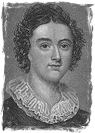
 Ann Hasseltine Judson, missionary, was born in Bradford, Massachusetts,
December 22, 1789. She received a thorough education, and early in
life became deeply interested in religious matters.
Ann Hasseltine Judson, missionary, was born in Bradford, Massachusetts,
December 22, 1789. She received a thorough education, and early in
life became deeply interested in religious matters.
She met Rev. Adoniram Judson in 1810, when he was preparing for missionary work at Andover Theological Seminary, and in 1812 she married and went with him to India, being the first woman to go to foreign lands as a missionary.
They were permitted to remain at Serampore only a short time, as the East India Company was bitterly opposed to the introduction of the Christian religion into the province; then they went to Rangoon where she bravely endured the privations and inconveniences of living under very trying conditions.
She was of the greatest assistance in the missionary work; but the severity of her labors, and the exhausting effect of the climate obliged her to come home for a long rest. During this period she was not idle, however, but lectured extensively in the cause of missions, and also wrote a history of the Burman mission which received high praise, not only in this country, but, abroad.
She returned to Burmah in 1823, to find missionary affairs prospering, but the next year war broke out between the English at Bengal and the Burman government, and the lives of the missionaries were in danger, as they were looked on as spies. Her husband was seized in his own house and hurried away to what was known as the "death prison." Mrs. Judson was strictly guarded in the mission-house, which had been stripped of furniture; her clothing being also taken, and she subjected to the brutality of her rough guardians. At last she succeeded in getting a petition to the governor of the city, and by this means and by bribes to inferior officers, she succeeded in mitigating, in some degree, the horrors of her husbands confinement. Later, he was removed to another town, and arrangements made for his sacrifice in honor of a general who was to take command of a fresh army. The general was suspected of treason and executed, and Mr. Judson's life saved. For a year and a half Mrs. Judson, with her baby in her arms, followed her husband from prison to prison, supplying him with food, for it was not provided by government, and working in every way to secure his release. She exercised such influence over the mind of the governor, that though her husband was several times condemned to death with others, he was preserved though the rest were executed. Of her destitution and sufferings during this period she has recorded the harrowing history, and her heroic endurance shows the strength and greatness of her character. So great was her absorption in the trials and anxieties at the time, that she "seldom reflected on a single occurrence of her former life, or recollected that she had a friend in existence out of Ava."
When, at last, peace was declared between the two powers her husband was released, and together they established a mission at Amherst, where she sought a restoration to health of body, and peace to a mind long distracted by agonizing anxieties. Her constitution was, however, so weakened by disease and suffering, that she died two months after, Oct. 24, 1826; and thus ended the life of one whose "name will be remembered in the churches of Burmah, when the pagodas of Gautama shall have fallen."
Besides her history of the Burman mission, Mrs. Judson translated the Burman catechism, and the Gospel of Matthew into Siamese, aided by a native teacher; assisted in the preparation of a Burmese grammar and made some translations for the use of the Burmese. Her life was written by Mrs. Emily C. Judson, and published in New York in 1850.
From The National Cyclopædia of American Biography... New York: James T. White & Company, 1893. Vol. 3.
>> More Ann Judson