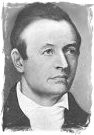
 Adoniram Judson, missionary, was born at Malden, Massachusetts,
August 9, 1788. Of his youth there is but little known. His father was
a Congregational minister, but instead of responding to the advantages
of religious culture, young Judson grew to manhood entertaining skeptical
views of Christianity. He was graduated from Brown University in 1807.
The next year was spent in traveling and in school-teaching, and it
was at this time that he published "Elements of English Grammar,"
and "Young Ladies' Arithmetic." His theological convictions
becoming radically changed, he returned to Plymouth, where his father
resided, and determined to seek admission to Andover Theological Seminary,
which had been established about that time. He entered in 1808, not
being a professor of religion, but desirous of knowing and learning
the truth; and within a short time was happily converted. The reading
of Buchanan's "Star in the East," and the influence of his
associates, Mills, Richards, and Hall, decided him to become a foreign
missionary.
Adoniram Judson, missionary, was born at Malden, Massachusetts,
August 9, 1788. Of his youth there is but little known. His father was
a Congregational minister, but instead of responding to the advantages
of religious culture, young Judson grew to manhood entertaining skeptical
views of Christianity. He was graduated from Brown University in 1807.
The next year was spent in traveling and in school-teaching, and it
was at this time that he published "Elements of English Grammar,"
and "Young Ladies' Arithmetic." His theological convictions
becoming radically changed, he returned to Plymouth, where his father
resided, and determined to seek admission to Andover Theological Seminary,
which had been established about that time. He entered in 1808, not
being a professor of religion, but desirous of knowing and learning
the truth; and within a short time was happily converted. The reading
of Buchanan's "Star in the East," and the influence of his
associates, Mills, Richards, and Hall, decided him to become a foreign
missionary.
The American Board of Commissioners for Foreign Missions, which had been formed in 1810, was not in a position, financially, to assume the support of its pioneer missionaries, and Mr. Judson went to England to obtain the aid of the London Missionary Society. He sailed in January, 1811, and while on the voyage, the English ship was captured by a French privateer, and Mr. Judson was kept a prisoner at Bayonne for some time. Obtaining a passport, after his release, he visited London to find his plan impracticable, and on his return to America, the American board decided to assume the responsibility of sending Messrs. Judson, Hall, Newell, and Nott as its missionaries to Burmah. February 5, 1812, Judson was married to Ann Hasseltine of Bradford, Mass., and the same month they sailed for Calcutta, reaching there June 18th.
The change in Judson's belief concerning baptism forced him to sever his connection with the American Board, and made him the pioneer in a new denominational effort for the evangelization of Asia. Both Mr. and Mrs. Judson were baptized by immersion on reaching Calcutta. The strained relations between England and America, England and Burmah, made their stay in Calcutta inadvisable, and they sailed to Mauritius, where they remained four months, doing missionary work among the English sailors of the garrison, and afterward departed for Madras. On reaching their destination they learned of the order for the transportation of the American missionaries from Bombay to England, and fearing a like disposition they sailed at once for Rangoon, the principal port of the Burman empire, arriving there July, 1813. More than a year passed before Judson learned of the formation of the Baptist general convention, and that it had taken him under its care.
For three years he devoted himself to the study of the difficult Burmese language, and mastered it so thoroughly that he spoke with the freedom of a native; having practically abandoned the use of the English language, he both thought and spoke in Burmese, only allowing himself one English newspaper.
After six years of labor his first convert was baptized. During this period he published tracts, translated the gospel of Matthew and the Epistle to the Ephesians, conducted public preaching, and labored indefatigably for the furtherance of his work, despite the unfriendly attitude of the Burmese monarch.
In 1824 he removed to Ava where he preached for a short time until war between the English and the Burmese broke out, which placed the missionaries in great peril and resulted in extreme hardships and suffering. Mr. Judson was imprisoned for two years at Ava, confined in the "death-prison," and subjected to the most extreme cruelty, being bound with either three or five pairs of fetters. In these straits he was only saved from actual starvation by the unwearying attentions of his faithful wife; for the prisoners were not supplied with food by the jailers. Mrs. Judson besought the officials to release and assist the missionaries; with her babe (born at this trying time), and a faithful Bengalese servant, following her husband who had been driven with the others, under the fierce sun, from one prison to another. Through the influence of Sir Archibald Campbell, at the end of two years Mr. Judson was finally released, and with his wife left Ava for Amherst, the capital of the Provinces.
Mr. Judson at this time yielded to the solicitation of the British East India government and returned as interpreter with an embassy to Ava, to negotiate a new treaty between the English and the Burmese. A short time after his departure Mrs. Judson died, in the year 1826, having become so weakened by her hardships and sufferings that she was unable to resist the fever which attacked her. Her child died soon after, leaving the missionary indeed alone. The record of Mrs. Judson's life and sufferings is well known and has hardly a parallel in female missionary annals.
In 1829 Judson joined the Boardmans at Maulmain, which became the chief seat of the Baptist mission in Burmah. Here schools and a house of worship were built (the missionaries being generously aided by Sir Archibald Campbell), and a number of converts were added to the church.
About this time Judson thoroughly revised the New Testament in Burmese, and prepared twelve smaller works in the same tongue. In 1830 he visited central Burmah and gave away hundreds of tracts, besides making many converts, his boat at every landing being visited by natives anxious for books, and converts of years before greeted him. It was at this time also that he visited the Karen jungles, where his labors were so fruitful that it has been stated that the next twenty-five years yielded 20,000 Karen converts to Christianity. Before returning to Maulmain he spent a year at Rangoon, and devoted himself to the work of the translation of the Scriptures into Burmese, which he completed in 1834, when he at once began the revision of the Scriptures, and completed this great labor in 1840. While in Rangoon he shut himself in an upper room and surrendered himself entirely to the arduous work of translation, yet in spite of all his efforts at seclusion and the known displeasure of the king; nearly half his time was taken up with interviews. "During the great festival in honor of Gautama held near the close of the following winter there were nearly 6,000 applicants at his house for tracts." "Some," he says, "come two or three months' journey from the borders of Siam and China. 'Sir, we hear that there is an eternal hell; we are afraid of it; do give us a writing that will tell us how to escape it.' Others came from the frontiers of Cathay, 100 miles north of Ava. 'Sir, we have seen a writing that tells of an eternal God. Are you the man who gives away such writing? If so, pray give us one, for we want to know the truth before we die.'"
In 1834 he married Sarah Hall Boardman, a missionary who had labored in Burmah for years. Five years later he visited Bengal, compelled by lack of health to seek a change of air, and after a stay of a few months returned to Maulmain much benefited, and began subsequently the preparation of the Burmese Dictionary, with two complete vocabularies, English and Burmese, Burmese and English. This work was interrupted by the illness of Mrs. Judson, and in 1845 it seemed best that she should return to the United States. On the voyage she died and was buried at St. Helena, and Dr. Judson with his motherless children continued the journey homeward.
Arriving in America he warned the Board that they must not expect him to make public addresses, for, he said, "in order to become an acceptable and eloquent preacher in a foreign language, I deliberately abandoned my own. From long desuetude [disuse] I can scarcely put three sentences together in the English language," Judson was at this time in very poor health but he addressed large audiences through an interpreter. In 1846 he again sailed for Maulmain, having been married before his departure, to Emily Chubbuck of Utica, New York, who was noted not only for her devoted missionary spirit, but for her literary ability, having considerable reputation as a writer of both prose and verse.
After a brief time they removed to Rangoon where Dr. Judson continued his work on the dictionary which he was never to finish. Returning to Maulmain, in addition to his literary work he assumed the care of a Burman church. His health which had been failing for some time, was further undermined by a fever, and he took a sea-voyage to the Isle of France in hope of its being permanently restored. His wife was unable to accompany him on account of her own feeble health, and he departed accompanied only by an attendant.
The title of D.D. was given to Judson by Brown University in 1823. His literary works were a Burman dictionary, a Pali dictionary, a Burman grammar, and a complete Burman Bible. He was well known throughout India, being honored by English and native dignitaries alike, and the converts of his thirty-seven years of missionary labor deeply loved and revered him. He died April 12, 1850, three days out from Burmah, and was buried at sea.
From The National Cyclopædia of American Biography... New York: James T. White & Company, 1893. Vol. 3.
>> More Adoniram Judson