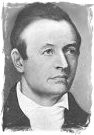
Born in Malden, Massachusetts, August 9, 1788.
Died on the Indian Ocean, April 12, 1850.
 1. His Home. Nestled among the friendly trees of Malden,
a beautiful suburb of Boston, Massachusetts, still stands the old wooden
house in which Adoniram Judson, a Congregational minister, born at Woodbury,
Connecticut, brought his bride, Abigail Brown, born at Tiverton, Rhode Island,
after their marriage November 23, 1786. Their first child, born August 9,
1788, they called Adoniram. The family resided here until the son was four
and one-half years old; then at Wenham till he was twelve; then at Braintree
until he was sixteen, when they took up permanent residence at the historic
town of Plymouth.
1. His Home. Nestled among the friendly trees of Malden,
a beautiful suburb of Boston, Massachusetts, still stands the old wooden
house in which Adoniram Judson, a Congregational minister, born at Woodbury,
Connecticut, brought his bride, Abigail Brown, born at Tiverton, Rhode Island,
after their marriage November 23, 1786. Their first child, born August 9,
1788, they called Adoniram. The family resided here until the son was four
and one-half years old; then at Wenham till he was twelve; then at Braintree
until he was sixteen, when they took up permanent residence at the historic
town of Plymouth.
2. Success in School. At three young Judson was able to read. With boyish ambition he gathered other children together while from a chair he would conduct a service. His favorite hymn began, "Go preach my Gospel, saith the Lord." In grammar school he showed unusual taste for languages and was nicknamed Virgil, or "Old Virgil dug up." At twelve he sought after books to read, that older people refused him because of his youth, though his father fostered his desire for knowledge and never doubted that the son would some day be a great man. This unconcealed parental pride and ambition cost the child in later years a great struggle, for all worldly ambition had to be sacrificed for the one great purpose of his life. In 1804 the young man Judson as a sophomore entered Providence, afterwards named Brown, University. Three years later, when but nineteen, he won the honors of his class. His college days were marked by close application and great care in his life and conduct. The same year he finished college he opened a private academy in Plymouth, and taught nearly one year, during which time he published two school books,— "Elements of English Grammar" and "Young Ladies' Arithmetic."
3. Conversion. While Adoniram was reared in a thoroughly Christian atmosphere during his college days, his life was stained by infidelity, which at that time swept over the land, and the precocious student became a Free Thinker before he completed his course. In this frame of mind, after his graduation, he made a tour thru the Northern States. He chanced to stop at a lonely inn and was assigned to a room next to a young man who died that night. Adoniram did not resent sleeping next to the dying man, but he wondered who was passing away and if he was, like himself, a Free Thinker, or was he a Christian. The next morning he learned of the young man's death and more: he who had passed away was an intimate friend and college classmate. Judson was stunned. He abandoned his further pleasure trip and returned home. He became an earnest seeker after salvation, much to the joy of his parents. By special favor, since he was neither a professor of religion nor a candidate for the ministry, he was admitted to Andover Seminary and on December 2, 1808, solemnly dedicated himself to Christ. About five months later he became a member of the Third Congregational Church at Plymouth.
4. Missionary Consecration. Conversion and consecration to the ministry were almost simultaneous. He became a Christian to become a minister and soon he added "to become a missionary." Dr. Buchanan's sermon, "The Star of the East," in which are related the missionary labors of Schwartz, in Burma, fired his soul. Judson, with four other devoted young men, formed a missionary society, and beneath a haystack near the college they consecrated themselves to foreign missions. Judson had much opposition to brook. He was offered a splendid position in Brown University. Dr. Griffith offered to make him his colleague in Plymouth church. When his mother heard this she said, "And you will be so near home." But he replied, "I shall never live in Boston. I have farther than that to go." His father's plans were frustrated; his mother and sister in tears pled with him not to become a foreign missionary.
5. Missionary Appointment. Judson and his associates made known their wishes to the teachers of the Seminary, and on June 27, 1810, to the General Association of the Congregationalists in Massachusetts. Thru this step the American Board of Foreign Missions, which has carried forward such a wonderful work in missions, was organized. Feeling their weakness in handling such a new and stupendous problem, this infant Board sent Judson to England to confer with the London Missionary Society; but joint efforts seemed impracticable. Upon his return he was appointed as a missionary in Asia, to locate in Burma or elsewhere as he deemed best.
6. Marriage. Judson's life by the cord of love was bound to Miss Ann Hasseltine, whose sublime heroism has made her one of the most remarkable women of her generation. She was born December 22, 1789; at sixteen confessed Christ; and in the face of much public sentiment against it, decided to become a foreign missionary. February 3, 1812, Judson took leave of his parents in Plymouth; on February 5 he was united in marriage to Ann Hasseltine; the next day he was ordained at Salem; and on February 19, with his bride, embarked on the brig, Caravan; bound for Calcutta.
7. Becomes a Baptist. It took four months for the voyage to India. During this time they studied their Bibles and decided to accept the tenets of the Baptists, because they had been led to believe that faith should precede baptism and baptism was immersion. It cost a great struggle, for in making the change he was casting aside all previous training and dropping the Board that had sent him. There was no Baptist Board. Surely his step was one of great faith and deep conviction. On September 6, 1812, Judson and his wife were baptized by Rev. Ward in Calcutta. When news reached America of this change, the Baptists were aroused and organized the American Baptist Missionary Union.
8. No Welcome in India. The East India Company compelled them to leave as they tried to settle at different places within their domain. Hither and thither they went; lived four months on the Isle of France, where they learned of the death of Mrs. Newell, the first American martyr of Foreign Missions; tried to land at Madras, in India, and finally found a resting place July 13, 1812, at Rangoon, Burma. They had much preferred the protection of the British flag, even though very unfriendly at that time, to the despotic, cruel care of the King of Burma.
9. Labors Abundant. In Rangoon the first ten years of missionary labors were given mainly to the mastering of the Burmese language, without grammar, dictionary or English-speaking teacher. Three years later to the day he completed a grammar for the Burmese language. May 20, 1817, he finished the translation of Matthew; he wrote tracts, concise, clear statements of Bible truth, and gave them out discriminatingly and prayerfully, and these located his first serious inquirer after truth. His keen logic, setting at naught the shrewdness of the natives, along with his beautiful Christian spirit, often brought applause from the hearers. After nearly six years in Burma, on April 4, 1819, Judson ventured to preach his first public discourse. June 27 he baptized Moung Hau, his first Burman convert. Many who had long been taught followed, and the mission was a happy body of believers.
10. Regions Beyond. But all was not favorable. The Viceroy of Rangoon harassed Judson until he decided to call on the Emperor at Ava. His appeal was of no avail, and he returned home greatly discouraged. He planned to move under English domain, but the little native church prevailed against his leaving. In 1822 Judson again called on the Emperor in Ava and this time was received favorably and asked to locate in the city. At this time Rangoon had a membership of eighteen natives, a chapel, printing press and schools, and two missionary couples from America to take care of the infant church. So answering the longing of his soul to enter the regions beyond, the Judsons began their home in Ava January 23, 1824.
11. In Prison. The Emperor gave Judson a plot of ground for a mission and assured him royal protection. Mrs. Judson soon had a fine class of native girls and the outlook was most promising. But war broke out between Burma and the English Government of India and the Judsons were looked upon as spies. On June 8, 1824, Judson was committed to the horrible prison of Oung-pen-la. It was forty by thirty, five feet high, with no ventilation save thru the cracks between the boards. "In this room were confined one hundred persons of both sexes and all nationalities, nearly all naked, and half famished. The prison was never washed or even swept. Putrid remains of animal and vegetable matter, together with nameless abominations, strewed the floor. In this place of torment Mr. Judson lay with five pairs of fetters on his legs and ankles, weighing about fourteen pounds, the marks of which he carried to his dying day. At nightfall, lest the prisoners should escape, a bamboo pole was placed between the legs and then drawn up by means of pulleys to a height which allowed their shoulders to rest on the ground while their feet depended from the iron rings of the fetters." With fine sensibilities, reared in tender surroundings, always active and pushing, no one can imagine what endurance he was called upon to exercise in the twenty-one months of prison life, much of the time in fetters.
12. His Heroic Wife. But Judson was not the only sufferer. His wife was without protection. Yet she brought food to the prison day after day and with bribes passed the officials and gave relief to some of the wretched prisoners. She gave birth to a child, and after twenty-one days carried it in her arms to show to its father in the prison. The child took small-pox; then the mother herself took the same loathsome disease, followed closely by spotted fever, which brought her close to death. After many entreaties she secured permission for her husband to come out of prison, and he, with fetters on and a guard following, carried their crying babe about the streets, begging nourishment from some Burman mother.
13. Deliverance. Though Judson was imprisoned because the Burman government thought him a spy, now it released him to translate and mediate in making terms of peace with the English government. He had kept scrupulously clear from all affairs of the government, but was compelled to take part. After six weeks' service he was cast into prison because of the advance of the English. He was soon released by Capt. Campbell, who took Mr. and Mrs. Judson to his own quarters and gave them every care.
14. Sunshine and Shadows. Peace being declared, the Judsons departed and arrived in Rangoon March 21, 1826. He refused an offer from the English government of $3,000 per year, and took up his mission work with undaunted courage. But his associates had fled, the native church was scattered and the mission property was destroyed. Famine, anarchy and wild beasts infested the place and Judson decided he would take the four native Christians and locate at Amherst, a place of greater safety. He was compelled to go to Ava to negotiate a commercial treaty, and while there two and one-half months his wife died. Upon his return he was met by the Christians in great lamentations; his heart was desolate. Yet he took up mission work again with ardor, resumed his translation of the Bible, talked with inquirers and preached every Sunday. On April 24, 1827, his little child, which was such a comfort to him, was taken from him, and bereft of wife and child he was alone in the world. Because Maulmain was rapidly eclipsing Amherst in population, and to get away from the scenes of sadness he had passed thru, Judson decided to move again.
15. In Maulmain. In moving to Maulmain the native church, including inquirers and nineteen scholars, followed. This formed a splendid nucleus, and work was begun in four centers. Soon he baptized his first convert and others rapidly followed. In spite of missionary duties he found time to begin translation of the Old Testament. Thru a native he resumed church work at Rangoon, which grew rapidly.
16. In Burma Again. In 1830 Judson again attempted to establish the faith within the gates of Burma proper. He located at Prome and preached to thousands. But the king, hearing of his work, gave orders for him to depart; reluctantly he withdrew to Rangoon, where he remained almost a year. About this time the Mission Board urged him to take furlough, but though on the field eighteen years without rest, he declined on the ground of the need of the field. He was overjoyed upon returning to Maulmain to learn that large numbers of Burmans and Karens and Talings had united with the church. Two million pages of tracts and Scriptures had been printed and a church in the jungle some distance had been organized. Taking a band of native Christians, whom he sent out two by two and every few days had return and report to him, he established systematic tours in the jungles.
17. Second Marriage. For eight years Judson had toiled alone. In Mrs. Sarah Hall Boardman, widow of one of his missionary associates, he found a kindred spirit for all his ideals, and on April 10, 1834, they were united in marriage. She was a widow for three years but had kept up the good work her husband, George D. Boardman, had so well carried on at Tavoy. She not only dealt with inquirers and directed the mission, but with her child carried by a native she climbed mountains, forded streams, and threaded forests and marshes in her tours thru jungles to carry the good news. Her schools were marked with such success that when government aid was granted for schools throughout the province, it was expressly stipulated by the English government that they should be conducted on the plan of Mrs. Boardman's at Tavoy.
18. The Burmese Bible. After twenty-one years of patient toil Judson completed the translation of the Bible into the Burmese on January 31, 1834. He then took seven years more to revise his first work and at last on October 24, 1840, the entire book was ready for the press. Competent judges pronounce the Judson Bible as the best translation that has appeared in India, and like the Luther Bible it will probably be the Bible for three centuries to come. It is said to be perfect in its literary cast.
19. Failing Health. When fifty years old, and after twenty-five years of incessant toil in Burma, Judson's health began to show signs of giving way. Difficulty in his lungs, attended with great pain and loss of speech, compelled him to take a sea voyage to Calcutta. He returned better. But at this time Mrs. Judson also was attacked by a disease that in the end closed her labors. They together went to Calcutta, then to the Isle of France and back to Maulmain. On this trip one of their children died. Mrs. Judson did not improve; all missionary work had to cease and they determined to go to America. Leaving the youngest three children behind with missionaries and taking the eldest three with them, they started. On September 1, 1845, while their boat was off St. Helena, Mrs. Judson passed away. Judson prepared the body for burial and that afternoon it was carried ashore and buried in the public burial grounds of that rocky island. That evening the boat lifted anchor for its journey.
20. Reception in America. Judson with his three children, arriving October 15, 1845, in Boston, was illy prepared to meet the wonderful greeting that was awaiting him. He was in delicate health; his pulmonary trouble kept him from speaking above a whisper and so he addressed audiences thru another repeating. At times he would disappoint audiences by not telling of his labors but declaring the wonderful story of redeeming love. He found it difficult to frame sentences in the English after so long a time thinking in a foreign tongue. Yet in spite of all this his journey from home to home and city to city was like a triumphal march; secular and religious papers reported his movements, so great was the respect paid to him.
While on this tour he engaged Miss Emily Chubbuck, who, under the name of Fanny Forester, had a wide literary reputation, to prepare suitable memoirs of Mrs. Sarah B. Judson, his deceased second wife. The result of this association was that on June 2, 1846, she became his wife. Many feared this marriage would spoil her literary career and his missionary service. But not so. And on July 11, 1846, Judson, with his wife, leaving his children in America to be educated, sailed for Burma with some new missionaries.
21. In Burma Again. During the eighteen months of absence one of his three children had passed away and but two lived to greet him. He still longed to enter Burma proper, but the country was now ruled by a king more intolerant than ever. His barbarities and cruelties far exceeded anything known in the land, and missionary operations, if any, had to be done in greatest secrecy. But Judson had been working on a dictionary and Rangoon offered facilities that Maulmain did not, and so he located in Rangoon again. During the day he worked on his dictionary; at night in his home he met native Christians who would risk their lives to meet with him. This stress, improper food, much sickness in his family and terrors of the king compelled him to retreat. He did so with almost a broken heart. He had hoped that the Board at home would authorize him to go even to Ava and face the fierce king; but "the timid and narrow policy of his brethren in America" forbade his doing this until two years later, and then it was too late.
22. His Death. Mrs. Judson's health gave him occasion for alarm. But instead of her passing beyond, he himself, after a most heroic fight even while on a sea voyage for his health, died at sea on April 12, 1850. That evening in greatest silence, broken only by the voice of the captain, his body was lowered on the larboard side into the Indian Ocean, even without a prayer.
23. A Review. Judson was permitted to finish the more difficult part of his Burmese dictionary, the English and Burmese; the Burmese and English was completed by his colaborer, Mr. Stevens. When evangelizing Burma first formed itself in his mind, he hoped to build up one congregation with a hundred converts before he died. At his death, however, Burman and Karen Christians who had publicly been baptized numbered over 7,000, beside the many during his thirty-five years of service who died happy in the faith. There were sixty-three congregations established under the direction of 163 missionaries, native pastors and assistants. This result becomes the more remarkable because it was accomplished in the midst of a people having a literature and religion to be supplanted. His consecration to missions gave occasion for the organization first of the Congregational Mission Board and then the American Baptist Missionary Union. But he had a very direct influence in quickening interest which led the Episcopalians and Methodists and Presbyterians to organize also. The story of his life and especially his suffering in Ava shall ever thrill the heart that is touched with suffering for Christ's sake, and his influence for world evangelization will cease only when the great task is completed.
| Chronology of Events in Judson's Life | |
|---|---|
| 1788 | Born at Malden, Massachusetts, August 9. |
| 1804 | Entered Brown University one year in advance, August 17. |
| 1807 | Received degree of B.A., September 2. |
| 1808 | Completed English Grammar, and "Young Ladies' Arithmetic"; Entered Andover Theological Institution, October 12. |
| 1809 | United with Third Congregational Church of Plymouth, May 28. |
| 1810 | Resolved with others to be a missionary, February. |
| 1811 | Sent to London to confer with London Missionary Society, January 11 to August 7; Appointed missionary to the East, September 19. |
| 1812 | Married to Ann Hasseltine, February 5; Ordained at Salem, February 6; Sailed from [Salem, February 19]; United with Baptist Church in Calcutta, September 6. |
| 1813 | Arrived in Rangoon, July 13. |
| 1819 | Began public worship in Burmese language, April 4; Baptized Moung Nau, first Burman convert, June 27. |
| 1823 | Completed New Testament in Burmese, July 12. |
| 1824 | Arrived in Ava, January 23; In fetters and prison as spy, June 8 to December 30, 1825. |
| 1825 | Mary [Maria] Elizabeth born, January 26. |
| 1826 | Arrived at Rangoon, March 21; Arrived at Amherst. July 2; Heard of Mrs. Judson's death (October 24) on November 24. |
| 1827 | Heard of his father's death (November 25, 1826) July 11; Arrived in Maulmain, November 14. |
| 1834 | Married Mrs. Sarah Boardman, April 10. |
| 1835 | Completed Old Testament translation, December 29. |
| 1845 | Mrs. Judson died while on way to America, September 1; Arrived in Boston. October 15. |
| 1846 | Married Emily Chubbuck. June 2; Sailed for Maulmain, July 11. |
| 1849 | Completed English-Burmese dictionary, January 24. |
| 1850 | Died at sea April 12. |
From Christian Heroism in Heathen Lands by Galen B. Royer. Elgin, Ill.: Brethren Publishing House, 1915.
>> More Adoniram Judson