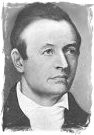
 The
story of American Missions can never be fully told, no list of Missionary
Heroes can ever be complete, and the name of Adoniram Judson be left out.
His place, both in point of time and in achievement, is a foremost one.
The
story of American Missions can never be fully told, no list of Missionary
Heroes can ever be complete, and the name of Adoniram Judson be left out.
His place, both in point of time and in achievement, is a foremost one.
Early Life.
Born of a godly parentage in Malden, Massachusetts, [United States], August 9, 1788; entering Brown University a year in advance at the age of sixteen, graduating as valedictorian, in 1807; he was able to write in his journal after a period of skeptical doubting—"1808, November. Began to entertain a hope of having received the regenerating influences of the Holy Spirit." He had just before this entered Andover Theological Seminary, a year in advance, "neither a professor of religion nor a candidate for the ministry." He made a solemn dedication of himself to God, December 2, that same year. That dedication was final and complete. "Is it pleasing to God?" became his motto. He put it before his eyes, at the same time realizing how futile the suggestion "unless I resolve, in divine strength, instantly to obey the decision of conscience."
As will be inferred from the above, young Judson was a precocious boy, more fond of books than of play, revelling in tough problems, learning to read when three years of age, a proficient in arithmetic at ten, and a voracious reader of books of all sorts. His father, a Congregational minister, fanned the flame of ambition and stimulated it by holding before him the vision of greatness.
The year following his graduation was a critical period in his history. He had become tainted by French infidelity, and a chosen and boon companion was a deist. Under this influence he became wayward, left home, joined "a company of strolling players," and led a "reckless, vagabond life." It was not for long. He was followed by his mother's tears, prayers, and warnings, which to him were more than his father's arguments. Providence had him in charge. He one night put up at a country inn. In the room next to his was a young man in a dying condition. The vision of the sick stranger disturbed his peace, and the question of his spiritual condition thrust itself in upon his restless thought. He arose in the morning to find that his next-door neighbor was dead, and that it was none other than his brilliant infidel friend. He instantly turned his steps homeward, a changed but not converted man, and subsequently, by special favor, was admitted into seminary life.
His Call to Missionary Life.
A year later, at the age of twenty-one, Judson is pondering seriously the work of foreign missions. A sermon of Dr. Claudius Buchanan's had fallen as a "spark into the tinder of his soul," and in February, 1810, he had resolved to become a missionary to the heathen. To this resolution he had been helped by association with Richards, Mills, Rice, and Hall, of "Haystack" fame, lately arrived at Andover from Williams College, the birthplace, if any one locality can claim that honor, of American missions abroad. Of this step young Judson seems early to have counted the cost. There were flattering prospects for the brilliant young divine at home, but from all these he turned deliberately aside; nor did he hide from himself or from Ann Hasseltine, whose heart and hand he sought, the peculiar trials most certain to fall to the lot of a missionary in those pioneer days.
There was at this time in the United States no missionary society reaching out into foreign lands, and but little faith impelling in this direction. But the hour was come for the birth of one of the grandest movements of modern times. And these flaming spirits were its forerunners. It is not necessary here to detail the formation of the American Board in 1810, the attempted cooperation with the London Missionary Society, and the failure of this expedient, throwing American Christians upon God and their own resources. Mr. Judson had himself been dispatched to England on this mission, and got a taste of prison life, having been captured by a French privateer en route. Not only at Bayonne, but at Paris and in London, he made the impression of being a man of no ordinary genius.
His Marriage and Departure.
On the 5th of February, 1812, he was married to Ann Hasseltine, of Bradford, Mass., a woman of great beauty, consecration, and moral heroism. The next day he was ordained at Salem, and on the 19th embarked on the brig "Caravan," with Mr. and Mrs. Newell, associate missionaries, bound for Calcutta.
The voyage around the Cape of Good Hope was a tedious affair of four months. The time was studiously occupied in a translation of the New Testament, which was the immediate occasion of the reopening of the question of baptism, both as to its proper subjects and the mode of its administration. The result is well known. Mr. Judson and his wife became Baptists and were immersed at Calcutta the 6th of September. Naturally they at once fraternized with the English Baptists at Serampore, Marshman, Carey, and Ward, and resigned their connection with the American Board. He immediately suggested to representative Baptists in New England that if a Baptist society were formed for the support of a mission in those parts, he would be ready to consider himself their missionary.
This change of sentiment took from the American Board its most promising man; but it set on foot another agency which ever since has moved forward in growing strength in the same great work of the world's evangelization. No one, it is presumed, ever questioned Mr. Judson's sincerity in this step. Probably no one can fail to see that a man with less force of character might have shrunk from a step which could not be other than costly, running against the grain of early education and the training of maturer years, and calling upon him to sever his relation to the Board that sent him forth, and to cast himself by faith upon the Master whom he at all hazards sought to obey.
It was not till after many a buffeting for a year and a half that these servants of God found the way open to begin their life-work in the Burman Empire. England and America were at war with each other, and the East India Company had not learned to welcome the missionary; indeed, it never learned that, nor the part that Christianity had to play in the regeneration of India. Peremptorily ordered to leave, they at length reached the Isle of France January 7, 1813, just after the saintly Harriet Newell had passed in triumph into life from that historic spot. May 7 of that year they embarked for Madras, intending to open a mission on Penang, an island in the Straits of Malacca. But on reaching Madras the only conveyance outward was a "crazy old vessel" bound for Rangoon; and upon this they determined to embark, passing out from under the protection of the English flag and committing themselves to the cruel mercies of a Burman despot. It appeared their only way of escaping arrest and being sent to England. It was really the hand of God leading them by a perilous voyage of great hardship to the work of their lives.
Rangoon.
They reached Rangoon July 13, 1813, and found quarters in the house of a son of Dr. Carey. It was a most filthy and wretched city, located near the mouth of the Irrawaddy, a river navigable for 840 miles, but a strategic point from which to reach the Burman Empire of about eight million souls. There was then but one Burmah, ruled over by a despotic monarch whose throne was at Ava. The Buddhist religion, "like an alabaster image, perfect and beautiful in all its parts, but destitute of life," held this people firmly in its grasp. Moreover, they were a "slow, wary, circumspect race." The difficulties were many, but the faith of the Judsons in the promises of God was greater. At once he set himself to the weary task of mastering a difficult language, "without grammar or dictionary or English-speaking teacher." His ardent temperament chafed under the delay incident to this prime condition of success; but he accepted it and was soon translating a Gospel and preparing tracts in the Burmese tongue, which the mission press gave to the people. Three years to a day after his arrival he completed a modest treatise on grammar, which twenty years later received the highest commendation. Soon after they began to print, the first real inquirer came to light, the forerunner of many to follow. Oral preaching came later, and in this Mr. Judson was an expert, meeting objections with great subtlety and impressing his hearers deeply by his fervid earnestness.
Six years passed by before he ventured upon public worship, and this was followed speedily by the first convert, who was baptized June 27, 1819. The work of the mission now began to attract the attention of the Viceroy of Rangoon. Persecutions immediately followed, and Mr. Judson determined to go at once to Ava and lay the matter before the throne itself. It was a hazardous step. He was accompanied by Mr. Colman, a new arrival at the mission. It was a journey of a month up the river. January 27, 1820, they put themselves under the guide of an interpreter for the royal interview, and in due time, with all formality, laid their petition before his Highness, asking permission to preach the religion of Christ in his dominions. They had brought as a present a Bible in six volumes, overlaid with gold; this they attempted to exhibit. They were coldly received, though respectfully heard, and dismissed taking their present with them. A second and a third attempt was made with one of the ministers of state in private, but with no better results, and having secured a passport, sadly, but hopefully, they returned.
Once since coming to Rangoon he had been obliged to leave for a few months because of ill health, and now it became necessary to visit Calcutta on Mrs. Judson's account. These were tedious journeys, in mean little boats, of great weariness and discomfort. This last was followed by Mrs. Judson's return to America for a two years' leave of absence. They had also been called to part with their first-born child. But through all these trials the courage and faith of these servants of God were wonderfully sustained. Their little church grew to number ten, and the spirit of the martyrs was in this pioneer band of Burman converts.
Dr. Price now came to recruit the mission, and his skill in removing cataract soon attracted the attention of his Highness at Ava, and he was ordered thither, Mr. Judson accompanying as interpreter. The doctor paved the way for the preacher, and many opportunities were improved to advocate the tenets of the Christian faith in the presence of persons of rank. His majesty was much more gracious. The way was opened for Dr. Price to permanently remain; and, before returning to Rangoon, Mr. Judson had secured a piece of ground for a house, intending to occupy it so soon as his wife returned from America. Accordingly, December 13, 1823, Mr. and Mrs. Judson set their faces towards Ava. Ten years of life in Rangoon had secured for Burmah a translation of the New Testament and an epitome of the Old, a native church, a footing at the capital, and such a mastery of the language that Judson could say, "I suppose I am the only man living who can tell to the Burmese people the story of the gospel in their own tongue." The work in Rangoon was committed to new-comers from America, and Ava was entered January 23, 1824. Of their
Life in Ava.
it is not easy to write briefly. Of missionary activity there was to be little; with suffering their cup was to overflow. They found the countenance of the king changed, a new privy council in place of their friends of the year previous, clouds of war with the English gathering over their heads, and they themselves suspected of being spies working in the interest of the foes of Burmah. Judson and Price, with the resident Englishmen, were put in fetters and thrown into a loathsome dungeon, hateful to every sense. At the end of eleven months he was removed to Oung-pen-la, a perilous march that well nigh cost him his life, where for six months more he endured the horrors of a Burmese prison. "The annoyance, the extortions and oppressions to which we were subject, are beyond enumeration or description," writes his faithful wife.
In the final negotiations with the English he served as interpreter, and thereby enhanced his reputation as a scholar and a linguist. During all these weary months his faithful wife, with a heroism unmatched, cared for herself and his manuscript translation, and with utmost tact, courage, and eloquence sought to mitigate the horrors of his confinement and cheer his brave spirit. There is no more pathetic picture than that of this devoted wife making her daily pilgrimage to the prison with some token of love and word of cheer, and once on a time holding up her new-born babe for the father's kiss through the bars of his cell, then following him to Oung-pen-la in a rough cart through the dreadful heat and dust, till, broken down at last, she was brought to death's door by smallpox followed by spotted fever.
There came an end of these never-to-be-forgotten woes when the victorious English made terms of peace. Rangoon was again visited, but the gains of years had been scattered by the whirlwind of war, and they followed the English to Amherst within the newly-ceded territory. There they resumed their work, but Mrs. Judson had reached the limit of her endurance. Her husband was again called to Ava, and during his absence she passed away, October 24, 1826, leaving him desolate. The cup of this faithful servant of God was now full, and we may well believe "he was never the same man afterwards." How many are the sacred spots of earth like the hopia-tree at Amherst, or the tamarind-trees of Ramree, where the dust of the Comstocks reposes!
Mr. Judson found what solace he could in his work and the love of his child, till she flew to the arms of her mother, April 24, 1827, and he was left alone, cast down but not destroyed.
Removal to Maulmain.
The mission was now removed to Maulmain at the mouth of the Selwan, which had outrun Amherst as the seat of English authority and rule. To this place the Boardmans and the Wades led the way, and he soon followed. The city was growing rapidly; the field daily widened, and success crowned their efforts. Preaching, translating, and teaching went on apace. Many new works were prepared for the press. Meanwhile a solitary member of that scattered Rangoon church is quietly at work, and "out of the stump of the tree cut down, there springs a shoot which has blossomed and flourished ever since." The Rangoon Mission numbers to-day [1890] not less than 90 churches and 4,000 members. Such vitality has the Christian church.
The same aggressive spirit that led him to Ava to beard heathenism in its high places moved him still later to try and plant the standard of the cross at Prome in the heart of the empire. But in this he was defeated, after a brave effort, by the prime ministers of the king, moved by hatred of foreign intrusion. He retired to Rangoon and pushed his work of translation.
At one of the great heathen festivals he had an opportunity of learning how effective had been the work of the press. He had given away thousands of tracts upon solicitation. "Some," he says, "come two or three months' journey from the borders of Siam and China. 'Sir, we hear that there is an eternal hell. We are afraid of it. Do give us a writing that will tell us how to escape it.' Others come from Kathay, a hundred miles north of Ava. 'Sir, we have seen a writing that tells about an eternal God. Are you the man that gives away such writings? If so, pray give us one, for we want to know the truth before we die.' Others come from the interior, where the name of Jesus Christ is little known. 'Are you Jesus Christ's man? Give us a writing that tells about Jesus Christ."'
The Boardmans had opened a mission among the Karens, and the Word of God proved quick and powerful among them. But these sainted souls were also called to tears. Their eldest and youngest born followed each other into life eternal, and Mr. Boardman, "one of the brightest luminaries of Burmah," fell in the jungles of Tavoy, in the midst of his work, leaving his wife and one son to mourn their loss. Mrs. Boardman continued at her post among the Karens. Mr. Judson now returned to Maulmain and entered with great zeal the promising work thus begun among the Karens. Eight years after the death of his wife, three years after the death of Mr. Boardman, April 10, 1834, Mr. Judson and Mrs. Boardman were married.
The Bible Translated.
January 31 of that year he had knelt before God with the last leaf of the Bible translated into Burman, and besought Him to accept the great work of his life, and "make his own inspired Word the grand instrument of filling all Burmah with songs of praise to our great God and Saviour Jesus Christ." Burning to preach the gospel, viva voce, he had stuck to his prodigious task till now, at the age of 56, he could rejoice that the Scriptures were put into one more of earth's many tongues.
In his "lust for finishing," he spent seven more years in revising his translation. That garret at Rangoon, that little room at Maulmain where he patiently wrought at his life-work, like that upper room at Beirut, where Drs. Eli Smith and Van Dyke consummated their translation of the Scriptures into Arabic, are among the historic places of the church of Christ. It is thus that the pioneers of missions have laid all after comers under obligation for the tools they find ready to hand. Twenty-four years of life were mainly spent thus, and the Burman Bible is Judson's chiefest and sufficing monument. He did for Burmah what Luther did for Germany and Wyckliffe for England, only his task was infinitely more difficult. The work itself was a grand success.
It was with great reluctance, but with entire loyalty to the Board whose servant he was, that he now turned to the preparation of a Burmese dictionary, and at the same time gave the passion for preaching such opportunity as he could.
Mr. Judson's second marriage proved to be a very happy one. She was an ideal missionary. By English friends in Calcutta she was pronounced "the most finished and faultless specimen of an American woman that they had ever known." In person she is described as "faultless in features, of warm, meek blue eyes, and soft hair, brown in the shadow and gold in the sun." She was an enthusiast in missions from childhood. She became an adept in the Burmese tongue, and her literary labors, tracts, translations, Scripture catechisms, and hymns were abundant and of a high order. After her marriage with Mr. Judson she became the mother of eight children.
Homeward Bound.
In the twelfth year of their married life, while homeward bound in search of health, she passed from earth at the port of St. Helena, September 1, 1845, and Mr. Judson journeyed sadly on with his motherless children, himself much broken in health. He arrived in Boston, October 15, 1845. Thirty-three and a half eventful years of toil, trial, and achievement had passed over his head since he sailed out of that harbor with the bride of his youth. He came back to a land as greatly changed as he, and his own message for expectant audiences was the old story of the love of God in Christ. He was too weak for public speaking, but his burning soul found expression through an interpreter, and again and again he thus served the cause to which he had devoted his life. At one time a few sentences, feebly spoken, but weighty with consecrated thought and purpose, saved the Arracan mission that the Baptist Board were about to abandon.
While on his tour through the country he met Miss Emily Chubbuck, best known as "Fanny Forrester," who was destined to become the third Mrs. Judson. A volume of her vivacious writings first attracted his attention, and awakened a desire to see her as a possible biographer of his late wife. She had been schooled to poverty and self-reliance, first as a factory-girl and then as a school-teacher and writer for a local paper. A sprightly letter to the "Evening Mirror" attracted the attention of Mr. N. P. Willis, and secured for her the opportunity and the remuneration for which she had been striving. Converted at eight years of age, impressed in childhood by the story of Ann Hasseltine, she was haunted by the conviction, which she strove to get rid of, that she one day must be a missionary.
And so it came about that the gifted young lady became the wife of Dr. Judson, an arrangement distasteful to the friends of each, but satisfactory to themselves.
Outward Bound.
Within nine months from his arrival in this country they were on their way to Burmah. Mr. Judson's heart turned from "the twilight of Maulmain" to the field of his first love, with all its discomforts and dense darkness, and once more he is back in Rangoon. A big, gloomy, bat-infested brick house opens to them; a ferocious, blood-thirsty viceroy waits to do what he dares to hinder the work; sickness makes a hospital of their cheerless quarters—but work is resumed on the dictionary, and secretly the gospel is preached. Mr. Judson must have learned the secret of Paul's contentment to be able to say of this period, "My sojourn in Rangoon, though tedious and trying in some respects, I regard as one of the brightest spots, one of the greenest oases, in the diversified wilderness of my life!" At length the intolerance of the Government made the situation desperate, and he was deterred from going to Ava to lay the case before his Royal Highness only by the failure of means and the discountenance of the Board at home. There was nothing left to do but to retreat, and this for him was a sorry business. When, two years later, he was given permission to go to Ava, it was too late. He is next at Maulmain steadily at work "like a galley-slave," on what he hoped would be a "standard work for all time."
But he was nearer the end of life than he dreamed. While deeply concerned for his wife's failing health, after the birth of their child, he himself was disabled by a sudden cold, and soon thereafter embarked for a long sea-voyage as the only hope of recovery. He bade adieu to wife and children, and on the 12th of April, 1850, died and was buried at sea. Thus peacefully ended, full of the conscious love of Christ, the life of this remarkable man.
An Estimate of the Man and his Work.
In the midst of great discouragements, in perils by land and sea, in moral darkness that could be felt, in dungeons of unnamable horrors, in the weariness of much and prolonged study, yet with a faith victorious, a courage undaunted, and a consecration complete," he laid the foundations of Christianity deep down in the Burman heart where they could never be washed away." "At the time of his death the native Christians (Burmans and Karens publicly baptized upon the profession of their faith) numbered over 7,000. Besides this, hundreds throughout Burmah had died rejoicing in the Christian faith. He had not only finished the translation of the Bible, but had accomplished the larger and more difficult part of the compilation of a Burmese dictionary."
He was, indeed, a man of brilliant parts, of studious habits, and of great thoroughness in all his work. He had the gifts and temperament of an orator. He might have filled with ease the foremost pulpit of his native land. But he was, above all and greater than all, a missionary of the apostolic order. He laid himself upon the altar of consecration and crucified his selfish ambition till nothing was left of it. He never questioned but that Burmah was to be given to Christ. It might take twenty or thirty years to make a beginning, but that was not his concern. A beginning was to be made, and he was called to do it. He shrunk from no hardship incident to that end; and the buoyancy of his spirits through all adversity was something scarcely conceivable, save through the grace of God freely given to him. To a man of his ardent temperament, knowing that he had given up everything for the carrying out of the great commission, the indifference of his fellow-disciples at home was his greatest trial. He sometimes longed to have the home churches transported for a month to Burmah, for a month to be face to face with her unsaved millions. But it is doubtful whether that, then or now, would prove a cure for spiritual indifference to the world's need. It might work in just the opposite direction if the vision was not first made clear by the love of Christ and the touch of the Spirit. And then the sight of the eyes is no longer necessary. Delving on in "the well" of that gross heathenism, he was not hidden, though working in obscurity. He got what he never strove after. His became one of the best known names of Christendom. He was known throughout India. The Crown Prince of Siam invited him to make him a visit at his charges. The English authorities profoundly respected him. English vied with American Christians in doing him honor. It was, no doubt, in part because this missionary enterprise was then in its infancy, the land remote and little known, the perils many, the hardships great, but it was yet more because the spirit of the man and the work to which he gave himself with such ardor was felt to be Christ's work just looming up before the dormant soul of Christendom and waking it out of sleep. They saw in him the spirit of Paul, and in his work the "Acts" were being repeated, and they could not help making some response, however inadequate, without denying the Master altogether.
Nor can we do Mr. Judson full justice without a clear and sharp appreciation of the fact that it was pioneer work in which he was engaged—it was carrying the torch of life into the darkness and blazing the way for others on the one hand, and creating missionary spirit on the other; so making history for the kingdom, and laying foundations upon which after generations should build—planting churches that would themselves take up the work and carry it forward. After all, when we have done our best, we are far from appreciating the work of these pioneers who make the grammars, dictionaries, translations, plant schools and churches, print and teach, and not for themselves alone, but to make ready to hand the tools with which their successors may with greater advantage push the work of evangelization.
Nor will we fail to honor duly those three noble women who successively shared his affections and his labors. They were, each in her way, remarkable women. The heroism of Ann Hasseltine, the missionary ardor of Sarah Boardman, the devotion of the literary Emily Chubbuck, are beyond question admirable to the last degree. Their joy in each other was mutual. They were happy marriages, all of them, and all greatly conducive to the ultimate result of his life-work. Their lives so intertwined in love and service that the story of neither is complete without the other.
Posthumous Influence.
Let it not be thought that their mission is ended. Just before his death Mr. Judson learned that "a tract had been published in Germany giving some account of his labors at Ava; that it had fallen into the hands of some Jews and had been the means of their conversion; that it had reached Trebizond, where a Jew had translated it for the Jews of that place, that it had awakened a deep interest among them, and that a request had been made for a missionary to be sent them from Constantinople." This was really in response to a deep desire of his soul to do something for the Jews. With tearful eyes he said, "Wife, I never prayed sincerely and earnestly for anything but it came; at some time, no matter at how distant a day, somehow, in some shape, probably the last I should have devised, it came." So is it still.
No one can read the simple story of these consecrated lives without being deeply impressed by them. Many a missionary will be made by its recital. Many a man has already been prompted thereby to a more unselfish life and heart-surrender to the work of missions. So will it continue to be. These names live in Burmah. They keep pace with the conquests of the kingdom over the earth. They belong in those Christian annals which, after the Acts of the Apostles, tell how all things written in the law of Moses and the Prophets and the Psalms concerning our Lord Christ are being fulfilled.
In a Baptist meeting-house in Malden, Mass., is a marble tablet and on it this inscription:
IN MEMORIAM.
REV. ADONIRAM JUDSON,
BORN AUGUST 9, 1788,
DIED APRIL 12, I850.
MALDEN HIS BIRTHPLACE,
THE OCEAN HIS SEPULCHRE,
CONVERTED BURMANS AND
THE BURMAN BIBLE
HIS MONUMENT.
HIS RECORD IS ON HIGH.
It is enough. Many have gathered inspiration from this brief story of a life. So may it be till the kingdoms of this world are all His whom we call Master and Lord. Amen.
NOTE.—The materials of this sketch were mainly drawn from the biography of Dr. Judson, written by his son, Rev. Edward Judson, and published by Randolph & Co., New York.
From American Heroes on Mission Fields by H. C. Haydn. New York: American Tract Society, ©1890.
>> More Adoniram Judson