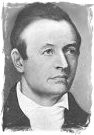
 There
is no name dearer to American Baptists than that of Adoniram Judson, the
pioneer missionary. Dr. Judson was born August 9, 1788, in Malden, Massachusetts,
where his father, Rev. Adoniram Judson, was pastor of the Congregational
church.
There
is no name dearer to American Baptists than that of Adoniram Judson, the
pioneer missionary. Dr. Judson was born August 9, 1788, in Malden, Massachusetts,
where his father, Rev. Adoniram Judson, was pastor of the Congregational
church.
In 1804, he entered the sophomore class in Brown University, and in 1807, he was graduated with the highest honors of his class. The year following his graduation he taught a private school in Plymouth, Mass., where his father was then residing as pastor of the Third Congregational church. At the close of the year he set out on a tour through the northern states. During his college course he had accepted views hostile to Christianity, but the sudden death of a sceptical classmate, the knowledge of which came to him under peculiar circumstances soon after he commenced his journey, changed the current of his thoughts, and abandoning his purpose to travel, he returned home, and devoted himself to a careful study of the claims of Christianity.
For a short time he was engaged in teaching in Boston. He then entered Andover Theological Seminary as a special student, for the purpose of prosecuting still further his inquiries. These at length resulted in a hearty acceptance of Christ as his Savior, and he united with his father's church at Plymouth, May 28, 1809.
In the following month he received and declined an appointment as tutor in Brown University. God had other purposes concerning him. In September, by reading Buchanan's "Star in the East," he was led to consider the work of foreign missions, and in February, 1810, he resolved to consecrate himself to this work. Other young men in the seminary at Andover, who, while in Williams College, had pledged themselves to missionary service, were in sympathy with him.
Judson completed his course at Andover, in September, 1810. As there was no foreign missionary society at that time in the United States, Judson wrote to the officers of the London Missionary Society, and received an invitation to visit England, and confer with them. At the meeting of the General Association of Massachusetts, in June, 1810, the subject of foreign missions was considered, and it was thought that an arrangement could be made which would render this step unnecessary. Disappointed in this, Judson sailed for England, January 11, 1811. The vessel was captured by a French privateer, and Judson was imprisoned at Bayonne, but he was soon released, and May 6, he arrived in London. Having conferred with the officers of the London Missionary Society, by whom he was favorably received, he sailed for New York.
At a meeting of the American Board of Commissioners for Foreign Missions, at Worcester, Mass., September 18, 1811, Judson and his associates were advised not to place themselves under the direction of the London Missionary Society, and the Board accepted Judson, Newell, Nott and Hall as their own missionaries, and pledged themselves to undertake their support.
Judson and his wife, Ann H. Judson, and Newell and his wife, sailed from Salem, Mass., February 19, 1812, for Calcutta. On the voyage, knowing that on his arrival in India he would meet the Baptist missionaries there, Judson commenced a study of the subject of baptism. The result was that his views underwent a change both as to the subjects and the act of baptism; and after his arrival at Serampore he and his wife were baptized by Rev. William Ward. The date of the baptism was September 6, 1812. Having resigned their appointment as missionaries of the American Board, Mr. Judson and his wife appealed to those in the United States of like views for sympathy and aid. The appeal thrilled the hearts of Baptists in all parts of the land, and the Baptist Triennial Convention was organized May 18, 1814.
On account of the hostility of the East India Company to the establishment of a mission in India, Judson decided to enter upon his work in Burma. He reached Rangoon, July 14, 1813, and entered at once upon the study of the language. It was not until June 27, 1819, that he baptized his first convert, Moung Nau. Not long after another Burman avowed his belief in Christianity.
These signs of success were followed by opposition on the part of the civil power, and Judson, with Colman, who had joined him at Rangoon, went to Ava to obtain royal approval. Failing in this, they returned to Rangoon with the purpose of removing the mission to the border of Arracan; but at the earnest request of their converts, Mr. Judson remained in Rangoon, while Mr. Colman took up his residence at Chittagong.
In December, 1821, Dr. Price joined the mission, and the king hearing of his medical skill, summoned him to Ava, and Mr. Judson accompanied him as interpreter. They were favorably received, and mission work was commenced in Ava.
At length Mr. Judson returned to Rangoon, and completed his translation of the New Testament. At the close of 1823, Mrs. Judson returned from the United States, whither she had sailed in August, 1821, and Mr. and Mrs. Judson repaired to Ava. War between Burma and the British East India Government soon followed, and a dark cloud overshadowed the mission. Rangoon fell into the hands of the British, May 23, 1824.
When the tidings reached Ava, Dr. Price and Dr. Judson (the latter received the degree of doctor of divinity from Brown University in 1823) were arrested, and thrown into the death prison. For eleven months they remained in this loathsome place, nine months in three pairs, and two months in five pairs, of fetters. Here they were kept from starvation only by the daily visits of Mrs. Judson, who brought them food, and as best she could alleviated their sufferings.
They were then sent to the prison at Oung-pen-la, a still more wretched place of confinement, where Dr. Judson remained six months. Thither Mrs. Judson followed them, and devoted herself to their wants with a heroism unsurpassed. No one can read the record of those terrible days and months of sore distress unmoved.
The continued success of the English arms prevented the execution of the prisoners, and at length they were released, to take part in the negotiations which the Burmese desired to make in order to save what had not already been lost. While Dr. Judson was engaged in this work, Mrs. Judson, exhausted by her heroic labors and sufferings, died at Amherst, October 24, 1826.
Dr. Judson removed to Maulmain, November 14, 1827, and continued his missionary labors. Here, on the last day of January, 1834, he completed his translation of the Bible into the Burmese language.
April 10, 1834, he was married to Mrs. Sarah H. Boardman, widow of the sainted George Dana Boardman.
Beside his missionary labors, he devoted himself for many years to the revision of his Burmese Bible, and the preparation of a Burmese dictionary. The failing health of Mrs. Judson led him, in April, 1845, to return to the United States. Mrs. Judson died at the island of St. Helena, September 1. October 15, Dr. Judson, with his motherless children, reached Boston.
Three days after his arrival, from the lips of Dr. Sharp, at a great public gathering, Dr. Judson received an appropriate and heartfelt welcome. This was the first of a long succession of such greetings, awaiting him wherever he went.
June 2, 1846, he was married to Miss Emily Chubbuck, of Utica, N.Y., and July 11, with his wife, he embarked for Burma.
On his arrival he made Rangoon his home, and here he continued his missionary labors until the autumn of 1849, when disease compelled him to relinquish them. He then took a short sea-voyage in order to recruit his failing strength, but without obtaining the boon he sought he returned to Maulmain.
In April, 1850, another sea voyage was recommended, and with a single attendant, his wife being too ill to accompany him, Dr. Judson set sail for the Isle of France. But he continued to grow weaker, and April 12, nine days after the embarkation at Maulmain, he died, and was buried in the ocean, latitude thirteen degrees north, longitude ninety-three degrees east.
Only occasionally was Dr. Judson accustomed to give his thoughts a poetical dress. Tender lines he "Addressed to an Infant Daughter, Twenty Days Old, in the Condemned Prison at Ava." "They were composed in my mind at the time," said Dr. Judson, "and afterward written down." The following versification of the Lord's Prayer, which is found in "The Psalmist" and other collections, was composed in the same place a few weeks later. "It illustrates," says Dr. Edward Judson, in his admirable life of his father, "the nature of the subjects which occupied the thoughts of the missionary during this long protracted agony. It is comprised in fewer words than the original Greek, and contains only two more than the common translation:"
Our Father, God, who art in heaven,
All hallowed be thy name;
Thy kingdom come, thy will be done
In earth and heaven the same.
Give us this day our daily bread;
And, as we those forgive
Who sin against us, so may we
Forgiving grace receive.
Into temptation lead us not;
From evil set us free;
The kingdom, power, and glory, Lord,
Ever belong to thee.
After his release from prison, oppressed by the loss of his wife and daughter, Dr. Judson wrote "The Solitary's Lament," commencing—
Together let us sweetly live,
Together let us die.
He also subsequently, on a sea voyage, addressed some verses to his children. But the best known of his poetical productions is his baptismal hymn (Psalmist, 807), commencing—
Come, Holy Spirit, Dove divine,
On these baptismal waters shine.
Another baptismal hymn, also written by Dr. Judson, begins—
Our Savior bowed beneath the wave.
From Baptist Hymn Writers and Their Hymns by Henry S. Burrage. Portland, Maine: Brown Thurston & Co., ©1888.
>> More Adoniram Judson