 As
Carey was the father of modern missions, Judson was the father of American
missions. The thought was no doubt in many minds, and in that circle of
young men from which sprung the American Board, each no doubt owed much
to the others; but partly from his own strong gifts of body, mind, and
downright moral consistency, Judson was the first to carry out in actual
missionary life what to others was a plan, a hope, a prayer.
As
Carey was the father of modern missions, Judson was the father of American
missions. The thought was no doubt in many minds, and in that circle of
young men from which sprung the American Board, each no doubt owed much
to the others; but partly from his own strong gifts of body, mind, and
downright moral consistency, Judson was the first to carry out in actual
missionary life what to others was a plan, a hope, a prayer.
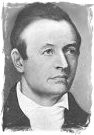
Born Aug. 9, 1788, eldest son of the Congregational minister at Malden, Massachusetts, [United States], he could read when three years old, was acute with figures when ten, and, proud and ambitious, entered Brown University, where at nineteen he graduated first in his class. His college course won only praise; but his brightness brought him under the influence of a skeptical college friend, and he came home to declare himself to his father, with characteristic downrightness, an infidel.
His father was then minister at Plymouth; and there the son taught school for a year, at this time publishing a school grammar and an arithmetic. He had some thoughts of dramatic writing, and made a tour of travel as far as New York, for a time traveling with a theatrical company.
Returning to Sheffield, Mass., where his uncle was minister, he arranged for a farther journey westward; but was much impressed by a young minister who preached there by exchange; and next day, setting out, took lodging at a country inn, where a young man lay very ill in the adjoining room. Judson was restless, thinking of this man, sick and away from home; and next morning learned with deep feeling that he had died; and, hearing his name, was overwhelmed to find that it was his skeptical college friend.
His scheme of travel seemed now impossible; his infidel theories melted away; and he turned his horse's head toward Plymouth, and next month entered an advanced class at Andover Theological Seminary. He joined his father's church in Plymouth the next May.
In the seminary he read Buchanan's "Star in the East," and Syme's "Empire of Ava," and became associated with Samuel Nott, and Samuel J. Mills, Gordon Hall, and others of the Williams College "Haystack" company; and though offered a tutorship at Brown University, and an associate pastorate with Dr. Griffin in Boston, he devoted himself to foreign missionary work.
He had already written to the London Missionary Society; and, after consultation with the teachers and ministers near Andover, he joined his fellow-students in a letter to the Massachusetts General Association of Congregational Churches, which met at Bradford, June 29, 1810, asking advice and help towards missionary service. This letter was signed by Judson, Nott, Mills, and Samuel Newell.
There had been in existence since 1799 the Massachusetts Missionary Society, organized to carry the gospel to the Indians, and to cultivate the missionary spirit; but the General Association now organized the American Board of Commissioners for Foreign Missions, and commended the young men to its direction.
Judson was first sent to London to ask the co-operation of the London Society. His ship was captured by a French privateer, and he was imprisoned on ship and in France; but escaped to London, where he was cordially received; but later it was thought best to send him abroad without English assistance.
He was married Feb. 5, 1812, to Miss Ann Hasseltine, daughter of the minister at Bradford; Feb. 6 he was ordained, and on Feb. 19 he sailed with his bride from Salem for Calcutta.
On the long voyage he became convinced that the Baptist doctrine was in agreement with the Scripture; and after reaching Calcutta he applied to the English Baptist missionaries at Serampore, and, with his wife, was immersed, and resigned his connection with the American Board.
The East India Company presently ordered him and his fellow American missionaries to return home, subsequently allowing them to go to Mauritius. There Mrs. Newell died; and Mr. Rice, who had also become a Baptist, went to America to urge the organizing of a Baptist Missionary Society.
Judson and his wife, after four months in Mauritius, largely spent in mission-work with English soldiers, sailed for Madras, hoping to establish a mission at Pulo-Penang, in the Strait of Malacca. But the only ship sailing in that direction took them to Rangoon in Burmah, beyond the protection of the British flag, where they arrived July 13, 1813. There a son of Dr. Carey had occupied the English Baptist mission-house; but he was absent, and soon afterwards resigned the mission in their favor.
Burmah was then an independent empire, with a population of about eight millions; the government an absolute despotism, arbitrary and most cruel; the religion Buddhism. Rangoon, near the mouth of the Irrawaddy, is the natural depot of much of Central Asia, and was a strategic center for Christian missions. It was then a dirty town of about ten thousand inhabitants, intersected by muddy inlets, which filled at high tide. Here Judson began his permanent work.
Two languages were to be learned — the common Burmese, and the sacred Pali. The younger Carey had not preached, but had partly made a grammar and dictionary; and Judson at once began his translation of the Bible, which he finished in 1834.
In 1815 Mrs. Judson had to go to Madras for medical advice. That year their first child was born, a little boy who died in infancy. In 1816 Judson seemed to be breaking down, and hurriedly collected the notes he had made for a Burman grammar. It was published twenty years later, and greatly praised for comprehensive and concise accuracy. Partially recovering, he imported a printing-press from Serampore and a printer from America, and published his "View of the Christian Religion," the first of a series of tracts that had a strong influence with that thoughtful and reading people. Mrs. Judson also published a catechism.
These publications were followed by the appearance of Inquirers, the first one coming, March 7, 1817, and marking an epoch in the work.
With a deepened sense of the need of evangelistic work, Judson now went to Chittagong to find some native Christian who could preach and teach in Burmese. He was unexpectedly detained there seven months, during which his wife, with some missionary helpers who had joined them, maintained the work under vexatious persecutions, displaying great endurance and wonderful skill and diplomacy with the native authorities; and later going through the trials of an epidemic of cholera.
On his return Judson built an open zayat, a shed of bamboo, for public evangelization, with a room for assemblies of worship, and another, opening on the garden, for women's classes. The zayat was on a main public thoroughfare, under the shadow of the chief pagoda. Here he conversed with men of different classes, some of profound Oriental learning, and saw how the skepticism of European philosophy has been anticipated in the subtler skepticism's of India, which have undermined Oriental faith, and made preparation for a faith more rational.
The first regular service was held in the zayat April 4, 1819, Judson having been in Rangoon nearly six years, and then first venturing to preach in the native tongue. The 27th of the following June he baptized his first Burman convert, Moung Nau.
In November there were rumors of persecutions, and public services were suspended for several Sundays, and two new converts were baptized privately; and greater interest bringing new threats from the authorities, Judson went to Ava, the capital, to lay the matter before the king. The journey and return consumed over two months, and seemed rather to produce more explicit threats; and Judson resolved to remove to Chittagong, under British rule.
But now the little circle of converts awoke to independent life and courage. They could not bear to be scattered, but begged that, if the missionaries must go, it would not be till their membership was increased to ten, and they organized under some leader to hold them together and help their Christian life. Departure was therefore postponed; and ten months later the tenth convert and first woman was received into the church. This was on the eve of Judson's sailing to Calcutta with his wife because of her ill health; and through this absence the little church stood steadfast even under persecution.
Then the persecution ceased. A girls' school was opened; and the work took so interesting a form that, though Mrs. Judson's health compelled her to go to America, her husband remained at Rangoon.
He was now joined by Dr. Price, a medical missionary, whose remarkable success, especially in operations for cataract, led to his being summoned to Ava, to the king; and here Judson thought it best to accompany him.
This movement brought the whole missionary work at once under favorable notice of the court. There was no more talk of persecution, but apparently the largest opening for greatly enlarged work. Judson came into the presence of the king, and received the royal invitation to transfer his work from Rangoon to the capital; and after Mrs. Judson's return from America with improved health, and with re-enforcements for Rangoon, they removed to Ava, arriving there in January, 1824.
The court favor at Ava, however, was clouded over by a change of ministers, almost before their actual arrival. Many postponements and hindrances impeded their work, in spite of the favor held by Dr. Price's medical reputation; and in a few months the outbreak of war between Burmah and England threw the mission into confusion and dismay. There was a general suspicion of all persons of English speech; and ere long Judson, Dr. Price, and five others were arrested and thrown into prison.
This imprisonment lasted for eleven months in the "death-prison" at Ava, and afterwards for six months in the country prison of Oung-pen-la. Mrs. Judson was not arrested, though her house was searched and all valuable property confiscated. She made almost daily visits to the prison, though often refused admittance, and also to the palace, maintaining the respect and friendship of some of the court, and was able to carry her husband food and clothing, and after some months to build him a little bamboo shed in the prison yard, where he could sometimes be by himself, and where at times she was allowed to be with him. In January, 1825, a little daughter was born to her; and few months later she went through an epidemic of small-pox.
The horrors of Judson's imprisonment can only be imagined; crowded into narrow quarters with over a hundred common criminals, loaded with fetters, at first three pairs of fetters, afterwards five pairs, with no conveniences for cleanliness or even decency. After eleven months the captives were suddenly removed from the city prison, and with agonizingly painful marching taken to the country prison of Oung-pen-la. There, after days of weariness and pain, at night, for security, a bamboo pole was passed between the fettered ankles of a string of prisoners, and then hoisted by ropes till their shoulders only rested on the floor. Daily and nightly torture, racking fever, half starvation, and daily anticipation of death, marked these terrible months.
But the success of the British arms at length compelled the king to send Judson and Dr. Price as interpreting envoys to negotiate peace; and the British commander made his first absolute demand the release of the missionaries, and the Judsons returned to Rangoon. During his imprisonment his unfinished manuscript translation of the Bible was hid by his wife in a cotton pillow on which he slept. This was thrown aside as worthless when his prison was changed, but was found and saved by a native convert.
The Rangoon church being scattered, a new mission was begun at Amherst on British territory, but later removed to Maulmain, a more important center. This greatly prospered, though they had no more their youthful strength; and during Judson's absence at Ava, attempting to secure religious toleration, his wife died of a fever, and he returned soon to lay their little child by her side.
With broken heart and health he became almost wildly ascetic; living much alone, fasting and praying whole days in the woods. He relinquished part of his slender missionary pay, and made over to the Board about six thousand dollars, including presents and fees from the British government for treaty-negotiation service, and some private means brought originally from home. In 1830 he again attempted to penetrate Burmah, living six months at Prome, half-way between Rangoon and Ava, but was driven back by Burman intrigues. He then began a work among the wild Karens of the jungle, and with great success.
In 1834 he married Mrs. Sarah Boardman, widow of a fellow missionary. He completed his Bible, pronounced by Dr. Wayland the best translation in India, and by Orientalists "a perfect literary work."
In 1845 his health and his wife's was so broken that they sailed for Mauritius, and from there for America; but she died Sept. 1, while in port at St. Helena. Judson, with three children, reached Boston on Oct. 15.
He was in America till July, 1846, and, before re-embarking for India, was married to Miss Emily Chubbuck, who was known as a writer under the name of Fanny Forester.
His last years, 1846-1850, were spent in another earnest but unsuccessful attempt to break through Burman bigotry, in the continuation of his Burman dictionary and other literary work, and in the forwarding of the general missionary enterprise.
Towards the end of 1849 his health declined alarmingly. His sixty years had contained more wear and strain than come to many a long life. The "keen sword had worn out the scabbard." In the spring of 1850 it was hoped that a sea voyage might help him; and he was carried on shipboard April 8, but died April 12, and was buried at sea.
The late Rev. A. J. Gordon, D.D., in writing of the illustrious missionary whose name he bears, says: "Park Street Church in Boston, whose call the Spirit constrained Judson to decline seventy-five years ago, is still a large body, numbering perhaps a thousand members; but the church in Burmah, which that same Spirit led Judson to found, numbers to-day thirty thousand communicants, with a great company beside who have fallen asleep."
From Great Missionaries of the Church by Charles Creegan and Josephine Goodnow. New York: Thomas Y. Crowell, ©1895.
>> More Adoniram Judson