 America
has taken a prominent place in modern missionary effort. For a century
and a half she had been engaged in desultory efforts for the heathen
on her own continent, and men like Elliott and Brainerd had done
a noble work for the perishing [Native American] Indians. But the
beginning of this century witnessed a grand outburst of missionary
spirit beyond the Atlantic, and this spirit soon carried its messengers
east and west across the waters to the shores of the Old World, where
now they are to be found rivaling both in numbers and in zeal their
elder European brethren. Burmah, India, China, Africa, and the Isles
of the Pacific bear witness to their labours; the Turkish Empire
stands pre-eminently indebted to their efforts; and Lord Stratford
de Redcliffe has borne such a testimony to what he saw and knew
of American missionaries in Syria, Armenia, and Kurdistan, as proves
their title to a distinguished place amongst the warriors of the
cross.
America
has taken a prominent place in modern missionary effort. For a century
and a half she had been engaged in desultory efforts for the heathen
on her own continent, and men like Elliott and Brainerd had done
a noble work for the perishing [Native American] Indians. But the
beginning of this century witnessed a grand outburst of missionary
spirit beyond the Atlantic, and this spirit soon carried its messengers
east and west across the waters to the shores of the Old World, where
now they are to be found rivaling both in numbers and in zeal their
elder European brethren. Burmah, India, China, Africa, and the Isles
of the Pacific bear witness to their labours; the Turkish Empire
stands pre-eminently indebted to their efforts; and Lord Stratford
de Redcliffe has borne such a testimony to what he saw and knew
of American missionaries in Syria, Armenia, and Kurdistan, as proves
their title to a distinguished place amongst the warriors of the
cross.
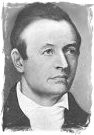
Adoniram Judson (born in 1788, in the home of a Congregationalist minister in Massachusetts, [United States]), as he was amongst the first of his countrymen to feel this new impulse, so was he confessedly the foremost in imparting it to others. The mission to Burmah, which was the first outcome of this awakened zeal, and in some respects the greatest and noblest field of its victories, must always be identified with him and with those three illustrious women who were successively his wives, and whose names and labours must for ever be inseparably linked with his. In reading the eventful story of the Judsons, so full of peril and of patience, so marked by suffering and success, we seem as if we had alighted upon some grand romance; but we rise from its perusal with a deep conviction of its stern reality, and with a growing admiration of the Christian heroism which it displays.
Judson, as it has been well said, was "a missionary of the apostolic school." Like others who have led the van in the assaults of the Gospel upon paganism, he was a man pre-eminently endowed both by nature and by grace for the great work in which Providence employed him. We shall find, as a rule, that it is not the intellectually halt and feeble who have been called to "jeopard their lives unto the death in the high places of the field," and that the men who have gained this high distinction have moreover been baptized in a remarkable degree "with the Holy Ghost and with power." Such was Judson. The early precocity of his genius may be gathered from the fact that at three years of age he could read; that before he was ten he had gained a reputation for solving difficult arithmetical problems; and that when he entered college at sixteen, he obtained the highest place. Bright, intellectual, and enthusiastic, he was moreover extravagantly ambitious. His father had said one day that "he would be a great man," and a great man he resolved to be.
He dreamt of being a statesman, an orator, a poet, and he built his castles in the air accordingly; but he was far nearer the truth when, at four years of age, he used to collect the village children around him, and mounted upon a chair, would preach to them a simple gospel with singular earnestness. His father and mother remembered in after years that the favourite hymn with which he prefaced these infant exercises was one beginning with the prophetic words—
"Go preach my Gospel, saith the Lord."
Brought up in a pious home, he had been visited by serious thoughts; but religion seemed to stand in the way of his ambition, and the wave of French infidelity reached him through the influence of a brilliant but skeptical fellow-student. Judson's thoughts and plans became consequently unsettled. Now we find him teaching a school at Plymouth, now attaching himself to a dramatic company, now touring in search of excitement through the Northern States. It was during this tour that God rescued him from infidelity and sin. He had reached a country inn, and the landlord apologized for putting him to sleep in the next room to that of a young man who was dying, but he had none other to offer him. Sad sounds came from that sick chamber through the midnight hours, and they stirred up solemn thoughts and anxious inquiries in Judson's breast. He made the case of that young man his own, and as he did so he felt the shallowness of his own newly-adopted philosophy and its insufficiency to sustain him in the hour of death. The morning dawned, and he inquired about the sufferer. "He is dead." He asked his name, and was stunned at finding that it was that of his friend — shall we not rather say of his tempter? That morning he turned his horse's head towards home; God had begun a work in his heart, which resulted in true conversion. Soon we find him in the calm retirement of the Theological School at Andover, patiently inquiring into the truth of God, and ultimately yielding himself to Christ with a fulness of conviction and satisfaction, which never afterwards during his life was harassed by a single doubt.
Two years had scarcely passed by since that memorable night at the wayside inn. His father was now a pastor at Plymouth and had conceived plans for his son's preferment. The minister of the largest church at Boston was willing to take young Judson as a colleague, and the parents, delighted at the prospect, complacently apprised him of the good news. "You will be so near home," said the mother. But Judson did not speak. His sister chimed in with her congratulations; and then the young man found a tongue, and earnestly replied, "No, sister, I shall never live in Boston; I have much farther to go." Two years before he had startled them by the announcement of his infidel opinions; they were scarcely less startled now, though in a strangely different way, by hearing his firm resolve to be a missionary to the heathen.
How had it come about? He had met with Buchanan's "Star in the East," and this had awakened the missionary spirit. He had read Syme's "Embassy to Ava," and this had turned his whole soul towards Burmah and its benighted Buddhists. The leaven of missionary enterprise had begun to work in the Andover seminary. Three young men — their names deserve to be recorded — Mills, Richards, and Rice — had formed themselves into a missionary society in the college, with the object of training themselves for work amongst the heathen. Judson joined them, and soon became the leading spirit of the devoted band. Some one asked him in later life, during a visit to America, whether he had been more influenced by faith or love in going to Burmah. He paused a moment, and then replied, "There was in me at that time little of either; but in thinking of what did influence me, I remember a time out in the woods behind Andover seminary, when I was almost disheartened. Everything looked dark. No one had gone out from this country. The way was not open. The field was far distant, and in an unhealthy climate. I knew not what to do. All at once Christ's 'last command' seemed to come to my heart directly from heaven. I could doubt no longer, but, determined on the spot to obey it at all hazards, for the sake of pleasing the Lord Jesus Christ." And then he added these memorable words, "If the Lord wants you for missionaries, He will send that word home to your hearts. If He does so, you neglect it at your peril!"
Out of that little group of students, as from a fruitful germ, grew up "The American Board of Commissioners for Foreign Missions," and Judson was their earliest and noblest agent. But first he was sent to England (in 1811) to confer with the London Missionary Society, and on the way was captured by a French privateer, and confined with other prisoners in the hold. Here, as he was translating from his Hebrew Bible into Latin, the doctor discovered him, and contrived his release from this part of the vessel. Landed at Bayonne, he was marched as a prisoner through the streets, and attracted the attention of a fellow-countryman by exclaiming against the injustice of detaining an American. This kindly citizen visited the dungeon to which Judson had been consigned and managed to pass the prisoner out under the capacious folds of his own great cloak. Eventually Judson made his way to England, where he was kindly received, and whence he was promised help; but this foreign aid was not needed, for the American Board of Missions had already attracted large support, and Judson soon re-crossed the Atlantic, and was set apart for his grand enterprise. He was to go to some Asiatic field — in India or Burmah, according as God's providence should point the way. On the 5th February, 1812, he married the beautiful Ann Hasseltine; twelve days later he embarked with her for Calcutta, and on the 17th of June they reached their destination.
And here began the link with Serampore and the strange events which led to the formation of the Burmese mission. Carey and his fellow-labourers invited them to stay at the mission-house; and as Judson's views on baptism had undergone a change during the voyage out, he severed his connection with the American Board, and resolved to cast in his lot with the Baptist missionaries. But the East India Company, hostile to their work, and alarmed at this new influx of missionary labourers, issued a peremptory order that they should return to their own country. It so happened that a Mr. Chater and Felix Carey (a son of the famous Serampore missionary) had gone a short time previously to Rangoon, to pioneer a way for missions in the empire of "the Golden Sovereign of land and water." It was decided to send the new-comers thither; but even this could be effected only by stratagem. They were smuggled on board a vessel for the Mauritius, but were detected, and forced to disembark; they contrived to get on board again, and on reaching St. Louis found that they must visit Madras as the only way of reaching Burmah. Here they narrowly escaped from another order of the Company, and eventually in a crazy vessel reached Rangoon in July 1813, half dead with sickness and discomfort.
It was a disheartening and a gloomy prospect that lay before them. There was at this time no provision made for their support. They were in a land of slaves ruled over by a despotic tyrant, and by rapacious viceroys, who were well called "the eaters of the provinces." Brutal murders and audacious robberies were of continual occurrence. The mission-house was close to the spot where public executions were constantly taking place. All around rose the gilded pagodas where the great Gaudama, as an incarnation of Buddha, was adored. In every street were seen the lamasaries, or homes of the priests, who were reckoned to be one in every thirty of the population, and who taught the cheerless creed of "Nirwana," or annihilation. Very few had so much as heard the name of Jesus, and it was death, according to the law, to renounce the faith of Buddha, which, alas! is still the dreary creed of three hundred millions of the earth's inhabitants. No marvel then that Judson and his wife should record that their first day in Burmah was "the most gloomy and distressing" that, ever they had passed.
But the devoted pair set to work at once, applying themselves to the acquisition of the spoken tongue and of Pali, which is, so to speak, the sacred text of Ava. Like all true Protestant missionaries, Judson felt that if he was to reach their hearts, he must not only speak their language, but that he must also give the people the Word of God in their own tongue. The Burmans are a reading people, and this was an additional reason for, and a fresh stimulus to, his work. So well did he succeed, that a Burmese governor, who received one of his translations four years after his arrival, could scarcely believe that it was the work of a foreigner. But we cannot dwell on this portion of his work. We may, however, mention here that in 1834, after twenty years of patient toil, he completed his translation of the whole Bible; and when the last page passed through his hands, he knelt down and prayed "for the forgiveness of Heaven on all the sins that had mingled with his labours, and commended his work to the mercy and grace of God, to be used as an instrument for converting the heathen to Himself."
There was then no grammar nor dictionary of the language, and this made his task one of extreme difficulty; but before he died he rendered the work of his successors comparatively light by compiling a grammar, and nearly completing a dictionary of the Burmese tongue. They remain to this day as monuments of his industry and talent, and have not yet been superseded. Nor was this all: he imported a printing press from Serampore, and a printer from America (where the Baptists had adopted his mission), and he published "A Summary of Christian Doctrine," and many valuable tracts, the circulation of which was greatly blessed.
Four years having been spent in preliminary study, Judson went to Chittagong to try and find amongst the native Christians some one who knew the Burmese tongue and could assist him in his work. There he was unexpectedly detained for seven months; but his brave wife remained at her post, with other missionaries who had arrived at Rangoon, gathering the native women around her, and teaching them the story of redeeming love. When persecution broke out, she not only prevented the abandonment of the mission by her firmness and decision, but she went in person to the authorities, and by her tact and address obtained a repeal of their harsh enactments. When cholera raged, and the rest of the party resolved to leave for Bengal in the last remaining vessel, she braced her mind to the occasion, returned to the mission house, pursued her studies as formerly, and "left events with God."
On his return Mr. Judson began what he felt to be the great purpose of his life — his evangelistic work. Under the shadow of the grand pagoda, and in a crowded thorough-fare, he built a humble zayat, or hall of public resort. Its walls were made of bamboo, and it was covered in with thatch. One room was open to the street, and there he sat all day to receive those whom interest or curiosity induced to listen to his message. Another room was fitted up for public worship, and a third was devoted to classes for the women, and opened on the garden of the mission-house. Quietly and slowly, but steadily and surely, the work went on. Inquirers, opponents, cavillers, found their way to that humble shed. He soon discovered that the philosophies and speculations of Europe had been anticipated in the East; that Idealism and Nihilism had been discussed by Brahmins and Buddhists centuries before the days of Berkeley and Hume; and that amongst the professors of the national creed there existed a large proportion of semi-atheists and metaphysical skeptics. With these he reasoned, dealing now with their common sense, and now with their consciences, pressing home on each the need man has of a Saviour and a Sanctifier, and showing how God has provided these in His glorious Gospel. At length one convert declared himself on the side of Christ, and Moung Nau was baptized as the first fruits of Burmah unto the Lord. Two others followed; but persecution threatened, and so on a November evening, when the sun had gone down, they made their humble, timid profession. "Perhaps," said the missionary, "if we deny Him not, He will acknowledge us, another day, more publicly than we venture at present to acknowledge Him." It was some comfort to him to find that on the next Lord's-day after the services were over, "the three converts repaired to the zayat, and held a prayer-meeting of their own accord."
By this time the number of inquirers began to excite the alarm of the Buddhist priests. A new and by no means friendly viceroy had replaced Mya-day-men, who had shown the Judsons no little kindness. He observed the zayat, and it was soon perceived that it was here the converts had learned "to forsake the religion of the country." Moreover the old emperor had died, and his successor, who was supposed to be a zealous Buddhist, had initiated his reign by gilding the great pagoda, which contained the sacred hairs of Gaudama, and by passing sundry enactments in favour of the popular religion. The growing fear of persecution checked inquiry, and the work was likely to cease.
Under these circumstances Judson thought it well to secure, if possible, the royal protection, or, at all events, some measure of toleration, and so he resolved to go to Ava, and to wait upon the emperor. Accordingly, he and Mr. Colman, a brother missionary, set out for the capital, with some valuable presents for members of the court, and a Bible in six volumes, covered with gold-leaf, to lay before the "golden feet." His old friend, Mya-day-men, undertook to present them, and every forehead was laid in the dust as the modern Ahasuerus, with royal gait, and with gold-sheathed sword in hand, gave audience in the splendid palace. After he had asked several questions, and heard the Prime Minister read the petition, he held out his hand for the tract, which contained a brief summary of the Christian faith. As he silently read the opening sentences, the hearts of the missionaries sent up a secret prayer to God— " Have mercy on Burmah! have mercy on her king!" But he dashed the paper to the ground with palpable disdain. An attempt to conciliate him was made by unfolding and displaying one of the attractive volumes; but the "Sovereign of land and sea" took no notice. The Prime Minister interpreted his master's will:— "In regard to the objects of your petition, His Majesty gives no order; in regard to your sacred books, His Majesty has no use for them: take them away."
With a heavy heart they returned home... The missionaries now resolved to leave Burmah for a while, with their three converts, and to go to a region between Bengal and Arracan, where a kindred tongue was spoken. This resolution produced dismay amongst the little group of inquirers at Rangoon. "Do stay with us," they said, "till there are ten disciples, and then appoint one to be the teacher of the rest when you are gone." The appeal was irresistible, and fervent prayer followed it. It reminds us of Abraham's intercession for Sodom; but in this case "the ten" were found. Before five months had passed, Judson was able to take his wife, whose health was seriously impaired, to Calcutta, and to leave the infant church to the native care of Moung Shwa-gnong. But within six months they returned to their little flock, and found their converts, notwithstanding much persecution, true to their profession, and glad beyond measure to welcome them. It was a cheering thing, moreover, to see their old friend, the kindly viceroy, just reinstated in office. The enemies of the Gospel had gone to him with an accusation against the native teacher — "He has turned the priests' rice-pot bottom upwards." "What matter!" said the viceroy; "let the priests turn it back again."
The work went on; disciples began to increase; schools were opened, and two remarkable men, Moung Shwa-ba and Moung Ing, of whom we shall hear again, were added to the Church; so that although "Mama Judson," as the natives loved to call her, was suffering severely from liver complaint, and had to go for two years to America as her last chance of life, her noble husband resolved to remain at his post. He was almost the only person on earth who had such a knowledge of their language as to be of use to the pagans of Burmah. And so with sorrowful hearts the husband and wife parted.
Dr. Price, a medical missionary, now joined the mission. His fame reached "the golden ears," and he was summoned to Ava. Judson accompanied him as interpreter. The reception on this occasion was more favourable than the last; but the "golden mouth" put some alarming questions to Judson: "And you in black, are you a medical man too?" "Not a medical man, but a teacher of religion, your Majesty." "Have any of the Burmese embraced it?" Judson diplomatically replied, "Not here." "But are there any in Rangoon?" demanded the emperor. "There are a few." "Are they foreigners?" persisted the despotic king. Judson trembled for the consequences; but the truth must be told at all hazards. "Some foreigners and some Burmese," he replied. There was an awful silence; but He who is mightier than the kings of the earth restrained man's wrath, and before Judson left the capital he had preached to both king and courtiers, and received an invitation to return and reside at Ava.
Mrs. Judson came back from America in December 1823, with additional missionary helpers, and within seven days of her arrival at Rangoon she and her husband were sailing up the Irrawady, on their way to Ava. The natives, who had never seen a white woman before, flocked in crowds to witness the wondrous sight, and soon the happy missionary and his devoted wife were installed in the premises assigned them by the king. Their work in the capital had begun under the most favourable circumstances; he was engaged in preaching, and she in conducting her school, when intelligence arrived of hostilities with the British, followed by the news that Rangoon had been captured! The few Englishmen in Ava were immediately imprisoned, and orders were issued for the arrest of the foreign teachers. Judson was suddenly seized, in his wife's presence, by an armed band, who threw him on the floor, tied his arms behind his back, and hurried him to prison. She barred herself with her four Burmese girls into an inner room, to escape the savagery of the infuriated guards. In the morning she contrived to send the faithful Moung Ing to make inquiries, and he brought back word that Judson and Price and the English merchants were in the death-prison, with three pairs of iron fetters on each, and all fastened to a long pole to prevent their moving.
We cannot enter into the particulars of that two years' terrible captivity, or of the heroic efforts made by Ann Judson to assuage the sufferings of her husband and his fellow-prisoners. But it is not too much to say that it was owing to her tact and intercessions that they were not murdered. It is a record on the one side of the noblest patience, and on the other of the most devoted love. During part of the time, and that too the hottest season of the year, Judson was shut up with some hundred Burmese robbers in a cell that had no window, and they were so jammed together that he could not find room to stretch himself. It was a rare luxury when he obtained the reversion of a lion's cage, after the poor animal had been starved to death, because it was supposed to be mysteriously connected with English power. The head-jailer, himself a branded murderer, was an incarnation of cruelty and mocking jocularity. After a time Mrs. Judson contrived, partly by presents and partly by appeals, to have the rigour of his bondage somewhat relaxed, and she kept up secret communications with him by writing on flat cakes which were concealed in bowls of rice, and by stuffing scraps of paper into the mouth of an old coffee-pot. Only once during his long captivity did his brave spirit give way. His wife had contrived a surprise that might remind him of home by concocting something like a mince pie with buffalo beef and plantains. He had borne taunts and insults without shrinking; he had endured fever and ague without dismay; he had seen some of his European fellow-prisoners die from extremity of hardship, and he had not quailed; he had kissed his new-born baby in his wife's frail arms, through the iron bars of his cell, and he had done so without a sigh; but when he looked upon this touching remembrance, of a happy home and of wifely tenderness, he bowed his head upon his knees, and the tears flowed down to the chains that clanked about his ankles, and the dainty viand remained untouched.
Mrs. Judson had managed to secrete the manuscripts of his translations in the earth beneath the mission-house; but the rainy season came on, and they were likely to be ruined with the damp. In his dungeon he was anxious about them, and he arranged with her to sew them up in a pillow, so mean in its appearance, and so comfortless withal, that the covetousness of even a Burman jailer should not be excited by it. The little sleep he enjoyed was all the sweeter because his aching head, as well as his anxious heart, was pillowed on the Word of God. When he was sent to another prison-house at Oung-pen-la, which he reached with lacerated and bleeding feet, the ruffian jailers seized for themselves the mat which covered the precious pillow, and threw the apparently useless article away. Moung Ing found the relic, carried it to the mission-house; and by its aid Burmah afterwards obtained the Bible in her native tongue.
When the English advanced upon the capital, Judson was employed by the Burmese as an interpreter, and sent to the camp to mediate. He discharged the difficult duty so admirably, that he was afterwards thanked by the Governor-General. Sir Archibald Campbell insisted, amongst other terms, upon the release of the Judsons, and they were soon under the protection of the British flag and on their way to their old station at Rangoon. But most of the converts were scattered, and there was no security for life under Burmese rule; so it was determined to carry the old zayat into the territory recently ceded to the British, and to set up a new mission at Amherst, and subsequently at Moulmein. Here they recommenced their blessed work, and not without success; but Judson having gone again to Ava in the vain endeavour to obtain religious toleration, returned only to find that his noble wife had died of fever in his absence, and that he was soon to lay his motherless child beside her, under the hopia (or hope tree), which seemed such a blessed emblem of their rest and resurrection.
Judson was never the same man after that. He had not indeed lost his holy resolution, but he had lost his cheerful elasticity. For a time he indulged in an ascetic spirit, and would live for days alone amongst the woods, in fasting and prayer, and seeing only those who came to him for religious instruction. But he came forth from this period of seclusion with a new baptism of energy and devotedness. He gave up all his patrimony to the cause of missions, and set out once more to assail the strongholds of Satan in the old Burman empire, and especially at Prome, its ancient capital. He was led to take an especial interest in the Karens, an interesting and patriarchal race, who were treated as slaves by the Burmese, but were infinitely their superiors in all the better traits of human character. They had no priesthood, and scarcely any form of religion, but possessed strangely truth-like traditions of Paradise, and the Fall, and the Deluge, and a coming Deliverer. It was this mission which led him to know and marry his second wife, Sarah Boardman, who had shared her first husband's labours amongst this people while he lived, and was now devoting herself to their best interests after his death. By the year 1836 there were as many as 248 Karen communicants, and the success went on until the converts were reckoned by thousands, and one of the missionaries could say, "Heathenism has fled from these banks; I eat the rice and fruits cultivated by Christian hands, look on the fields of Christians, see no dwellings but those of Christian families."
Eleven years more passed by and several children were born, but the health of Sarah Judson was shattered by constant toil, and she was ordered, as a last resource, to try a voyage to America. Her husband went with her, intending to see her as far as the Mauritius; but when they reached it, finding that she was fading away, he went on with her to St. Helena, and there she breathed her last on the 1st September, 1845. She had written a beautiful "Farewell," which she meant to give him at parting. It began—
"We part on this green islet, love;
Thou for the Eastern main,
I for the setting sun, love;
Oh! when to meet again?
and it ended with these invigorating words—
"Then gird thine armour on, love,
Nor faint thou by the way,
Till Boodh shall fall, and Burmah's sons
Shall own Messiah's sway."
Judson found the lines after she had "gone home," and when he copied them, he wrote after the last verse these words— "'Gird thine armour on' —And so, God willing, I will yet endeavour to do; and while her prostrate form finds repose on the rock of the ocean, and her sanctified spirit enjoys sweeter repose on the bosom of JESUS, let me continue to toil on all my appointed time, until my change, too, shall come."
Judson proceeded to America, but what a change he found since he had left it thirty-four years before! Scarcely one whom he had known was alive to welcome him; but the old apathy about missions had given way to a generous enthusiasm, and he felt pained by the excessive and universal homage that was paid to him. The universities had made him a Doctor by diploma; statesmen and philosophers crowded round him to pay their respects. He was a great man indeed, but the early ambition of his youth was quenched in the deep humility of an aged servant of the Lord. He remained but nine months in the States, and then returned to his work. He had been anxious to find a suitable biographer to write a memoir of his late wife, and was recommended to a lady who had gained no small literary fame under her nom de plume of Fanny Forrester. Emily Chubbuck was vivacious as well as talented, and many wondered when they heard that she was to be Dr. Judson's wife; but she made a noble partner for the missionary, and a loving mother to his children. She enriched our literature with one of the most exquisite biographies in the language, and gathered the materials which give us such an insight into the grandeur of her husband's life. Each of Judson's partners had distinctive talents; Ann was a linguist, Sarah a poetess, Emily an authoress. The first had in her most of the heroine, the second most of the missionary, and the third most of the savant. As wives, they were all worthy of such a husband; and he was worthy of them.
The last three years of Judson's glorious life were spent at Moulmein and Rangoon, amidst alternate difficulties and encouragements. An affection of his voice now prevented him from doing much in the way of preaching, but there was the less need of this as the mission was supplied with other labourers; still he superintended the work, and cheered the workers, and laboured hard himself at his Burmese Dictionary. He had completed the first section of it (the English-Burmese), when weakness, followed by fever, utterly prostrated him, and the physicians prescribed a voyage to the Isle of France. His devoted wife was not in a condition to go with him, but the mission printer and a faithful Bengali servant went in her stead. Four months afterwards she learned the sad news that within a fortnight after she had parted from him he was laid in an ocean grave (12th April, 1850). "He could not," wrote his widow, "have a more fitting monument than the blue waves which visit every coast; for his warm sympathies went forth to the ends of the earth, and included the whole family of man." He was brave, faithful, patient, hopeful to the end. His last words were uttered in his dear Burman tongue: "It is done." "I am going."
"Servant of God, well done!
Rest from thy lov'd employ;
The battle fought, the vict'ry won,
Enter thy Master's joy.
"The pains of death are past;
Labour and sorrow cease;
And life's long warfare clos'd at last,
His soul is found in peace.
"Soldier of Christ, well done!
Praise be thy new employ;
And while eternal ages run
Rest in thy Saviour's joy!"
From Modern Heroes of the Mission Field by W. Pakenham Walsh. New York: Fleming H. Revell, [n.d.]
>> More Adoniram Judson