"That Christ may dwell in your hearts by faith; that ye, being rooted and grounded in love, May be able to comprehend with all saints what is the breadth, and length, and depth, and height; And to know the love of Christ... " Ephesians 3:17-19
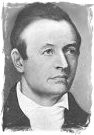 He
is a thorough-paced skeptic, this dashing young fellow with the slight
and fragile frame, the round and rosy face, the laughing brown eyes,
and the rich shock of chestnut hair. There is something defiant about
his unbelief. He is the son of a Congregational minister in Massachusetts,
who cherishes a fond and secret hope of seeing his brilliant boy
following in his own footsteps. But the son knows better than the
sire. At school and at college he has swept everything before him.
His teachers have stood astonished at the ease and splendor of his
triumphs. In every classical contest, Adoniram Judson was first and
his rivals nowhere. His phenomenal success has awakened within him
a proud and all-absorbing self-consciousness. The conquest that his
dazzling intellectual endowments must win for him in the golden future
fire his fancy with excited dreams. 'Day and night,' as one of his
biographers puts it, 'he feels his ambition with visions of eminence
and glory such as no mortal has yet won. Now he is a second Homer,
thrilling a nation with heroic lays; now a mighty statesman, guiding,
with steady hand, the destinies of his country; but, whatever the
dream of the moment, its nucleus is ever his own transcendent greatness.'
A minister! He a Congregational minister! He smiles disdainfully
at his father's lack of imagination.
He
is a thorough-paced skeptic, this dashing young fellow with the slight
and fragile frame, the round and rosy face, the laughing brown eyes,
and the rich shock of chestnut hair. There is something defiant about
his unbelief. He is the son of a Congregational minister in Massachusetts,
who cherishes a fond and secret hope of seeing his brilliant boy
following in his own footsteps. But the son knows better than the
sire. At school and at college he has swept everything before him.
His teachers have stood astonished at the ease and splendor of his
triumphs. In every classical contest, Adoniram Judson was first and
his rivals nowhere. His phenomenal success has awakened within him
a proud and all-absorbing self-consciousness. The conquest that his
dazzling intellectual endowments must win for him in the golden future
fire his fancy with excited dreams. 'Day and night,' as one of his
biographers puts it, 'he feels his ambition with visions of eminence
and glory such as no mortal has yet won. Now he is a second Homer,
thrilling a nation with heroic lays; now a mighty statesman, guiding,
with steady hand, the destinies of his country; but, whatever the
dream of the moment, its nucleus is ever his own transcendent greatness.'
A minister! He a Congregational minister! He smiles disdainfully
at his father's lack of imagination.
This was in 1803; and in 1803 the hectic and amazing vogue of Tom Paine was at its very height. In every seat of learning it was considered the correct thing to pooh-pooh Christianity. It is said that at Yale every student was an avowed infidel. The graduates even adopted the names of the great French and English atheists, and asked to be addressed by those names in preference to their own. The imperious mind of Judson was swiftly infected by the prevailing epidemic. At Providence College [now Brown University], in the class above his own, was a young fellow named E---, a youth of rare genius, of sparkling wit, of high culture, and of charming personality. This senior student was powerfully attracted to Judson, and Judson was flattered and fascinated by his friendship. E--- was, however, one of the leaders of the new philosophy; and, in accepting his companionship and confidence, Judson committed himself irretrievably to an attitude of audacious and aggressive unbelief. In those days his father's dreams of ordination seemed to rest upon a singularly flimsy foundation.

But, as is so often the case, it was the unexpected that happened. Wherever Adoniram Judson went, in the course of his historic and adventurous career, he carried with him, as Dr. Angus says, that evidence of the truth of Christianity which is at once the most portable and the most conclusive — the vivid memory of a startling and sensational conversion.
Our skeptical young student makes up his mind to set out on horseback on a tour of the northern States. He rests one night at a certain wayside inn. The landlord explains apologetically that the only room that he can offer is one that adjoins an apartment in which a young man is lying very ill — dying perhaps. Judson assures the innkeeper that it does not matter; death, he declares, is nothing to him; and, except that he will feel a natural sympathy for the unfortunate sufferer, the circumstances will in no way disturb him.
The partition between the two rooms is, however, terribly thin. In the stillness of the night, Judson lies awake, listening to the groans of the dying man — groans of anguish; groans, he sometimes fancies, of despair. The heartrending sounds powerfully affect him. But he pulls himself together. What would his college companions say if they knew of his weakness? And, above all, what would the clear minded, highly intellectual, sparingly witty E--- say? How, after feeling as he had felt, could he look into the face of E--- again? But it is of no use. The awful sounds in the next room continue, and although he hides his head beneath the blankets, he hears everything — and shudders! At length, however, all is still. He rises at dawn; seeks the innkeeper; and inquires about his neighbor.
'He's dead!' is the blunt reply.
'Dead!' replies Judson. 'And who was he?'
'Oh,' explains the innkeeper languidly, 'he was a student from Providence College; a very fine fellow; his name was E---!'
Judson is completely stunned. He feels that he cannot continue his tour. He turns his horse's head towards his old home; opens his stricken heart to his father and mother; and begs them to help him to a faith that will stand the test of life and of death, of time and of eternity. Full of the thoughts that his parents suggest to him, he retires to the calm seclusion of Andover, and there, with nothing to distract his attention from the stupendous themes that are pressing upon his mind, he makes a solemn dedication of himself to God. He feels, beyond the shadow of a doubt, that he has become a new creature in Christ Jesus. Returning home, he gladdens everybody by announcing his momentous decision; and, in the year that marks his coming-of-age, he becomes a member of his father's Church.
During these memorable days of crisis and of consecration one overwhelming thought has taken possession of his mind. The love of Christ! The love that, in the days of his overweening pride and selfish ambition, had not cast him off; the love that had neither been estranged by his waywardness nor alienated by his blatant and audacious unbelief; the love that had followed him everywhere; the love that would not let him go! Here, on my desk, are three separate accounts of his conversion. In summing up the situation, each writer refers to this factor in the case.
'The love of Christ displaced selfish ambition as the
ruling motive of his life,' says the First.
'He became a man of one idea — the love of Christ — and he
desired to spend his whole life in demonstrating it,' says the Second.
'Having been forgiven much, he loved much,' says the Third.
To comprehend the breadth and length and depth and height and to know the love of Christ which passeth knowledge — this became, at the dawn of his manhood, his one supreme and passionate aspiration. It is the climax of all that has gone before; it is the key of all that follows.
The depth and height of the love of Christ — he knew something of the depths from which it could rescue and of the heights to which it could raise.
But the breadth and length of the love of Christ — here was a new conception! The breadth and length! It seemed to embrace the whole wide world! And yet the world knew nothing of it! The idea took such a hold upon his mind that he could think of nothing else. He was haunted by the visions of nations dying in the dark. He started in his sleep at the thought of India, of Africa, and of China. The situation so appalled him that he became incapable of study. Then, one never-to-be-forgotten day, as he was taking a solitary walk in the woods, it seemed to him that the Saviour Himself drew near and said: 'Go ye into all the world, and preach the gospel to every creature.' His course was clear! Come wind, come weather, he must go!
But how? There was no Mission Board or Missionary Society to which he could apply. He talked it over with his fellow students until half a dozen of them were as eager as himself for such service. They petitioned the heads of the denomination, who, in their perplexity, laid the matter before the Churches. To the surprise of everybody, money poured in, and the newly formed committee was able to equip the mission-party, advancing each man a whole year's salary. Before leaving his native land, Judson had married. He and his bride sailed from Salem on February 18, 1812; they were welcomed at Calcutta by William Carey four months later; and, after a brief stay, set out for Burma. They reached Rangoon in July, 1813. Their first home was a rude hut built on a swamp outside the city wall. Wild beasts prowled around it. Near by, to the left, was the pit into which the offal [things thrown away as refuse] of the city was poured. Near by, to the right, was the place where the bodies of the dead were buried. The young couple were sickened and disgusted by every sight and smell. On the day of their arrival, poor Mrs. Judson was too ill to walk or ride; she had to be carried to her alluring home. Yet there was no repining. Both husband and wife smiled at the primitive conditions under which their first home was established; and, with brave hearts, they solemnly engaged to spend their entire lives among their barbarous and inhospitable neighbors.
And they kept their word, although the price they had to pay was terrible beyond words. On one occasion we see Mr. Judson, starved to a skeleton, being driven in chains across the burning desert, until, his back bleeding beneath the lash and his feet blistered by the hot sand, he sinks, utterly exhausted, to the ground and prays for the merciful relief of a speedy death. On another occasion he is imprisoned for nearly two years in a foul and noisome den, his confinement being embittered by every device that a barbarous and malignant brutality could invent. He must have sunk under the fierce ordeal had not Mrs. Judson, often under cover of darkness, crept to the door of his horrid cell and ministered to him. For three weeks, it is true, she absented herself from the prison; but, when she returned, she bore a little child in her arms to explain her delinquency. Shortly afterwards the mission-house was stripped of every comfort; Mrs. Judson is left without even a chair or seat of any kind. To add to her troubles, Mary, her elder child, develops small-pox. Under the terrific strain, the poor mother finds herself unable to nurse her baby, and its pitiful cries intensify her anguish. In sheer desperation, she bribes the jailers to release her husband for an hour or two. And, whilst she applies herself to the little patient who is tossing in the delirium of the dreaded scourge, he carries the baby into the village, begging the nursing-mothers there to pity and to nourish it.
The crisis passed; but passed to be followed by others. It was announced that Mr. Judson's imprisonment was to be terminated by his execution. The exact date and hour were proclaimed; and husband and wife braced themselves for the tragic separation. In the interval, however, he was smuggled away, and the distracted wife had no inkling as to what had become of him. And one of the most pitiful and pathetic pages in the annals of Christian missions is the page that describes the subsequent return of Mr. Judson to his stricken home. He was scarred, maimed, and emaciated by long suffering; she was so worn and haggard that he could scarcely recognize her. Her glossy black curls had all been shaved from her finely shaped head. She was dressed in rags — the only garments left her — and everything about her told of extreme wretchedness and privation.
And, before he had been fourteen years in Burma, he had buried his wife and all his children there. Yet, through it all, he never for a moment doubted the reality and richness of the love of Christ.
'The love of Christ!' he says again and again, in his letters, 'the breadth and length and depth and height of the love of Christ! If I had not felt certain that every additional trial was ordered by infinite love and mercy, I could not have survived my accumulated sufferings.'
But there were joys as well as sorrows. That was a great and golden day on which, after six long years of diligent labor, he welcomed his first convert. He never forgot the emotions with which, that day, he and Mrs. Judson took the Communion with a son of the soil who had entered into a deep and transforming realization of the wonder of the love of Christ.
On that day he set before himself two lofty aims. He prayed that he might live to translate the entire Bible into the native language, and to preside over a native Church of at least one hundred members. He more than realized both ambitions. He not only translated the whole Bible into the Burman tongue, but wrote, in addition, many valuable pamphlets in the native language. And, before he had been twenty years in Burma, he had baptized his hundredth convert.
After more than thirty years he revisited his native land.
'Behold,' exclaimed the chairman of the great meeting that welcomed him at Richmond, Virginia, 'behold what a change God hath wrought in Burma! The entire Bible has been skilfully translated, carefully revised, accurately printed, and eagerly read. In a land so recently enveloped in darkness and superstition, many vigorous Churches have been planted. Native preachers have been raised up to proclaim, in their own tongue, and among their own people, the unsearchable riches of Christ. The Karens, a simple-hearted and singular people, are turning by hundreds and thousands to the Lord. Among them the gospel has met with a success rarely equaled since the days of the apostles. On Burma the morning light is breaking!'
And, in achieving these notable triumphs, Mr. Judson adhered constantly to his old theme. 'Think much on the love of Christ!' he used to say to all his converts and inquirers, 'think much on the love of Christ!' He seemed convinced, as Dr. Wayland says, that the whole world could be converted if only each separate individual could be persuaded that there was a place for him in the divine love.
'Think much on the love of Christ!' It was the keynote of all his days. He returned to his beloved Burma; but he was never quite the same again. His health was shattered and his strength was spent. It was clear that his time was short. But in one respect, at least, he was unchanged. He talked with even greater fervor, frequency, and fondness of the deathless love of his Lord. 'And,' adds his biographer, 'if he found anything clouding his consciousness and enjoyment of the love of Christ, he would go away into the jungle and live there by himself until the sweetness of his faith had been restored to him.'
He died at sea. In the course of that last voyage, undertaken in search of health, he harped continually on the one familiar string. Mr. Thomas Ranney, who accompanied him, says that he kept repeating one text: 'As I have loved you,' so ought ye to love one another!' 'As I have loved you,' he would exclaim; 'as I have loved you!' and then he would cry ecstatically: 'Oh, the love of Christ! The love of Christ!'
Later, when confined to his berth, he would talk of nothing else. 'Oh, the love of Christ! The love of Christ!' he would murmur, his eye kindling with enthusiasm and the tears chasing each other down his cheeks. 'The love of Christ — its breadth and length and depth and height — we cannot comprehend it now — but what a study for eternity!' And, even after he had lost the power of speech, his lips still framed in silence the familiar syllables 'The love of Christ! The love of Christ!'
A few days before he passed, he spoke, with evident pleasure, of being buried at sea. It gave, he said, a sense of freedom and expansion; it contrasted agreeably with the dark and narrow grave to which he had committed so many whom he loved. The vast blue ocean, into which his body was lowered a day or two later, seemed to his dying fancy a symbol of his Saviour's unfathomable and boundless love — the love that passeth knowledge — the love that knows neither measure nor end, neither sounding nor shore.
From A Temple of Topaz by F. W. Boreham. Philadelphia: Judson Press, ©1928.
>> More Adoniram Judson