"Lives of great men all remind us, we can make our lives sublime."
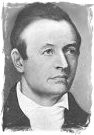 And
when their greatness is coupled with intense spirituality they are
doubly worthy of our study. Thus it was with Adoniram Judson, "the
man who filled a hemisphere and half a century with deeds of sublime
devotion."
And
when their greatness is coupled with intense spirituality they are
doubly worthy of our study. Thus it was with Adoniram Judson, "the
man who filled a hemisphere and half a century with deeds of sublime
devotion."
He was born in Malden, Massachusetts, August 9, 1788. His mother was a genuine Christian, gentle and loving; and his father, a Congregational minister, strong in character.
Adoniram's mother taught him to read at the age of three; and on his father's return after an absence, the precious lad surprised him by reading a chapter from the Bible. It was not uncommon in those days for children to begin their education at that early age, but though Judson suffered no bad effects from it, he did not approve of such a course, nor did he practice it with his own children.
When but four years old, a favorite pastime was "playing church" with his little friends. He always did the preaching, and it seems rather significant that the hymn he usually chose was, "Go preach my Gospel, saith the Lord."
Being fond of investigating things for himself, he was found at noon one day, lying on his back, looking at the sun through a hole in his hat. His eyes were red and swollen, but he was satisfied, for he confided to his little sister that he had "found out about the sun's moving."
In school he was very studious and because of this trait, together with a peculiar hat he wore, the boys called him, "Old Virgil dug up."
He entered Brown University when but sixteen, and applied himself diligently to his studies, determined that whatever profession he might choose, he would be "something great." He was delighted when chosen valedictorian of his class, and sent the news to his father in this brief letter:
"Dear Father:
I have got it.
Your affectionate son,
A. Judson."
In college, influenced by a feIlow-student, he became somewhat skeptical, which greatly grieved his parents.
After opening a private academy and teaching for a year, he desired to "see the world" and started on a trip for that purpose. During that trip his skepticism came to a sudden end. He stayed at a hotel one night, and in the room next [to] his lay a young man, dying. In spite of his professed skepticism, young Judson could not help wondering if the man were prepared to die. The poor fellow soon passed into eternity, and in the morning Judson found, upon inquiry, that the dead man was his old associate, the skeptic. He knew his friend was lost and the thought filled him with consternation. From that hour he was convinced that the religion of his parents was true. He resolved to enter the ministry and was admitted to the theological seminary at Andover, though still unconverted.
It was on December 2, 1808, that he gave his heart to God, and from that time his life was changed. The desire for greatness vanished and his one ambition was to glorify God.
A little book entitled: "Star in the East" gave him his first missionary impulse. He was naturally impetuous and enthusiastic, but something deeper impelled him to give his life for the salvation of the heathen. As he walked alone in the woods one day the command, "Go ye," came to him very forcibly. He recognized it as God's call to him, and he never wavered in his determination to obey the call.
In time an American missionary society was organized. Other young men had offered themselves for foreign work. In the interest of missions, Judson was sent to England. The ship was captured by the French, and he was called upon to suffer many hardships. He thought of the associate pastorate of the "'biggest church in Boston"' which he had been offered, and had refused. But having "put his hand to the plough," he would not look back.
After his return to America, the mission board decided to send out their pioneers as soon as the way should open, and several young men were appointed.
One day Mr. Judson was one of the company of ministers who took dinner at the Hasseltine home, in Bradford, Massachusetts. Ann, the gifted young daughter of the family, waited on the guests. She had been a lively, witty, pleasure-loving girl, always the gayest among the young people of the little town. But at the age of sixteen she had given her heart to the Lord, and when Mr. Judson met her she was a thoughtful, earnest Christian. They became friends, and at length he asked her to share with him the hardships of pioneer missionary work. Prayerfully she considered the serious question, and gave her consent. They were married February 5, 1812, and on the nineteenth day of the month they sailed for Calcutta.
When the long voyage was over, discouragements awaited them, and only ten days after their arrival in India, they were ordered back to America. But they would not give up their project so easily, and instead of returning to their own country, they went to the Isle of France, and thence to Madras. Here again they encountered the opposition of the East India Company, and nothing remained for them but to go back to their native land or escape to Rangoon, Burma. They chose the latter, although the prospects for missionary work there were anything but bright.
At that time the area of Burma was 280,000 square miles, with a population of perhaps six or eight million. The form of government was absolute despotism, and the religion, Buddhism — a religion "without God, prayer, pardon, or Heaven." Mrs. Judson wrote of it: "The Burman system is like an alabaster image — perfect and beautiful in its parts, but destitute of life." In all Burma there was not a single native Christian.
The Burmese language was very difficult to acquire, but the missionaries commenced a diligent study of it, and in a short time were able to talk with the natives. Mr. Judson prepared a Burmese grammar and several tracts, and commenced a translation of the New Testament.
Although there was very little in outward circumstances to encourage them, these young missionaries did not falter, and Judson wrote back to America: "If they ask what promise of ultimate success is here, tell them, 'As much as there is an almighty and faithful God who will perform His promises, and no more."'
Weeks, months — yes, even years were spent in patient seed-sowing, before the time of reaping came.
During this time death visited the Mission Home and the baby, little Roger, who for eight brief months had gladdened their lives and comforted their hearts, was taken away. But missionaries cannot pause long to mourn; and though the anguish was keen, they toiled on.
One day a man visited Mr. Judson, asking for "more of this sort of writing," having seen some tracts. His interest seemed genuine, and being urgent, he was given two half-sheets of the New Testament, then in preparation, covering the first five chapters of Matthew.
The missionary's heart was encouraged by this circumstance. But an inquirer does not always become a convert, and although mention was made of him later, it is not recorded that he ever turned to God.
In 1819 a "zayat," or place of public worship, was erected. This was a humble structure, 27x18 feet in size, and built of bamboo, thatch, and whitewashed boards. Through the long day the missionary sat there, reading aloud a Burmese tract, and ready to talk to any one who might pause to listen.
God has said, through the pen of His apostle, "Be ye stedfast, unmoveable, always abounding in the work of the Lord, forasmuch as ye know that your labour is not in vain in the Lord." And to the faithful toilers in Rangoon this promise was fulfilled, though the time of waiting may have seemed long. Six years after their arrival in Burma, a man between thirty and forty years of age, having given satisfactory evidence of his faith in Jesus, was baptized. Of his conversion Mrs. Judson wrote: "This event, this single trophy of victorious grace, has filled our hearts with sensations hardly to be conceived by Christians in Christian countries." And Mr. Judson wrote in his journal about the same time: "We have had the pleasure of sitting down for the first time, at the Lord's table, with a converted Burman; and it was my privilege — a privilege to which I have been looking forward with desire for many years — to administer the Lord's Supper in two languages."
Others were converted; the Word spread slowly but surely, and it was feared the government would oppose. Hoping to be granted permission to continue the work, Judson visited the emperor at Ava then the capital of Burma, but his efforts were unsuccessful.
Eight or nine years in a tropical climate tells on a missionary's strength and Mrs. Judson's health failed to such a degree that it seemed best for her to return to America for a while. After two years she arrived once more in Burma, well and eager for work.
During her absence Mr. Judson had made another visit to Ava, and had been received with favor by the emperor, who had invited him to establish a mission in that city. New missionaries from America were left to care for the little church at Rangoon, and in January, 1824, the Judsons went to Ava, never dreaming of the suffering that awaited them. Hardly had they become established in their new house, when war broke out between England and Burma. The missionaries were in no way connected with England, but the ignorant Burmese thought that because they received money by the way of Bengal, they must be paid by the English; and Mr. Judson was arrested and thrown into prison.
The sufferings of those days of imprisonment can scarcely be imagined. The prison was a building — if building it could be called — forty feet long, thirty wide, and five or six feet high at the sides, with no ventilation, covered with a thin roof, and filthy beyond description. In that wretched place nearly one hundred prisoners were confined.
Very heroically did Mr. Judson endure the terrible sufferings of those awful days. And no less heroic was the gentle wife, whose ministrations made those dreary days a little less drear. Although she used every means an ingenious mind could suggest, she was unsuccessful in securing her husband's release, but at times his condition was made a little more bearable.
One day a new visitor accompanied the brave wife to the prison — a little daughter twenty days old. Can you imagine the father's feelings as he looked for the first time at this "wailing, blue-eyed blossom"?
After eleven months in the wretched prison at Ava, the white prisoners were suddenly seized, stripped of their outer garments, and driven barefooted over the burning sands for several miles to a place called Oungpen-la. The prisoners fully expected to be executed there, but were again put into prison. At times their condition was a little more tolerable than at Ava, but at best it was wretched.
Mrs. Judson followed her husband to Oungpen-la, where her place of abode was a filthy room. While there, she was taken sick with a most serious disease which threatened to end her life; yet in it all she felt "an assured conviction that every additional trial was ordered by infinite love and mercy."
After six months Mr. Judson was released and ordered to a Burmese camp to act as interpreter. There he suffered hardships almost equal to imprisonment, until he was finally released and allowed to return to Ava, only to find his wife sick with spotted fever, and their little Maria, a puny, sickly baby whom he scarcely recognized.
When Mrs. Judson's health improved sufficiently they left Ava, and of the joy of their departure Judson said long afterward: "What do you think of floating down the Irrawaddy on a cool, moonlight evening, your wife by your side, and your baby in your arms, free, all free? But you cannot understand it either, for it needs twenty-one months' qualification; and I cannot regret my twenty-one months of misery when I recall that one delicious thrill. I think I have had a better appreciation of what Heaven may be ever since."
It was thought best to remove to a new settlement called Amherst, where missionary work was resumed. But soon Mr. Judson was compelled, though reluctantly, to go to Ava upon an errand which proved fruitless; and, during his absence Mrs. Judson was stricken with fever.
The first letters that told of her sickness were full of hope for her speedy recovery. But she grew worse, and one day the gentle spirit went to Jesus. Letters conveyed the sad tidings to Mr. Judson, and when he returned there was a newly-made grave under the hope-tree near the Mission House. Six months later there was another grave, for little Maria had followed her mother to Heaven.
In a letter to "Mother Hasseltine" Mr. Judson told of "the bitter, heart-rending anguish, which for some days would admit of no mitigation; and of the comfort which the Gospel subsequently afforded — the gospel of Jesus Christ, which brings life and immortality to light." With reference to Mrs. Judson's suffering during his imprisonment, he wrote: "With what meekness, and patience, and magnanimity, and Christian fortitude, she bore those sufferings! And can I wish that they had been less? Can I sacrilegiously wish to rob her crown of a single gem?" The submission of his grief stricken heart is well expressed in his own words: "Faith decides that it is all right; and the decision of faith, eternity will soon confirm."
The years that followed were sad ones for the lonely missionary. Mr. and Mrs. Judson had been very closely attached to one another and he had loved his children very tenderly. With all these ties severed, can we wonder that he wrote: "I am left alone in the wide world; my own dear family I have buried; one is in Rangoon; and two, in Amherst. What remains for me but to hold myself in readiness to follow the dear departed to that blessed world?"
He made over to the Missionary Board all his personal property and the money he had received for government service, reserving nothing for himself. Convinced of the vanity of all things earthly, he destroyed all records of his work that he thought might bring him fame.
For a time he was almost consumed with grief, and yet he toiled steadily on — preaching, teaching, and translating.
During these years work was carried on in Maulmain, Prome, and Rangoon. A great festival at Rangoon gave a beautiful opportunity for sowing the Gospel seed. Mr. Judson himself gave away 10,000 tracts, giving only to those who asked for them. Some came from great distances to make such requests as these: "Sir, we have seen a writing that tells us of an eternal God. Are you the man who gives away such writings? If so, pray give us one, for we want to know the truth before we die. Are you Jesus Christ's man? Give us a writing that tells us about Jesus Christ."
After having been away from America for eighteen years, he received a cordial invitation to return. The homeland looked attractive, but while the harvest was so plenteous and the laborers so very few, he would not leave the field, and the invitation was declined.
Judson's greatest delight was in the direct work of spreading the Gospel. Translating was a task not so much enjoyed, but he realized its importance; and much of his time was thus employed. Seventeen years were spent upon the translation of the Bible and when it was finished, he knelt down with the last leaf in his hand and dedicated it to God. Seven years were spent in revising it. He was most accurate in every detail and his translation has been pronounced "the most perfect book of its kind in India."
At the time of his imprisonment a portion of his precious manuscript was buried for safety. A little later, fearing it would mold, Mrs. Judson unearthed it, sewed it into a pillow and gave it to her husband to use. When he was taken to Oungpen-la the jailer, noticing something hard in the pillow, tore it open and threw the manuscript away. But God, who has ever preserved His Holy Word, would not suffer it to be destroyed, and it was found by the faithful convert and friend, Moung Ing, who carried it to the Mission House, where it remained unhurt.
In the remotest mountains and deserts of Burma lived a wild tribe called Karens, considered barbarians by even the uncivilized Burmese. But God had touched their hearts and had sent them a missionary, George Boardman, who labored among them and the Tavoyans with untiring affection until the flesh failed. His early death was a great loss to the little band of missionaries in Burma. There was so much to be done, and so few to do it, it seemed that no one could be spared. But God knew best.
Judson made one tour among these wild people and though many hardships were encountered, it was a delightful trip. It was only because his help was so much needed elsewhere that he abandoned the thought of making another tour to the deserts and mountains where the Karens lived in small secluded villages in these mountainous districts.
After Mr. Judson had spent eight years in solitude he was united in marriage to Mrs. Boardman, and found her to be truly, like the first Mrs. Judson, "an help meet for him." Together they worked and prayed for Burma. The children that came were a comfort and blessing to the parents in that dark land, and were loved tenderly. But sickness and death visited the flock and one little form was laid away, to await the resurrection morn. Mrs. Judson's failing health at last made her return to America imperative. As she was unable to go alone, her husband accompanied her. They took their oldest children with them, and left three behind. While detained at the Isle of France, Mrs. Judson health seemed greatly improved and they agreed that she should go on to America with the children and let Mr. Judson return to Burma. It cost much self-sacrifice to make the decision, and Mrs. Judson's feelings in view of the contemplated separation were expressed in the touching poem:
"We part on this green islet, Love—
Thou for the eastern main,
I for the setting sun, Love,
O, when to meet again!
"My tears fall fast for thee, Love,
How can I say farewell?
But go, thy God be with thee, Love,
Thy heart's deep grief to quell.
"Then gird thine armor on, Love,
Nor faint thou by the way,
Till Buddha fall, and Burma's sons
Shall own Messiah's sway."
However, her health again declined and they continued the voyage together. Gradually but surely her strength failed. She longed to "depart, and to be with Christ," although at times a desire to reach her native land and especially to see once more her parents and her son George, whom she had sent home to America, made her wish to linger.
During these days much of her time was spent in praying for the early conversion of her children. While the ship lay anchored at St. Helena, the life ended. Twenty years had been spent in ceaseless labor for souls, and with her dying breath she testified that she still loved the Savior.
A grave was made on the rocky island, beside that of another missionary whose death had occurred under similar circumstances. "The wings of the Maulmain songstress are folded on St. Helena," Mr. Judson wrote later.
With his three motherless children he proceeded to America where he was warmly welcomed and greatly honored. He had indeed become "great," as he had planned in his boyhood days, but the desire for greatness had long since vanished and while his heart was touched by the loving welcome, he could scarcely bear the praise and popularity accorded him.
So thoroughly had he mastered the Burmese that he could speak publicly in that language better than in his native tongue, and since there were "thousands of preachers in English, and only five or six Burmese preachers in the whole world," he begged to be allowed to save what remained of his voice and strength to use after his return to Burma.
While in America he made the acquaintance of Miss Emily Chubbuck, a godly, talented woman who in early life had felt that she ought to be a foreign missionary. They were married, and she proved to be in every way a worthy successor to the two noble women who had gone before her.
Mr. Judson enjoyed the two and a half years spent in America, but he longed to be back in the field where he had so long labored; and six months after his marriage, he and Mrs. Judson embarked for Burma, leaving the children in America to be prepared for lives of usefulness.
They took up their abode in a house which furnished "plenty of room for self-denial," but they were happy in the service of their Master. Two of the little ones who had been left in Burma awaited their coming, but one had joined the other dear ones in Heaven. "'We are a very happy family; not a happier, I am sure, on the broad earth," Mr. Judson wrote.
In November, 1849, he was suddenly taken sick one night, and his health never returned. From that time he fast ripened for Heaven. His whole demeanor bespoke the reality of his salvation and the love of Christ was his favorite theme. His soul longed for Heaven, yet he felt he would gladly spend a few more years working for his Master. He said to Mrs. Judson one day, "A few days would not be missed from my eternity of bliss, and I can well afford to spare them, both for your sake and for the sake of my poor Burmans. I am not tired of my work, neither am I tired of the world; yet, when Christ calls me home, I shall go with the gladness of a boy bounding away from his school."
A sea voyage presented the only possible hope of recovery and though he disliked the thought of separation from his family, it was thought best to try it. Early in April, 1850, accompanied by a missionary and a native servant, he started for the Isle of Bourbon. But his voyage was soon over. His sufferings were intense and the mortal frame grew very weak. On the afternoon of April 12, 1850, he spoke to his servant, saying in Burmese, "It is done, I am going." Another hour passed, while his fellow-missionary held his hand and the servant wept bitterly, and the gentle breathing ceased — the faithful missionary's spirit had flown."
"His work was done; and like a warrior olden,
The hard fight o'er, he laid his armor down,
And passed, all silent through the portal golden,
Where gleams the victor's crown."
He had wished he might be buried at sea and that evening without a prayer they lowered him into his ocean grave. "No man knows his sepulchre," but God's eye will watch over it until that day when the sea shall give up her dead. His last resting place is unmarked, but in the work he had accomplished he left a monument more enduring than marble — one which shall last forever. In the land where, at the beginning of his labors, not a single native Christian was to be found, there were thousands at the time of his death, witnessing to Christ's power to save; while many had joined the Church triumphant in Heaven.
More than seven decades have gone by since Adoniram Judson laid down his armor, but the influence of his life is not over; "by it he being dead yet speaketh."
From Hearts Aflame by Florence Huntington Jensen. Waukesha, Wisc.: Metropolitan Church Assn., ©1932.
>> More Adoniram Judson