Born in Yorkshire, England, May 21, 1832.
Died at Chang-Sha, China, June 3, 1905.
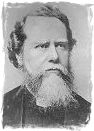 The
opening chapter of J. Hudson Taylor's Retrospect of his work
in China, is entitled "The Power of Prayer;" and that chapter,
with the other contents of the book, reveals such reverent attention to
the voice of God that it seemed to partake of the atmosphere which the
angels breathe as they execute the Father's commands.
The
opening chapter of J. Hudson Taylor's Retrospect of his work
in China, is entitled "The Power of Prayer;" and that chapter,
with the other contents of the book, reveals such reverent attention to
the voice of God that it seemed to partake of the atmosphere which the
angels breathe as they execute the Father's commands.
Such a work as he accomplished was not preceded by any happen so, haphazard preparation. He did not feel that his call, distinct and definite though it was, was the only thing needful; but, having this, he held on to it through such a process of thrashing and winnowing of the seed he was to scatter that he became a most successful sower in the land of Sinim. The steps to accomplish this are well worth tracing, and none other could do so as well as he.
In acknowledging "an unspeakable debt of gratitude" to his beloved parents, Mr. Taylor tells that before his birth his father was deeply moved in behalf of China's suffering millions, and "was led to pray that if God should give him a son, he might be called and privileged to labor in the vast and needy empire which was then apparently so sealed against the truth."
In following the fulfillment of that inspired petition, one is impressed that unless there is earnest attention to heed God's voice, the divine plan for the individual will be marred. God's purpose cherished in the heart, will, as the buds of the rose, develop into flowers of fragrance; yet unless the human will shall submit to divine control, the heavenly plan for that life is as easily broken as are the petals of the flower.
Young Taylor never knew of his father's desire and prayer until he had himself fought his way to China and laid seven years of service upon her barren altar. But that petition was written in heaven, and its spirit was cherished in holy influences in the home. One mountain in the way of its fulfillment, amounting even to infidelity in the boy, was removed by the prayers of his mother and sister, after the father had lost all hope of his going to China.
At fifteen he was a stranger to Christ. "Often I had tried to make myself a Christian," he says, "and failing, of course, in such efforts, I began at last to think that for some reason or other I could not be saved." Discouragement caused him to drift to infidelity; but one day, when his mother was visiting about seventy or eighty miles from home, she went to her room, determined to pray for her only son until he was born into the heavenly family. For hours she laid hold of the mighty arm of power which surrounds every imperiled soul. And there she remained till she received evidence that her son was converted. In the meantime, his attention was drawn to a little tract in the home library, and the words "The finished work of Christ" especially impressed him.
"What was finished?" he questioned; and thus he answered: "A full and perfect atonement and satisfaction for sin; the debt was paid by the Substitute; Christ died for our sins, 'and not for ours only, but also for the sins of the whole world.' Then came the thought, 'If the whole work was finished and the whole debt paid, what is there left for me to do?' And with this dawned the joyful conviction, as light flashed into my soul by the Holy Spirit, that there was nothing in the world to be done but to fall down on one's knees, and, accepting this Saviour and His salvation, to praise Him forevermore."
Just one month before, his sister had begun daily prayers for him, to be continued till his conversion.
"Brought up in such a circle and saved under such circumstances, it was perhaps natural that from the commencement of my Christian life, I was led to feel that the promises were very real, and that prayer was, in sober matter of fact, transacting business with God, whether on one's own behalf or on behalf of those for whom one sought His blessing."
A few months after his conversion he took time for a special season of seeking God. "In the gladness of my heart," he says, "I poured out my soul before God; and again and again confessing my grateful love to Him who had done everything for me — who had saved me when I had given up all hope and even desire for salvation — I besought Him to give me some work to do for Him, as an outlet for love and gratitude; some self-denying service, no matter what it might be, however trying or however trivial — something with which He would be pleased!" "Well do I remember, as in unreserved consecration I put myself, my life, my friends, my all, upon the altar, the deep solemnity that came over my soul with the assurance that my offering was accepted."
No more his own, henceforth a worker for God, His ambassador, His representative, he must be about his Father's business. Thus was he Heaven-anointed; and his place of service was also Heaven-appointed. His call to China came as certainly from the same great Source as his call to service. He says: "Within a few months of this time of consecration, the impression was wrought into my soul that it was in China that the Lord wanted me. It seemed to me highly probable that the work to which I was thus called might cost my life; for China was not then open as it is now. But few missionary societies had at that time workers in China, and but few books on the subject of China missions were accessible to me."
He borrowed Medhurst's "China" of a minister, who asked his purpose. "I told him that God had called me to spend my life in missionary service in that land. 'And how do you propose to go there?' he inquired. I answered that I did not at all know; that it seemed to me probable that I should need to do as the Twelve and the Seventy had done in Judea — go without purse or scrip, relying on Him who called me to supply all my need. Kindly placing his hand upon my shoulder, the minister replied: 'Ah, my boy, as you grow older you will get wiser than that. Such an idea would do very well in the days when Christ Himself was on earth, but not now.'
"I have grown older since then," he wrote after many years of labor in China, "but not wiser. I am more than ever convinced that if we were to take the directions of our Master and the assurances He gave to His first disciples more fully as our guide, we should find them just as suited to our times as to those in which they were originally given."
Now began the pruning and planting process which became so productive on Chinese soil. Of such feeble constitution that his parents had abandoned all hope of a missionary career, the called and consecrated youth laid hold anew upon life, and "God gave increased health."
I began to take more exercise in the open air to strengthen my physique. My feather bed I had taken away, and I sought to dispense with as many other home comforts as I could, in order to prepare myself for rougher lines of life. I also began to do what Christian work was in my power, in the way of tract distribution, Sunday-school teaching, and visiting the poor and sick, as opportunity afforded."
Medhurst's book had recommended medical work; and the missionary-to-be took up this study. But he did not forget his Guide-Book. "Before leaving home," he says, "my attention was drawn to the subject of setting apart the first-fruits of all one's increase and a proportionate part of one's possessions to the Lord's service. I thought it well to study the question with my Bible in hand before I went away from home and was placed in circumstances which might bias my conclusions by the pressure of surrounding wants and cares. I was thus led to the determination to set apart not less than one tenth of whatever moneys I might earn or become possessed of for the Lord's service." Not only did he do this, but found great blessing in giving much more than this to the Lord's cause.
He was next led to investigate another subject of deep importance. He says: "A friend drew my attention to the question of the personal and premillennial coming of our Lord Jesus Christ, and gave me a list of passages bearing upon it, without note or comment, advising me to ponder the subject. For a while I gave much time to studying the scriptures about it, with the result that I was led to see that this same Jesus who left our earth in His resurrection body was so to come again. ... I saw, further, that all through the New Testament the coming of the Lord was the great hope of His people, and was always appealed to as the strongest motive for consecration and service, and as the greatest comfort in trial and affliction. I learned, too, that the period of His return for His people was not revealed, and that it was their privilege, from day to day and from hour to hour, to live as men who wait for their Lord. ...
"The effect of this blessed hope was a thoroughly practical one. It led me to look carefully through my little library to see if there were any books there that were not needed or likely to be of further service, and to examine my small wardrobe, to be quite sure that it contained nothing that I should be sorry to give an account of should the Master come at once. The result was that the library was considerably diminished, to the benefit of some poor neighbors, and to a far greater benefit of my own soul, and that I found I had articles of clothing also which might be put to better advantage in other directions.
"It has been very helpful to me from time to time through life, as occasion has served, to act again in a similar way; and I have never gone through my house, from basement to attic, with this object in view, without receiving a great accession of spiritual joy and blessing. I believe we are all in danger of accumulating — it may be from thoughtlessness, or from pressure of occupation things which would be useful to others, while not needed by ourselves, and the retention of which entails loss of blessing. If the whole resources of the church of God were well utilized, how much more might be accomplished! How many poor might be fed and naked clothed, and to how many of those as yet unreached the gospel might be carried! Let me advise this line of things as a constant habit of mind, and a profitable course to be practically adopted whenever circumstances permit."
Mr. Taylor plunged heartily into gospel work in Hull, where he went for medical training. Late one night he was asked by a man to come and pray with his wife, who he said was dying. "Up a miserable flight of stairs, into a wretched room, he led me; and O, what a sight there presented itself to our eyes! Four or five poor children stood about, their sunken cheeks and temples all telling unmistakably the story of slow starvation; and lying on a wretched pallet was a poor, exhausted mother, with a tiny infant thirty-six hours old, moaning rather than crying, at her side. ... 'Ah!' thought I, 'if I had two shillings and a sixpence instead of half a crown, how gladly should they have one-and-sixpence of it!' But still a wretched unbelief prevented me from obeying the impulse to relieve their distress at the cost of all I possessed.
"It will scarcely seem strange that I was unable to say much to comfort these people. I needed comfort myself. I began to tell them, however, that they must not be cast down, that though their circumstances were very distressing, there was a kind and loving Father in heaven; but something within me said, 'You hypocrite! telling these unconverted people about a kind and loving Father in heaven, and not prepared yourself to trust Him without half a crown!'
"I was nearly choked. ... To talk was impossible under these circumstances; yet, strange to say, I thought I should have no difficulty in praying. ... 'You asked me to come and pray with your wife,' I said to the man; 'let us pray.' And I knelt down. But scarcely had I opened my lips with 'Our Father who art in heaven,' than conscience said within: 'Dare you mock God? Dare you kneel down and call Him Father with that half crown in your pocket?' Such a time of conflict came upon me then as I have never experienced before or since. How I got through that form of prayer I know not, ... but I rose from my knees in great distress of mind."
"The poor father turned to me and said: 'You see what a terrible state we are in, sir; if you can help us, for God's sake do!' Just then the words flashed into my mind, 'Give to him that asketh of thee,' and in the word of a King there is power. I put my hand into my pocket, and slowly drawing forth the half crown, gave it to the man. ... The joy all came back in full flood tide to my heart; I could say anything and feel it then, and the hindrance to blessing was gone — gone, I trust, forever!
"Not only was the poor woman's life saved, but I realized that my life was saved, too! It might have been a wreck — would have been a wreck probably, as a Christian life — had not grace at that time conquered, and the strivings of God's Spirit been obeyed. I well remember how that night, as I went home to my lodgings, my heart was as light as my pocket. The lonely, deserted streets resounded with a hymn of praise which I could not restrain. When I took my basin of gruel before retiring, I would not have exchanged it for a prince's feast. I reminded the Lord, as I knelt at my bedside, of His own word, that he who giveth to the poor lendeth to the Lord; I asked Him not to let my loan be a long one, or I should have no dinner next day; and with peace within and peace without, I spent a happy, restful night."
The morning mail brought him a gift four times as great as he had given the poor family, and he says: "I then and there determined that a bank which could not break should have my savings or earnings as the case might be — a determination I have not yet learned to regret. ... If we are faithful to God in little things, we shall gain experience and strength that will be helpful to us in the more serious trials of life."
Another test in money matters upon which not only hinged answers to prayer, but which touched his life plan of going to China, served greatly to strengthen Mr. Taylor's growing faith. He believed that men might be influenced through prayer. The doctor by whom he was employed while studying was a forgetful paymaster, and pay-day passed without Mr. Taylor's receiving his much-needed wages. He prayed earnestly about it; but still his employer forgot. Finally, on a day when his landlady should be paid, the doctor turned suddenly to him with, "By the [way], Taylor, is not your salary due again?"
"My emotion may be imagined! I told him as quietly as I could that it was overdue some little time. How thankful I felt at that moment! God had surely heard my prayer, and caused him, in this time of my great need, to remember the salary without any word or suggestion from me. He replied: 'O, I am so sorry you did not remind me! You know how busy I am. I wish I had thought of it a little sooner, for only this afternoon I sent all the money I had to the bank; otherwise I would pay you at once.' It is impossible to describe the revulsion of feeling caused by this unexpected statement. I knew not what to do. ...
"As soon as he was gone I had to seek my little sanctum and pour out my heart before the Lord for some time, before calmness — and more than calmness — thankfulness and joy, were restored to me. I felt that God had His own way, and was not going to fail me. I had sought to know His will early in the day, and as far as I could judge, had received guidance to wait patiently."
And so he waited, spending the evening at the doctor's office, reading the Bible and preparing texts for his services at the lodging-houses in the lowest parts of the town, where he expected to speak next day. Just as he was putting on his overcoat to go, about ten o'clock, he heard the doctor coming. One of his wealthiest patients had just come and paid his bill. "It seemed that somehow or other he could not rest with this on his mind, and had been constrained to come at that unusual hour to discharge his liability." This time the doctor remembered, and turned over part of the bills to the prayerful boy.
"Again I was left," he says, "to go back to my own little closet and praise the Lord with a joyful heart that after all I might go to China!" A mighty weight hung on the golden chain of answered prayer. If his faith grasped not the promises to influence a man at home who was acquainted with God, how could it prevail with men in China who knew Him not? To him, "this incident was not a trivial one; and to recall it sometimes, in circumstances of great difficulty, in China or elsewhere, has proved no small comfort and strength."
Later Mr. Taylor went to London for further medical studies. He was led to trust in Him who feeds the sparrows, for his support in that great metropolis; for if he could not trust Him in a land of Christian influences, where was food in plenty, how could he trust Him where at almost any time he might be cut off from all human aid? The question of support was settled through prayer. Every bill was met promptly; and though at times he lived on bread and fruit and water, he grew rich in faith and experience.
He also had another severe test. In the dissecting-room he received deadly blood-poisoning through a needle prick in the finger. Two other medical students had similar accidents at the same time, and died in consequence thereof. The surgeon said to him, "You are a dead man." Indeed he was brought to death's door; but he had formed more than a speaking acquaintance with One who has power over disease and death, and he spread out his case before Him; and he says, "I was spared in answer to prayer, to work for God in China." "If you have been living moderately," another doctor said, "you may pull through; but if you have been going in for beer and that sort of thing, there is no manner of chance for you." His meager diet was a benefit at this time at least.
One more demonstration of the power of prevailing prayer, — an experience for which the others were preparatory: One of his medical duties was to dress the foot of a patient suffering from gangrene. As a sympathetic Christian nurse, he longed to acquaint his patient with his Saviour. But the patient was an avowed atheist, and very antagonistic to religion. A Scripture reader who had visited him had been ordered from the room, and he had spit in the face of the visiting vicar of the district.
"Upon first commencing to attend him," says Taylor, I prayed much about it, but for two or three days said nothing to him of a religious nature. By special care in dressing his diseased limb, I was able considerably to lessen his sufferings, and he soon began to manifest grateful appreciation of my services. One day, with a trembling heart, I took advantage of his warm acknowledgments to tell him what was the spring of my action, and to speak of his own solemn position and need of God's mercy through Christ. It was evidently only by a powerful effort of self-restraint that he kept his lips closed. He turned over in bed with his back to me, and uttered no word.
"I could not get the poor man out of my mind, and very often through each day I pleaded with God, by His Spirit, to save him. ... After dressing the wound and relieving his pain, I never failed to say a few words to him, which I hoped the Lord would bless. He always turned his back to me, looking annoyed, but never spoke a word in reply.
"After continuing this for some time, my heart sank. It seemed to me that I was not only doing no good, but perhaps really hardening him and increasing his guilt. One day, after dressing his limb and washing my hands, instead of returning to the bedside to speak to him, I went to the door, and stood hesitating for a few moments with the thought in my mind, 'Ephraim is joined to idols; let him alone.' I looked at the man and saw his surprise, as it was the first time since speaking to him that I had attempted to leave without going up to his bedside to say a few words for my Master.
"I could bear it no longer. Bursting into tears, I crossed the room and said, 'My friend, whether you will hear or whether you will forbear, I must deliver my soul,' and went on to speak very earnestly with him, telling him with many tears how much I wished that he would let me pray with him. To my unspeakable joy he did not turn away, but replied, 'If it will be a relief to you, do.' I need scarcely say that I fell on my knees and poured out my whole soul to God on his behalf. I believe that God then and there wrought a change in his soul, ... and within a few days he definitely accepted Christ as his Saviour. O, the joy it was to me to see that dear man rejoicing in hope of the glory of God!" He had not entered a church for forty years.
"I have often thought since, in connection with this case and the work of God generally, of the words, 'He that goeth forth and weepeth, bearing precious seed, shall doubtless come again with rejoicing, bringing his sheaves with him.' Perhaps if there were more of that intense distress for souls that leads to tears, we should more frequently see the results we desire. Sometimes it may be that while we are complaining of the hardness of the hearts of those we are seeking to benefit, the hardness of our own hearts and our own feeble apprehension of the solemn reality of eternal things, may be the true cause of our want of success."
In Mr. Taylor's voyage to China, September 19, 1853, to March 1, 1854, shipwreck among cannibals was avoided through prayer. In China he met among other missionaries, Drs. Medhurst, Parker, Edkins, Burdon, and William Burns. The latter he called "such a spiritual father," and tells how "with true spiritual insight he often pointed out God's purposes in trial in a way that made all life assume quite a new aspect and value. His views especially about evangelism as the great work of the church, and the order of lay evangelists as a lost order that Scripture required to be restored, were seed thoughts which were to prove fruitful in the subsequent organization of the China Inland Mission."
Upon the burning of his belongings at Shanghai, he observes: "To me this appeared a great calamity, and I fear I was more disposed with faithless Jacob to say, 'All these things are against me,' than to recognize that 'all things work together for good.' I had not then learned to think of God as the one great Circumstance 'in whom we live and move and have our being;' and of all lesser, external circumstances as necessarily the kindest, wisest, best, because either ordered or permitted by Him. Hence my disappointment and trial were very great." But it was one of the many providences that finally led to the establishment of the great system of missions.
On a journey from Shanghai to Ning-po, "among the passengers on board the boat was one intelligent man, who in the course of his travels had been a good deal abroad. ... On the previous evening I had drawn him into earnest converse about his soul's salvation. The man listened with attention, and was even moved to tears; but still no definite result was apparent. I was pleased, therefore, when he asked to be allowed to accompany me, and to hear me preach." As Mr. Taylor was in the cabin a few moments, he heard a splash and a cry, and running out, found this man was overboard and had sunk in the water. Instantly lowering the sail of the boat, he sprang into the water, and called to a near-by fishing-boat to come with their drag hooks.
"'Come!' I cried, as hope revived in my heart. 'Come and drag over this spot directly. A man is drowning just here!'
"'It is not convenient,' was the unfeeling answer.
"'Don't talk of convenience!' cried I in agony; 'a man is drowning, I tell you!'
"'We are busy fishing,' they responded, 'and can not come.'
"'Never mind your fishing,' I said; 'I will give you more money than many a day's fishing will bring; only come — come at once!'
'How much money will you give us?' ' We can not stay to discuss that now!
Come, or it will be too late. I will give you five dollars' (then worth
about thirty shillings in English money).
"'We won't do it for that,' replied the men. 'Give us twenty dollars, and
we will drag!'
'I do not possess so much. Do come quickly, and I will give you all I have!'
'How much may that be?'
'I don't know exactly; about fourteen dollars.'
At last, but even then slowly enough, the boat was paddled over, and the net let down. Less than a minute sufficed to bring up the body of the missing man. ... But all was in vain — life was extinct.
"To myself this incident was profoundly sad and full of significance, suggesting a far more mournful reality. Were not those fishermen actually guilty of this poor China man's death, in that they had the means of saving him at hand, if they would but have used them? Assuredly they were guilty. And yet, let us pause ere we pronounce judgment against them, lest a greater than Nathan answer, 'Thou art the man.' Is it so hard-hearted, so wicked a thing to neglect to save the body? Of how much sorer punishment, then, is he worthy who leaves the soul to perish, and Cain-like says, 'Am I my brother's keeper?'
"The Lord Jesus commands, commands me, commands you, my brother, and you, my sister. 'Go,' says He, 'go ye into all the world, and preach the gospel to every creature.' Shall we say to Him, 'No, it is not convenient'? Shall we tell Him that we are busy fishing, and can not go? that we have bought a piece of ground, and can not go? ... Let us consider who it is that has said, 'If thou forbear to deliver them that are drawn unto death. ... doth not He that pondereth the heart consider it? and He that keepeth thy soul, doth not He know it? and shall not He render to every man according to his works?'"
The work of J. Hudson Taylor in China can only be fully understood by knowing how he came to sever his connection with his society, the Chinese Evangelization Society. The following gives his reason and reasoning: "The society itself was in debt. ... To me it seemed that the teaching of God's word was unmistakably clear: 'Owe no man anything.' To borrow money implied, to my mind, a contradiction of Scripture — a confession that God had withheld some good thing, and a determination to get for ourselves what He had not given. ... If the Word taught me anything, it taught me to have no connection with debt.
"I could not think that God was poor, that He was short of resources, or unwilling to supply any want of whatever work was really His. It seemed to me that if there were lack of funds to carry on work, then to that degree, in that special development, or at that time, it could not be the work of God. To satisfy my conscience I was therefore compelled to resign connection with the society which had hitherto supplied my salary."
His colleague, Mr. Jones, was led to take the same step. The brave, conscientious men depended upon God alone for supplies, and He honored their faith. Mr. Taylor says, "I could look right up into my Father's face with a satisfied heart, ready, by His grace, to do the next thing as He might teach me, and feeling very sure of His loving care."
As Mr. Taylor was preaching one day, in 1857, there was a pleasing interruption; a middle-aged man stood up and said: "I have long sought for the truth, as my fathers did before me; but I have never found it. I have traveled far and near, but without obtaining it. I have found no rest in Confucianism, Buddhism, or Taoism; but I do find rest in what I have heard here tonight. Henceforth I am a believer in Jesus."
This was their first convert. "A few nights after his conversion he asked how long this gospel had been known in England. He was told that they had known it for some hundreds of years. 'What!' said he, amazed; 'is it possible that for hundreds of years you have had the knowledge of these glad tidings in your possession, and yet have only now come to preach it to us? My father sought after the truth for more than twenty years, and died without finding it! O, why did you not come sooner!'"
Mr. Taylor was married in 1858, to the daughter of the devoted missionary, Samuel Dyer, who had gone to the Straits in 1827.
When Dr. Parker was obliged to return with his motherless children to Scotland, Dr. Taylor took charge of his dispensary and hospital at Ningpo, "relying solely upon the faithfulness of a prayer-hearing God to furnish the means required for its support. ... Had not God said that whatever we ask in the name of the Lord Jesus shall be done? And are we not told to seek first the kingdom of God, — not means to advance it?"
Hundreds of patients were to be provided for, and only money enough left for about a month's expenses! Dr. Parker's native staff, having no such faith, resigned. But some members of the little church volunteered to help Dr. Taylor, "depending," he says, "like myself, upon the Lord; and they with me continued to wait upon God, that in some way or other He would provide for His own work.
"Day by day the stores diminished, and they were all but exhausted when one day a remarkable letter reached me from a friend in England which contained a check for fifty pounds. After a little season of thanksgiving with my dear wife, I called my native helpers into our little chapel, and translated to them the letter. I need not say how rejoiced they were, and that we together praised God. ... When, nine months later, I was obliged, through failure of health, to relinquish this charge, I was able to leave more funds in hand for the support of the hospital than were forthcoming at the time I took it.
By the year 1860 thirty or forty native Christians had been gathered into the church at Ning-po; but Dr. Taylor's health failed, and a return to England was the only hope of restoration. While there the whole great field, daily reviewed upon a large map on his study wall, seemed as near to him as when he was in China. With returning strength he engaged in a revision of the New Testament, and observes, "I have often seen since, that without those months of feeding and feasting on the word of God, I should have been quite unprepared to form, on its present basis, a mission like the China Inland Mission.
"In the study of that divine Word I learned that, to obtain successful laborers, not elaborate appeals for help, but first, earnest prayer to God to thrust forth laborers, and second, the deepening of the spiritual life of the church, so that men should be unable to stay at home, were what was needed. I saw that the apostolic plan was not to raise ways and means, but to go and do the work, trusting in His sure word who has said, 'Seek ye first the kingdom of God, and His righteousness; and all these things shall be added unto you.'"
Mr. Taylor asked God for five workers. These were forthcoming, the fifth reaching the field in 1865. He was encouraged to ask for greater things. "Months of earnest prayer and not a few abortive efforts had resulted in a deep conviction that a special agency was essential for the evangelization of Inland China. ... I had also a growing conviction that God would have me to seek from Him the needed workers, and to go forth with them. But for a long time unbelief hindered my taking the first step. How inconsistent unbelief always is! I had no doubt that, if I prayed for workers, 'in the name' of the Lord Jesus Christ, they would be given me. I had no doubt that, in answer to prayer, the means for our going forth would be provided, and that doors would be opened before us in unreached parts of the empire. But I had not then learned to trust God for keeping power and grace for myself, so no wonder that I could not trust Him to keep others who might be prepared to go with me. I feared that in the midst of the dangers, difficulties, and trials which would necessarily be connected with such a work, some who were comparatively inexperienced Christians might break down, and bitterly reproach me for having encouraged them to undertake an enterprise for which they were unequal. ...
"Yet, what was I to do? The feeling of blood-guiltiness became more and more intense. Simply because I refused to ask for them, the laborers did not come forward — did not go out to China — and every day tens of thousands were passing away to Christless graves! Perishing China so filled my heart and mind that there was no rest by day and little sleep by night, till health broke down. At the invitation of my beloved and honored friend, Mr. George Pearse, I went to spend a few days with him at Brighton.
"On Sunday, June 25, 1865, unable to bear the sight of a congregation of a thousand or more Christian people rejoicing in their own security, while millions were perishing for lack of knowledge, I wandered out on the sands alone, in great spiritual agony; and there the Lord conquered my unbelief, and I surrendered myself to God for this service. I told Him that all the responsibilities as to issues and consequences must rest with Him; that as His servant, it was mine to obey and to follow Him — His to direct, to care for, and to guide me and those who might labor with me. Need I say that peace at once flowed into my burdened heart?" J. Hudson Taylor called, Heaven answered; and men and women were in waiting for the hour. Soon there were a goodly number in training for China.
"I had determined never to use personal solicitation, or to issue collecting books. Missionary boxes were thought unobjectionable, and we had a few prepared for those who might ask for them, and have continued to use them ever since."
On being invited to speak on China at a village near London, Dr. Taylor consented on condition that no collection be taken. At the close the chairman was so impressed with China's needs that he wished to take a collection notwithstanding the doctor's objections. But he says: "My wish was, not that those present should be relieved by making such a contribution as might there and then be convenient, under the influence of a present emotion; but that each one should go home burdened with the deep need of China, and ask God what He would have them do. If, after thought and prayer, they were satisfied that a pecuniary contribution was what He wanted of them, it could be given to any missionary society having agents in China, or it might be posted to our London office; but perhaps in many cases, what God wanted was not a money contribution, but personal consecration to His service abroad, or the giving up of son or daughter — more precious than silver or gold — to His service. I added that I thought the tendency of a collection was to leave the impression that the all-important thing was money, whereas no amount of money could convert a single soul; that what was needed was that men and women, filled with the Holy Ghost, should give themselves to the work. For the support of such there would never be a lack of funds."
In February, 1866, the doctor's mission band began a daily prayer-meeting to ask God for funds for this, His enterprise. In five weeks, nearly nine thousand dollars had been received; and in May a party of twenty-two, including children, sailed for China.
Figures have but feeble tongues to tell the story of benefit and blessing that followed that consecrated band. "The missionary career of J. Hudson Taylor," says Arthur H. Smith, himself a missionary thirty-five years in China, "having its quiet and unnoticed beginnings in 1853, culminated in the amazing breadth and sweep of the China Inland Mission, until at life's close he laid down its leadership in 1905."'
Statistics published in the same book for 1905, give 849 missionaries, including missionaries' wives and associates, with 1,282 native workers; 205 stations, and 632 sub-stations, and 35,726 communicants; 188 schools, with nearly 3,000 pupils, and 44 hospitals and dispensaries. What an agency for bearing the living Word to a dying people! No other society has in China so many workers; and these go out trusting for support in the God who called J. Hudson Taylor to the work.
May many more laborers listen to the divine appeal that stirred this great leader's soul, until "this gospel of the kingdom shall be preached in all the world for a witness unto all nations;" and then the Saviour for whom J. Hudson Taylor looked and longed will come and take His people home.
The Missionary Incentive
May it please the reader to take an interim after the sketch of this godly man — converted from boyhood infidelity into a lover of the Saviour's coming — to listen to the voice of one — the late Dr. Arthur T. Pierson upon this subject, whose words are so reasonable, whose knowledge of missions was so remarkable, whose love for his Master so wonderful, that he was well prepared to speak upon so exalted a theme as is thus introduced in his precious book on missions, "The New Acts of the Apostles":
"One powerful incentive, of which not only the Acts of the Apostles but the whole New Testament is full, is, we fear, far less prominent in the thoughts of the modern church. We refer to the blessed hope of our Lord's return.
"Revive this hope of our Lord's coming, and it begets hourly watching, ceaseless praying, tireless toiling, patient waiting. Moreover, this blessed hope is forever linked with the glorious compensation for all service and sacrifice for Christ. 'Behold, I come quickly; and My reward is with Me, to give every man according as his work shall be.'
"His coming, then, not our death, opens the door to the wedding feast, and the 'joy of the Lord.' Then the prize awaits the successful runner. Then the crowns are given.
"We shall never have apostolic missions till this apostolic hope claims again its rightful place. Daily dying — so that in the body one bears the marks of the Lord Jesus — will be easy only to him who feels redemption drawing nigh, and who follows the Son of man in His humiliation, as one who is to sit with Him on the throne of His glory.
His expected appearing is His saints' avenging and rewarding. ... Then, however dark and dismal the failure of mission work, faithfulness and not success will be the standard and measure of reward. ...
"This blessed hope both loosens the hold we have on this world and the hold this world has on us. If we are to build heaven here, we may be justified in laying deep and firm foundations; but if all these things are to be dissolved, if all work not done for God is to be burned up as wood, hay, stubble, and the work done for God is to be tried by fire — then what folly to spend our faculty and vital force upon what is to be turned to ashes! Let us walk with God and work with God, and so prepare a structure of character and of service which shall survive the fiery ordeal.
"Perhaps at no one point does the hope of our Lord's return touch our need so closely and vitally as in this — that it incites to unselfish service. ... The miser dies when the missionary is born; the carnal is cast out if the spiritual is to come in; only he who loses himself can save others.
"But just here the hope of the Lord's coming supplies exactly what is needed. ... In those seven epistles to the churches which open the Apocalypse, our Lord uses His imminent coming as a perpetual hope, motive, incentive; and this is enough to make it a sin, if not a crime, to lose sight of it. ...
"This blessed hope is the crown of all other hopes, and suggests to us an expectation that will be realized.
...Does the Scripture justify us in looking for the conversion of the world during the present dispensation, or is this the period of the out gathering of the church from all nations? For what are we to labor, and what is our rational Scriptural hope? James bade the first council at Jerusalem hearken unto him as he reminded them of God's purpose as declared by Simeon, visiting the gentiles 'to take out of them a people for His name.' That is not only uniformly declared to be the exact purpose of the gospel witness during these times of the gentiles, but it has been the actual result of these nearly two thousand years of such witness. At this advanced age, history is interpreting prophecy and expounding Scripture, if we will but hear it. ...
"Our highest 'Christian civilization' is an amalgamation of the church and the world. ... The great body of disciples are only nominally such, either wholly worldly or worldly holy; at the door of frivolous gaiety they drop their Christian consistency, as an Oriental guest shuffles off his sandals, and mix freely with the idolaters of folly and fashion. The church is to-day in danger of the moral putrefaction that loses all godly savor, and the moral petrifaction that loses all godly sensibility. Apostolic piety scarcely survives in the church at large. Disciples rarely keep themselves unspotted from the world; and it is only here and there that we find a few who seem to be filled with the Spirit. ... Some who have drawn their very life from Christianity now turn to curse the dam that nursed, and wound the breast that fed them.
"The ripeness of modern civilization borders on rottenness; and while men boast of society, its foundations sink; and the anarchy which is the natural end of atheism, threatens all with wreck. Science itself has furnished the lawless with weapons which are equally mighty against ballot or bullet; and Germany and Russia, France and Britain, and the great republic, are to-day at the mercy of the dynamite fiend.
"Notwithstanding such signs of the times, there are some who regard the outlook as so hopeful that they think the recent 'Parliament of Religions' was the inauguration of the millennium. What enviable sleight of mind that can turn everything into signs of progress! ...
"From all such frivolous methods of dealing with the Scripture and with facts, we turn candidly to ask, What does the New Testament encourage us to hope for as the outcome of our missionary work?
"If we read aright, the teaching of our Lord is plain. God's present purpose is that the gospel shall everywhere be preached for a witness unto the nations and for the gathering of the ecclesia; and then shall the end come, and the Lord Himself return and possess the kingdom, and carry its triumphs to completion. ... The devil's great wrath may only be due to the shortness of his time; and the ripeness of the tares may only hint the nearness of the harvest.
"If we are discouraged or despairing, our need and remedy is, perhaps, a laying hold of the hope set before us, in the gospel. As the Scriptures warrant no expectation of the world's conversion in this age of witness, so far as we look for such result, we work on a wrong basis, and will either be disappointed or deceived in the outcome. ...
"Let the disciples once get firmly planted on this rock basis, that we are sent forth, not to accomplish a world's conversion, but only its evangelization, and victory springs up out of defeat. Hope that had lost wings, plumes herself for a new flight, and over the grave of buried expectation, rises with the song of a lark."
From The Advanced Guard of Missions by Clifford G. Howell. Mountain View, Calif: Pacific Press Publishing, ©1912.
>> More Hudson Taylor