 "When
I am a man, I mean to be a missionary and go to China," said a little
boy many, many years ago. And that is exactly what came to pass.
"When
I am a man, I mean to be a missionary and go to China," said a little
boy many, many years ago. And that is exactly what came to pass.
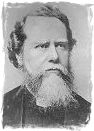
This little boy was James Hudson Taylor, who was born in Barnsley, England, May 1, 1832. His father, James Taylor, was the son and the grandson of preachers, and was a local preacher himself. He loved God and served Him so faithfully that every one knew he was a Christian. And his wife, Amelia Hudson Taylor, was as good and as true to God as he was. No boy could have had better parents than little Hudson had.
As a baby, he was sweet and bright, but not very strong, and it would have been easy to spoil him. But his father and mother knew he must be taught obedience and self-control, and they agreed to teach him these lessons, even though he was a frail child.
When he was just a little fellow of two or three, he went with his father and mother to church. If he was good all through the long service, after the benediction was pronounced, they would hand him back to his grandfather, who sat in the pew behind them. This was something he remembered all through his life.
One of the things he enjoyed as a little boy was playing meeting with his little brother. When his little sister Amelia was big enough to walk, it was Hudson who taught her how to take the first little steps. When his two little brothers died, Hudson learned that sorrow, as well as joy, is a part of this life.
One day there was a fair in town, and the one great attraction for Hudson was a collection of stuffed birds and animals, for he loved the things of nature. To his dismay, he found that they were enclosed within a high board fence. In his hand was a hard-earned penny which he offered to the man at the entrance, only to be told that the admittance fee was "tuppence" [twopence]. "But I haven't got another penny, and don't you see that it would be better to have one penny than none at all?" he reasoned. The argument was logical, but the gate-keeper remained firm, and little Hudson went away to tell his troubles to his mother. She explained that it was the man's duty to charge two pennies for admission, and then she found a very satisfactory way of solving the problem. She said that he had been so good and worked so well in the past days that she would give him another penny for his work, and off he ran with a glad heart.
The Taylor children were taught that it was just as important to keep themselves neat, with hands and faces clean, shoes polished, and nails well kept, when at home as when in company.
Punctuality was another valuable lesson they learned. Each child was expected to be on time at meals and for every other appointment. Mr. Taylor said, "If there are five people, and they are kept waiting one minute, do you not see that five minutes are lost, which can never be found again?" He had not much to give his children in the way of wealth or worldly advantage, but he bequeathed to them something far better — a simple strong faith in God and reverence for His Word.
Not being strong enough to go to school when he was small, Hudson's education was mostly gained at home; and from his sensible and wise parents he learned more valuable lessons than he would have learned at school.
Mr. Taylor was interested in foreign missionary work, and especially in China. The children shared his interest, and a little book: Peter Parley was read and reread. Both Hudson and his sister Amelia declared that they intended to go to that country some day.
Hudson's schooldays began when he was eleven. It was a help to him to be in the company of other boys, yet these were not especially happy days for him. He lost the simple faith of his younger days, and it was a number of years before he yielded himself fully to God.
At the age of fifteen he began working as a clerk in a bank. His old-fashioned ideas were laughed at by an older clerk, and when he returned home after nine months, he was further away from God than ever before.
Mother and father were burdened for the salvation of their boy. His sister Amelia made up her mind that she would go alone three times a day to pray for him, and it was not long before those prayers were answered.
One day when he had nothing in particular to do, his eyes fell on a tract. "There will be a story at the beginning and a sermon or moral at the close," he said to himself; "I will take the former and leave the latter for those who like it." But as he read, conviction seized him and he gave himself to God. Amelia was the first to hear the joyful news, as his mother was away from home. Upon her return he greeted her gladly, eager to tell her about his conversion. "I know, my boy," she said, "I have been rejoicing a fortnight in the glad tidings you have to tell."
"Why, has Amelia broken her promise?" he asked. "She said she would tell no one."
"Ah, my son," was the answer, "no one has told me. But my heart became so burdened for you a fortnight ago that I determined not to arise from prayer until the assurance of your salvation came. So clearly did it come that I have been praising God ever since.
There was peace and joy in Hudson's heart, and in his gratitude he offered himself to God, to work wherever He might call him. "Then go for Me to China," God said. The call seemed as clear as if God had spoken in an audible voice, and the young man did not hesitate.
He told his Sunday-school teacher of his call, and was encouraged and given a copy of the gospel of Luke in a Chinese dialect. He tried to prepare himself in every possible way for the life of a missionary. He gave up his feather bed and other things he had enjoyed, so that he would be used to a rugged life. Plenty of outdoor exercise made him stronger in body and Christian work strengthened his soul. He felt that if he wanted to win souls in China he must begin at home, so he distributed tracts, taught a Sunday-school class, called on the sick and the poor, and did everything he could find to do for God.
Then he began studying the meaning of the Chinese letters in the little book his Sunday-school superintendent had given him. He knew that it would not be an easy task to learn the Chinese language and he wanted to begin as soon as possible. Some one had said that those who learned it needed "bodies of iron, lungs of brass, heads of oak, hands of spring steel, eyes of eagles, hearts of apostles, memories of angels, and lives of Methuselah." Though far from possessing all these qualifications Hudson went at it courageously and made good progress.
The next definite step in his preparation was to become the assistant of Doctor Hardey. He knew that if he could become skilful in caring for sick bodies, it would give him a good chance to help souls. At first he lived in Doctor Hardey's home, which was very comfortable and pleasant, but not the best preparation for a missionary's life. The next move was to his aunt's home, which was less luxurious than the doctor's. Still he felt there was much more chance for self-denial, and it was not long until he found just the kind of place he felt he needed.
About this time Hudson met a German missionary who had come back from China. When this man noticed the light hair and eyes of the younger one he said, "Why, you would never do for China. They call me 'red-haired devil,' and they would run from you in terror! You could never get them to listen at all." This might have discouraged some, but Hudson only replied quietly, "And yet it is God who has called me and He knows all about the color of my hair and eyes."
Hudson Taylor's next abode — and the one where he felt that he could get real training for China — was in a very undesirable portion of the city of Hull. Two rows of poor little cottages faced each other, and between them was a ditch where rubbish was thrown. The neighborhood was called "Drainside." When the tide rose high enough the rubbish was carried away. Unattractive as this was, Hudson Taylor selected one of these cottages as his dwelling-place. A room less than twelve feet square was his, while his landlady, Mrs. Finch, with her children, occupied the upstairs room and the kitchen. Mr. Finch was away at sea most of the time, and his wife was glad of the three shillings a week paid her by Hudson Taylor.
He boarded himself and lived mostly on oatmeal, rice, and brown bread, finding it a pleasure to deny himself in order that he might have money with which to help others. At the close of his day's work he would take his lonely walk to his comfortless room, and on Sundays he visited the sick and helped the poor. It was not the kind of life one would be apt to choose, but God's blessing was upon him, and that is more than all the world has to offer.
There was one lesson that young Mr. Taylor knew he must learn, if he wanted to be a successful missionary in China, and that was the lesson of faith. He knew there would be many times in that far-away country when he would have no one to depend upon but God, and he must know how to get his prayers through and receive an answer. He wanted to know how to "move man, through God, by prayer alone."
Dr. Hardey had told Hudson Taylor to remind him when it was time for his salary to be paid, as he was a very busy man, and probably rather forgetful, but Hudson made up his mind that he would do nothing except to pray about it. He felt that God could remind Dr. Hardey in answer to his prayers, and this would strengthen his faith.
One time the day drew near, and passed by, and the salary was not paid. At the end of the week, he found he had just a half-crown left. Still he said nothing, except to God. Sunday night, after a meeting with the poor people to whom he often preached, a man asked him to come and pray for his wife, who seemed to be dying. He had asked the priest to come, but he was too poor to pay the eighteen pence which the priest asked. His family was starving and the poor man was discouraged.
Taylor knew they needed food and he thought, "Ah, if I only had two shillings and sixpence instead of this half-crown, how gladly would I give these poor people a shilling." He had something at home for supper that night and for breakfast the next morning, but nothing more than that. Could he give up all he had and trust God to supply his need?
Through a dark court they went, then up some rickety stairs, and reached the poor room where the man's wife lay, with a baby thirty-six hours old, moaning at her side. Four or five hungry children stood about the room. When Taylor saw this scene of poverty, he thought he would like to give them a shilling and a half, but had not made up his mind to give up the whole coin. He tried to tell them of a loving heavenly Father who would care for them, but he could not say very much. Then he knelt to pray, but his conscience troubled him. How could he pray when he was not willing to give to these poor people who needed help so desperately? "You see what a terrible state we are in, sir; if you can help us, for God's sake do!" the poor man said. Taylor remembered that Jesus said, "Give to him that asketh thee," and he obeyed the command. He gave up his all, and in doing that he not only helped the poor people in their distress, but he won a victory and was happy.
"Give, and it shall be given unto you," the Bible says, "good measure, pressed down, and shaken together, and running over." Early the next morning the mailman left an envelop containing no letter, nor even the name of the sender, but a pair of new kid gloves and a half-sovereign coin. This was five times as much as he had given away, and he felt that God had paid him good interest.
Two weeks more passed by and still the salary was unpaid. His room rent would be due on Saturday night and his landlady really needed the money. But he had made up his mind not to say anything to the doctor about it, and he adhered to his purpose.
Late Saturday afternoon Dr. Hardey suddenly asked, "By the by, Taylor, is not your salary due?" Quietly the young man replied, "It is overdue some little time."
"Oh, I am sorry you didn't remind me," the doctor said. "You know how busy I am. Wish I had thought a little sooner, for only this afternoon I sent all the money I had to the bank. Otherwise I would pay you at once."
This was a test of the young man's faith, indeed, but as soon as he could, he found a quiet place to pray, and God assured him that everything would work out all right. That evening he prepared for Sunday's meetings among the poor people, and was just ready to go home, when the doctor appeared on the scene, laughing. "Such a funny thing has just happened," he said. "One of my wealthiest patients has just come at this late hour to pay his doctor bill. Look up the ledger, Taylor, and see how much it is. Strange, isn't it, that he should come at this hour of the night, when he could write a check any day?" The bill was paid and the money turned over to Taylor. He was very happy, for several reasons. His needs were supplied, and more than that his landlady could be paid. But the greatest reason of all for his happiness was that prayer was answered. Dr. Hardey had been "moved, through God, by prayer alone." It was a big step in his preparation for a missionary's life.
It was not long after this that he went to London for further preparation. He had very little money, and met with some difficulties, but in due time he found a hospital where he could continue his studies. His lodging-place was a long distance from the hospital, and he could not afford to ride on the omnibus, so he had plenty of exercise going back and forth. He also had chances to exercise his faith.
As an act of kindness to Mrs. Finch, who had rented him his room at "Drainside," Taylor went to the shipping company for which Mr. Finch worked, and obtained his wages, which he sent to Mrs. Finch, saving her the cost of the commission which would have been charged if the money had been forwarded by the company.
Being especially in need of money at one time, she asked him to send the monthly salary as early as possible. Taylor was very busy at the time, and rather than spend a day in going to the city he sent money of his own, expecting to replace it when he should draw his pay. When he went to the company and asked for the money, the clerk said, "In looking this matter up, I find that the officer whose pay you wish to draw has run away from the ship and gone to the gold-diggings. Therefore, we have no money of his to be drawn."
"Well, that is very inconvenient for me, as I have already advanced the money and I know his wife will have no means of repaying it." The clerk could do nothing for him, and it was indeed a test, but he placed his trust in God.
It was not long until there was another faith test. He pricked his finger one day while sewing some sheets of paper together for a note book to use in the lecture room. The next day he helped dissect the body of some one who had died with a very dangerous fever. He had forgotten all about the finger-prick until he felt himself becoming tired and sick. The poison from the dead body had entered his system through that tiny needle-prick and the surgeon said, "Go home and arrange your affairs as quickly as possible, for you are a dead man."
Hudson Taylor told the surgeon that the thought of being with his Lord very soon filled him with joy, "but," he added, "I do not think I shall die, for unless I am much mistaken I have work to do in China; and if so, however severe the struggle, I must be brought through."
"That is all very well," said the surgeon, who did not believe in God, "but get a carriage and drive home as soon as possible. You have no time to lose, for you will soon be incapable of winding up your affairs."
When he reached his room he bathed his hand in hot water, and while doing this, talked to the servant about salvation. He was "instant in season, out of season," always watching for an opportunity to say something for Jesus. The doctor who was called to see him told him there was a chance of his pulling through if he had been living simply. "But," he said, "if you have been going in for beer and that kind of thing, there is no manner of chance for you." For some time his meals consisted of brown bread and water, which was about as simple as the diet of the Hebrew children in Babylon, and the plain food worked well in both cases.
When the worst of the disease was over and he was slowly recovering, he was told of the death of two fellow-students who had worked with him in the dissecting room that day. God had work for Hudson Taylor to do and had spared his life. He was advised to take a trip to the country, but had not the necessary money. As usual, he took the matter to the Lord in prayer and God answered in an unexpected way.
One day while he was still very weak he thought of going to the office of the shipping company to inquire about Mr. Finch's wages. It seemed unlikely that it would do any good, and the two-mile walk looked like an impossibility. But as he prayed about it God made it very plain that He wanted him to go, and he started out, trusting Him for strength. As soon as he entered the office the clerk said, "Oh, I am so glad you have come, for it turns out that it was an able seaman by the same name that ran away. The mate is still on board." He gladly paid the money, which Taylor received with joy. Though severely tested, his faith had been rewarded.
The next day he saw the doctor who had attended him during his sickness, and told him all about his answers to prayer. When he mentioned the long walk he had taken to get the money, the doctor said, "Impossible! Why I left you lying there more like a ghost than a man." When he was convinced that the walk had actually been taken and that the money received was just enough to take him to the country, after making all necessary payments, his eyes filled with tears and he said, "I would give all the world for a faith like yours."
Over three years had gone by since Hudson Taylor heard the voice of God say, "Go for Me to China," and he was becoming anxious to go. His medical course was not finished, but he felt inclined to give it up, and go as soon as the way should open. Very earnestly he prayed for guidance, and the more he prayed, the more he felt that it would be God's plan for him to go at once.
China seemed to be opening her doors for missionary work and the Missionary Society decided to send their young candidate without delay to that distant land.
An ocean voyage in those days was a very different matter from one today, and Hudson Taylor spent five months and a half on the sailing vessel Dumfries, which took him from Liverpool to Shanghai. September 19, 1853, he left his native land. His mother and one or two friends boarded the boat with him and in his cabin they prayed and sang and read a Psalm, before the boat started. "Dear Mother," he said, "do not weep. It is but for a little while and we shall meet again. Think of the glorious object I have in leaving you! It is not for wealth or fame, but to try to bring the poor Chinese to the knowledge of Jesus." When the others had gone ashore, he wrote on a piece of paper, "The love of God which passeth knowledge. J.H.T." This little parting word was tossed across to his mother as she stood on the pier. As the ship sailed away, he climbed a mast that he might have a longer view of the friends on the shore. There he waved his hat, while they waved their handkerchiefs until the boat was out of sight. Hudson Taylor was actually on his way to China!
The next twelve days were stormy ones. The captain said, "Unless God helps us, there is no hope." And God did help them. The young missionary remembered the promise "Call upon me in the day of trouble: I will deliver thee, and thou shalt glorify me," and calmly looked to God.
At last the storm was over. Around the Cape of Good Hope, past Australia, and into the Pacific ocean, then through the China Sea they sailed, reaching their destination March 1, 1854. During that time Taylor had not been idle, but had held meetings for the ship's crew, assisted by another Christian young man who was on the ship.
Can you imagine how a missionary feels as he nears the shores of the country where he has chosen to spend his life? Hudson Taylor felt when he had his first glimpse of China's shores, that the prayers of years were answered, and when he saw a group of natives, and heard them chatter in their strange tongue, he longed to be able to tell them the glad tidings of salvation. "My feelings on stepping ashore," he wrote, "I cannot describe. My heart felt as though it had not room and must burst its bonds, while tears of gratitude and thankfulness fell from my eyes."
Mr. Taylor had been given three letters of introduction, and started out to look up the people to whom they were addressed. The first one, he found, had died a month before, and the second one had left for America. Then he found his way to the London Mission Compound, and the missionaries there, though strangers, made him welcome and gave him a place to stay. Eager to prepare for real work, he began studying the language the next morning.
After much searching he found at last a house which he could rent. It was dilapidated and very dirty but he was glad to have a place for himself, as he disliked to be dependent upon others. People found out that he was a doctor, and many sick came to him. As he ministered to the needs of their bodies, he told them of the cure for sin-sick souls. A school for boys and girls was started and Mr. Taylor was happy. There were difficulties too, but Taylor had fitted himself for hard things by the rugged life he had lived before leaving England.
Busy months and years followed, filled with joys and disappointments. He took a number of journeys in a houseboat, preaching the Gospel in villages and cities where the name of Jesus had never been heard. Hardships were many and sometimes his life was in danger, but he did not turn back.
For some time he considered the question of adopting Chinese dress, and finally decided to do so, believing he could accomplish more for the Lord in that way. He had his head shaved, leaving a little hair which would grow into a Chinese cue [hair tied at the back of the head in a braid], and with baggy trousers, white calico socks, satin shoes, and to complete the costume, a loose silk gown with wide sleeves, he attracted less attention, and won the hearts of the natives as he could not do when in English dress.
It would take too long to tell of all Hudson Taylor's strange experiences in that strange land. Once he started to go from Shanghai to Ningpo. The first part of the trip was made by boat, then he proceeded on foot, with coolies to carry his luggage. Stopping at an inn, the only supper he could obtain was one of cold rice and snakes fried in lamp oil. It was not very appetizing, but he tried to eat, fearing he would be recognized as a foreigner if he refused. His room was shared with ten or eleven other men, and a board laid across two stools, with his umbrella and shoes for a pillow, formed his bed.
In the morning he began looking for the bed and box which had been carried by coolies, and was greatly disappointed upon finding no trace of them. Search as he would, they were not to be found. The next night he tried in vain to find a place to lodge, and at last lay down on the steps of the temple, with his money under his head.
It was not long until he heard footsteps approaching, and soon stealthy hands were feeling about him. "What do you want?" he asked quietly, and the man disappeared, returning later with a companion.
"What do you want?" Taylor asked.
"We are passing the night outside the temple as you are," they answered.
He then suggested that as there was plenty of room on the other side, they'd better leave that side for him, but his advice didn't seem to be appreciated, so he decided he would sit up, to watch them more closely.
"You had better lie down and sleep, or you will not be able to work tomorrow," they said. "Don't be afraid, we shall not leave you, and shall see that no one does you harm."
Taylor knew better than to believe them and said, "Listen to me. I do not want your protection. I am not a Chinese and I do not worship your vain idols. I worship God. He is my Father and I trust in Him. I know well what you are, and what you wish to do, and shall keep my eye on you and shall not sleep." One of the men disappeared, only to return with another man. They watched for some time, hoping he would go to sleep, but he began to repeat verses of Scripture and sing hymns. They did not appreciate this, and finally went away.
Since Taylor's luggage was not to be found, he was obliged to return to Shanghai instead of going on to Ningpo. Later on it fell to his lot to nurse a man who was sick with smallpox, and when it was all over, he was obliged to burn the clothing he had used in the sick room. He had given his money away freely and was unable to buy a new supply. Then, just at the right time, the box lost on the way to Ningpo, turned up unexpectedly, and his needs were supplied.
This was only one of the almost numberless incidents which fulfilled the promise—"The LORD will provide" [Jehovah-jireh, Genesis 22:14]. This verse and "Hitherto hath the LORD helped us," were Taylor's favorite mottoes.
In the course of his work, Mr. Taylor became acquainted with Miss Maria Dyer, an English girl whose father had been a missionary in China. Her uncle in England, who acted as her guardian, gave his consent to her marriage, and in January, 1858, there was a wedding in one of the missions. In a humble little place in Ningpo they began their work together and were very happy as they told the beautiful old story of Jesus and His love.
It was well for Hudson Taylor that he learned before leaving England, "to move man, through God, by prayer alone," for he had many and many an opportunity to put the lesson into practice. At one time he was in charge of a hospital, and the workers were trusting God to supply the needs. One day the cook told him that their rice was almost gone -- the last bag had been opened. And this was his answer — "Then the Lord's time for helping us must be close at hand." And sure enough, before the rice was gone, $250 came from England. Great was the joy of the workers, and patients in the hospital, listening to the songs and shouts of praise, said, "Where is the idol that can do anything like that? Have they ever delivered us in our troubles, or answered prayer after this sort?"
After six years in China the missionary was worn out, and a trip to England was planned, with Mrs. Taylor. It was a very profitable trip, for their health was built up, and the China Inland Mission was founded. Then back to China he went, for many more years of work for his Master. England was again visited, then America, and there was a period of rest in Switzerland. But his heart was in the land to which God called him in his young manhood, and there he laid his armor down. June 3, 1905 was the day of his death. Chinese Christians bought the most beautiful coffin they could find. However, his work did not die with him, and many souls in Heaven, won to God through the work of the China Inland Mission, will thank God because its founder, James Hudson Taylor, went to China.
From Hearts Aflame by Florence Huntington Jensen. Waukesha, Wisc.: Metropolitan Church Assn., ©1932.
>> More Hudson Taylor