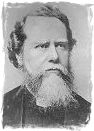
 James
Hudson Taylor: Founder of the China Inland Mission; born at Barnsley
(18 miles south. of Leeds), Yorkshire, England, May 21, 1832; died at Changsha
(340 miles north of Canton), China, June 3, 1905. His father was an eloquent
and able Methodist local preacher and his mother a woman of more than ordinary
sweet and patient spirit. Hudson Taylor combined the ability of his father
with the gentle disposition of his mother. He was converted through the reading
of a tract at the age of fifteen, and not long afterward passed through a
remarkable experience, at which time he dedicated himself to God for whatever
service might be appointed. Unknown to himself, his father, who had been
deeply interested in China, had prayed that his son might go to that land
as a missionary, and very early, through the reading of Walter Henry Medhurst's China (London,
1838), the thoughts of young Taylor were directed to that country.
James
Hudson Taylor: Founder of the China Inland Mission; born at Barnsley
(18 miles south. of Leeds), Yorkshire, England, May 21, 1832; died at Changsha
(340 miles north of Canton), China, June 3, 1905. His father was an eloquent
and able Methodist local preacher and his mother a woman of more than ordinary
sweet and patient spirit. Hudson Taylor combined the ability of his father
with the gentle disposition of his mother. He was converted through the reading
of a tract at the age of fifteen, and not long afterward passed through a
remarkable experience, at which time he dedicated himself to God for whatever
service might be appointed. Unknown to himself, his father, who had been
deeply interested in China, had prayed that his son might go to that land
as a missionary, and very early, through the reading of Walter Henry Medhurst's China (London,
1838), the thoughts of young Taylor were directed to that country.
With a view to preparing himself for his lifework, he engaged as assistant to a physician at Hull, and subsequently studied medicine at the London Hospital. The great interest awakened in China through the Taiping Rebellion, which was then erroneously supposed to be a mass movement toward Christianity, together with the glowing but exaggerated reports made by Carl Friedrich August Gutzlaff concerning China's accessibility, led to the founding of the China Evangelization Society, to the service of which Hudson Taylor offered himself and on September 19, 1853, he sailed for China before the completion of his medical studies. The six years from 1854 to 1860 were spent in Shanghai, Swatow, and Ningpo, working sometimes in company with older missionaries of other societies and especially with William Chalmers Bums of the English Presbyterian Mission. During this period he retired from the China Evangelization Society, which subsequently ceased to exist, and continued as an independent worker, trusting God to supply his need. His experiences of God's faithfulness in meeting his own personal needs and the needs of a hospital at Ningpo, of which he had taken charge, had much to do with the subsequent step of founding the China Inland Mission. While at Ningpo he married Miss Maria Dyer, daughter of the Rev. Samuel Dyer of the London Missionary Society. Of the children born by this marriage, three survive their father's decease, and two are today missionaries in China.
Invalided home in 1860, he spent the next five years in England, and, in company with the Rev. Frederick Foster Gough of the Church Missionary Society, completed the revision of a version of the New Testament in the colloquial of Ningpo for the British and Foreign Bible Society, and also finished his medical course. To arouse interest in the great Middle Kingdom he published a book entitled China, its Spiritual Need and Claims (London, 1865, 8th ed., 1890), which has been much used in calling forth sympathy for China and volunteers for the field, who began to go out in 1862, the first being James J. Meadows. In 1865, at Brighton, Taylor definitely dedicated himself to God for the founding of a new society to undertake the evangelization of inland China. In May, 1866, he, with his wife and children and a party of sixteen missionaries, sailed for China. Thus was definitely launched that organization which, on January 1, 1911, had 968 missionaries (including wives) connected with it, and in the support of which more than £1,471,000 had been contributed in answer to prayer and without public or private solicitation of funds. From the founding of the mission in 1865 Taylor's time became more and more occupied as general director of a growing work. His duties necessitated extensive journeys in China and frequent visits to the home country. In 1888 a wider ministry was commenced through the formation of a home center in North America. This arose through Taylor's presence at the Northfield Convention. Two years later another center was founded in Australasia. Various visits to the continent of Europe led to the inception of associate missions, which recognized Taylor as their general director on the field. In January, 1911, these associate missions had 216 workers on the field.
The constant pressure and increasing strain inseparable from such a work frequently threatened a serious breakdown; but Taylor, though far from strong as a child, manifested remarkable recuperative powers. In 1900, however, at the New York Conference, the first serious signs of failing health began to manifest themselves. Having already associated Dixon Edward Hoste with himself in the directorate of the mission, he slowly resigned his great responsibilities, still seeking to assist the work as consulting director while living quietly in retirement in Switzerland. His second wife (née Faulding), to whom he had been married in 1871, and by whom he had two children, died in the summer of 1904. Early in 1905 Taylor determined, though extremely feeble, to pay another visit to China. After visiting various centers he reached Changsha, the capital of the previously anti-foreign province of Hunan, where he suddenly and peacefully passed from his labors. His remains were interred at Chinkiang, by the side of his first wife and those of his children who had died in China.
As a Bible student Taylor was unique. Holding firmly to the plenary inspiration of the Scriptures and putting them to daily test in his life and work, he became a most helpful and remarkable expositor, his Bible readings being greatly appreciated at the various conventions held in Europe and North America. As a leader of men and careful organizer he had preeminent gifts. Being convinced of his duty, every detail was carefully thought out and arranged for, and then no subsequent difficulty or opposition was allowed to daunt him. Gifted with the power to command sleep whenever needed, he labored night and day, resting only when exhausted nature compelled him, No day, however, was entered upon without a period of quiet prayer and Bible study. James Hudson Taylor was, to quote the pregnant words of Prof. Gustav Warneck, "A man full of the Holy Ghost and of faith, of entire surrender to God and his call, of great self-denial, heart-felt compassion, rare power in prayer, marvelous organizing faculty, energetic initiative, indefatigable perseverance, and of astonishing influence with men, and withal of child-like humility." Taylor was the author of: Union and Communion (London, 1893); A Retrospect (1894); Separation and Service (1898); and A Ribband of Blue, and other Bible Studies (1899). Marshall Broomhall.
Bibliography: M. G. Guinness, Story of the China Inland Mission. 2 vols., London, 1893; M. Broomhall, Pioneer Work in Hunan, ib. 1906; idem, The Chinese Empire, a General and Missionary Survey, ib. 1908; idem, Faith and Facts as Illustrated in the Hist. of the China Inland Mission, ib. 1909.
From The New Schaff-Herzog Encyclopedia of Religious Knowledge... New York: Funk and Wagnalls Company, 1911.
>> More Hudson Taylor