 In the year 1854 a sailing vessel was becalmed in the vicinity of New Guinea. Seeing
the distressed look on the captain's face as he peered intently into the sea, a young
Englishman inquired as to the cause of his anxiety. This was the reply: "A four-knot
current is carrying us swiftly toward some sunken reefs over there. Our fate seems to
be sealed." On the shores of the island, cannibals were rushing about and lighting
fires in great glee. Presently the captain spoke again: "We have done everything that
can be done." "No," responded the young man, "there is one thing we haven't done. Four
of us on board are Christians. Let each of us retire to his cabin and in agreed prayer
ask the Lord to give us a breeze immediately." This was agreed upon and done. After a
few minutes of earnest intercession, the young man came up on deck confident that the
petition had been granted. Finding the first officer, a godless man, in charge, he
requested him to let down the corners of the mainsail. "What would be the good of
that?" he asked. The young man told him that he and three others had been asking God
to send a wind, that it was coming immediately and that there was not a minute to lose,
since they were so near the reefs. With a look of contempt, the officer replied with
an oath: "Nonsense! You can't pray up a wind." Noticing a few moments later that the
topmost sail was beginning to tremble, he said: "That is only a cat's-paw — a mere puff
of wind." "Never mind what you think," cried the young man. "Let down the mainsail
quickly."
In the year 1854 a sailing vessel was becalmed in the vicinity of New Guinea. Seeing
the distressed look on the captain's face as he peered intently into the sea, a young
Englishman inquired as to the cause of his anxiety. This was the reply: "A four-knot
current is carrying us swiftly toward some sunken reefs over there. Our fate seems to
be sealed." On the shores of the island, cannibals were rushing about and lighting
fires in great glee. Presently the captain spoke again: "We have done everything that
can be done." "No," responded the young man, "there is one thing we haven't done. Four
of us on board are Christians. Let each of us retire to his cabin and in agreed prayer
ask the Lord to give us a breeze immediately." This was agreed upon and done. After a
few minutes of earnest intercession, the young man came up on deck confident that the
petition had been granted. Finding the first officer, a godless man, in charge, he
requested him to let down the corners of the mainsail. "What would be the good of
that?" he asked. The young man told him that he and three others had been asking God
to send a wind, that it was coming immediately and that there was not a minute to lose,
since they were so near the reefs. With a look of contempt, the officer replied with
an oath: "Nonsense! You can't pray up a wind." Noticing a few moments later that the
topmost sail was beginning to tremble, he said: "That is only a cat's-paw — a mere puff
of wind." "Never mind what you think," cried the young man. "Let down the mainsail
quickly."
This he was not slow to do. Hearing the heavy tread of the men on deck, the captain came up from his cabin and saw that the breeze had indeed come. In a few minutes they were sailing away from the dangerous reefs, much to the disappointment of the native cannibals on the beach.
Writing of this and similar experiences, the young man said: "Thus God encouraged me, ere landing on China's shores, to bring every variety of need to Him in prayer, and to expect that He would honor the name of the Lord Jesus and give the help which each emergency required."
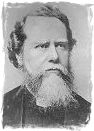
So we have been introduced to a remarkable man, J. Hudson Taylor, and to the text, John 14:13, which was woven into the fabric of his life and into the texture of his stupendous achievements: "And whatsoever ye shall ask in my name, that will I do, that the Father may be glorified in the Son."
The Fountain That Cleanses From Sin
James Hudson Taylor was born at Barnsley, England, May 21, 1832. He was fortunate to have been born in a home of genuine piety. Heaven lay about him in his infancy. He saw it in his father's faith and in his mother's prayers. Even prior to his birth his parents had dedicated him to God and prayed that he might be a missionary to China, though this information was withheld from him until long after he had reached that land.
Despite the godly example and teaching of his parents, Hudson became a skeptical and worldly young man. He began to think that for some reason or other he could not be saved and that the only thing for him to do was to take his fill of this world, since there was no hope for him in the next.
Hudson Taylor's conversion, like all else in his life, is a monument to the power of prayer. When he was about seventeen years of age he went one afternoon into his father's library in search of a book with which to while away the time. Finally he picked up a gospel tract which looked interesting, saying to himself: "There will be a story at the beginning and a sermon at the end. I will read the former and skip the latter."
Little did he know what was going on at that very time in the heart of his mother, who was on a visit seventy or eighty miles away. That very afternoon she went to her room with an intense yearning for the conversion of her son, turned the key in the door and resolved not to leave the spot until her prayers were answered. Hour after hour she continued pleading, until at length she arose with glad assurance that the object of her prayers had already been accomplished.
Meanwhile, in the course of reading the tract, Hudson had come upon the expression, "The finished work of Christ." Remembering the words, "It is finished," he raised the question, "What was finished?" He at once replied: "A full and perfect atonement and satisfaction for sin. The debt was paid by the Substitute. Christ died for our sins and not for ours only but also for the sins of the whole world." Next came the thought, "If the whole work was finished and the whole debt paid, what is there left for me to do?" Then came the blessed realization that there was nothing in the world to be done but to fall down on one's knees in prayer and in faith accept the salvation wrought out by Christ. "Thus," says Hudson, "while my dear mother was praising God on her knees in her chamber, I was praising Him in the old warehouse to which I had gone alone to read at my leisure this little book."
Several days later he told his sister of his new-found joy in Christ and secured her promise not to speak of it to anyone. When the mother returned a fortnight later, he met her at the door and told her he had a piece of good news for her. Writing many years later, Hudson Taylor said: "I can almost feel that dear mother's arms around my neck, as she pressed me to her bosom and said, 'I know, my boy. I have been rejoicing for a fortnight in the glad tidings you have to tell me.' 'Has Amelia broken her promise?' I asked in surprise. 'She said she would tell no one.' My dear mother assured me that it was not from any human source that she had learned the tidings and went on to tell the incident mentioned above."
While the mother far away was praying in faith that he might that very day enter into the experience of salvation, he actually tasted its felicity, having realized that there was nothing for him to do but to lay hold of the finished work of Calvary, in faith believing, in prayer receiving. Mother and son alike were casting their anchor in the promise of John 14:13, "Whatsoever ye shall ask in my name, that will I do, that the Father may be glorified in the Son." The text was precious to him, first of all, because it led his polluted soul to Calvary's cleansing fountain, and because it brought him to—
The Altar of Consecration
After some months young Taylor began to feel a great dissatisfaction with his spiritual state. His "first love" and his zeal for souls had grown cold and he did not have victory over sin. He did not doubt his conversion, but he was convinced from his knowledge of the Scriptures and of the lives of certain outstanding Christians that a deeper experience of divine blessing could be his portion. He could not be satisfied with anything less than the best, God's best. How could he obtain it? He thought of the text that blazed across his pathway at every hour of need and of high decision: "Whatsoever you shall ask in my name, I will do it." He believed that salvation is like "honey from the rock" — the honey for sweetness, the rock for strength. By prayer he had entered into the sweetness of salvation. By prayer he now sought the strength of salvation. Moved by deep longings he retired one afternoon to be alone with God.
"Well do I remember," he says, how I poured out my soul before God. Again and again confessing my grateful love to Him who had done everything for me ... I besought Him to give me some work to do for Him as an outlet for love and gratitude ... Well do I remember as I put myself, my life, my all upon the altar, the deep solemnity that came over my soul with the assurance that my offer was accepted ... A deep consciousness that I was not my own took possession of me." Having made the great surrender, he was ready to hear the voice of his Lord saying, "Who will go for Me to China?" and to reply, "Here am I, send me." At once he began to prepare for the strenuous life of a pioneer. He took more exercise in the open air and exchanged his feather bed for a hard mattress. Regularly each week he distributed tracts and held cottage meetings. With the aid of a copy of Luke's Gospel in the Mandarin dialect he began to study the Chinese language.
One day he called on the Congregational minister and asked to borrow his copy of Medhurst's China, explaining that God had called him to missionary service in that land. "And how do you propose to go there?" the minister inquired. Taylor replied that he did not know but in all probability he would go forth as did the Twelve and the Seventy, relying solely on the One who sent him to supply all his needs. Placing his hand on the lad's shoulder the minister replied: "Ah, my boy, as you grow older you will become wiser than that. Such an idea would do very well in the days when Christ himself was on earth, but not now."
Since his all was upon the altar, Taylor could say: "God and God alone is my hope and I need no other."
The Text Taught Him to Move Man, Through God, by Prayer Alone
Young Taylor began the study of medicine as well as Greek, Hebrew, and Latin. He realized, however, that the most important preparation of all must take place in the realm of his own soul. In China he would have to depend utterly upon his Lord for protection, supplies -- everything. Lest a dismal failure befall him later on, he determined to test thoroughly the Saviour's promise: "Whatsoever ye shall ask in my name, that I will do." He resolved to learn, as he said, "before leaving England, to move man, through God, by prayer alone."
He made the test in a specific situation relative to his salary. His employer had asked Hudson to remind him whenever his salary became due. This he determined not to do as per the usual custom but rather to leave it wholly in the hands of the Lord. While he was continuing in earnest prayer about the matter, the time came for the payment of a quarter's salary. On settling up his accounts one Saturday night he found himself possessed of only one remaining coin — a half crown piece. About ten o'clock on Sunday night as he was doing gospel work in the various lodging houses, a poor man asked him to go and pray with his wife who was dying. He was led down a court and up a miserable flight of stairs into a wretched room. What a pathetic sight there presented itself. Four or five children stood about, their sunken cheeks and temples telling unmistakably the story of slow starvation, and lying on a wretched pallet was a forlorn-looking mother with a tiny infant moaning at her side. "Ah," thought Taylor, "if I had two shillings and a sixpence, instead of half-a-crown, how gladly should they have one-and-sixpence of it." He was willing to give them part of what he had, but not the entire coin. He sought to comfort them by saying that however distressing their circumstances, there was a kind and loving Father looking down from Heaven. But something within him cried, "You hypocrite! Telling these unconverted people about a kind and loving Father in Heaven, and not prepared yourself to trust Him without half-a-crown."
He was now feeling very miserable. If his coin were only changed, he would gladly give a florin and keep only the sixpence remaining. But he was not yet prepared to trust in God alone, without the sixpence. Not being able to continue the conversation, he said to the man: "You asked me to come and pray with your wife. Let us pray." He knelt down, but no sooner had he said, "Our Father," than he heard a voice within saying, "Dare you mock God? Dare you kneel down and call Him Father with that half crown in your pocket?" Finishing the prayer, he arose.
"I put my hand into my pocket," he says, "and slowly drawing out the half crown gave it to the man, telling him that it might seem a small matter for me to relieve them, seeing that I was comparatively well off, but that in parting with that coin I was giving him my all; but that what I had been trying to tell them was indeed true — God really is a Father and may be trusted. And how the joy came back in full flood-tide in my heart! Not only was the poor woman's life saved, but my life had been saved too." He was convinced that money thus given in Christ's name was a loan which He would repay.
He went home happy in heart, and before retiring asked the Lord not to let his loan be a long one or he would have nothing to eat the next day. Early the next morning the postman's knock was heard at the door. He very rarely ever received a letter on Monday morning, hence he was surprised when the landlady came in with a letter. On opening the envelope he found a sheet of blank paper and a half sovereign. "Praise the Lord!" he exclaimed. "Four hundred percent for a twelve hours' investment!" He then and there learned that the bank of Heaven is always dependable and pays good dividends.
His faith in the power of prayer was greatly strengthened, but in the course of two weeks his money was spent and still his employer had not remembered to pay him his salary. He devoted much time to wrestling with God in prayer. On Saturday night his landlady would be expecting a payment. About five o'clock that afternoon Dr. Hardey came up to him and said, "By the way, Taylor, is not your salary due again?" Informed that it was due and past due, the doctor expressed regret that he had not thought of it earlier, "For," he said, "only this afternoon I sent all the money I had to the bank. Otherwise I would pay you at once."
Deeply disappointed, though careful not to let his employer know it, Taylor went to a quiet place and poured out his heart to the Lord. About ten o'clock that evening Dr. Hardey appeared, laughing heartily. "A strange thing happened just now," he stated. "One of my wealthiest patients felt constrained to come to my house at ten o'clock at night to pay his bill, instead of sending a check as per his custom. Very strange!" Having credited the payment in the ledger, the doctor was about to leave, when suddenly he handed young Taylor several of the banknotes and said: "By the way, you might as well take these notes as payment on your salary." "Again I was left," concludes Taylor's account of this incident, "my feelings undiscovered, to go back to my little closet and praise the Lord with a joyful heart that after all I might go to China."
Those last words — "after all I might go to China" — revealed the consuming obsession of his being. After further medical studies in London, he accepted appointment under the Chinese Evangelization Society and sailed on September 19, 1853. After a tempestuous voyage, and after the ship on two occasions was within a few feet of being wrecked, Shanghai was safely reached March 1, 1854.
In China at last! He was not there for his health or on a pleasure jaunt, but as Christ's ambassador. He plunged into the study of the language, on which he had made some progress in England and on shipboard. Now that he was at close grips with idolatry and superstition, he was almost overwhelmed by the enormity of the undertaking to which he had committed himself. For many months he talked and preached with no evidence of results. What must he do to obtain success in his endeavors? Once again John 14:13 came to his assistance.
The Secret of Concern and Success in Soul Winning
Taylor longed for the compassion of heart that issues in fervent and successful soul winning, and the words of Jesus, "Ask whatsoever ye will in my name," made it clear that prayer is the appointed means of obtaining a spiritual end. The Divine sequence is illustrated in Psalm 126, verses 4-6: (1) Petition for blessing, (2) Sowing in tears, (3) Reaping in joy. In other words, praying issues in concern or "weeping," and "weeping" in "reaping."
While traveling by boat one day, Taylor entered into conversation with a Chinaman who had once visited England, where he went by the name of Peter. The man listened attentively to the missionary's account of Christ's saving love and was even moved to tears, but refused the immediate acceptance of the proffered salvation. A little later, evidently in a mood of great despondency, Peter jumped overboard and sank. In agonized suspense Taylor looked around for assistance and saw close by a fishing boat with a dragnet furnished with hooks.
"Come!" shouted Taylor to the fishermen. "Drag over this spot. A man sank here and is drowning!"
"It is not convenient," was the unfeeling reply.
"Don't talk of convenience!" cried the missionary. "A man is drowning."
"We are busy fishing and cannot come," they responded.
When Taylor urged them to come at once and offered to pay them, they demanded to know how much. His offer of five dollars was refused. He then said: "Do come quickly and I will give you all the money I have — about fourteen dollars." Finally, the boat was brought and the hooks let down. Less than a minute was required to bring up the body but all efforts at resuscitation failed. Life was extinct.
To Hudson Taylor this incident was profoundly sad in itself and pathetic in its parabolic significance. Were not those fishermen guilty of the death of the Chinaman, in that they had the opportunity and means of saving him but refused to use them? Most assuredly they were guilty. "And yet," says Taylor, "let us pause ere we pronounce judgment against them, lest a greater than Nathan answer, 'Thou art the man.' Is it so wicked a thing to neglect to save the body? Of how much sorer punishment, then, is he worthy who leaves the immortal soul to perish. The Lord Jesus commands me, commands you: 'Go into all the world and preach the gospel to every creature.' Shall we say to Him, 'No, it is not convenient?' Shall we tell Him that we are busy at fishing or other business and cannot go? It is of no use for us to sing as we often do: 'Waft, waft ye winds the story.' The winds will never waft the story but they may waft us. Oh, let us pray and let us labor for the salvation of China's unevangelized millions. Hudson Taylor believed that only by fervent prayer could the cold hearts of Christians be fanned into a flame of concern on behalf of a lost world for which Christ died.
After some years of unwearied labors, the servant of God found himself beset by a period of manifold disappointments and severe sorrows. A number of the workers were incapacitated by ill health, while others had died; some of the native converts had lapsed into sin and idolatry; and funds were very low. Instead of looking at circumstances, however, he thought of God as the One Great Circumstance and cried out to Him for blessing in the harvesting of souls. He wrote to a fellow worker: "Pray on! Labor on! Do not be afraid of the toil or the cross. They will pay well."
And so they did, in God's way and time. From the steps of the principal temple in Cheng-hsien, he preached long and earnestly to a crowd that gathered; and when from sheer weariness he could make himself heard no longer, he went farther up the hill to pour out his heart in intercession for China's multitudes, living, dying, without God and without hope. A few nights later he found himself surrounded by a company of devout believers, who for long years shone as lights in a dark world. One of the converts was Mr. Nying, a proud Confucianist scholar, who became a Christian witness of great zeal and power. Another was Lao Kuen, transformed from being the terror of the town into a gentle, flaming evangel of Christ. Another was the keeper of a gambling-den and house of ill-fame. Upon his conversion he banished the gambling-tables, emptied his house of bad characters, and turned his largest room into a chapel. Moreover, he had it cleaned and whitewashed before offering it, free of cost, as a place of worship. In faith believing, in prayer receiving, Taylor had been looking to Christ for souls. He rejoiced in these miracles of grace and in the confidence that they were the first-fruits of a great harvest in that section of China. He had been asking and the answer in part had come, "that the Father might be glorified in the Son."
The Sustaining and Protecting Presence that Never Fails
Of all the Divine blessings, Hudson Taylor longed most for the unfailing presence of His Lord. Nothing else really mattered, for in His presence was adequate protection, abounding strength, and fullness of joy. And he was convinced that this blessing, as all others, was included in the Saviour's "whatsoever" and obtained on the same condition-- "ask." John 14:13 made it clear that by prayer he was to enter into the Presence. Did that Presence ever fail him? We shall see.
On January 20, 1858, Hudson Taylor married Maria Dyer, a missionary located at Ningpo. In the summer of 1867 their little Gracie, eight years old, idol of their hearts, fell critically ill. A few days earlier Gracie saw a man making an idol.
"Oh, Papa," she exclaimed seriously, "he doesn't know about Jesus or he would never do that! Won't you tell him?" He did so, the little girl following with eager interest. Later on she prayed most earnestly for the idol maker and for all the idol-making, idol-worshiping Chinese.
Just a week later Gracie was dying. Their loss was overwhelming and the tempter whispered, "Your God has forsaken you." But the father wrote a few weeks later: "Our dear little Gracie! How we miss her sweet voice ... and the sparkle of those bright eyes. But He who said, 'I will never leave thee,' is with us ... nothing can ever substitute for the Presence of Christ."
"I will never leave thee" said the promise.
"Nothing can substitute for the Presence of Christ" said the missionary amid his tears.
The notorious bombardment of Canton by the British in 1837 produced a most serious crisis for the missionaries. When the awful news of the bombardment reached the Cantonese in Ningo [i.e. Ningpo], their wrath knew no bounds and they immediately plotted the death of all foreigners in the city. Knowing that a number of foreigners met each Sunday night for worship in a certain house, the plotters arranged to surround the place one night and murder them all. Hearing of the plot and that between fifty and sixty Portuguese had already been slain, the missionaries met to seek the protecting presence of the Most High and to hide under the shadow of His wings.
At the very time they were praying the Lord was working. An unknown official came to their rescue and prevented the attack. "Thus again," says Taylor, "we were led to prove that
'Sufficient is His arm alone, And our defense is sure.'"
The Protecting Presence heard their plea and failed them not in their hour of desperate need. On July 7, 1870, Mrs. Taylor gave birth to her sixth child — a son who lived only one week. Prostrated by cholera, the mother was in critical condition. She was only thirty-three. For twelve years she had been the light and joy of her husband's life, and the deep mutual love that bound their hearts together made unthinkable the thought of separation. Yet the light of his life faded before his eyes and he was left alone to nurse his bitter sorrow.
Alone? In the hour of crushing grief, was he alone? "I am left," wrote the heart-broken missionary, "to toil and suffer alone — yet not alone, for God is nearer to me than ever ... I am cast down but not forsaken. Jesus is my life and strength, and His bosom is my resting-place now and for ever."
Alone, yet not alone!
Cast down but not forsaken!
His bosom ... my resting place forever!
The promise, "I will never leave thee," was valid. The Protecting Presence never failed. The text continued its amazing ministry.
The Text Opened to Him a Deeper Experience of Divine Grace
Others may not have sensed it, but there was in Hudson Taylor's heart a poignant sense of dissatisfaction. Confronted by enormous demands in the conduct of the rapidly expanding Mission, buffeted by disappointments and criticisms, "emptied from vessel to vessel," his spiritual life seemed to him more like a cracked cistern than the gushing fountain of fullness which Jesus depicted when He said: "He that believeth on me, from within him shall flow rivers of living water." From his knowledge of the Scriptures and of the lives of Christian saints, he was convinced that there was available to him a deeper experience of the Divine fullness. He yearned for a life characterized by the filling of the Holy Spirit, unbroken fellowship with his Lord, peace in the storm, joy in adversity, and attainments in holy living. How was he to enter into this deeper work of grace, this plenitude of spiritual power? His favorite text pointed the way: "Ask in my name." John 14:13 affirms that every blessing of God and every promise of Christ is made available through the channel of prayer.
Writing to his parents in England he spoke freely of his need and of his longing: "I cannot tell you how I am buffeted sometimes by temptation. I never knew how bad a heart I had ... Do pray for me. Pray that the Lord will keep me from sin, will sanctify me wholly and use me more largely in His service."
As he read the Word and poured out his heart yearnings in prayer, he was impressed with the evident expectation of Jesus that all of His followers should be "endued with power from on high" and "walk in holiness before Him." Eventually he recognized that what he needed was not striving and struggling, but resting; that sanctification, like salvation, is not an attainment, but is a gift from above in response to the prayer of faith; that holiness is not a status of perfection but is rather a relationship — a resting in Jesus; that abiding in Christ means oneness with Him and oneness means that all the fullness of Christ is ours. Having entered into this sublime experience, his life was strangely and beautifully enriched. He writes to a fellow missionary:
"I have the very passage for you, a passage God has so blessed to my own soul, John 7:37-39, 'If any man thirst, let him come unto me, and drink'... No matter how difficult my service, how sad my bereavement, how helpless I am, how deep are my soul-yearnings, Jesus can meet all my needs. Moreover, He says: 'He who believes Me, trusts Me fully, from within him shall flow...' Can it be so? Can the thirsty soul not only be refreshed, but so saturated that streams flow down from it? Even so! And not mere mountain torrents, full while the rain lasts, then dry again; but 'from within him shall flow rivers of living water' — rivers like the Yangtze, always a mighty stream, always flowing, deep and irresistible."
All his letters henceforth pulsate with this one absorbing theme. To his sister he writes: "It is a wonderful thing to be really one with Christ. Think what it involves. Can Christ be rich and I poor? Can your head be well fed while your body starves? Could a bank clerk say to a customer, 'I cannot pay this sum to your hand but only to your self'? No more can your prayers, or mine, be discredited if offered in the name of Jesus; that is, on the ground that we are His, members of His body."
His mind was once again reverting to the transcendent truths of John 14:13— "Whatsoever ye shall ask in my name, that will I do, that the Father may be glorified in the Son."
The Storehouse of God's Unlimited Bounty
Hudson Taylor staked everything on the plain words of Jesus: "Whatsoever ye shall ask in my name, that will I do." He believed, as Jesus taught, that the Heavenly Father is not embarrassed by any shortage of supplies, and that if we ask, in childlike trust, our every need will be supplied. "Depend on it," he stoutly contended, "God's work done in God's way will never lack God's supplies." Was a confidence so artless justified? Jesus said: "Your Father knoweth that you have need ... Ask and ye shall receive." Was it as simple as that? We shall see.
Over the mantlepiece in Hudson Taylor's humble home in Ningpo were two scrolls, in Chinese characters — Ebenezer, "Hitherto hath the Lord helped us," and Jehovah Jireb, "The Lord will provide." The faith expressed in these mottoes was subjected to many severe testings. Quite suddenly the angel of death took the wife of his missionary associate, Dr. Parker, leaving him with four motherless children. On their account and because his own health was shattered, Dr. Parker was compelled to return to Scotland. This created a crisis in the Mission, for Dr. Parker was the only doctor in Ningpo. It looked as though the mission dispensary and hospital would have to be closed, for hitherto the expense of their maintenance had been met by the proceeds of Dr. Parker's practice among the Europeans. This income was now cut off. Taylor believed that to close the hospital and dispensary on financial grounds would be nothing less than doubting God. Calling the hospital assistants together, he explained the situation and said: "If you are prepared to trust God to supply our needs, you are invited to continue your work here. Otherwise you are free to leave. I am confident that His grace is sufficient. Hath not our God said that whatsoever we ask in the name of the Lord Jesus shall be done?"
As the weeks passed, supplies decreased. One day the cook said that the last bag of rice had been opened. This was his answer: "Then the Lord's time for helping us must be close at hand." And so it was. Before the rice was completely gone, fifty pounds ($250) arrived from England. With overflowing hearts the workers went among the patients telling what had occurred and asking, "Have your idols ever delivered you in your troubles or answered prayer after this sort?"
Whenever Taylor needed workers, he asked in the name of Christ and to His glory, and expected the need to be supplied. Furloughed to England on account of critical ill health, he was confined to his room for many months. As he lay on his bed occupied in thought and prayer, he heard the ascending cry of China's Christless millions. In the room were two ever-accusing, ever-challenging objects:
The open Bible with its insistent "Go ... to every creature."
The map of China with its urgent "Come ... and help us."
When his health was improved, he was encouraged by Mr. Lewis, his pastor and editor of the Baptist Magazine, to write a series of articles on "China's Spiritual Needs and Claims." Every sentence was steeped in prayer. "They are perishing," he wrote, "a thousand every hour, a million every month, while to me and to every believer is given to ask in prayer whatsoever we will; to ask without limit in the name of Jesus."
The matchless name-- "Jesus!"
The incomparable privilege-- "ask in prayer!"
The unlimited offer-- "whatsoever we will!"
Writing to his mother at this time, he quoted the same text, John 14:13, and urged her to fervent, believing prayer.
Then came June 25, 1865, and the epochal decision on the sands of Brighton beach. As was said long ago in the time of Jacob, so once again, "There wrestled a man with him until the breaking of the day." The conviction came upon Hudson Taylor that he ought to ask for two new workers for each of the eleven unoccupied provinces and two for Chinese Tartary and Tibet, or twenty-four in all. But would support for so many be forthcoming? Would their anchor hold amid the trials of service in China? Or would they lose heart and blame him for bringing them into such hardships? Eventually, a shaft of light broke over his mind and he exclaimed, "If we are obeying the Lord, the responsibility rests with Him, not with us." Straightway he wrote in his Bible: "At Brighton, June 25, 1865, prayed for twenty-four willing, skillful laborers for China." That date marks the birthday of the China Inland Mission, so marvelously used of God. The Lord of the harvest did "thrust forth laborers" in answer to prayer and moved some of His stewards to supply the necessary funds for passage and support.
Whenever there was any need in connection with the Lord's work, he believed in asking according to the explicit instructions of John 14:13. On one occasion, while in England, he counted up the contributions received from the fourth of the month to the twenty-fourth and found that they amounted to sixty-eight pounds. Calling several friends together he related the facts and added: "This is about 235 pounds less than our average expenditure in China for a period of three weeks. Let us ask the Lord to remind some of His stewards of the needs of the work." The answer was not long delayed. That very evening a letter arrived telling how a dear Christian felt constrained to sell some jewelry and donate the proceeds to the spread of the saving gospel. The amount of the enclosed check was 235 pounds, 7 shillings, 9 pence.
One day while on an evangelistic tour in China, he entered into conversation with an old man, by the name of Dzing, who said: "What am I to do with my sins? Our scholars say we should worship idols and live only on vegetables. But a vegetable diet seems to leave the question of sin untouched and worshiping idols does not satisfy me. I lie on my bed and think. I sit alone in the daytime and think. I am seventy-two years old and today knows not tomorrow's lot. Oh, sir! Can you tell me what is to be done about my sins?" Tenderly the missionary told "the old, old story of Jesus and His love." Then, hearing several hundred millions of Chinese echoing the old man's cry, "What is to be done about my sins?" he spent long hours in fervent intercession for more heralds of the Cross. In his Bible he wrote: "Asked God for fifty or one hundred additional native evangelists and for men to break into the unoccupied provinces. Asked in the name of Jesus. I thank Thee, Lord Jesus, for the promise whereon Thou hast given me to rest."
Audacious faith — asking for scores of new workers when the funds for the support of the Mission had dwindled almost to nothing. He wrote to a friend: "We have twenty-seven cents and all the promises of God." Two months later a letter arrived from an unknown friend in England, saying she was contributing eight hundred pounds ($4,000.00) for extension of the C. I. M. into new, untouched provinces.
The promises!
Twenty-seven cents and the promises!
Best of all, the promise that includes all others:
"Ask whatsoever ye will in my name."
Many new workers volunteered and funds for their support were provided. Well could Taylor say: "In all our calculations we calculate on God's faithfulness."
Taylor's second wife was Miss [Faulding] of the China Inland Mission. His evangelistic journeys kept him away from home for months at a time; and there were yet longer separations when Mrs. Taylor and the children were in England. "Sometimes it seems hard," he wrote to his wife, "to be so long away from you and the children. But when I think of One who spent thirty-three years away from His home and finished them on Calvary, I feel ashamed of my selfishness." Again and again in times of trial he would play his harmonium and sing some of the great Christian hymns. This was his favorite:
"Jesus, I am resting, resting, in the joy of what Thou art;
I am finding out the greatness of Thy loving heart."
At the time when there were about one hundred missionaries in the C. I. M., Hudson Taylor began to entreat the Lord to send forth, as of old, "other seventy also." With this object in view, he called some of his fellow-missionaries together for "a day of fasting and prayer," and there was much midnight wrestling of this man of prayer, all alone with his Lord.
Returning to England, he was powerfully used of God as the woes of China's lost millions poured through the channels of his burdened heart and as he pleaded for "other seventy also" to join the work. Although he never asked for funds and never permitted a collection, consecrated gifts poured in to the home treasurer. Many also offered their lives, and thus before the end of that year, more than seventy new workers had sailed for China. Still there were vast areas untouched and about a million souls for each missionary on the field. Once again the heart of Hudson Taylor turned to his favorite verse. "We have been led," he says, "to pray for one hundred new workers this year. We have the sure word, 'Whatsoever ye shall ask in my name, that will I do, that the Father may be glorified in the Son.' The work of God will never lack God's supplies."
The sure word: "Whatsoever."
The certain answer: "that will I do."
The abundant supply: "Will never lack."
Before the year ended, 102 new missionaries had sailed and, with no appeal for funds other than those sent up to God, more than eleven thousand pounds had come in to pay their passage to the field. With abounding joy, Taylor recalled the quaint remark of a colored evangelist: "When God does anything, He does it handsome!"
In response to urgent invitations, Hudson Taylor decided to visit America on his way back to China. His messages at Moody's Northfield Conference and other places made a profound impression. After he had spoken to the Conference at Niagara-on-the-Lake and had departed for other engagements, Robert Wilder brought a burning message on "Go into all the world." In the course of his address he said that he had learned from a certain Christian woman the wonderful secret of how to work for Christ twenty-four hours a day and to keep on doing so all the year round. When asked how it was possible, she replied: "I work twelve hours and when I have to rest, my representative in India, whom I support, begins her day and works the other twelve." Wilder urged those who could not go to the foreign field to support a representative and thus work twenty-four hours a day for Christ. The idea caught fire, not only in this group but in many others. Within a short time enough money was contributed to support scores of missionaries, and scores of earnest young lives were offered for foreign service.
Arriving in China, Taylor found "many adversaries" but he rejoiced in the glad tidings of many souls saved and of pentecostal blessings in many areas.
Taylor next issued a world-wide appeal entitled, "To Every Creature." The taking of the gospel to all the world was not a human project but a divine command to be taken in utmost seriousness by all those who acknowledged the Lordship of Christ. "How few of the Lord's people," he said, "have practically recognized the truth that Christ is either Lord of all or is not Lord at all." He felt "God's sigh in the heart of the world" and appealed to Christians everywhere to do exactly what Jesus had commanded-- "preach the gospel to EVERY creature." He was thinking in terms of a thousand new workers in China alone within five years. For so great a victory he was looking solely to Christ and to those unlimited resources which He makes available to those who lift up hearts of prayer and reach out hands of faith. "Christ is infinitely worthy and gracious," he declared. "For in return for our little all, He will give us Himself and His great all."
Prevailing prayer was soon in process of being answered, as the Lord of the Harvest called out laborers and put it on the hearts of His servants in England, America, Europe, and Australia to pour out their gifts. One of the parties to arrive was a group of fifty earnest, singing Scandinavians, who, as they plunged into the darkness of interior China, sent back this confident message: "March along — we are going to conquer! We have victory through the blood."
The Text Piloted the Traveler Home
Hudson Taylor was often refreshed in his labors by thinking of the home-coming that awaited him in the Father's house. As he grew older that prospect became increasingly sweet and he prayed that in God's own time his last climbing footstep would bring him into the "house not made with hands," to go out nevermore. As he read the beautiful promise, "I go to prepare a place for you," his heart responded, "Even so, come, Lord Jesus, come quickly!"
Having returned to England in ill health, he was brought to the very doors of death by the terrible news of the disruption of the work and the murder of hundreds of missionaries, as well as hundreds of native Christians, in connection with the Boxer uprising of 1900. Anguish of heart was killing him. Yet he believed that this baptism of blood would, under God, work out to the furtherance of the gospel. And so it did, for the hearts of Christians around the world were thrilled to new faith and new devotion by the heroism of those who perished, as well as by the courage of those who, having survived the season of horrors, returned to their labors as soon as the storm subsided. The spirit of the martyrs is indicated by the tender mother, who, dying on the road after witnessing the death of one of her children and the prolonged suffering of others, whispered to her husband: "I wish I could have lived and could have gone back to tell the dear people more about Jesus."
Quite fittingly, Taylor's last earthly days were spent in China. It was a delight to have fellowship with old friends, to hear wonderful reports of a great harvest being reaped, and to be greeted by the native Christians, who lovingly called him the "Venerable Chief Pastor."
When, in 1900, he had heard the heart-rending news of the martyr deaths of the Boxer Rebellion, he had exclaimed:"Oh, to think what it must have been to exchange that murderous mob for His Presence, His bosom, His smile." On June 3, 1905, the soul of Hudson Taylor passed beyond the veil.
His was now—
The rapture of His presence!
The peace of His bosom!
The benediction of His smile!
A few minutes after the noble spirit had departed, a Chinese evangelist and his wife entered the room. "Dear and Venerable Pastor," he said, "we love you. We are your children. You opened for us the road, the road to heaven. You loved us and prayed for us long years."
And so, in the land of perpetual sunrise, God's Man of Mighty Prayer is still engaged in the holy business of asking in Jesus' name for a rebirth of missionary passion and the gathering of earth's perishing millions into the fold of the Good Shepherd.
Used with permission. From Heroes of Faith on Pioneer Trails by E. Myers Harrison. Published by Moody Press, Chicago, Illinois, ©1945.
>> More Hudson Taylor