| 1848 | Born at Gilcomston, Scotland. (December 2nd) |
| 1875 | Offered her services for foreign missionary work of her church. (May) |
| 1876 | Sailed for West Africa. (August 5th) |
| 1883 | Ordered home on furlough. (April) |
| 1885 | Returned to the field. |
| 1888-1902 | At Okoyong. |
| 1902-1910 | On the Enyong Creek. |
| 1915 | Died at Itu. |
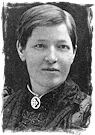 "Have
you seen Mary Slessor? She is the most wonderful woman in West Africa," came
from the lips of Sir William Wallace, the Deputy Governor of Northern Nigeria,
when the speaker and the writer sat, a dozen years ago, on the deck of the Corona,
the Governor's yacht, as she slowly forced her way up the deep swirling waters
of the Niger, at the end of the rainy season.
"Have
you seen Mary Slessor? She is the most wonderful woman in West Africa," came
from the lips of Sir William Wallace, the Deputy Governor of Northern Nigeria,
when the speaker and the writer sat, a dozen years ago, on the deck of the Corona,
the Governor's yacht, as she slowly forced her way up the deep swirling waters
of the Niger, at the end of the rainy season.
"Have you seen Mary Slessor? She is worth seeing," said one of the heads of foreign missionary enterprise to the writer when journeying along the west coast of Africa nine years ago.
"You ought to see Mary Slessor. She is a wonder," said a resident from Northern Nigeria, not far from Lake Chad.
Who was Mary Slessor? She was the woman Livingstone among the missionaries.
"Stop! Do you hear me! Stop!" the white woman called as she ran out of the bush path into the village field, where two tribes were about to settle their differences of opinion by force of arms.
"You dare not shoot while I am talking to you!" She was a weak woman, small of stature, telling men heated by lust of battle to stop fighting. She was only a woman, but what a woman! All the tribes far and near had learned to respect her.
"Come here, you!" [she said] to a man who with his gun up, was about to fire. "Give me that gun, and go and find your chief and bring him here!" Then, telling her followers to clear the long grass away and put up her chair, she marched across to where the enemy was lined up behind the mud walls of the village, and, calling for the chief, she insisted that he come immediately, as she wished to speak to him.
Reluctantly the chief appeared at the stockaded gate. Taking hold of his arm she marched him back to her chair which was placed under a shady tree in a clearing which her followers were busy in enlarging. A couple of antelope skins used by two of her servants as sleeping mats were stretched on either side of her chair. She motioned to the chief whom she had brought along from the village to sit down on her left, when from the bushes on the right appeared the other chief followed by a crowd of his armed men, wildly gesticulating. Mary Slessor had sat down in the meantime, but she got up again and told the newly arrived leader of the warriors to send his men back into the woods. She wanted him alone. Was he afraid of her that he brought so many men? Reluctantly the tribesmen withdrew, and scowling and growling, the newly arrived leader sat down on a mat at her right. It took her just ten minutes to settle the palaver, to turn two enemies into friends, to send them back to their people and to their work on the farms. One is tempted to say "they lived happy ever after," but that would hardly be true, for as soon as Mary Slessor's influence had faded, old troubles would begin again.
Though Mary Slessor had no children of her own, she was called "Mother" by multitudes. She was a woman of great common-sense and fearlessness...
Mary Slessor was a woman who could get on with everybody. She had no enemies and yet withal tremendous force of character. The natives trusted her absolutely. From long distances they came to bring to her their troubles, and unfailingly she straightened them out for them. When there were difficulties which ... the natives were unable to solve, they invariably turned to the "White Mother."
It was a warm spring evening in 1893. The blue smoke rose from the cook-fires in the compounds of Okoyong. The dust haze of fine sand particles from the great Sahara that had hung over the forest all day had been driven away by a gentle south breeze. The palm-fringed forest awoke to its night life, when, through the bush path, moist and mossy, under majestic panoplies of cotton trees, a string of carriers struggled onward towards the clearing, singing quaint songs responsively in honor of the mistress who was coming to call upon a sister of her tribe, hidden for eighteen years in the jungles of the cross rivers. Weirdly their chant preceded their arrival, as Ma Akambo, barefooted, with a baby on her back and a bunch of bairns, black as the midnight, around her feet, was doing chores and cleaning up before their evening prayers.
Mary Slessor straightened herself and listened, as through banana bushes, past yon native hut, the strange Safari (caravan) hove into sight. Another Mary, daughter of Charles Kingsley (Kingsley of "Westward Ho!" and of "Hypatia"), had come from far to meet our strange white queen of wild Okoyong. As Stanley once met Livingstone and with simple words, so often paraphrased, saluted the explorer, "Dr. Livingstone, I presume," so Mary Kingsley said to Mary Slessor, "I take it, you are Ma Akambo," while Mary Slessor answered, "My name is Mary, and I bid you welcome."
A greater contrast than we see in these two women could hardly be imagined, — one barefooted, shorthaired and rough-handed, clad in poorest garments, serviceable though and neat, the daughter of a drunkard, but now an honored queen of multitudes of black- skinned [natives], — the other, cultured, the daughter of a Christian gentleman of highest standing, her intellectuality far beyond that of the vast majority, and yet withal life's object for her was naught but globe-trotting. The daughter of a Christian, yet professing no Christian principles, but "les extrèmes se touchent," and in the "Bang-bang" wilds of Central Africa strong cords of sympathy, of fellow feeling, yea of love, were knotted to last as long as life should last.
"Come in," said insignificant Queen Mary to her stately visitor, "Come in, and receive a Scottish lassie's welcome." They shared their evening meal, then by the fire they sat, while out of the night and gloom gleamed the white eyeballs of the children of the forest. For hours they sat and talked of life and higher life, life's meaning and life's object, of exploration, of palm oil ruffians (for by this name went nearly all the traders of the coast), of native superstitions, witchcraft, demon worship, of native women's degradation, and of the murder of all infant twins.
It was Mary Kingsley who was keen on folk-lore and who thought much of the poor barbarians' faith in the wily spirits of the gloomy forests, and felt that the work of missionaries might be the doom of many an interesting custom, while Mary Slessor, seeing beneath the surface, was far more interested in the work of saving babies' lives, relieving sorrow, hunting for opportunities to spread the knowledge of the Prince of Peace throughout the blood-drenched villages and hamlets of the natives.
"Had you been here," said Ma, "during the first years I lived at Okoyong, you would feel differently about what seem to you the beauties of native life, for sudden death and sicknesses of chiefs meant always human sacrifices in this land when I arrived. One day I was called into a village eight hours from Ekenge, to save if possible the life of the chief who then was dying. The intervening villages were hostile, no natives dared to follow when I left to save, if it might be, the lives of many slaves and women who would be slaughtered if the king should die, in order that beyond the grave he might have servants in the future life. After exciting hours, and a march through drenching rain, I reached my destination and was welcomed by the grim expectant faces of an armed crowd that was ready to begin the slaughter as soon as it should hear from the king's compound the death wail. I felt as if I'd walked into a den of wild beasts. With some medicine which I was able to procure, with not a little trouble, from another station (Ikorofiong) where a married missionary couple were working, the ebbing life was saved, and with it the lives of many of the forest children."
"What do you know of undesirable women being sold to Inokong to serve as food at the high feasts of this section of the Aros? All twins whom God sends to the mothers of this country are killed and many of the mothers too. One day Etim, the eldest son of our chief Edem, had been hurt by a tree falling on his back and he had died. According to the custom, men and women, yea and little children, from the nearest village were condemned to death, it being held that they, by witchcraft, had caused Etim's death."
"I could speak to you for half the night were I to tell of all the trouble I had to save the lives of those poor wretches of the village. It cost me silks and satins to save some; for others I cajoled the chief so that he set them free, and, for the last, long prayers and threats were needed, and to this day it is a wonder to me that not one was lost: it was God's gracious hand that gave to me the lives of all those villagers. The lovely customs that you think so much of, are — could you but read the hearts of these child people — an unending horror, — fear of the future, fear of their enemies, fear of demons! Oh, Mary Kingsley! How is it possible for you, a woman of intelligence, to suggest that it were better if this demon worship were preserved, and the natives left in what you call their innocence! Your weakness is the little wrong you know within your life, and therefore you do not see in others darkness dominant. I have known sin from early childhood and realize the difference of a Christian life from one that is without a Savior."
Low in the west the evening star was setting, while clouds of Heaven's constellations looked down upon the heart communion of two souls. To Mary Kingsley's eyes salt tears had come.
"Ma Okoyong, I admire you, the greatest and most Christian woman of this coast. I would give anything to have your faith, but I can't, I can't: when God made me, there was lost the part that one believes with."
Had Mary Kingsley then been won by Mary Slessor, and the two joined hands for Christ and Africa, it is difficult to say what might not have been done; but Mary Kingsley left, and shortly after died ...
Thirty years have gone by into the "Never never" since Mary Slessor first reached the Bight of Benin, and stepped ashore at Duke Town. Further and further inland she pressed the frontier of her influence, by way of Old Town, Creek Town, Ekenge and Akpap, Arochuku, Itu, Ikotobong, Use, Ikpe, and now she has reached her final earthly destination, Odoro lkpe. The three mission stations close to the coast she found when first she arrived have grown to twelve main stations and many out-stations. She has been government agent and vice-president of the native court, the only woman judge in the British Empire. She has been appointed an honorary associate of the order of the Hospital of St. John at Jerusalem for "meritorious services," honored by governors and governor-generals, by the King of England, by her fellow-missionaries and by the children of Africa she loved. She is sixty-six years old and her time of suffering and service, her time of earthly strenuous self-sacrifice is drawing to a close. Her skin is like parchment, gray her head, her shoulders bent. How many a time had not her body passed through the fiery furnace of coast fever! How many a time had she not shaken with the ague, shivering in that tropical heat, racked by malaria and dysentery! Her body, never strong, had, like a well-worn tool, come to the end of usefulness; her mind and will were still as strong as ever. What a pity that such a soul could not be given a new body — so it would seem to us with our finite minds! Were human life on earth the only aim and object of our being, then every life is but a tragedy. If, on the other hand, the teaching of the Christ be true and life on earth is but a time of preparation for higher service, the short-lived years of an apprenticeship, then the use that this woman, Mary, made of her life is part of an apprenticeship of heroes and of heroines that will be given wider spheres in the great Hereafter. The training of her will, the building of her character, the daily striving to do good and better, built up the soul of that poor weaver girl into a thing of noble stature. The stage which we are told consists of planks that mean the world, shows in the comedies and tragedies of theater naught but disjointed incidents of life. No life is comedy, though there may be comedy in life: true, many lives are tragedy, but some are not: no Christian's life is ever that, for in its very suffering is contained sublimest happiness. Christ is the great example who for the joy that was set before Him endured the Cross. That all-transcendent joy, that apotheosis, is the Christian's certain hope.
The men-murdering world war with its flood of horror reached the far seclusion of Odore Ikpe and caused acute suffering to the little gray-haired lady there, more suffering than her worn-out body was able to sustain, and there she breathed her last on earth surrounded by the children whose lives she had saved.
One of the stateliest processions Old Calabar had ever seen followed "Eka Kpukpru Owo" (everybody's mother) to the old cemetery so richly sown with white sand from Europe, on the Mission Hill at Duke Town. Old Mammy Fuller, who had loved Mary much, sat alone atop of the grave and hearing women wailing as the funeral procession approached, rose up and called out, "Do not cry, do not cry. Praise God from whom all blessings flow," while in the far-off northland a little friend of hero-Mary wrote at her departure:
"She who loved us, she who sought us,
Through the wild untrodden bushlands,
Brought us healing, brought us comfort,
Brought the sunshine to our darkness—
She has gone—the dear white Mother—
Gone into the Great Hereafter.
Thus she taught and thus she labored;
Living, spent herself to help us,
Dying, found her rest among us.
Let the dry, harsh winds blow softer
And the river's song fall lower,
While the forest sways and murmurs
In the mystery of evening,
And the lonely bush lies silent,
Silent with a mighty sorrow."
From African Missionary Heroes and Heroines by H.K.W. Kumm. New York: MacMillan Company, 1917.
>> More Mary Slessor