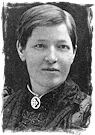
 [The following covers Mary Slessor's life
from around 1913, through her last illness, August, 1914. She
died January 13, 1915].
[The following covers Mary Slessor's life
from around 1913, through her last illness, August, 1914. She
died January 13, 1915].
Some distance from Ikpe there is a high hill called Odoro Ikpe, on which the Government has a rest-house.
Ma climbed up there one Saturday night.
"What a grand view!" she cried, as she looked over the wide plain and breathed in the cool fresh wind with a great content, "I've never been so high before."
And then her eyes grew sad. For all that green country was the home of heathenism. The chiefs had shut and bolted the door of their hearts against Jesus, and would not let any teachers or missionaries come in and disturb their ways.
Ma had often gone to them in her wheeled chair, fording rivers, crossing swamps, pushing through wet forests, and stood and knocked at their hearts in His name, but in vain. They were afraid that if she came all their old fashions would tumble down about their ears.
She was not the one to lose courage. As she sat there on the hill-top, she dreamed that she saw the whole region being won for Jesus, and the people coming to His house clothed and in their right mind.
"O God!" she prayed, "old and feeble and unworthy as I am, help me to win them."
And there and then she put on her armour and braced herself for battle.
"Janie," she said, "we'll stay here until we overcome these chiefs."
Janie looked round and grunted. The rest-house had only holes for windows; there was a doorway, but no door; the floor was of dried mud, and there was not even a table or a chair. But Ma could be happy with nothing, she would have been content with bare ground for a bed, and the starry sky for a covering. She did, indeed, find that it was better to sleep in the open air than in the stuffy rest-house, and she lay down every night in the verandah with the cool wind fanning her cheeks.
Day after day she called the chiefs and talked with them; she coaxed the little boys and girls, who were timid and sullen, to come and learn A B C; she stood at night in the villages when the women were cooking at their fires and the young people were dancing to the sound of the drum, and spoke to all who would listen of the love of Jesus and His power to free them from sin.
And at last, after a weary struggle, her patience and goodness and humour melted the hard hearts, and one by one the chiefs came and said they would allow her to do anything she liked, and they would try to worship her God and learn the new ways.
Her heart was full. She went out in the cool of the night and stood gazing over the dim plain. All was silent and still, and the stars were shining more gloriously than she had ever seen them before. Her eyes swept over them, as they often did, and rested on the Southern Cross, the group she loved most of all, because it was the symbol of her dear Lord watching over the dark and sinful world, and her thin worn face was beautiful, for her dream had come true.
She went in and sat on the floor, and leant her weary back against the wall of the room, and wrote by the light of a candle stuck in its own grease, telling her friends how happy she was — the happiest woman in all the world.
"I can't think," she said, "why God has so highly honoured and trusted me."
She was a wreck, her body was a mass of pain, she was growing deaf and blind, she was tired and weak, and oh, so lonely! Yet her heart was bursting with love and gratitude and joy. O wonderful Ma!
All this time she was working three stations — Use, Ikpe, and Odoro Ikpe, and going constantly between them. She kept a diary, and every night — often in the middle of the night — she wrote in it the story of the day. And what a story of toil and heroism it is! Here are one or two little sentences from it:
Left the beach for Ikpe in the evening, sail in moonlight; reached Ikpe 4 p.m. next day; ran on to a tree; boys thrown into the water.
Egbo out all night, screaming and drumming like madmen till daylight. All drunk.
First night in new house. Sorry to leave the wee hut I have enjoyed so much comfort and blessing in.
Patients from early morning; man bitten by rat; another by snake. School begun, nearly a hundred scholars.
First Christian funeral at Ikpe.
Chiefs here by daybreak for palavers.
Splendid congregation. People changing for the better.
Terrific thunderstorm. School-boys drenched. Got a big fire on in hall, and all sat round the blaze and I gave them a reading lesson.
A great reception at Use — thank God for the girls and home. Thank God for sleep!
On roof all day, head and neck aching, hands broken and bleeding.
Carrying sand, cleaning corn patch, mudding and rubbing walls.
Cut my first two roses from the rose bush — lovely, a tender gift from God.
After sleepless night found white ants in millions in the drawers.
Washed a big washing.
Terrific rain storm, no school.
Very feeble, scarcely able to stand upright in church.
Horrid night with cross child.
Lovely letters from dear ones. God is very good to me.
Every boy in school clothed to-day for first time.
Heaps of sick babies.
Full up with work till late at night. Dead tired.
Two women murdered on the way from market and their heads taken away.
Fever; trying to make a meat safe.
Sleepless night, baby screaming every few minutes.
Splendid fever-sleep full of dreams. Thank God for daily strength to go on however feeble. Thank God for the girls who got up and got me tea without any bother.
Reached Rest House at darkening. A fearful night of misery with mosquitoes, and hard filthy ground on which we lay. Rose at first streak of dawn and never was so glad to leave a place. Baby yelled all night.
Nothing done, low fever, but a very happy day.
Fever, stupor sleep. Lost count of days.
Useless after utterly sleepless night. Made such sermons and delivered them all night long.
Her friends in Scotland began to call her home, tempting her with visions of rest and peace and lazy days in gardens amongst flowers and all sorts of good and loving things, but though she thought of it with longing and tears, she said she must first build a house on the hill-top of Odoro Ikpe to be ready for a missionary when the Church sent one. After that perhaps...
So she started to put up her last house, and because she was so feeble and her gang of labourers were such idlers and drones, she found it the hardest task she had ever tried to do, "The African works well," she said, "if you are at hand to guide and spur him on, but just leave him and he sits down and talks or sleeps till you come back." So vexed sometimes was she with the men dawdling over their trifling bit of work that she would rise and box their ears, but they just laughed and thought it a fine joke. Ma did not like to do such things: she wrote to one of her little correspondents: "You would have thought your missionary friend was rather hard-hearted, but hard things have to be done and said when one's heart aches to say and do most melting things."
Ma had more hope of the children than of the grown-ups, and she tried to get hold of them and teach them. "Though they are black," she told a boy in the Highlands, "they are just as bonnie and nice as if they were white. Indeed the colour does not matter. We are all the same inside our heads and hearts, and the little lads who know about Jesus are trying as hard to be good and brave Christians as you boys who are white."
She was specially hopeful about the boys. Once a missionary spoke to her about one who seemed to have no wish to be a Christian, and she replied, "Dinna gie up hope. You dinna ken what is behind him and what he has to fight against. His mother has maybe made him promise not to do it — perhaps made him chop mbiam (take the solemn oath) over it." And after she talked with the boy she said, "He's a fine laddie, and ye'll have him yet."
Many boys came to her for help in their troubles, and how patiently she listened to what they had to say, and how wisely and tenderly she spoke to them! She loved them all, and thought about them just as a kind mother would have done. To those who were going to be taught and trained she said, "You must be the leaders of your race and help them to rise, but you can only lead others to Jesus if you follow Him closely yourself."
That was always what she was telling her own children: "Keep close to Jesus." "Bairns," she would say, "it's the wee lassie that sits beside her mother at meal-times that gets all the nice bittocks. The one who sits far away and sulks disna ken what she misses. Even the pussy gets more than she does. Keep close to Jesus the Good Shepherd all the way."
When the Government took a number of the Ikpe lads to work on the new railway being built to the coal-fields they came to Ma and said they were afraid to go so far.
"God will go with you and keep you," she said. "Try and find out some one who preaches the Gospel and keep near him."
On the fly-leaf of a Bible she gave one of them, she wrote:
Udö Ekpenyoñ Edikpo.
Trusting he will hold by the truths of this Holy Book when in the midst of strangers he may be exposed to temptation. Never forget prayer when reading.
Your friend, M. SLESSOR.
"This book," she told Udö, "will be a lamp to you and guide you."
These young men returned none the worse of their exile.
The boys who wanted to be good had more to put up with than those at home. At Ikpe there was mbre, or play, called ekang, and all young men had to join it and pay a fee of £10. Those who would not were fined ten rods, some fish, some leaves called akan, and two jars of palm wine, and had to appear in the street and dance backwards to the beat of the drum, and then were flogged and hounded to their homes. This custom Ma put down.
Once the chiefs gave orders that all men were to hunt in the bush, and the animals caught were to be sacrificed and eaten in honour of the Ndems in the town. The lads of the Church refused to go to the hunt or to eat of the sacrifice. "Then," said the chiefs, "you will be banished." Word was sent to Ma, who was at Use, and when she came she told the chiefs that no lad must be forced to do anything against his conscience, and from that day to this there has been neither hunt nor sacrifice.
The people sacrificed and ate animals before the Ndems, because they believed that it would make the yams on their farms grow big. Ma said God alone gave them such a blessing, and that the children of the Church could no longer follow the custom. It was not long before the custom was stopped.
She was very far out of the world, and seldom saw a white face. How glad she was when Mr. Bowes from Calabar appeared. They walked together from Ikpe to Odoro Ikpe. On the road she stopped and helped a woman to lift a very heavy load of palm nuts to her head. Then she went into the compound of an old chief who was ill, found out what was the matter, and arranged to send him medicine. At the entrance were three white chickens with their heads cut off. "It is a sacrifice," she said. "Oh, the pity of it." On going up the steep hill Mr. Bowes wanted to carry a bag she had slung over her shoulder. "Na, na, laddie," she said, "it's my cat and it helps-to balance me."
Writing to Ratcliffe at this time, she says:
I have been without money for nearly a month! What do you think of that? Sometimes, but not very often, we have been hungry because we had not enough money to send to the market to buy food. The workmen make such a hole in my pocket. It is very difficult to get money brought from Calabar, and then the people won't take English money when it does come. They use copper wires, which we buy from the next station. Don't we live a very funny life? ...
"It is sometimes a rather wearying kind of living, the gipsying sort of life," she told Christine; "but while there are no workers to go round we must do this as the second best way of holding on." And then she wonders what her little friend is doing and asks: "Are you going to do something fine in the new year? I trust so. At least you will be good, and To Be is a better verb than To Do in my estimation."
She began to remember that Christine was growing up, and did not like the idea. So she says to her: "I shall try and keep you in my heart with all the sweet mystery of girlhood. I should like, for many things, just to keep you among the simple loves and pleasures of home, and not to let you slip over into the womanhood which has such heights and depths that alternately beckon and frighten one. But God's order is the only right one, and you have a claim on Him."
"I shall be fifteen this August," Christine replied. "I am rather sorry we are all getting so big. However, there is one comfort, when we grow bigger we will be able to go out into the world and do good things, and perhaps splendid things, and help to make people better and happier — though, of course, we can do that always."
That was what Ma liked to hear, and when any of her young friends grew up and married and went out into that world of which Christine spoke, she would send them lovely messages. Here is one to a grand-niece of Mr. and Mrs. Goldie (the pioneer missionaries of Calabar who had been so good to her) when she was about to sail to America:
MY DEAR Lassie— You do not know me, but your parents and all belonging to you are very dear to me, and I have always, from before you were born, loved you all and tried to follow you all.
And now God is calling you to live your life and to witness for Him in a strange land; and doubtless you will have fits of home-sickness, and times when you will want those who have hitherto made your world for you, and sometimes your husband will feel the same, for marriage does not — if it be a wholesome and sane one — destroy the old loves, but as one who knows what the leaving home means, I know that you will find your Saviour near, and all-sufficient for all times and things.
Do you know a good old practice of ours in a strange land has been to sing the second Paraphrase every Saturday night. You tell your husband to try it. At worship every Saturday night you sing that, and though your voices break, you find it a tonic.
You will have all your things packed up and ready and your purchases all made, but as there are always a few small odds and ends, as hairpins and button-hooks, etc., left at the end when you are ready to embark and your boxes not at hand, I enclose a few shillings to have in your pocket for that emergency.
I remember Mrs. Goldie having forgotten gloves and safety-pins in Liverpool, and we rushed out of the cab to get them on our way to the steamer!
May every blessing go with you, and may your married life be a long and useful and happy one. He who hath hitherto led you will still compass your path. —Yours affectionately, MARY SLESSOR.
Ma loved to hear how the girls at home were working for Jesus. How interested she was in all the new things that were being started — the Girls' Auxiliaries, the Study Circles, and Guilds! "The Church," she said, "is wise in winning the young, for they are going to be the mothers of the future and shape the destiny of the nation, and they will be all the wiser and the better mothers and Church members and citizens for what they are doing."
Some of her little friends were quite young. There was Dorothy, for instance, who was only five. She sent out Ma a picture-book which she had made herself, and Ma wrote back saying, "I wish I could give you a kiss and say 'Thank you' to your very real self by my very real self, instead of sending you a mere message on paper. But you see I cannot fly over the sea, and you can't come here so what better can we do?"
The letters from home Ma kept, along with other treasures, in an old chest of drawers that she loved because it had been her mother's. If the bairns had been extra good she would gather them about her there after the lamp was lit, and show them everything. The letters were read over and over, and the children knew all about Dorothy's doll that could speak and sleep, and Jim's rocking-horse which Santa Claus had brought, and the new little brother that had come to Mary's home. Then the photographs of Dorothy, and Fay and her brother, and Christine and Happy, and others would be spread out and talked about and admired again. There were also the little gifts sent to her, just trifles, but very precious to her, because some bairn at home had worked at them. "To think of the trouble they took," she would say.
And the heather! How Ma loved it! These dry bits of plants brought tears to her eyes and sent her thoughts away across the wide sea to the homeland, and she saw in vision the glint of the sun, and the shadow of the cloud on the purple moors, and felt the scent of the heather and the tang of the salt sea breeze, and heard again the cry of the whaup.
"That's the Bonkle heather," she would say; "oh, the kind hearts there." "And that's the Blairgowrie heather and bog myrtle; never a year but it comes, and it is like a call across the sea."
One package she opened very tenderly, for it held the wee toys and well-worn books of a little boy who had died. They had been sent out to her from the heart-broken mother. Ma could never look at this beautiful gift without her eyes growing misty with tears.
In another corner was a cupboard filled with china and coloured glass, very common, but very rare in Ma's eyes, because they were gifts bought by the bairns at market or factory with their odd pennies and shyly offered to her. She often scolded them well for wasting their money in such a way, but all the same she was proud of these tokens of their love.
Then, softened by sweet memories and kind feelings, the family went to evening prayers. The children, squatting on the floor, read verses round, and Ma talked to them simply about higher things, sometimes in Scots, sometimes in Efik, after which they would sing old psalms or hymns, like "Now Israel may say," which was one of Ma's favourites. No books were used, and woe betide the bairn or visitor who did not know the beginning of the next verse! Ma, however, liked the children to learn new hymns, and sometimes they could be heard singing the tuneful ones in the yard or away in the bush or on the road.
From Chapter 10 of Mary Slessor the White Queen: A True Story of Adventure, Heroism and Faith by W. P. Livingstone. London: Hodder and Stoughton, 1931. Originally published as The White Queen of Okoyong... [1917?]
>> More Mary Slessor