The story of Mary Slessor's battle to bring the gospel and civilization to the "Dark Continent."
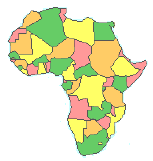 The place is the Calabar River on the slave coast of Africa.
The time is an afternoon in September 1876. A rusty ocean steamer is heading toward
the mouth of the Calabar. This part of Africa is known as the White Man's Grave,
and only a fool could come here without being afraid. The land a few miles from
shore is unexplored. Killer elephants and lions, swarms of insects, witch doctors,
and cannibals live there. To enter that land would mean death.
The place is the Calabar River on the slave coast of Africa.
The time is an afternoon in September 1876. A rusty ocean steamer is heading toward
the mouth of the Calabar. This part of Africa is known as the White Man's Grave,
and only a fool could come here without being afraid. The land a few miles from
shore is unexplored. Killer elephants and lions, swarms of insects, witch doctors,
and cannibals live there. To enter that land would mean death.
Life means little along the Calabar. Slavery is common and to kill a woman or a slave means nothing. If a family has too many children, they will just leave the unwanted child in the bushes to die. The birth of twins is thought to be an evil sign. Twin babies are cruelly murdered, and their mother is driven from her home to die in the jungle.
There is no respect for truth and honesty here. "Do right" would be a meaningless phrase, for these people do not understand what is right. The law of the jungle is "do whatever you can get away with." For this reason, people live their short lives in fear and filth.
The boat drops anchor well up the Calabar River beside a rough town. This is Duke Town. The mission station at Duke Town is the destination for the only woman traveling aboard the steamer. Mary Slessor is coming from Scotland to serve God in this harsh climate. A small boat from the mission comes alongside the steamer and takes her to shore.
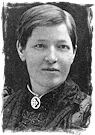 Mary Slessor
is 29 years old. She comes from a poor family. Her father was a drunkard,
but her mother was a godly woman. Since she was 11, Mary has earned her living working
in factories for twelve hours a day, six days a week. Despite these hard circumstances,
she served God faithfully in Scotland, and the hardships have helped prepare her to
serve Him now in Africa.
Mary Slessor
is 29 years old. She comes from a poor family. Her father was a drunkard,
but her mother was a godly woman. Since she was 11, Mary has earned her living working
in factories for twelve hours a day, six days a week. Despite these hard circumstances,
she served God faithfully in Scotland, and the hardships have helped prepare her to
serve Him now in Africa.
The Duke Town missionaries have had some success in the coastal regions. They have built a school, hospital, orphanage, and chapel at the station. Through their preaching and teaching they have been able to stop some of the worst heathen practices. The village leaders are beginning to realize that what they call "God-law" (the teachings from the Bible) makes sense. On any Sunday there are several hundred natives in services.
This was the situation when Mary Slessor began her work teaching in the mission station and visiting in the coastal and river villages. As soon as Mary could learn the local languages, she went without a translator. She was told that it was dangerous to travel alone, but she found that she could get to know the people better in this way.
The farther Mary traveled from the mission station, the greater needs she found. Mary told the natives the good news of Christ. She urged them to quit worshiping the skulls of dead men and not to be afraid of "evil spirits." The new missionary taught, "Do not kill the wives and slaves of a 'big man' when he dies. They cannot help him in the next life." She showed the women better ways to fix food and keep homes and children clean.
Sometimes at night Mary would lie awake on a dirt floor in some coastal village. "Oh Lord," she prayed, "I thank Thee that I can bring these people Thy Word. But Lord, there are other villages back in the jungle where no white man has gone. They need Jesus, too. Help me reach them!" Then, whenever she had an opportunity, she would ask another missionary or a native about her going to these villages. The answer was always the same: "No. You would be killed. They cannot be reached."
Her worst enemy was the tropical diseases which hit her so suddenly. There were many times when it seemed as though she were about to die, but she pulled through. It was a real temptation to forsake this unhealthy area and return to the cool mists of Scotland.
The Scottish missionary did go home on a short furlough, but she soon came back to Africa. She was thrilled to learn that she was now to be on her own at an outstation. Her new home was Old Town, some distance upriver from Duke Town.
Her first view of Old Town was of a human skull swinging from a pole in front of the town meeting house. Each hut had its own little gods. Mary's "home" was a mud hut next to a trader.
Her days were full of treating sick, teaching the Bible, and visiting neighbors. Mary became known throughout the area for her wise, fair counsel. There was a Christian chief, King Eyo Honesty the Sixth, who often asked Mary for advice in dealing with white men. She, in turn, asked him for help in working with the natives.
Mary was successful in Old Town, but she was also deeply burdened for the remote Okoyong tribe that had never heard the gospel. How could she bring the love of Christ to these people as well? They valued only three things: guns to have power, chains to keep their slaves, and liquor to dull their minds. But God was leading her there, and Mary was willing to trust God to show her how to win these savage people to Christ.
Mary prayed for God's leading. At last, in June 1888, she quietly announced that she would go upriver alone and find a place to settle. "You will die. You will die," her friends told her. They wept at the prospect of her leaving.
King Eyo Honesty said that if she must go, he would send her as a "big person" in his own special canoe. It was the grandest canoe in all of Calabar. Mary accepted Eyo's offer and headed for the land of the Okoyong. The farther they went, the more her twenty paddlers wanted to turn back. They feared the Okoyong. But the Lord was with the group, and they arrived safely. The Lord had also prepared the heart of the chief of the first village they found. Mary was the first outsider ever allowed to live there. The chief also said that she could build a school.
This area was far more wicked than any Mary had seen. The people respected only vengeance and cruelty. To a people who did not know what love was, Mary brought the love of Christ.
This was a wild time for the missionary. Hardly a day went by without a serious crisis. Mary knew that she could not expect to change their lives immediately, but she could not merely stand back and watch these people do wrong. She got little rest and her health was bad. But she was always there when she was needed.
Whenever Mary heard of any trouble, she would rush to the scene. As she approached, the men would be preparing for war. They passed around liquor, danced, and yelled threats at the other side. They were in war paint, and their spears and shields glimmered in the sun. The skulls and scalps of earlier victims waved from poles.
Just as the two sides were about to rush together, they saw a small, seemingly calm woman standing on a log between them. "Out of the way, Ma. We fight!"
She ignored the shouting warrior.
"Out of the way. You die, too, white Ma. Move on!"
"Shoot if you dare!" she called back.
When the two sides came to remove this gray-haired obstacle, Mary knew that she had won. She would scold them as children, plead with them to show mercy, or suggest they move to the shade of a tree to talk. Mary knitted while they talked, and she got a lot of knitting done. After hours of talking the men were calmer and too tired to fight. They went home without bloodshed.
News of trouble might come too late for Mary to get there in time. If this happened, she would go to her table, pull out a fine piece of parchment, and quickly make big marks all over it. She then sealed this with wax and tied it with a great red ribbon. A runner sped this important document to where the fight was about to begin. Mary's scribbles were nothing but nonsense, but none of the Okoyong could read! The warriors would spend the day puzzling over the important piece of paper sent by the "white Ma." They would still be studying the document when Mary arrived in person to settle the dispute.
After a time, Mary realized that as long as the Okoyong had nothing else to do, they would get drunk, and drunkenness always led to fighting. "Perhaps," she thought, "if they knew there was something better, this would stop."
Mary displayed her nicest possessions: some cloth, a teapot, and an old sewing machine. The Okoyong liked what they saw. "You can have nicer things than this if you take the palm oil and yams to the traders," she told them.
"These things you have--very nice," said one chief. "But it is no good. Traders afraid to come here. No good for us to go to them. River gods kill us."
"I will go with you. You will be safe.
"No. Too much bad."
Mary told of the wonderful things down the river. Finally they agreed to go and loaded a canoe. The chiefs and warriors shook with fear as they set off towards Duke Town and Old Town.
King Eyo hosted a great feast for the visiting chiefs. He showed them the good things they could have if they gave up their old ways. He told them that the God of the "white Ma" was the true God. Eyo was kind to the poor, backward Okoyong chiefs. Before they left he gave them each presents, including some fine cloth. The Okoyong could hardly believe their good fortune.
As a result of these meetings, the Okoyong region was opened to outsiders. Mary had done what traders, soldiers, and diplomats had been unable to do for four hundred years. There was now a reason for honest work. This experience was a turning point in the life of the Okoyong people.
In time, many of the Okoyong would accept the gospel. Free of their pagan fears and drunkenness, they could now understand God's love for them. The idols disappeared from the villages and in their place small churches were built. A court system was established to settle disputes, and Mary was made the first judge.
Civilization came more quickly to the Okoyong than it did along the coastal regions. For hundreds of years the white traders along the coast had tried to force the natives to change. It was not until the gospel changed the people's hearts that real progress was made.
As for Mary, she felt a tug on her heart for the region beyond the Okoyong. Her converts in Okoyong protested, "We love you. They will kill you. Do not go." Mary loved the Okoyong people, just as she had loved the people of Old Town. But her call was, "Onward! I dare not look back."
Mary's reputation as a great and wise woman and as a fair and honest judge had gone before her into the land of the Azo, a dreaded cannibal tribe. At first the Azo people seemed to show little interest in her message, but soon many accepted Christ. Mary reported that there was one town that had two hundred converts. None of them could read, so she pleaded for pastors to come to instruct the new Christians.
In the time she had left, Mary did all she could. She walked the paths until she was too old and feeble. Some Scottish friends sent her a cart that could be used to pull her to the villages. They urged Mary to come to Scotland for a rest. She wanted to, but prayed instead that God would give her the strength to finish the job among the cannibals. Strength came and she worked faster and harder.
Two years later, in January 1915, the Lord took Mary home to be with Him.
A government boat was then sent to carry her body down the river to Duke Town. She was buried on a hillside by the mission station where she had first served.
The group which gathers on that cemetery is a testimony to the life Mary Slessor lived. There are high government officials who found they could trust this woman's advice. A dignified tribal chief, once a cannibal, stands there. He found the "white Ma" a faithful friend. There is a young man whom Mary nursed through a fever. Twins are there who would have been murdered at birth had she not come. As they look up from her grave to the land around them, they see a country that Mary Slessor claimed for Christ while standing on the deck of a rusty ocean steamer almost forty years before.
This land cannot be the same again, nor can they.
+Reprinted from FAITH for the Family (1977). © Bob Jones University, www.bju.edu. All rights reserved. Used with permission.
>> More Mary Slessor