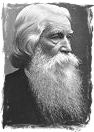
 We
are often saddened to read of heroic missionaries whose lives are cut short
at the very time when they seem to be most needed. No doubt but God can
bring good out of every sorrow, but, as far as human eyes can see, such
losses are sad indeed. But John G. Paton was one of the missionaries who
have been permitted to spend long lives in the work of their choice, and
to rejoice in old age over the fruits of their labors. John Paton was the
son of pious Scotch parents. The description of his home reads like a passage
from "The Cotter's Saturday Night:"
We
are often saddened to read of heroic missionaries whose lives are cut short
at the very time when they seem to be most needed. No doubt but God can
bring good out of every sorrow, but, as far as human eyes can see, such
losses are sad indeed. But John G. Paton was one of the missionaries who
have been permitted to spend long lives in the work of their choice, and
to rejoice in old age over the fruits of their labors. John Paton was the
son of pious Scotch parents. The description of his home reads like a passage
from "The Cotter's Saturday Night:"
"The cheerfu' supper done, wi' serious face
They round the ingle form a circle wide,
The sire turns oe'r, wi' patriarchal grace,
The big ha' Bible, once his father's pride;
His bonnet rev'rently is laid aside,
His lyart haffets wearing thin and bare;
Those strains that once did sweet in Zion glide,
He wales a portion with judicious care;
And, 'Let us worship God,' he says, with solemn air."
Three of the eleven Paton children became ministers of the gospel, and all of them did honor to the devoted father and mother, and to that humble peasant-home wherein they had learned to fear God and to help one another.
When John Paton was still a child he gave his heart to God and resolved to become a missionary. His father's pleading prayers for the conversion of the heathen had been heard, and the answer was to come from within his own home.
John learned his father's trade—that of stocking-making—and worked at it faithfully from the age of twelve; devoting every spare moment, however, to the study of Latin and Greek. His studious habits brought him to the attention of a party of government surveyors, who promised that they would, if he would bind himself to seven years of service, secure his education at the expense of the government. This offer must have been a tempting one to a boy with Paton's hunger for learning but he firmly put it aside, feeling that to accept it would shut him off from a missionary career for many years at least.
For ten years Paton was a city missionary in Glasgow, at the same time carrying on his studies in the classics, theology and medicine. His labors as a city missionary were heavy and difficult, but resulted in great good. He learned to deal with all kinds of people, and he saw the power of the gospel to uplift the most depraved. Perhaps he could have had no better preparation for the work of a foreign missionary.
In the year 1858, Paton went with his young wife to the New Hebrides. They found a rude and cruel people. War dances and cannibal feasts were the favorite amusements. Nothing save their faith in the gospel of Christ could have led the missionaries to hope for the redemption of such a race.
Less than a year after he reached his field of work a double and crushing sorrow came to Paton. His devoted young wife went home to God, and two weeks later their baby boy followed her. Alone among the savage people, Paton passed through some of the darkest days of his life. But his faith in God was complete, and his zeal in the work did not falter.
The difficulties of this work increased. At the first the curiosity of the natives had prompted them to show a kind of friendliness to the missionaries. It was charged, however, later on, that the foreigners caused drouth [drought] and disease, and they were threatened with death unless they left the island immediately. Again and again did the natives vow to take the life of Paton, but each time he was saved.
Even when the more serious dangers were past for the time, the missionary was constantly annoyed by the deceit and dishonesty of the natives. They stole whatever they could lay their hands upon. Moreover, their cannibal practices were so sickening in their horror that none could be in the midst of them without the keenest mental suffering. One of the customs against which Paton fought persistently was that of strangling widows. It was believed that when a man died his wife should be killed at once, so that her spirit might go with him to the other world.
Again and again these people renewed their attacks upon the life of Paton. Once their priests or sacred men announced that they would kill him by sorcery. They tried their charms and incantations but of course without effect. Then they announced that they would bring about his death before the following Sunday. When Sunday came, and he walked to the place of worship in his usual health, one of the sacred men leaped about him with his spear and threatened to destroy him. But the other two took the part of the missionary, and he was allowed to return to his home in safety.
In the year 1860 a terrible epidemic of measles broke out in Tanna. It was brought there by cruel and greedy traders who shut up a native in the hold of their ship and exposed him to the contagion. The prejudice against the foreigners who had brought the disease extended to the faithful missionaries and teachers who ministered to the sufferers in their sickness. The natives surrounded the mission house again and again, and threatened to kill Paton and the native teachers who were with him. Several of the teachers themselves fell victims to the disease. In all about one-third of the population of the island perished. These were dark days for the Tanna mission.
In the year 1862, more than three years after Paton's location on Tanna, persecutions became so constant and cruel that it was impossible for him and Mr. and Mrs. Mathieson, his companion missionaries, to continue their work. The natives burned the church, and would have burned the mission house and all within it, but for a great storm, which drove the flames in the opposite direction. The missionaries signaled a ship, and were taken off, leaving their property and that of the mission behind.
When Paton joined his fellow missionaries on the island of Aneityum they urged him to go at once to Australia, and to try to raise from the Christian people there funds sufficient to build a mission ship, to go to and fro among the islands of the New Hebrides group. This was greatly needed, as the traders could not be trusted to bring supplies to the missionaries, or to carry news from one to another.
As Paton went from city to city, and told the exciting story of his life in Tanna and the needs of the people there, he created almost unbounded enthusiasm. So successful was his work in Australia that he was persuaded to go to England and Scotland with his plea. He succeeded in raising the large sum necessary to build the ship, and also in deciding a number of persons to give their lives to missionary work in the New Hebrides. The funds for the building and running expenses of "The Dayspring" were largely contributed by the Sunday schools visited by Mr. Paton, and the interest thus awakened had much to do in permanently identifying these children with missionary work.
Mr. Paton was married, while in Scotland, to Miss Margaret Whitecross, a woman of fine mind and a Christian entirely given to the Lord's work. In 1866 they settled on Aniwa, an island near Tanna. At first the people were suspicious of them, but by and by they began to give hearing to the gospel. Those who had been heathen and cannibals became devout worshipers of God. A native church was organized and the Lord's supper celebrated. Churches were built and schools were extensive and in time Christian teaching prevailed upon the island.
In 1884 and again in 1892, Mr. Paton made extensive tours in the interest of mission work in the New Hebrides. Wherever he went he secured large sums of money for the mission, and awakened a deep and lasting interest. Probably no other modern missionary has created so much enthusiasm by his personal labors among the churches.
In the year 1900 he visited America for the last time. He was then seventy-five years old, but his body was strong and his zeal unflagging. During this last visit to the United States and Great Britain he spoke on the average once every day.
He died in Melbourne, Australia, January 28, 1907, aged eighty-three years. His wife had preceded him to the Homeland, and he was glad to go. Few live as long; and few, indeed, live as well.
From Pioneer Missionaries: Short Sketches of the Lives of the Pioneers in Missionary Work in Many Lands by Jessie Brown Pounds. Indianapolis, Ind.: The Young People's Department of the Christian Woman's Board of Missions, 1907.
>> More John Paton