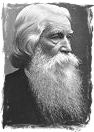
Born near Dumfries, Scotland, May 24, 1824.
Died in Australia, January 28, 1907.
 "Though everything else in religion," wrote John G. Paton of his father's
prayers, "were swept out of memory, or blotted from my understanding,
my soul would wander back to those early scenes, and shut itself
up once more in that sanctuary closet, and, hearing again the echoes
of those cries to God, would hurl back all doubt with the victorious
appeal: 'He walked with God. Why may not I?'"
"Though everything else in religion," wrote John G. Paton of his father's
prayers, "were swept out of memory, or blotted from my understanding,
my soul would wander back to those early scenes, and shut itself
up once more in that sanctuary closet, and, hearing again the echoes
of those cries to God, would hurl back all doubt with the victorious
appeal: 'He walked with God. Why may not I?'"
Many years before that "sanctuary closet" in the old home had been established, that same father, James Paton, then a youth, had found one beneath the shady trees of a grove down the lane from an old Scottish home. This retreat he often sought for study and prayer. One day, when with bared head the pious student was engaged in prayer, a seemingly strange thing occurred. His head-dress, then called a bonnet, was taken from the place where he had laid it. After searching, he found it hanging on a tree near by. The same thing occurred the day following. This much puzzled the young man. Next day, pinned to a tree, just above where he knelt, was a little card, bearing this message: "She who stole away your bonnet is ashamed of what she did. She has a great respect for you, and asks you to pray for her that she may become as good a Christian as you."
A sequel to this unique introduction is that the consecrated grove gave place to the family altar; for the playful maiden became the wife of James Paton; and their first-born was John Gibson Paton, the subject of this sketch.
Of the daily worship in the home, this son writes: "None of us can remember any day ever passed unhallowed thus. No hurry for market, no rush of business, no arrival of friends or guests, no trouble or sorrow, no joy or excitement, ever prevented at least our kneeling around the family altar, while the high priest led our prayers to God, and offered himself and his children there." From such a home and such an example came John G. Paton.
When one more picture of the childhood home is given, it will be understood how our missionary came to bind up his life with God's great purpose. "How much my father's prayers impressed me," he writes, "I can never explain, nor could any stranger understand. When, on his knees, and all of us kneeling around him in family worship, he poured out his whole soul with tears for the conversion of the heathen world to the service of Jesus, and for every personal and domestic need, we all of us felt as if in the presence of the living Saviour, and learned to know and love Him as our divine Friend. As we rose from our knees, I used to look at the light on my father's face, and wish I were like him in spirit, hoping that, in answer to his prayers, I might be privileged and prepared to carry the blessed gospel to some portion of the heathen world."
To read of the struggles through which the youth and young man passed to gain an education, arouses our sympathy and admiration, and deepens the conviction that trials and poverty are not the smallest of life's blessings.
When under twelve years of age he took up his father's trade of stocking making, working from 6 a.m. to 10 p.m., using a part of the meal hours for study; "for," said he, "I had given my soul to God, and was resolved to aim at being a missionary of the cross or a minister of the gospel."
He spent six weeks at an academy; then secured a position in an office, walking four miles a day to and from his work. Instead of spending the noon hour at play, he poured over his books. An official observed this, called him to his office, and offered him training at college if he would sign an engagement for seven years. Young Paton thanked him gratefully, offering to engage for four years.
"Why," said the man, "will you refuse an offer that many gentlemen's sons would be proud of?"
"I said, 'My life is given to another Master, so I can not engage for seven years.'"
"To whom?" he asked sharply.
"I replied, 'To the Lord Jesus, and I want to prepare as soon as possible for His service in the proclaiming of the gospel.'
"In great anger he sprang across the room, called the paymaster, saying, 'Accept my offer, or you are dismissed on the spot!'
"I answered, 'I am extremely sorry if you do so, but to bind myself for seven years would probably frustrate the purpose of my life.'"
Unable to appreciate the worth of the youth, the man dismissed his truest employee; and the boy with a purpose stronger than circumstances was cast adrift. But he soon obtained a position in Glasgow as tract distributor. During his ten years of mission work, he carried studies at the university, Divinity Hall, and Anderson College. But while happy in his work, he heard "the wail of the perishing heathen in the South Seas." Tears blinded his eyes when a report was made at a meeting, that the missionary wanted for the New Hebrides had not been found. All the while, "the Lord kept saying within me, 'Since none better qualified can be got, rise and offer yourself.'" When he yielded he was gladly accepted.
He and Mr. Copeland, with their wives, landed safely on Aneityum, August 30, 1858. Dr. Paton was assigned to Tanna. "My first impressions drove me to the verge of utter dismay. On beholding these natives in their paint and nakedness and misery, my heart was as full of horror as of pity. Had I given up my much-loved work and my dear people in Glasgow, with so many delightful associations, to consecrate my life to these degraded creatures? Was it possible to teach them right from wrong?"
But his first feelings passed away, and erelong he was earnestly trying to lead them to the Saviour. Said he, "Our hearts rose to the task with a quenchless hope!"
The tribes were at war. While a house for the missionaries was building, excited and armed savages ran about with feathers in their hair; faces painted red, black, and white; some with one cheek black, the other red; others with brow white, the chin blue.
One day, Dr. Inglis paused from his work, leaned against a post in silent prayer, then said, "Let us rest for this day, and pray for these poor heathen." Then they left their work to pray. Five or six men had just been killed, their bodies taken to a spring less than a mile away, and cooked and eaten by their murderers.
Early in 1859 a baby boy was born to our island exiles. But sorrow was "treading hard upon the heels of that joy!" In a few days the missionary was doubly bereft, and he consigned wife and child to one lonely grave.
Some of the chiefs became friendly to Paton and his helpers; but a drought set in, and it was ascribed to the missionaries. A big council was held, and it was decided that unless the friendly chiefs should kill them or compel them to leave the island, the chiefs and missionaries too should be murdered.
"Pray to your Jehovah God for rain," said the friendly chiefs. And pray they did; and "the Ever-Merciful" interposed in their behalf, and rain was sent.
Later, sickness came, and the missionaries were blamed for this. Then the death of a chief was ascribed to Paton and the worship of Jehovah; and it was resolved to burn the mission property and murder the missionaries or compel them to leave. A brother of the dead chief came from Aneityum to conciliate the natives; but he too fell sick. Then the Tannese were furious.
The inhabitants for miles around united to destroy the missionaries. In a public meeting it was resolved to select men to kill the mission band and the natives who were friendly to them. "Frenzy of excitement prevailed, and the blood-fiend seemed to override the assembly, when, under an impulse that surely came from the Lord of pity, one great warrior chief, who had hitherto kept silence, rose, swinging aloft a mighty club, and smashing it earthwards, cried aloud: 'The man that kills Missi must first kill me! The man that kills the missionary teachers must first kill me and my people; for we shall stand by them and defend them till death!'" At once another chief joined with him, and the great assembly broke up in dismay.
Gaze for a moment upon that scene; and then upon another over in the new mission home not far away, where were gathered a little "defenseless company," who with one accord and one heart were spending those hours "in anxious prayers and tears." "Clearly did our Lord Jesus interpose directly on our behalf that day! And our hearts overflowed with gratitude to the Saviour who rescued us from the lions' jaws."
Again Paton went out among them. He took a firm stand against wife-beating and widow sacrifices. At length ten chiefs agreed to join in the effort to stop it. After another burst of war, he succeeded in getting twenty chiefs to agree to fight no more except on the defensive. They held to this for some time.
Soon several men came by night for instruction. The wife of one of these died, and he decided to bury her as he had seen Mrs. Paton buried. He got white muslin and tape, and made her a shroud, and laid her away. He declined the doctor's offer to attend and pray, lest the natives would not come. A friendly chief, Nowar, who had learned something of the gospel, volunteered to pray. "It moved me to many strange emotions," wrote the missionary, "this Christian burial, conducted by a heathen, and in the presence of heathen, with an appeal to the true and living God, by a man as yet darkly groping among idols and superstitions. ...Thus the waves of hope and fear swept alternately across our lives.
The Tannese were adepts at lying and stealing as well as killing. One article after another was stolen from the missionary till even his cooking-kettle was taken. The very bed-clothing was carried away in the daytime.
Some time after, one party after another came rushing to the mission house in great excitement—a smoke like a volcano was in the sea. They wished the doctor to come at once. He was in no hurry, and explained that it might be a man-of-war coming to inquire if their conduct was good or bad; if they had stolen his property, etc. Finally two chiefs came and asked:
"Missi, will it be a ship of war?"
The doctor thought it might.
"Will he ask if we have been stealing your things?"
"I expect he will."
"And will you tell him?"
"I must tell him the truth."
"O Missi, tell him not! Everything shall be brought back to you at once!"
In a remarkably short time one came running with a kettle, another with a pan, others with blankets, knives, forks, plates, and all sorts.
"The charm and joy of that morning are fresh to me still," wrote Dr. Paton after a score of years. Captain Vernon's ship steamed into the harbor, Port Resolution. He held a reception for the chiefs, took them aboard his boat, and discharged his big guns, at which they were terribly frightened. The captain reassured them, gave them presents, and they returned much impressed.

The doctor suffered greatly of fever. In a severe attack, the faithful Abraham and his wife, from Aneityum, helped him to creep part way up the hill near the mission house. There he lay down to die. But those dark-skinned guardians kept vigil till consciousness returned, and with it "a faint gleam of hope and life." They then carried his wasted form to the brow of the hill, and laid him on a bed of cocoanut leaves, and gave him cocoanut juice to drink. God kept the savages at bay till the sick man was somewhat restored. Then material for a new house, to be built away from the lowland, was carried up the hill.
"That noble old soul Abraham stood by me as an angel of God in sickness and in danger; he went at my side wherever I had to go; he helped me willingly to the last inch of strength in all that I had to do; and it was perfectly manifest that he was doing all this, not from mere human love, but for the sake of Jesus. That man had been a cannibal in his heathen days, but by the grace of God, there he stood verily a new creature in Christ Jesus. ...
"When I have read or heard the shallow objections of irreligious scribblers and talkers, hinting that there was no reality in conversions, and that mission effort was but waste, O, how my heart has yearned to plant them just one week on Tanna, with the 'natural man' all around in the person of cannibals and heathen, and only the one 'spiritual' man in the person of converted Abraham, nursing them, feeding them, saving them 'for the love of Jesus.'" "All the skepticism of Europe would hide its head in foolish shame, and all its doubts would dissolve, under one glance of the new light that Jesus and Jesus alone pours from the converted cannibal's eye!"
Again the sound of strife was heard; the blood-fiend was unleashed. The friendly people advised Mr. Paton to move. The island chiefs sent word not to desert his house or it would be burned. The doctor decided upon the boldest course. With Abraham and another teacher, he started to visit the inland tribes and try persuasion.
"At last, unexpectedly, we stumbled upon the whole host assembled on the village common at a great feast; and at the sight of us every man rushed for his weapons of war. Keeping my teachers close beside me, I walked straight into the midst of them, unarmed of course, and cried as loud as I possibly could in their own tongue:
"My love to all you men of Tanna! Fear not! I am your friend. I love you every one, and am come to tell you about Jehovah God, and good conduct such as pleases Him."
At this an old chief came and took him by the hand, and said, "Sit down beside me here and talk with me." Some fled in terror; others looked on with delight. After about an hour's talk, they apparently agreed to give up war, and allowed the doctor to conduct worship. The leading men shook hands with him, and invited him to visit them often.
The natives near the mission were astonished out of measure when he returned alive and reported his visit. "It had never been so seen after this manner on Tanna!" Peace continued for the space of four weeks.
"One morning at daybreak I found my house surrounded by armed men, and a chief intimated that they had assembled to take my life. Seeing that I was entirely in their hands, I knelt down and gave myself away body and soul, to the Lord Jesus, for what seemed the last time on earth. Rising, I went out to them, and began calmly talking about their unkind treatment of me, and contrasting it with all my conduct towards them. ... At last some of the chiefs, who had attended the worship, rose and said:
"'Our conduct has been bad; but now we will fight for you, and kill all those who hate you.'"
Thus again the angel-guarded man was spared; and he induced the leading chief to promise to kill no one for his sake. But while surrounded with so many almost entirely under the control of the "murderer from the beginning," he was not long left in peace. "And yet," he triumphantly exclaims, "with my trembling hand clasped in the hand once nailed on Calvary, and now swaying the scepter of the universe, calmness and peace abode in my soul!"
Only a few days after this deliverance, a man rushed furiously upon him with an ax; but a chief defended him with a spade. Next day, a wild chief followed him for four hours with a loaded musket, and often aimed to fire, but was restrained. "Looking up in unceasing prayer to our dear Lord Jesus, I left all in His hands. His words, 'Lo, I am with you alway, even unto the end of the world,' became to me so real that it would not have startled me to behold Him, as did Stephen, gazing down upon the scene. ... It is the sober truth, and it comes back to me so sweetly after twenty years, that I had my nearest and dearest glimpses of the face and smile of my blessed Lord in those dread moments when musket, club, or spear was being leveled at my life. O, the bliss of living and enduring as seeing 'Him who is invisible'!"
Three times one night, he was awakened by the savages trying to break into his house to kill him. The next day, the report went all around the harbor that those who tried to shoot him were "smitten weak with fear."
They were more successful in almost killing poor Namuri, a native teacher. The doctor watched over him for weeks, nursing him to recovery, then wished him to remain at the mission. He replied: "Missi, when I see them thirsting for my blood, I just see myself when the missionary first came to my island. I desired to murder him as they now desire to kill me. But he came and continued coming, to teach us, till, by the grace of God, I was changed to what I am. Now the same God that changed me to this, can change these poor Tannese to love and serve Him. I can not stay away from them."
It was not in Paton to keep such a man from duty, and thither he went, a transformed being. But a savage came one morning to the service, and while the good teacher knelt in prayer, this angry man sprang upon him, and beat him almost to death. Reviving a little, he dragged himself to the mission to save Mr. Paton, then died with the prayer: "O Lord Jesus, forgive them, for they know not what they are doing. ...Take not away Thy worship from this dark island! O God, bring all the Tannese to love and follow Jesus!"
"One such convert was surely a triumphant reward for Dr. and Mrs. Geddie, whom God had honored in bringing him to Jesus."
About three months' time was spent in erecting a church and school building. The doctor had never tried printing; but on receiving the gift of a press, he attempted the task in that wild tongue. "And do you think me foolish when I confess that I shouted in an ecstasy of joy when the first sheets came from the press all correct? It was about one o'clock in the morning, and I was the only white man then on the island, yet I literally pitched my hat into the air, and danced like a schoolboy round and round that printing-press." And do not "think that I did not, over that first sheet of God's word ever printed in the Tannese tongue, go upon my knees too, and then, and every day since then, plead with the mighty Lord to carry the light and joy of His own holy Bible into every dark heart and benighted home on Tanna."
In 1860 Dr. Paton had the joy of welcoming the devoted missionaries Mr. and Mrs. S. F. Johnson from Nova Scotia. They entered heartily into his work, and what a benediction was their presence! But about this time, a species of heathenism was exhibited worse than that of the cannibals. As if men confederated with the regions of darkness to defeat God's work, English traders purposely introduced measles among the natives, which swept them down as a deadly plague. Thirteen of the mission helpers and about one third of the natives fell under the disease. And though the doctor and Mr. Johnson ministered unceasingly to them, and saved many, the unfriendly, superstitious ones blamed them for the scourge, and determined their destruction. In a murderous attack, January 1, 1861, in which the lives of both were only preserved by marvelous mercy, Mr. Johnson's nervous system, unused to such perils, received such a shock that he never recovered, living only a few weeks.
And now, to add to the horrors of the situation, the traders who were responsible for the plague, told the natives it was the missionaries who had caused it, and declared they would not trade with the natives until the missionaries were killed.
Following the death of Mr. Johnson, the doctor was so near death with fever that he lost consciousness, and it seemed that he must die. His only nurses were two converted cannibals, Abraham and Kowia, the latter a native chief of Tanna who had been converted on Aneityum. While thus on the verge of the grave, the missionary opened his eyes once more, and heard Kowia murmur: "Missi, all our Aneityumese are sick. Missi Johnson is dead. You are very sick, and I am weak and dying. Alas, when I am dead, who will bathe your lips and brow?"
The doctor was too weak to answer; and the lonely heart of the faithful nurse breathed itself forth in prayer: "O Lord, our Father in heaven, art Thou going to take away all Thy servants and Thy worship from this dark land? What meanest Thou to do, O Lord? O, restore and spare Missi, dear Missi Paton, that Tanna may be saved!"
"Touched to the very fountains of my life by such prayers, from a man once a cannibal, I began, under the breath of God's blessing, to revive."
In a few days Kowia told the doctor that his wife and children had sickened and died, and that he was dying. He had come to bid the doctor farewell, then he would go and lie down and die by their graves, where Abraham would bury him. "I wish to lie beside them," he said, "that we may rise together in the great day when Jesus comes. ... Farewell, Missi. I am very near death now, and we will meet again in Jesus and with Jesus!"
"What think ye of this, ye scoffers at missions? What think ye of this, ye skeptics as to the reality of conversion? He died as he had lived since Jesus came to his heart,—without a fear of death."
Thus one after another of the sentinels fell; but the lonely missionary still stood to wave the colors above the dying, that those who would look might live.
But, as if the elements would war against the man who placed his entire dependence in God, fearful hurricanes swept the island, leveling the breadfruit and cocoanut trees, and ruining the yam plantations. Even the doctor's house was blown down, except one room, and his church was torn almost to pieces.
A thunder-storm followed the hurricanes; and part of the very hill on which the mission house stood was torn up and thrown into the valley beneath. Surely now the gods were angry at the missionary; and murderous mobs prowled around the one room into which the survivors, with their little earthly store, were gathered. The mission station of Mr. Methieson, on the other side of the island, was in a similar situation.
When still a prisoner in the one room, Paton one day heard his goats bleating as if being killed, and he hastened to their rescue. Immediately he was surrounded by savages bent on taking his life.
"God moved me," he says, "to talk to them firmly and kindly. ...I then lifted my hands and eyes to the heavens, and prayed aloud for Jesus to bless all my dear Tannese, and either to protect me or take me home to glory, as He saw to be for the best. One after another they slipped away from me, and Jesus restrained them once again. Did ever a mother run more quickly to protect her crying child in danger's hour than the Lord Jesus hastens to answer believing prayer?"
But "the very shadow of doom" was yet to fall across his path. After the murder of the Gordons, a trader took a party of the Erromangans in his boat by night to Tanna, assembled the harbor chiefs, and urged them to kill Mr. Paton and his party, and the other mission band on Tanna; then they would go to Aneityum and kill the missionaries there, and sweep the worship of Jehovah from all the New Hebrides! "Restrained by the Merciful One," the chiefs refused, and the emissaries of Satan returned in defeat. But the very next day the mission was thronged with armed men, who recited their atrocities from the killing of Williams to that of the Gordons, having, one of the chiefs said, "destroyed the worship and driven away Jehovah."
The islanders were in an uproar, thirsting for blood. Dr. Paton had one visible comforter, Abraham. Together they sought protection beneath the shadow of the Almighty. A part of Abraham's prayer was:
"O Lord, our heavenly Father, they have murdered Thy servants on Erromanga; they have banished the Aneityumese from dark Tanna. And now they want to kill Missi Paton and me! Our great King, protect us, and make their hearts soft and sweet to Thy worship. ... Make our hearts good and strong for Thy cause, and take Thou away all our fears. ... If they kill us two, let us die together in Thy good work, like Thy servants Missi Gordon the man and Missi Gordon the woman."
As the doctor listened, he says, "My heart melted within me as it had never before done under any prayer poured from the lips of cultured Christian men!"
While conditions existed which no pen can fully picture, that strong man of God held to his post. Even Nowar said, "If you and Abraham do not leave us, we will kill you both." At this extreme moment, three ships came into the harbor; and the boasting natives slunk away, and the friendly ones grew courageous. Three men, including Dr. Geddie, came ashore, and offered to take the doctor to a place of safety. But he knew that if he should leave, both missions would be broken up. For several months he lingered; but the whole island was in a fever of excitement, and to stay longer meant certain death.
"I held on while one gleam of hope remained," writes the brave missionary. "Escape for life was now the only path of duty." The war conch was blown, and the savages came swooping in. There was not a moment to lose. Locking his door for the last time, and taking with him Abraham and his wife, and a teacher who had just come to them from the other mission, the intrepid man for the first time beat a retreat,—not in defeat, but in maneuver for greater victories.
As they entered the bush, a would-be assassin sprang from concealment and aimed his tomahawk at the doctor's head. Once more the man of destiny was spared as he appealed to Jehovah, his Protector. He escaped to a secluded chestnut-tree, into which he climbed, and where he spent much of that awful night. There he was through lonely hours, surrounded by perils unnumbered, having fled from earthly goods, the home he had built, and the grave of his dead; yet he says: "Never, in all my sorrows, did my Lord draw nearer to me and speak more soothingly in my soul, than when the moonlight flickered among those chestnut leaves, and the night air played on my throbbing brow, as I told all my heart to Jesus. Alone, yet not alone!"
Again joining the teachers, they tried to escape by the sea; but the waves, after all but swallowing them up, drove them back. They returned to the shore, and kneeling upon the sand, committed each other to the Lord "for the last and worst."
Soon Faimungo, an inland chief, came to warn them of danger, then turned to leave them, not wishing to see "the murders of the morning." Under divine impulse the little band started to follow this chief, despite his warnings. It was their only hope. They went about four miles, when they met an armed party, who leveled their muskets; but the chief cried, "No, you shall not kill Missi to-day!" He then passed on, leaving the doctor facing a row of leveled muskets. The prayer of faith again enclosed the warrior with the armor of God. Gradually he moved backward, "and God kept the enemy from following."
Then another hostile party was safely passed. The chief stood firmly against a third. "I am not afraid now, Missi, he said. "I am feeling stronger near my own land!"
Presently they came to a village, where the chief sat down, saying, "We can rest with safety." But very soon he sprang up in wild excitement. A multitude was rapidly approaching. The chief planted his back against a tree. The doctor and party stood beside him. A body of most powerful men rushed upon the dancing-ground. The chief urged the doctor to pass on; but that would be certain death. "No," said he, "if I am killed, it will be by your side."
"Twang" went a killing-stone, which just grazed Abraham's cheek. Then they encircled the little band in a deadly ring. "My heart," says the man of prayer, "rose up to the Lord Jesus. I saw Him watching all the scene. My peace came back to me like a wave from God. ... In that awful hour I saw His own words as if carved in letters of fire upon the clouds of heaven: 'Seek, and ye shall find.' 'Whatsoever ye shall ask in My name, that will I do, that the Father may be glorified in the Son.'"
At last the teachers made a rush forward, the chief followed with a bound, and the doctor followed him. But the armed host ran along on either side, with weapons ready to strike. "I verily believe," declared the spared man, "that the same hand that restrained the lions from touching Daniel, held back those savages from touching me."
They ran till a stream crossed the path. All the refugees jumped it safely except the doctor, who fell back. "Twang" went another killing-stone; but the branch of a tree sheltered his head, and he scrambled up and followed on. The savages gazed after him in silence, but not one crossed the stream. The doctor's men were amazed at his escape.
Faimungo led them on in the race for life, till he reached his district, then sent with them three of his men, who soon forsook them in an especially perilous place. Two men met them, and poised at them their quivering spears; but on sight of the doctor's harmless revolver, and at his command, they threw their spears on the sand, and took up his basket and carried it to the next district. This revolver was one that some one had left with Dr. Paton; but it was never loaded while in his possession.
Through the tender mercies of our God, the party finally reached Mr. Methieson's station alive. It was, however, to find them in sad situation. "Their only child had just been laid in the grave, and they were in great grief and greater peril." But how do you suppose they spent the brief respite granted there? "Amidst all our perils and trials, we preached the gospel to about one hundred and sixteen persons. ... And now, as I am writing this, there is a church of God, singing the praises of Jesus, in that very district of Tanna."
One night as the worn-out little band lay asleep, the doctor's faithful little dog, Clutha, sprang upon him, quietly waking him, and he gently wakened the others. A hushed prayer went up to the throne. Men with flaming torches passed the house, and set fire to the church, then to the reed fence leading to the house. In a few minutes the house would be aflame, and savages were in waiting to kill the occupants as they should try to escape. The doctor took the little revolver, and despite Mr. Methieson's protest, "You will never return," he ventured forth, saying, "Leave that to God."
He ran to the fence, and tore it up, but was immediately surrounded by seven or eight savages. "Kill him! Kill him!" was the cry. One savage tried to seize hold of him, but he leaped from his clutch, drew his revolver, and cried, "Our God is here now to protect us and punish you!" The savages yelled in rage, and each urged the others to strike.
But what should occur at this dread crisis? Nothing less than an awful tornado uttered its voice. "Truly their Jehovah God is fighting for them!" exclaimed the terror-stricken warriors. They flung aside their torches, and away they went. And Jehovah's wind drove the flames from the dwelling-house.
The next morning, their enemies had resolved to kill them and burn the mission, and were assembling for the purpose; but at this fatal moment a cry was heard, "Sail O! Sail O!" The Blue Bell was entering the harbor. The poor prisoners could hardly believe that deliverance had really come; but it was true. The Blue Bell landed them safely on Aneityum in the spring of 1862.
The doctor had lost all but our dearest earthly treasure—the Bible—and his translation of it into the Tannese. As he was much worn, his brethren urged him to visit Australia, and there awaken an interest in their island neighbors.
We have followed this soldier of the cross far enough to learn the secret of his life—communion with, faith in, and obedience to, his invisible Leader. In 1864 he returned to his native Scotland. There he was united in marriage to Margaret Whitecross, who thereafter shared the missionary's lot in the New Hebrides.
On their return thither, when the ship touched at Tanna, the old chief Nowar was determined they should remain there. Finding that this could not be, he stole away, and, as the doctor learned years afterward, found an Aniwan chief who was visiting on Tanna, took off from his own arm the white shells—the insignia of his chieftainship—and bound them on the other, saying: "By these you promise to protect my missionary and his wife and child on Aniwa. Let no evil befall them; or by this pledge, I and my people will avenge it."
"It was indeed one of the bitterest trials of my life," writes this follower of Him who wept over Jerusalem, not to be able to return and settle down at once on dear old Tanna; but I could not go alone against the decided opposition of all the other missionaries." "I went," he says, "to Aniwa, the nearest island to the scene of my former woes and perils, in the hope that God would soon open up my way and enable me to return to blood-stained Tanna."
Their house was not completed ere it was threatened with fire and its inmates with musket. God used the threat, however, to stir up a chief, Namakei, to befriend them. A savage lurked about for ten days to murder them, and their danger was extreme. But "however our hearts sometimes trembled in the presence of imminent death, and sank within us, we stood fearless in their presence, and left all results in the hands of Jesus. Often have I had to run into the arms of some savage when his club was swung or his musket leveled at my head. ... Often I have seized the pointed barrel and directed it upwards. ... At other times, nothing could be said, nothing done, but stand still in silent prayer."
While working at the house, an incident occurred which the doctor called the miracle of the speaking wood. Requiring some nails and tools, he lifted a piece of wood, wrote a message upon it, and requested the old chief to carry it to Mrs. Paton. "He was amazed to see her looking at the wood and then fetching the needed articles." The doctor afterward read the message to him, and explained that "in the same way God spoke to us through His book. The will of God was written there; and by and by, when he learned to read, he would hear God speaking to him from its page."
"A great desire was thus awakened in the poor man's soul to see the very word of God printed in their own language. ... And when my work of translating portions of Holy Scripture began, his delight was unbounded, and his help invaluable. The miracle of a speaking page was not less wonderful than that of speaking wood!"
The first Aniwan that ever came to the knowledge and love of Jesus was the old chief Namakei, "who had befriended them. Frequently he visited them, and one day came bringing his little daughter, an only child, saying: 'I want to leave my Litsi with you. I want you to train her for Jesus.'"
This was the beginning. Their home "became literally the school of Christ, the boys growing up to help all my plans, and the girls to help my wife, and to be civilized and trained by her, and many of them developing into devoted teachers and evangelists." The little ones considered themselves the guardians of their teachers, and saved them from many a cruel plot.
But heathenism struggled hard for supremacy on Aniwa as elsewhere. Enemies clamored for the death of the missionaries. The leading men of the island assembled to talk it over. Some were for burning the mission and driving away or killing the mission band. Finally a sacred man, a chief, arose, and pointing them to rows of beautiful white shells strung around his arm, said:
"Nowar, the great chief at Port Resolution on Tanna, when he saw that Missi and his wife could not be kept there, took me to his heart, and pledged me by these, the shells of his office as chief, taken from his own arms and bound on mine, to protect them from all harm. He told me to declare to the men of Aniwa that if the Missi be injured or slain, he and his warriors will come from Tanna, and take full revenge in blood." This turned the scale. Their lives were again spared.
The island was sadly in need of fresh water. "I resolved," said the missionary, "by the help of God, to sink a well near the mission premises, hoping that a wisdom higher than my own would guide to the source of some blessed spring.
"One morning I said to the old chief and his fellow chief, both now earnestly inquiring about the religion of Jehovah and of Jesus:
"'I am going to sink a deep well down into the earth, to see if our God will send us fresh water up from below.'
"They looked at me with astonishment, and said in a tone of sympathy approaching to pity:
"'O Missi! Wait till the rain comes down, and we will save all we possibly can for you.'
"I replied: 'We may all die for lack of water. If no fresh water can be got, we may be forced to leave you.'
"The old chief looked imploringly, and said: 'O Missi! you must not leave us for that. Rain comes only from above. How could you expect our island to send up showers of rain from below?'
"I told him, 'Fresh water does come up, springing from the earth, in my land at home, and I hope to see it here also.'
"The old chief grew more tender in his tones, and cried: 'O Missi, your head is going wrong; you are losing something, or you would not talk wild like that! Don't let our people hear you talking about going down into the earth for rain, or they will never listen to your word or believe you again.'"
Paton began work on the well. It was hard indeed digging in the tropic heat; but with the price of attractive fish-hooks, he secured the help of some of the active young men. When at a depth of about twelve feet, a side caved in. Then the chief remonstrated very gravely, and for the fiftieth time assured the doctor that rain would never come up through the earth on Aniwa.
"'Now,' said he, 'had you been in that hole last night, you would have been buried, and a man-of-war would have come from Queen 'Toria to ask for the Missi that lived here. We would say, "Down in that hole." The captain would ask, "Who killed him and put him down there?" We would have to say, "He went down there himself!" The captain would answer: "Nonsense! Who ever heard of a white man going down into the earth to bury himself? You killed him; you put him there. Don't hide your bad conduct with lies!" Then he would bring out his big guns and shoot us, and destroy our island in revenge.'"
It was really a very serious matter in the eyes of the chief; and none of his men would enter the hole again. The doctor tried to quiet his fears and improvised a rude windlass, and himself went down and proceeded with the well. The natives would pull up the rope for pay. "And thus I toiled on from day to day, my heart almost sinking sometimes with the sinking of the well, till we reached a depth of about thirty feet. The phrase 'living water,' kept chiming through my soul like music from God, as I dug and hammered away!"
At this depth the earth was a little damp. "My soul had faith that God would open a spring for us; but side by side with this faith was a strange terror that the water would be salt, — so perplexing and mixed are even the highest experiences of the soul!"
"One evening I said to the old chief, 'I think that Jehovah God will give us water to-morrow from that hole!'
"The chief said: 'No, Missi; you will never see rain coming up from the earth on this island. We wonder what will be the end of this mad work of yours.'
"I still answered, 'Come to-morrow.' ... At the moment, I knew I was risking much. ... but I had faith that the Lord was leading me on, and I knew that I sought His glory, not my own!
"Next morning, I went down again at daybreak, and sank a narrow hole in the center about two feet deep. The perspiration broke over me with uncontrollable excitement, and I trembled through every limb, when the water rushed up and began to fill the hole! Muddy though it was, I eagerly tasted it, and the little 'tinny' dropped from my hand with sheer joy, and I almost fell upon my knees in that muddy bottom to praise the Lord. It was water! It was fresh water! It was living water from Jehovah's well! ... No spring in the desert ... ever appeared more worthy of being called a well of God than did that water to me!"
The assembled crowd waited in eager expectancy. "By and by," writes the joyful well-digger, "when I had praised the Lord, and my excitement was a little calmed, the mud being also greatly settled, I filled a jug, and ascending to the top, called for them to come and see the rain which Jehovah God had given us through the well. They closed round me in haste, and gazed on in superstitious fear. The old chief shook it to see if it would spill, then touched it to see if it felt like water. At last he tasted it, and rolling it in his mouth with joy for a moment, he swallowed it, and shouted: 'Rain! Rain! Yes, it is rain! ... Missi, wonderful, wonderful is the work of your Jehovah God. No god of Aniwa ever helped us in this way.'"
Finally the chief inquired if it was just for the missionary's family, or if they could have some. "You and all your people," replied the doctor, "and all the people of the island, may come and drink and carry away as much of it as you wish."
Convinced of the value of the treasure and of the success of the enterprise, the chief inquired, "Missi, what can we do to help you now?"
"O, how like is human nature all the world over! exclaims this experienced missionary. "When one toils and struggles, when help is needed which many around could easily give and be the better, not the worse, for giving it, they look on in silence, or bless you with ungenerous criticism, or ban you with malicious judgment. But let them get some peep of personal advantage by helping you, ... and how they rush to your aid! But I was thankful to accept of the chief's assistance, though rather late in the day."
A substantial wall was placed in the well; and all visitors at Aniwa are taken to see it as one of the wonders of the island. Strangely enough, though the natives have since sunk six or seven wells, where water has been found, it was salt water. "We have learned to dig," they said, "but not how to pray, and therefore Jehovah will not give us rain from below."
After the well had been finished, the old chief said: "Missi, I think I could help you next Sabbath. Will you let me preach a sermon on the well?"
"Yes," Dr. Paton replied, "if you will try to bring all the people to hear you." The news spread that Chief Namakei was to be the missionary next worship day. The crowd assembled, and "Namakei appeared, dressed in skirt and kilt. He was so excited, and flourished his tomahawk about at such a rate, that it was rather lively work to be near him. I conducted short opening devotions, and then called upon Namakei. He rose at once, with eye flashing wildly, and his limbs twitching with emotion. He spoke to the following effect, swinging his tomahawk to enforce every eloquent gesticulation:
"'Friends of Namakei, men and women and children of Aniwa, listen to my words! Since Missi came here he has talked many strange things we could not understand—things all too wonderful; and we said regarding many of them that they must be lies. ... But of all his wonderful stories, we thought the strangest was about sinking down through the earth to get rain! Then we said to each other, The man's head is turned; he's gone mad! But the Missi prayed on and wrought on, telling us that Jehovah God heard and saw, and that his God would give him rain. Was he mad? Has he not got the rain deep down in the earth? We mocked at him; but the water was there all the same. We have laughed at other things which the Missi told us, because we could not see them. But from this day, I believe that all he tells us about his Jehovah God is true. Some day our eyes will see it. For to-day we have seen the rain from the earth.'"
Then, rising to a climax of eloquence, he cried: "My people, the people of Aniwa, the world is turned upside down since the word of Jehovah came to this land. ... Now, by the help of Jehovah God, the Missi brought the invisible rain to view, which we never before heard of or saw, and [beating his hand on his breast] something here in my heart tells me that the Jehovah God does exist, the Invisible One, whom we never heard of nor saw till the Missi brought Him to our knowledge. ... From this day, my people, I must worship the God who has opened for us the well. ... The gods of Aniwa can not hear, can not help us, like the God of Missi. Henceforth I am a follower of Jehovah God! Let every man that thinks with me go now and fetch the idols of Aniwa, the gods which our fathers feared, and cast them down at Missi's feet . ... The Jehovah God has sent us rain from the earth. ... Why should He not also send us His Son from heaven? Namakei stands up for Jehovah!"
"This address and the sinking of the well broke the back of heathenism on Aniwa. That very afternoon, the old chief and several of his people brought their idols and cast them down at my feet. ... Company after company came to the spot, loaded with their gods of wood and stone, and piled them up in heaps.
"Often since, I have meditated on that old cannibal chief reasoning himself and his people, from the sinking of the well, and the bringing of the invisible water to view, into a belief as to the existence and power of the great, invisible God, and only hearer and answerer of prayer; and the contrasted picture rises before my mind of the multitudes in Britain, America, Germany, and our colonies, all whose wisdom, science, art, and wealth have only left them in spiritual darkness—miserable doubters!"
"The first traces of a new social order began to rise visibly on the delighted eye. The whole inhabitants, old and young, now attended school . ... Heathen worship was gradually extinguished . ... Again, O Galilean, Thou hast conquered!"
At their first communion service, the doctor gave "a careful exposition of the Ten Commandments," the breaking of which is sin, and for the keeping of which there is great reward, and presented the gospel as the way of escape from sin. Twelve were received into church-membership; and of his joy the doctor wrote, "I shall never taste a deeper bliss till I gaze on the glorified face of Jesus Himself."
At the close of one service, one of the converts waited under an orange-tree for the doctor, and said: "Missi, I've given up everything for Jesus except one. ... I have not yet given up my pipe and tobacco!"
Paton says: "I was more anxious to instruct his conscience than to dominate it. I therefore replied in effect thus:
"'I rejoice, Youwili, that you are ready to give up everything to please Jesus. He well deserves it, for He gave up His life for you. For my part, you know that I do not smoke; and from my point of view, I would think it wrong for me to waste time and money, and perhaps health, in blowing tobacco smoke into the air. I think I am happier and healthier without it. ... I regard it as a foolish and wasteful indulgence, a bad habit.'" The doctor does not state whether Youwili gave it up or not, but says, "Most of our natives, on their conversion, have voluntarily renounced the tobacco idol."
He also gives an instance of a teacher who "wanted to do something to show his gratitude to Jesus. ... A voice came to him like a flash, 'If you care so much for Me and My work, you can easily sacrifice your pipe.' He instantly took up his pipe and laid it before the Lord, saying, 'There it is, O my Lord; and whatsoever it may have cost me shall now from year to year be Thine.'"
Mighty impulses were given to the missionary cause in Scotland, England, America, and Australia, by Dr. Paton's addresses, which were "apostolic in simplicity and fervor." He raised means for purchasing and equipping the mission ship the Dayspring, and an auxiliary ship, and for other mission enterprises. Mr. Spurgeon once introduced him as "the king of the cannibals." "That saintly man of prayer," George Muller, at the close of an address, warmly thanked Paton, and said, "Here is fifty pounds, which God has sent to me for your mission."
Drawing back, the doctor replied: "Dear friend, how can I take it? If I could, I would rather give you five hundred pounds for your orphans, for I am sure you need it all!"
But the good man knew where God wanted it, and replied: "God provides for His own orphans. This money can not be used for them."
Long were the useful lives of Dr. and Mrs. Paton extended, — given as was that of their Master, to the uplifting of fallen human beings. Dearly were they loved by the islanders among whom they long labored. Her death occurred May 16, 1905, in Australia. Almost to the very last he labored on, going among the churches to inspire them with missionary zeal. The frail body, which had been through so many toils and conflicts, at last gave way, and he too, on January 28, 1907, in the eighty-third year of his age, "fell asleep in Jesus."
With the words that close the first volume of his autobiography, we bid him farewell, looking forward to the fulfillment of the prayer it breathes: "I offer every one who has done me the favor to read or to listen, my kindly greeting. May you and I meet in the glory of Jesus, and continue our fellowship there! Good-by."
From The Advanced Guard of Missions by Clifford G. Howell. Mountain View, Calif: Pacific Press Publishing, ©1912.
>> More John Paton