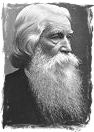
 He
was just a little curly-headed Scotch laddie, and as he played about
the thatched cottage, no one had any idea he would some day be a missionary
in the faraway islands of the South Seas.
He
was just a little curly-headed Scotch laddie, and as he played about
the thatched cottage, no one had any idea he would some day be a missionary
in the faraway islands of the South Seas.
His eventful life began May 24, 1824, in a part of the country which was so beautiful that it was called by the Scotch people, the "Queen of the South." The days spent by little John with his ten brothers and sisters in that cottage home were happy ones. Mother and father feared God, and the children were brought up to love and to serve Him too. They found it a pleasure to go to church, even if they did have to walk four miles to get there.
On Sunday evenings the family gathered for special Bible study. Each one took his turn in reading, and the questions and answers of the "Catechism" were carefully gone through. And thus the foundation was laid for a good knowledge of God's Word, and for strong Christian characters.
Mr. Paton was a stocking maker, and before young John was twelve years old he began working with his father. From six o'clock in the morning until ten at night they kept at their work, stopping half an hour for breakfast and for supper, and an hour for dinner. The days must have seemed long to the little boy, but the lessons he learned in the handling of tools and the care of machinery he found to be very helpful when he became a missionary.
There was one incident of those early days which the children never forgot. It was a hard year. The potato crop failed, and other crops were poor. Food prices were high, and the humble family, like other peasants, suffered from it. The father had gone away, expecting to return the next day with money and food, but that night the children went to bed without much supper. The trusting mother told God all about it, and assured the little ones that He would send plenty in the morning. The next day a present came from her father, who knew nothing of their circumstances, and their needs were supplied. The children were surprised to see how their mother's prayers had been answered. Gathering them around her she thanked God for His kindness and then said, "O my children, love your heavenly Father, tell Him in faith and prayer all your needs, and He will supply them, so far as it shall be for your good and His glory."
The wisest man that ever lived said, "Remember now thy Creator in the days of thy youth." The boy of our story followed that advice, and gave his heart to God while he was young. And then his one ambition was to preach the Gospel, to tell others about the salvation he had found.
There were a good many obstacles in the way of his getting an education. But he was not discouraged. To overcome obstacles is good for a young person—or for any one, for that matter—and so John kept at it until he was well fitted to work for his Master.
Happy as were the Patons in their cottage home, the day came when separations were begun. John had applied for a position in Glasgow, and must go there to be examined. It was about forty miles to Kilmarnock, where he could take a train, and he had to go on foot, because he could not afford to travel in a stagecoach. His baggage consisted of one small bundle. But the One who said, "I know thy ... poverty, (but thou art rich)," was with him, and courageously he launched out on the ocean of life.
His father, who loved this oldest son very tenderly, walked with him for six miles, and his "counsels and tears and heavenly conversation on that parting journey" were never forgotten by the son. During the latter part of the way they were speechless. The father carried his hat in his hand, and his long yellow locks fell on his shoulders, while silent prayers ascended.
When they reached the place appointed for parting, they clasped hands and the father said, "God bless you, my son! Your father's God prosper you, and keep you from all evil!"
The young man went his way, turning at the corner and waving his hat in farewell. A little farther on, he climbed the dyke for one last look, and there saw the father who too had climbed the dyke, hoping for one more glimpse of his boy. The father's eyes were not so keen as the son's, and he looked in vain for a few moments, then climbed down and started for home, his head still bared, and his heart, no doubt, still offering silent prayers for his son. In the years that followed, temptations came, as they will to every boy, but the form of his father, as he saw him in parting, seemed like a guardian angel. The blessing his father invoked was upon him and he was kept from sin.
The years which followed were busy years for young Mr. Paton—sometimes distributing tracts, sometimes teaching school, sometimes hard at work as a city missionary, and all the time fitting himself to be still more useful in the Lord's vineyard.
But the time came when he seemed to hear a voice plainly calling from the New Hebrides, and he longed to give his life as a missionary among the cannibals there. He thought and prayed about it a great deal, for he wanted to be sure that he was really called of God. When he was convinced that it was the voice of the Master, he offered himself. Dr. Bates, who was in charge of the Heathen Missions Committee, cried for joy.
Mr. Paton went to his room with a happy heart, for he was obeying God's call. To Joseph Copeland, who had been a close companion all through their college days, he said, "I have been away signing my banishment"; adding, "I have offered myself as a missionary for the New Hebrides."
Mr. Copeland said nothing, but sat and thought, long and earnestly, then said, "If they will accept me, I am also resolved to go."
Almost every one thought it very strange and very foolish for two young men to give their lives for the salvation of people so cruel and uncivilized as the natives of the South Pacific Islands. One old gentleman said, "The cannibals! you will be eaten by the cannibals!"
Mr. Paton said, "Mr. Dickson, you are advanced in years now, and your own prospect is: soon to be laid in the grave, there to be eaten by worms; and I confess to you, that if I can live and die serving and honoring the Lord Jesus, it will make no difference to me whether I am eaten by cannibals or by worms; and in the Great Day my resurrection body will arise as fair as yours in the likeness of our risen Redeemer." The old gentleman had nothing more to say.
But there were two persons who, with all their hearts, bade him God-speed, and they were the ones whose opinion he cared more for, no doubt, than for the opinions of all others put together—his own father and mother. When he was a child they had consecrated him to God for that very work. "And we pray with all our heart," they said, "that the Lord may accept your offering, long spare you, and give you many souls from the heathen world for your hire."
On the sixteenth of April, 1858, Mr. and Mrs. Paton and Mr. Copeland said good-bye to bonny Scotland, and set sail for foreign shores. They were heartily welcomed to the Island of Aneityum by the missionaries and by the Christian natives. After spending a little time there, they went on to the Island of Tanna. Mr. and Mrs. Paton settled on one side of the island, and Mr. Copeland was to spend part of his time with them.
The natives of Tanna seemed so ignorant, so wild and so sinful that Mr. Paton was almost dismayed at first. Would it be possible to teach them anything of the love of Jesus? But he thought of what had been accomplished on Aneityum, where many souls had been brought to the Lord, and he believed God could do as much for Tanna. So he began his duties in faith.
One day when he was at work, building the mission-house, assisted by one of the missionaries from Aneityum, there was a fight between two tribes. When it was over, they heard that five or six men had been shot, and that the victors had feasted on their bodies. But these horrible things only made the missionaries more eager to learn the language, so that they might tell the natives of the love of God.
The people of Tanna seemed to think the missionaries very strange creatures, and crowded around in curiosity. Of course Mr. and Mrs. Paton could not speak a word they could understand, but they nodded and smiled, and tried to be friendly.
One day Mr. Paton noticed a man picking up an article and saying to another man, "Nungsi nari enu?" Thinking he must be asking, "What is this?" Mr. Paton picked up a piece of wood, repeating the words. They smiled and answered his question. After that it was not hard to find out the names of everything around them.
Another time two men drew near, and one of them pointed to Mr. Paton, saying, "Se nangin?" Evidently he was asking his name, so Mr. Paton asked the same question of them. They smiled and told him their names. Every word he learned he carefully wrote down, spelling according to sound, and in a surprisingly short time, enough of the language was learned so that short conversations could be carried on.
When Mr. and Mrs. Paton landed on the Island of Tanna in November, both were in good health, and they expected to work together for a long time. But in February a deadly fever—the foe of foreign missionaries—attacked Mrs. Paton, and early in March she slipped away to Heaven, leaving her sorrowing husband and a baby boy less than three weeks old. Soon afterward he too was transplanted from the Island home to the Paradise of God, and Mr. Paton was left alone. He laid his loved ones away together, covering the top of the quiet grave with beautiful white coral. There he often went to pray, and in his loneliness, "God was with him."
Teaching the Tannese proved to be up-hill work. Sometimes the blessed truths of the Gospel would seem to be sinking into their darkened minds, and again all effort would seem to be lost. Sometimes the natives would seem to be very friendly, and at other times ready to kill Mr. Paton. If a drought came, they said it was caused by the missionary and his God, and then their enmity was great.
There were several men who came, Nicodemus like, at night, and in the security of Mr. Paton's house, they asked many, many questions about the religion of Jehovah. One chief said, "I would be an Awfuaki man [a Christian] were it not that all the others would laugh at me. That I could not stand"—just what many civilized boys and girls, and men and women too, have said.
The natives were adept at stealing, and many articles belonging to Mr. Paton disappeared mysteriously. If he happened to drop a small article, such as a knife or a pair of scissors, a Tanna-man would place his foot over it, looking most innocent. Bending his toes to keep it underneath his foot he would walk away, leaving the missionary to wonder, upon missing the article, what could possibly have become of it. Sometimes an article would be hidden among the plaits of hair, or underneath the arm. Sometimes it would be carried away openly, no effort being made to conceal the theft.
Once Mr. Paton had his bedclothes hung out to dry, after a long rain. He was watching, as were the wives of two Aneityum helpers, for he suspected that the natives would look with covetous eye on the bedding so displayed.
Suddenly a chief, Miaki, ran to him crying, "Missi, come in quick, quick! I want to tell you something and to get your advice." Mr. Paton followed him into the house, but Miaki had hardly begun his story when the two women cried, "Missi, Missi, come quick! Miaki's men are stealing your sheets and blankets!"
But by the time he could get outside the house the men were gone, and the sheets and blankets too. Mr. Paton charged Miaki with having deceived him, calling him into the house just to give his men a chance to steal the bedclothes. Miaki looked somewhat ashamed, but only for a moment. Then he pretended to be terribly angry at the men, and struck furiously at the bushes with his huge club, saying, "Thus will I smash these fellows, and compel them to return your clothes."
One dark night they stole all his fowls, which he had bought from them for calico and knives. He heard them and knew what they were doing, but he dared not interfere, as they would probably have taken his life if he had.
Another night they broke into his cookhouse, and carried off every one of his cooking utensils. When he told the chief about it, he said he would compel the thieves to return everything. But no thieves could be found—every one was innocent. Mr. Paton knew he must have something in which to boil water, and promised a blanket to the one who would bring back the kettle. It was returned, without the cover, by Miaki himself.
One morning there was great excitement among the people of Tanna. They rushed to the missionary crying, "Missi, Missi there is a god, or a ship on fire, or something of fear, coming over the sea! We see no flames, but it smokes like a volcano. Is it a spirit, a god, or a ship on fire? What is it? What is it?"
Mr. Paton calmly replied, "I cannot go at once; I must first dress in my best clothes; it will likely be one of Queen Victoria's men-of-war coming to ask me if your conduct is good or bad, if you are stealing my property, or threatening my life, or how you are using me."
They begged him to go and see it but he insisted that he must get ready to meet the "great chief" on the ship.
Somewhat frightened, the two principal chiefs inquired, "Missi, will it be a ship of war?"
"I think it will," he said; "but I have no time to speak to you now; I must get on my best clothes."
"Missi, only tell us," they begged, "will he ask if we have been stealing your things?"
"I expect he will."
"And will you tell him?"
"I must tell him the truth; if he asks I will tell him."
"O Missi, tell him not!" they implored. "Everything shall be brought back to you at once, and no one will be allowed again to steal from you."
"Be quick! Everything must be returned before he comes. Away! away! and let me get ready to meet the great chief on the man-of-war."
Those who before were innocent, suddenly became willing to admit their guilt, and pots, pans, knives, forks, plates, blankets and all sorts of things were speedily brought and laid down by the mission-house. Anxiously they inquired, "Missi, Missi, do tell us, is the stolen property all here?"
Mr. Paton glanced over the returned articles and said, "I don't see the lid of the kettle here yet."
"No, Missi," one of the chiefs said, "for it is on the other side of the island; but tell him not; I have sent for it and it will be here tomorrow."
The missionary charged the chiefs to remain near him, saying, "If you and your people run away, he will ask me why you are afraid, and I will be forced to tell him. Keep near me, and you are all safe; only there must be no more stealing from me."
"We are in black fear," they said, "but we will keep near you, and our bad conduct to you is done."
The tall captain and his officers, dressed in their grand uniforms, made an imposing sight, and the native chiefs were much impressed. Miaki requested that they be allowed to measure the "great chief's" height on a spear, so that all the people of the island might see how tall and great he was. The obliging captain granted the request, and the spear was afterward exhibited to thousands.
The next morning the captain met twenty chiefs, by invitation, at Mr. Paton's house. The captain advised them to do no harm to strangers and warned them of the possible consequences of such acts. He invited them to go on board the ship with him, and their amazement on seeing the great guns was great. But when two shells were shot toward the ocean, and a big ball crashed through a coconut grove, they were terrified beyond measure, and begged to be taken ashore. Each was presented with a small gift, and they long remembered their visit to the "fire-god of the sea."
But their promises of good behavior were soon forgotten, and Mr. Paton's life was in constant danger. Yet he calmly continued doing his duty, feeling sure that God would protect him till his work was done. Many a time death seemed certain, but miraculous deliverance came.
At a village near the mission-house lived Namuri, a native of Aneityum, who had been converted. By his faithful Christian life, and by his teaching, he showed the Tannese what the love of God could do.
One morning a "sacred man," jealous of Namuri's influence, tried to kill him by throwing at him a deadly weapon called a killing-stone. The teacher escaped to the mission-house, though faint and bleeding.
When he saw Mr. Paton he said, "Missi, quick! and escape for your life! They are coming to kill you; they say they must kill us all today, and they have begun with me; for they hate Jehovah, and hate us because we worship Him." Mr. Paton tenderly cared for the teacher, and in a few weeks he was better. Then he longed to go back to his village, and when Mr. Paton begged him to stay at the mission-house he said, "Missi, when I see them thirsting for my blood, I just see myself when the missionary first came to my island. I desired to murder him, as they now desire to kill me. Had he stayed away because of such danger, I should have remained heathen; but he came, and continued coming to teach us, till, by the grace of God, I was changed to what I am. Now the same God that changed me to this, can change these poor Tannese to love and serve Him. I cannot stay away from them; but I will sleep at the mission-house, and do all I can by day to bring them to Jesus."
After a few weeks the same priest attacked him again, and left him, thinking he was dead. With the little strength that was left he crawled to Mr. Paton's house. His beloved "Missi" was with him in his dying hours, caring for him and comforting him. Very patiently he bore all his sufferings, saying, "For Jesus' sake! For Jesus' sake!" For those who had so cruelly persecuted him he prayed, "O Lord Jesus, forgive them, for they know not what they are doing. Oh, take not away all Thy servants from Tanna! Take not away Thy worship from this dark island! O God, bring all the Tannese to love and follow Jesus!" And so he passed away, a faithful martyr. Mr. Paton himself made Namuri's coffin and dug his grave, and tearfully and prayerfully they laid him away.
After building a second dwelling-house -- the first one having been in a very unhealthful location -- and then erecting a church, which was to serve as a schoolhouse also, Mr. Paton turned his attention to printing, which was an occupation entirely new to him. A printing-press and a font of type had been given to him, and so when he had translated a small portion of the Bible into Tannese, he began the laborious work of setting the type. He found printing to be far more of a task for him than carpenter work had been, but he kept at it. At last the type was set, the pages properly arranged, and the booklet was ready to be printed. It was a happy moment when the first sheet came from the press—the first bit of God's Word ever printed in Tannese. Although it was one o'clock in the morning, Mr. Paton shouted for joy, threw his hat into the air, and danced around and around the press. He almost wondered if he were losing his reason, but he decided he had just as good a right to praise the Lord in that way as David had to dance before the ark in olden days. I think so too; don't you?
Most of the English traders who visited the New Hebrides were cruel, wicked men, who seemed to take delight in torturing the poor, ignorant natives. One of their most cruel acts was to bring the measles among them. This they did intentionally, glorying in the fiendish deed.
The natives, not knowing how to care for themselves, suffered far more from the measles than white people do, and scores and scores of them died. Some hoping relief from the burning fever, plunged into the ocean, and death was the result. Others dug holes in the ground, where they lay until they died. They were buried in the graves they had thus made for themselves. A number of Mr. Paton's Aneityumese helpers succumbed to the disease, and the rest, in terror, took a boat for their own island as soon as they had a chance—all but faithful old Abraham, who had been Mr. Paton's devoted helper in many a time of sickness and trial. When all the rest were leaving, he too packed his few belongings, and planned to go. But when he saw that the thought of his going grieved Mr. Paton, he asked, "Missi, would you like me to remain alone with you, seeing my wife is dead and in her grave here?"
"Yes," Mr. Paton said, "I should like you to remain; but considering the circumstances in which we will be left alone, I cannot plead with you to do so."
Abraham's dark face lighted with the joy of sacrifice as he replied, "Then, Missi, I remain with you of my own free choice, and with all my heart. We will live and die together in the work of the Lord. I will never leave you while you are spared on Tanna."
Another dear friend was Kowia, a Tannese chief who had been converted on Aneityum. His death brought mingled sorrow and joy—sorrow, because so faithful a helper was gone; and joy, that one native of Tanna had fallen asleep in Jesus with the bright hope of a glad resurrection.
The days that followed on Tanna were dark ones for Mr. Paton and faithful old Abraham. The hatred of the natives increased, and the lives of the Christians were in constant danger.
On the island of Erromanga a bloody scene was enacted about this time. In the earlier days two missionaries had been clubbed to death a few minutes after their arrival on Erromanga, and the savages had feasted on their bodies. But in time, other brave missionaries took their places, and for four years Mr. and Mrs. Gordon had worked there. Things seemed to be going well at the Erromangan mission, when suddenly Mr. and Mrs. Gordon were murdered.
The news of the horrible deed spread, and the Tannese seemed to admire the courage of the Erromangans.
Mr. Paton heard one of the chiefs shout, "My love to the Erromangans! They are strong and brave men, the Erromangans. They have killed their Missi and his wife, while we only talk about it. They have destroyed the worship and driven away Jehovah!"
When Mr. Paton warned them that God would yet punish the Erromangans, they cried, "Our love to the Erromangans! Our love to the Erromangans!"
In every danger, Abraham stood by Mr. Paton, refusing to leave him. One evening while they were praying together, Abraham prayed, "Our Lord, our hearts are pained just now, and we weep over the death of Thy servants; but make our hearts good and strong for Thy cause, and take Thou away all our fears. Make us two and all Thy servants strong for Thee and for Thy worship, and if they kill us two, let us die together in Thy good work, like Thy servants Missi Gordon the man and Missi Gordon the woman." Can you imagine how Mr. Paton's heart was touched at such a prayer?
For a long time Mr. Paton refused to leave what he believed to be his post of duty, even though a musket was frequently leveled at him, a spear poised, or a club swung in the air, ready to do its deadly work. But the time came when the only right course seemed to be to escape for their lives. After untold perils, they reached the Mathieson's mission-station, on the other side of the island.
The danger there was just as great, and together they watched and prayed for a chance to leave the island. The last night on Tanna was a terrible one, but God's angels encamped around them, and kept them from harm, as His Word has promised.
About ten o'clock Mr. Paton was awakened from sleep by his little dog, Clutha. He awoke the Mathiesons, and as they watched from within the house, they saw a company of savages with flaming torches set fire to the church, and then to the reed fence that connected the church and house. A few moments more, and the house would be on fire, while armed men waited ready to kill the missionaries as soon as they tried to escape.
With a small American tomahawk in one hand and a harmless revolver in the other, Mr. Paton ran out, cut the fence, and threw it into the flames. Seeing shadows on the ground, he looked up, finding himself surrounded by seven or eight savages, with their huge clubs raised. "Kill him! Kill him!" they shouted. Leveling the revolver as if to shoot, Mr. Paton said, "Dare to strike me, and my Jehovah God will punish you. He protects us, and will punish you for burning His church, for hatred to His worship and people, and for all your bad conduct. We love you all; and only for doing you good you want to kill us. But our God is here now to protect us and to punish you."
They yelled in savage hate, but no one seemed willing to strike the first blow. Just at that moment an awful tornado of wind and rain was heard coming from the south. If it had come from the north, the flames from the burning church would have reached the house and it would surely have been destroyed. But the wind blew the flames away from the house, and soon a torrent of rain was falling. The natives terror-stricken said, "That is Jehovah's rain! Truly their Jehovah is fighting for them and helping them. Let us away!" Soon every one of them had gone and Mr. Paton went to the mission-house. As he entered, Mr. Mathieson exclaimed, "If ever, in time of need, God sent help and protection to His servants in answer to prayer, He has done so tonight! Blessed be His holy name!"
In the morning their enemies renewed the attack, determined to have the missionaries out of the way. They were nearing the house when, in the midst of the excitement, was heard the cry, "Sail O! Sail O!" Yes, a boat was approaching, sent from Aneityum to rescue the missionaries, if yet alive. After some trying delays, they boarded the ship and sailed for Aneityum.
Not long afterward, both Mr. and Mrs. Mathieson died, and Mr. Paton was left alone to tell the story of the mission on Tanna. In after years the seed that had been sown sprang up, and other missionaries ministered as Mr. Paton had hoped to do, to a little church composed of converted Tannese.
Mr. Paton had planned to stay on Aneityum and continue his translation of the Bible, and then to go back to Tanna as soon as the way opened. But the other missionaries thought it would be best for him to go to Australia, to interest the Christians there in the work on the New Hebrides. Somewhat reluctantly he took the trip, but it proved to be a very successful one.
The missionaries needed a ship in which they could go from place to place among the Islands, and Mr. Paton thought of a very successful plan for getting it. Every boy or girl who gave sixpence became the owner of a share in the vessel.
The children were delighted with this plan and gladly brought their pennies. Soon enough money was given, and Mr. Paton sent it to Nova Scotia, where the boat was to be built. It was a beautiful little vessel when completed, and was named the "Dayspring." Thousands of the little "shareholders" visited their ship which was to carry the Gospel to the New Hebrides.
Traveling in Australia in those days was rather difficult, and Mr. Paton encountered many hardships.
Whenever he could travel by coach or by train, he availed himself of the opportunity; sometimes kind friends helped him to get from one place to another, and sometimes he walked.
Once he had an appointment nine miles away. No horse could be hired, and so he started out on foot, carrying a bag of curios and a heavy bundle of clubs, arrows, and dresses from the Islands. He trudged on, his bundle and bag growing heavier all the time. At length he met some men hurrying with ropes to the rescue of a poor animal which was almost buried in the mire of the road. They pointed out a light, and advised him to go straight toward it.
He did so, but soon found himself lost in a swamp. He called and called, but no one heard -- no one save God. About midnight, he heard two men in conversation, apparently not far away. Summoning all his strength he called and was heard.
"Who's there?"' a voice called.
"A stranger. Oh do help me!"
"How did you get in there?"
"I have lost my way."
One of the men said to the other, "I will go and get him out, whoever he may be. 'We must not leave him there; he'll be dead before the morning. As you pass by our door, tell my wife that I am helping some poor creature out of the swamp, and will be home immediately."
He succeeded in rescuing Mr. Paton from the swamp, and took him to his destination, where he was kindly received. The next day, though somewhat sore from carrying his heavy burdens, he held three services and told the story of the mission.
But perhaps his most thrilling adventure in Australia was his wild ride on "Garibaldi," a race horse. Mr. Paton was not used to horseback riding, but as there seemed to be no other way to get to a certain appointment twenty-two miles away, he accepted the kind offer of Garibaldi's mistress, and started out.
He rode along slowly for some distance, until passed by some gentlemen who were rather amused at his awkward riding. They advised him to quicken his horse's pace, but he explained that his safety was in going slowly, so they rode on ahead.
But Garibaldi had been trained for racing, and he determined not to be beaten. Despite all Mr. Paton's efforts to hold him back, he bounded forward with great speed. A thunderstorm broke, which seemed to urge Garibaldi to a still wilder pace. On, on they dashed, until they saw a farmhouse before them, and Garibaldi made for it, evidently having been there at some time before.
It happened to be the very place Mr. Paton was bound for and the family were on the lookout for him. A young man ran out, threw the gates open and succeeded in stopping the runaway horse. "I have saved your life," he said; "what madness to ride like that!" Mr. Paton could scarcely speak, but he tried to explain his situation.
When helped from the horse, he was so dizzy from his wild ride that he could not stand, and fell down in the mud, where he was obliged to sit until he could gain control of himself.
His situation was extremely embarrassing. He knew they all thought he was drunk, and indeed, he did appear like a drunken man. His clothing was wet and mud-bespattered, and his baggage would not be there until later. The farmer finally loaned him a suit of his own, which was several sizes too large, but made him more comfortable, nevertheless.
When he inquired whether any arrangements had been made for a meeting, the farmer, still thinking him drunken asked, "Do you really consider yourself fit to appear before an audience tonight?"
At tea Mr. Paton again tried to convince the family that he was sober, saying, "Dear friends, I quite understand your feelings, appearances are so strongly against me. But I am not drunken as you suppose. I have tasted no intoxicating drink; I am a lifelong abstainer." At this they laughed outright, as if to say, "Man, you're drunk at this very moment."
But they finally told him of the arrangements they had made, and the meeting was held. They became greatly interested, and thereafter treated him with the greatest kindness.
After Mr. Paton had traveled through Australia and awakened much interest in the New Hebrides mission work, it was thought best for him to go to Scotland for the same purpose. He had been gone from his native land five years, and was warmly welcomed back to the home of his childhood. His saintly parents still lived, and greeted him with rejoicing and tears.
In Scotland Mr. Paton met Miss Margaret Whitecross, a godly young woman well fitted for missionary work. They were married at her sister's home, and together they sailed for their chosen field—the Islands of the South Seas. They reached Aneityum August 20, 1866, where he learned that during his absence faithful old Abraham had gone to his heavenly reward. Mr. Paton had sent him from Australia a silver watch which he prized highly. When he was dying he said, "Give it to Missi, my own Missi Paton; and tell him that I must go to Jesus, where Time is dead."
Mr. and Mrs. Paton opened a new mission station on the Island of Aniwa, and began work, full of faith and courage.
One of the first things to be done on Aniwa was to build a house, and when it was finished it was roomy, comfortable, and healthful, though not especially beautiful.
One day while at work Mr. Paton needed some tools, and so, writing a note on a bit of wood, he handed it to a chief who was helping him, and asked him to give it to Mrs. Paton.
"But what do you want?" the old chief asked wonderingly.
"The wood will tell her," Mr. Paton replied.
The chief rather thought Mr. Paton was fooling him, but did as he requested. Mrs. Paton looked at the wood and then, to the surprise of the old chief, gave him just what Mr. Paton wanted. The missionary then took the opportunity of telling him about the Bible, where God's will was written; and just as Mrs. Paton heard him "speak" from the wood, so the old chief, when he learned to read, could hear God "speak" from the Bible.
After a few years had passed, the mission premises looked like an attractive little village, with church, school, orphanage, printing office and other buildings. Surrounding all was a neat, painted fence. The natives began to see that the white man's ways of living were better than their own, and gradually they adopted civilized customs.
The missionaries were not without opposition on Aniwa. But the natives were never so hostile as the Tannese, and it was not very long before the Word of God began to take root in their hearts.
The first Aniwan to turn to the Lord was the old chief, Namakei. From the beginning he was friendly, and finally the light of God broke into his darkened soul. From the time of his conversion until his death, he was Mr. Paton's faithful helper.
One of the difficulties on Aniwa was a lack of water, and Mr. Paton decided to dig a well, trusting that God would prosper his effort.
When he suggested his plan to Namakei, the old chief was amazed and tried to discourage him, declaring that rain never came from below. Mr. Paton assured him that in his own land, fresh water came springing up from the earth, but Namakei was positive such a thing would never happen on their island. Surely Missi had gone mad.
Digging the well was hard work, but Mr. Paton kept bravely at it. By offering them fishhooks, he persuaded some of them to help him, and felt very thankful when one evening he found the prospective well was twelve feet deep. But the next morning, to his dismay, he found that one side had caved in, and their work seemed fruitless, that all their labor had been in vain.
Namakei was more convinced than ever that rain would never come through the earth on Aniwa, and earnestly expostulated with Mr. Paton.
"Had you been in that hole last night," he said gravely, "you would have been buried, and a man-of-war would have to come from Queen 'Toria to ask for the Missi that lived here. We would have to say, 'he is down in that hole.' The captain would ask, 'Who killed him and put him down there?' We would have to say, 'He went down there himself.' The captain would answer, 'Nonsense! who ever heard of a white man going down into the earth to bury himself! You killed him, you put him there; don't hide your bad conduct with lies!' Then he would bring out his big guns and shoot us, and destroy our island in revenge. You are making your own grave, Missi, and you will make ours too. Give up this mad freak, for no rain will be found by going downward on Aniwa. Besides all your fish-hooks cannot tempt my men again to enter that hole; they don't want to be buried with you. Will you not give it up now?"
But Mr. Paton persevered. When the well had been dug about thirty feet deep, the earth began to feel damp, and one evening he said to Namakei, "I think that Jehovah God will give us water tomorrow from the hole."
"No, Missi," the old chief replied, "you will never see rain coming up from the earth on this island. We wonder what is to be the end of this mad work of yours. We expect daily, if you reach water, to see you drop through into the sea, and the sharks will eat you! That will be the end of it; death to you, and danger to us all."
The next morning Mr. Paton went down into the well. He dug a little bit more and the water came! It was muddy, but he tasted it, and it was fresh.
The natives were eagerly waiting when Mr. Paton appeared with a jug full of water from Jehovah's well. Namakei shook it, touched it, and at last tasted it, then cried, "Rain, Rain! Yes, it is rain! But how did you get it?"
"Jehovah, my God, gave it out of His own earth in answer to our labors and prayers. Go and see it springing up for yourselves!"
When they had looked cautiously into the well and had seen "Jehovah's rain," Namakei said, "Missi, wonderful is the work of your Jehovah God! No god of Aniwa ever helped us in this way. The world is turned upside down since Jehovah came to Aniwa! But, Missi, will it always rain up through the earth, or will it come and go like the rain from the clouds?"
Mr. Paton assured them that it would remain, and that every one on the island might use as much of it as he wished. Very willingly they brought coral blocks and helped him to wall it up, and all rejoiced over the wonderful gift of Jehovah. The old chief requested Mr. Paton to let him preach a sermon about the well, and he did so. He declared his faith in Jehovah, the living God, and asked the people to bring their useless gods of wood and stone to be destroyed. "Namakei stands up for Jehovah!" he said as he closed his sermon.
And so the religion of Jehovah began to find its way into their hearts.
Old Namakei was greatly interested in the printing department of the mission work. Mr. Paton had secured a somewhat dilapidated printing press, and a small supply of type. By the exercise of ingenuity and perseverance, he succeeded in doing some printing, though the toil and worry it cost him were sufficient to have "broken the heart of many a compositor," he said.
When the first book was in preparation, Namakei would ask, morning after morning, "Missi, is it done? Can it speak?"
When at last it was finished, the old chief asked eagerly, "Does it speak my words?"
"It does."
"Make it speak to me, Missi! let me hear it speak."
Mr. Paton read to him some of the passages of Scripture of which the book was composed, and the old chief joyfully exclaimed, "It does speak; it speaks my own language, too! Oh, give it to me."
After pressing it to his heart, and turning it around he handed it back saying disappointedly, "Missi, I cannot make it speak! It will never speak to me."
Mr. Paton explained that when he had learned to read he could make it speak.
"O Missi, dear Missi, show me how to make it speak!" was the old chief's eager request.
He seemed to be straining his eyes and Mr. Paton suspected that his sight was poor, so he found a pair of glasses to fit him. At first Namakei was afraid to put them on, but when at last he had been persuaded, he cried joyfully, "I have gotten back the sight I had when a boy. O Missi, make the book speak to me now!"
Mr. Paton gave him the first three letters of the alphabet and soon he had mastered them. He ran to the missionary saying, "I have lifted up A, B, C. They are here in my head now and I will hold them fast. Give me other three."
The old man applied himself so diligently that the alphabet was soon learned and he was able to read small words. In time he could read nicely, and to young people and strangers he would say, "Come, and I will let you hear how the book speaks our own Aniwan words. You say it is hard to learn to read and make it speak. But be strong to try! If an old man like me has done it, it ought to be much easier for you."
Namakei's wife, Yauwaki, was afraid to go near the mission-house, but one day, being induced to look inside, she exclaimed in wonder. When Mrs. Paton began to play on the harmonium she seemed charmed and soon ran away to call the women and girls of her village "to hear the 'bokis' (their way of pronouncing 'box') sing."
One day Namakei said to Mr. Paton, "Missi, can you give my wife also a pair of new glass eyes like mine? She tries to learn, but she cannot see the letters. She tries to sew, but she pricks her finger, and throws away the needle, saying, 'The ways of the white people are no good!' If she could get a pair of glass eyes, she would be in a new world like Namakei." Mr. Paton found a pair for her and when at last she was induced to put them on she exclaimed, "Oh, my new eyes! my eyes! I have the sight of a little girl. Oh, my new eyes!"
Every Aniwan who became a Christian began at once to have family prayers, and ask a blessing on each meal. The food might be scanty and not the best, but he never forgot to thank his heavenly Father for it. One day Mr. Paton heard a man gratefully thanking God for the meal spread before him and his family. It was during a time when food was very scarce, and upon approaching them, he saw the family partaking of cooked fig leaves. I think many a white person could learn a lesson from this.
A very important part of the missionary family were the orphans. These poor little waifs were practically adopted by the missionaries, and many of them became efficient Christian workers.
One time they were suffering from want of food, and went to Mr. Paton saying, "Missi, we are very hungry."
"So am I, dear children," the kind missionary replied, "and we have no more white food till the 'Dayspring' comes."
"Missi," they said, "you have two beautiful fig trees. Will you let us take one feast of the young and tender leaves? We will not injure branch or fruit."
Mr. Paton gladly gave permission, and soon the children were perched in the trees like so many squirrels, enjoying their feast.
At last the supplies came, and among them was a cask of biscuits and the orphans gathered around it. "Missi," they asked, "have you forgotten what you promised us?"
"What did I promise you?"
Disappointed, they whispered, "Missi has forgot."
"Forgot what?"
"Missi, you promised that when the vessel came you would give us each a biscuit."
"Oh," said Mr. Paton, "I did not forget; I only wanted to see if you remembered it."
Laughing, they replied, "No fear of that, Missi! Will you soon open the cask? We are dying for biscuits."
When each boy and girl had received a biscuit, the oldest one said, "We will first thank God for sending us food, and ask Him to bless it to us all." A simple, childlike prayer was offered, and then the orphans ate their biscuits, enjoying them as only hungry boys and girls can.
Old Namakei was greatly pleased when a baby boy came to the Patons—the first white baby ever born on Aniwa. He wanted him called Namakei the Younger, though the father and mother did not greatly appreciate the honor.
At one time when armed natives surrounded the mission-house, determined to murder the missionaries, the little boy slipped away from his parents, and ran out among the warriors. When he had hugged and kissed each one, he seated himself on the knee of the ringleader, and scolded them all, calling them, "Naughty! Naughty!" Their frowns turned to grins, and one by one they slipped away.
When Namakei was very old and feeble, he greatly desired to visit the Island of Aneityum with Mr. Paton, and attend the yearly meeting of the missionaries.
Very affectionately he bade his people good-bye, realizing that he might not see them again. In parting he pled with them to be "strong for Jesus." When he heard how one island after another was accepting the Gospel, he said, "Missi, I am lifting up my head like a tree. I am growing tall with joy."
After a few days on Aneityum he said, "Missi, I am near to die! I have asked you to come and say farewell. Tell my daughter, my brothers, and my people to go on pleasing Jesus, and I will meet them again in the fair world."
Mr. Paton helped him to lie down under the shade of a banyan tree, and then he whispered, "I am going! O Missi, let me hear your words rising up in prayer, and then my soul will be strong to go."
As well as he could in the midst of his sobs, Mr. Paton prayed, and then the old chief said, "O my Missi, my dear Missi, I go before you, but I will meet you again in the home of Jesus. Farewell."
Missionaries and Christian natives mingled their tears over his grave—the grave of one who had once been a cannibal, with human bloodstains on his hands. But the blood of Jesus washed those stains away and transformed him into a saint. "If any man be in Christ," truly "he is a new creature."
Mr. and Mrs. Paton worked patiently, faithfully on, and the day came when Aniwa was a Christian island.
During his last years Mr. Paton traveled a great deal, but not for pleasure. His one aim was that the work of God in his beloved Islands might be carried on, and to that end he constantly toiled. And when at last the long and useful life came to a close, he could pillow his dying head with the satisfaction that comes from "duties well performed, and days well spent."
From Hearts Aflame by Florence Huntington Jensen. Waukesha, Wisc.: Metropolitan Church Assn., ©1932.
>> More John Paton