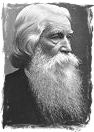
 John
Gibson Paton: Presbyterian missionary; born at Kirkmahoe (9 miles north
of Dumfries), Scotland, May 24, 1824; died at Canterbury, Victoria,
Australia, January 28, 1907. He was educated at the University of Glasgow,
the divinity hall of the Reformed Presbyterian Church, and the Andersonian
medical university, all in Glasgow, where he was a city missionary
from 1847 till 1857. He was licensed December 1, 1857, and ordained
a missionary to the New Hebrides March 23, 1858, and left Glasgow with
his wife Mary Ann Robson on April 16. At Melbourne they transhipped
to Aneityum where they landed August 30. He began his labors on the
island of Tanna November 5, 1858. There, on February 12, 1859, his
wife died in child-bed, and her infant son, March 20. The natives proved
to be intractable and he was finally driven away by their savage attacks
on February 4, 1862.
John
Gibson Paton: Presbyterian missionary; born at Kirkmahoe (9 miles north
of Dumfries), Scotland, May 24, 1824; died at Canterbury, Victoria,
Australia, January 28, 1907. He was educated at the University of Glasgow,
the divinity hall of the Reformed Presbyterian Church, and the Andersonian
medical university, all in Glasgow, where he was a city missionary
from 1847 till 1857. He was licensed December 1, 1857, and ordained
a missionary to the New Hebrides March 23, 1858, and left Glasgow with
his wife Mary Ann Robson on April 16. At Melbourne they transhipped
to Aneityum where they landed August 30. He began his labors on the
island of Tanna November 5, 1858. There, on February 12, 1859, his
wife died in child-bed, and her infant son, March 20. The natives proved
to be intractable and he was finally driven away by their savage attacks
on February 4, 1862.
He then began those tours in behalf of New Hebrides mission work which were ultimately to make him known throughout all the English-speaking world. He went first to the Presbyterian churches of Australia and New Zealand. In 1864 he visited Scotland, was elected moderator of the General Synod of the Reformed Presbyterian Church, secured seven missionaries for the New Hebrides, and returned with his second wife, Margaret Whitecross. He landed in Sydney January 17, 1865, made another tour of the churches, and visited the New Hebrides. In November, 1866, he became a missionary on one of the islands, Aniwa. He held his first communion there October 24, 1869, and ultimately saw all the natives nominal Christians. In March, 1873, he visited the Australasian colonies to raise money; returned to Aniwa the next year, but in 1883 laid before the General Assembly of the Presbyterian Church of Victoria the necessities of the New Hebrides mission and was sent by it in 1884 to Great Britain to raise the money. He returned with the funds desired early the next year, visited Aniwa, but then took up his missionary tours again through Australasia between 1886 (when he was elected moderator of the Presbyterian Church of Victoria) and 1892, then through the United States and Canada, and so around the world, returning to Victoria in 1894.
In 1897 he was in Melbourne carrying through the press the New Testament in the Aniwan language. In 1899 he was in Aniwa. In 1900 he attended the Ecumenical Missionary Conference in New York City, and was hailed as a great missionary hero. In 1901 he was back in Australia. His health had begun to fail, his wife was also ailing, and on May 16, 1905, she died. In 1904 he issued his translation into Aniwan of the Acts of the Apostles and began proofreading on that of Genesis.
He was a man of picturesque appearance and bore his testimony with great power. He described himself as theologically "a Presbyterian Evangelical Calvinist of the old Covenanter Reformed Church of Scotland." He wrote many pamphlets on missionary topics, and also to expose the evils of the Kanaka labor traffic, as well as opposing the French annexation of the New Hebrides in favor of British occupation. But the book which made him famous was his autobiography, whose sale was enormous on the strength of his perils on Tanna and Aniwa. The book owed much to the literary skill of his brother, Rev. James Paton, D. D. (who died in Glasgow December 21, 1906), and appeared in three parts, John G. Paton, Missionary to the New Hebrides. An Autobiography. Edited by his Brother (New York, 1st part, 1889, 2nd part 1890; parts three and four, carrying the story from 1885 till his death, appeared bound up with the other parts, 1907).
Bibliography: Besides the Autobiography, consult Harriet B. Genung, J. G. Paton, Missionary to the Martyr Islands, Boston. 1907.
From The New Schaff-Herzog Encyclopedia of Religious Knowledge... New York: Funk and Wagnalls Company, 1910.
>> More John Paton