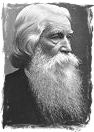
 John
Gibson Paton (1824-1907), missionary to the New Hebrides, born on
24 May 1824 at Braehead, Kirkmahoe, Dumfriesshire [Scotland], was
eldest of the eleven children (five sons and six daughters) of James
Paton, a peasant stocking-maker, by his wife Janet Jardine Rogerson.
Both parents were of covenanting stock and rigid adherents of the
'Reformed Presbyterian Church of Scotland,' which still represented
the faith of the covenanters. When Paton was five years old, the
family removed to Torthorwold, a few miles from Dumfries, where
his parents passed the remaining forty years of their lives. Here
he attended the parish school, till, in his twelfth year, he was
put to his father's trade of stocking-making. Paton soon freed himself
from the family workshop, and began to support and educate himself.
He put himself for six weeks—all he could afford—to Dumfries
Academy; he served under the surveyors for the ordnance map of Dumfries;
he hired himself at the fair as a farm labourer; he taught, when
he could get opportunity, in schools, and even for a time set up
a school for himself; but every spare moment was devoted to serious
study. At last he settled down for ten years as a city missionary
in a then very neglected part of Glasgow, where he created an excellent
school and put the whole district in order.
John
Gibson Paton (1824-1907), missionary to the New Hebrides, born on
24 May 1824 at Braehead, Kirkmahoe, Dumfriesshire [Scotland], was
eldest of the eleven children (five sons and six daughters) of James
Paton, a peasant stocking-maker, by his wife Janet Jardine Rogerson.
Both parents were of covenanting stock and rigid adherents of the
'Reformed Presbyterian Church of Scotland,' which still represented
the faith of the covenanters. When Paton was five years old, the
family removed to Torthorwold, a few miles from Dumfries, where
his parents passed the remaining forty years of their lives. Here
he attended the parish school, till, in his twelfth year, he was
put to his father's trade of stocking-making. Paton soon freed himself
from the family workshop, and began to support and educate himself.
He put himself for six weeks—all he could afford—to Dumfries
Academy; he served under the surveyors for the ordnance map of Dumfries;
he hired himself at the fair as a farm labourer; he taught, when
he could get opportunity, in schools, and even for a time set up
a school for himself; but every spare moment was devoted to serious
study. At last he settled down for ten years as a city missionary
in a then very neglected part of Glasgow, where he created an excellent
school and put the whole district in order.
The 'Reformed Church,' by which John Paton was ordained, had already a single missionary, the Rev. John Inglis, at Aneityum, the southernmost of the New Hebrides Islands in the South Seas; and the elders of the church were seeking somewhat vainly for volunteers to join in that hazardous enterprise. Paton offered himself, and was accepted. On 1 December 1857 he was licensed as a preacher, in his thirty-third year, and on 23 March following he was ordained. With his newly married young wife, Mary Ann Robson, he reached the mission station at Aneityum on 30 August, and the pair were soon sent on to establish a new station in the island of Tanna, the natives of which were then entirely untouched by Western civilisation, except in so far as they had from time to time been irritated by aggression on the part of sandalwood traders. The young Scotchman and his wife, without any experience of the world outside the small body to which they belonged, were thus the first white residents in an island full of naked and painted wildmen, cannibals, utterly regardless of the value of even their own lives, and without any sense of mutual kindness and obligation. A few months later, in March 1859, a child was born to this strangely placed couple, and in a few days more wife and child were both dead.
Paton, alone but for another missionary on the other and almost inaccessible side of the island, was left for four years to persuade the Tannese to his own way of thinking. In May 1861 a Canadian missionary and his wife, on the neighbouring island of Erromango, were massacred; and the Tannese, encouraged by the example, redoubled their attacks on Paton, who, after many hairbreadth escapes, got safely away from Tanna, with the loss of all his property except his Bible and some translations which he had made into the island language during his four years' struggle.
From Tanna Paton reached New South Wales, where he knew no one, walked into a church, pleaded successfully for a few minutes' hearing, and spoke with such effect that from that moment he entered on the career of special work which was to occupy the remaining forty-five years of his long life. His main objects—in which he succeeded to a marvellous degree—were to provide missionaries for each of the New Hebridean Islands, and to provide a ship for the missionary service. As the direct result of his extraordinary personality and power of persuasion, the 'John G. Paton Mission Fund' was established in 1890 to carry on the work permanently. Returning for the first time to Scotland (1863-4), he there married again, and with his new wife and certain missionaries whom he had persuaded to join in his work was back in the Pacific early in 1865. After placing the new missionaries in various islands, Paton himself settled on the small island of Aniwa, the headquarters whence from 1866 to 1881 he contrived to make his influence felt. After 1881 his 'frequent deputation pilgrimages among the churches in Great Britain and the colonies rendered his visits to Aniwa few and far between,' and his headquarters were at Melbourne.
In addition to his special work as missionary he took considerable part in moving the civil authorities—not merely British, but also those of the United States—to check the dangerous local traffic in strong drink and firearms. He also resisted the recruiting of native labour from the islands; and he lost no opportunity of protesting against the growth of non-British influence in the same places.
During a visit home in 1884, at the suggestion of his youngest brother, Dr. James Paton, the missionary somewhat reluctantly undertook to write his autobiography. James Paton (1843-1906), who had also passed from the ministry of the 'reformed' to that of the Free Church of Scotland, and had graduated D.D. of Glasgow University, shaped his brother's rough notes into a book which, first published in 1889, has played a great part in spreading Paton's influence.
His last years were mainly spent in Melbourne. He died there on 28 January 1907, and was buried in Boroondara cemetery.
Paton's second wife, Margaret, whom he married at Edinburgh in 1864, was daughter of John Whitecross, author of books of scriptural anecdote, and was a woman of great piety and strong character. She showed literary ability in her 'Letters and Sketches from the New Hebrides' (1894), and remarkable power of organisation in her work for the Australian 'Presbyterian Women's Missionary Union.' She was of great assistance to her husband up to her death on 16 May 1905; in her memory a church was erected at Vila, now the center of administration in the New Hebrides. By her Paton had two daughters and three sons. Two sons became missionaries in the New Hebrides; and one daughter married a missionary there.
[John G. Paton, Missionary to the New Hebrides: an Autobiography, edited by his brother, the Rev. James Paton, D.D., with portrait and map (2 pts. 1889); vol. i. 1891; 're-arranged and edited for young folks,' 1892 and 1893 (a penny edition); Letters and Sketches from the New Hebrides, by Mrs. John G. Paton, 1894; John G. Paton, Later Years and Farewell: a Sequel, by A. K. Langridge and (Paton's son) Frank H. L. Paton, 1910; The Triumph of the Gospel in the New Hebrides, by Frank H. L. Paton, 1903.]
Originally published in Dictionary of National Biography. Supplement 1901-1911. London: Smith, Elder, & Co., 1912.
>> More John Paton