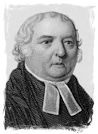
 The
missionary heroes whose histories have been already sketched in this
volume, found their fields of valour and devotion amongst races which,
however benighted, were yet to a great degree civilized, and in some
instances positively refined; but we have now to turn to the history
of men who spent their lives amidst barbarians, and who won their
noblest trophies among cannibals and savages. Foremost of the band
stands Samuel Marsden, the "Apostle of New Zealand." This
sturdy Yorkshireman, whom no dangers could affright, and whom no
difficulties could deter, like many of his fellow-heroes, was born
of humble parents, at Horsforth, in the neighbourhood of Leeds, [England],
in 1764, and after having received an elementary education in his
native village was transferred to the Grammar School of Hull, which
was then presided over by Dr. Milner, the well-known ecclesiastical
historian.
The
missionary heroes whose histories have been already sketched in this
volume, found their fields of valour and devotion amongst races which,
however benighted, were yet to a great degree civilized, and in some
instances positively refined; but we have now to turn to the history
of men who spent their lives amidst barbarians, and who won their
noblest trophies among cannibals and savages. Foremost of the band
stands Samuel Marsden, the "Apostle of New Zealand." This
sturdy Yorkshireman, whom no dangers could affright, and whom no
difficulties could deter, like many of his fellow-heroes, was born
of humble parents, at Horsforth, in the neighbourhood of Leeds, [England],
in 1764, and after having received an elementary education in his
native village was transferred to the Grammar School of Hull, which
was then presided over by Dr. Milner, the well-known ecclesiastical
historian.
It is said that for a time he worked at the anvil, but that he evinced no ordinary literary promise seems certain from the fact that he was adopted by the "Eland Society," which sought out young men of talent for the ministry, and by it was sent to complete his education at St. John's, Cambridge. This occurred some few years before Henry Martyn became a student at the same College. Before, however, Marsden had taken his degree, the offer of a colonial chaplaincy amongst the convicts of New South Wales was made to him through the influence of Mr. Wilberforce, and on the recommendation of the Rev. Charles Simeon, who had early discovered the peculiar fitness of the young mechanic for a post which was as rough and arduous as it was noble and self-denying. How little did either he or his patrons know for what a destiny God's providence was preparing him!
The youthful chaplain was waiting at Hull, with his newly-wedded bride, for the sailing of the ship which was to carry them to their "distant banishment," when just as he was entering the pulpit on Sunday morning, the signal-gun was fired, and he and his wife had to set out at once for the beach, accompanied by the whole congregation, to whom, instead of a sermon, he gave his parting benediction, and then set sail amidst their prayers and their farewells.
While the vessel waited at Portsmouth for her cargo of convicts, Marsden visited the Isle of Wight, and it was a sermon of his in Brading Church that led to the conversion of "the Dairyman's Daughter," whose touching story has been so well told by Leigh Richmond in his "Annals of the Poor."
It was a rough and in many respects an unpleasant charge that awaited Marsden at Paramatta [now spelled Parramatta; New South Wales, Australia]. The colony was composed of the worst of felons and bush-rangers ... a vicious population who had been banished from their own land for every conceivable crime, and for whose reformation and instruction scarcely anything had been done. The work allotted to him was enough to appall the stoutest heart, but the heroic clergyman entered upon it with the faith of a man who believed in his mission, and though he was thwarted and opposed and misrepresented at every step by those in authority, he still persevered "through evil report " (we cannot add "and through good report") in carrying out his own well-laid plans for the benefit of the abandoned criminals who formed his charge, and for that of the reckless and brutish population which surrounded them. It was the policy, and oftentimes the base self-interest of those who held power in the colony to resist all attempts at reformation and improvement; and as the brave and godly chaplain persisted in his efforts, he was constantly assailed with personal abuse, official misrepresentation, and newspaper libels. Again and again he had to appeal for protection to the laws of his country, and on each occasion with success; till at last his philanthropic efforts won the notice and approbation of such friends of the human race as Lord Gambier, William Wilberforce, and Elizabeth Fry; and better still, his suggestions on behalf of the moral and spiritual welfare of the colony were adopted by the Government at home.
It was during a visit which he paid to England in 1807, for the purpose of laying his plans before the authorities, that he pleaded the cause of New Zealand with the Church Missionary Society, and thus laid the foundation of one of the most remarkable missions of modern times.
Fourteen years previously, when on his first voyage to New South Wales, he had read "The Life of Brainerd," and it had kindled in his bosom, as it has kindled in many others, a flame of missionary zeal. Whilst engaged in his projects for the colonists, he did not lose sight of the despised Australian natives, and made frequent though abortive efforts for their good; but his attention was more particularly directed to the New Zealanders. They were feared and hated in New South Wales; but Marsden soon discovered them to be a noble type of savage, though constantly engaged in internecine wars, and often stirred up to murderous reprisals upon white men, by the ill-treatment they received.
They were an inquisitive and enterprising people, and paid frequent visits to New South Wales. Marsden opened his hospitable doors to receive them, and soon gained a wondrous influence over them. Sometimes he had as many as thirty of them beneath his roof. One remarkable chieftain, Tippahee, with his four sons, visited the colony in 1806, and our hero found that the tattooed cannibal was a man of superior ability, anxious for the improvement of his people, and ready to adopt plans for the elevation of his race. Marsden sent him back to New Zealand laden with seeds and tools and useful gifts, and thus prepared the way for the nobler projects which occupied his thoughts.
We can well imagine with what earnestness the vigorous and devoted man of God pleaded the cause of his protégés with the committee of the Church Missionary Society in London, and we know with what alacrity they responded to his appeal. No clergymen could at first be found to engage in the heroic enterprise; but two skilled mechanics were placed under Marsden's charge, to visit the islands, to establish friendly relations with the natives, and to use the arts of civilization as a means towards the promulgation of the Gospel. This subordination of means to an end is distinctly marked in their instructions: "Ever bear in mind that the only object of the Society, in sending you to New Zealand, is to introduce the knowledge of Christ among the natives, and in order to this, the arts of civilized life."
Whatever may have been Mr. Marsden's earlier ideas with regard to the importance of civilization in its relation to Christianity, his experience, at the end of thirty years of toil, found expression in these words: "Civilization is not necessary before Christianity; do both together if you will, but you will find civilization follow Christianity more easily than Christianity follow civilization." And then he added these memorable words: "I shall not live to see it, but I may hear of it in heaven, that New Zealand, with all its cannibalism and idolatry, will yet set an example of Christianity to some of the nations now before her in civilization." It was this thorough confidence in the truth of God, not only as an end, but as a means, which carried him through hosts of difficulties.
On Marsden's return voyage to Port Jackson, with his two associates, it so happened that a poor, sickly, emaciated New Zealander sailed with them in the same ship. Ruatara, like many of his countrymen, had been cruelly treated by English sailors, who, under delusive promises, had induced him to sail with them to England, and then, after having almost worked him to death, left him in poverty and sickness, to find his way back, as best he could, to his native land. The benevolent chaplain pitied the poor outcast stranger, and inquired into his history. Strange to say, he was nephew to Tippahee; and Marsden soon found that he was endowed with many of his uncle's noblest qualities, and with earnest desires for the advancement of his people. Notwithstanding the cruel treatment he had received, he had been deeply impressed with what he had seen in England, and more especially with the observance of the Lord's-day. The care and tenderness of his bluff but kindly friend soon re-established his health, and won him over to promise his valuable services in aid of Marsden's Christian enterprise.
Upon their arrival at Paramatta, disastrous news awaited them. A large merchantman, the Boyd, having put into the harbour of Whangaroa, had been plundered by the natives, and all the passengers and crew had been murdered and devoured. It was afterwards ascertained that the most wanton provocation had been given by the captain to a young chief who had been on board, and hence this horrible retaliation. This, in its turn, led to terrible reprisals. Some whalers, hearing of the loss of the Boyd, determined to avenge it, and confounding the innocent with the guilty, came down upon Tippahee in his island home in the Bay of Islands, put him and his people to the sword, and burnt their village to ashes.
The state of excitement was so great that Marsden wisely postponed his missionary enterprise; and meantime Ruatara returned to his home, and began to enlighten his people by recounting what he had heard and seen, by introducing seeds and agriculture, and by "making a Sunday," as he expressed it, for the space of "five moons," at the end of which period he seems to have lost his reckoning, and to have abandoned that part of his plan. At length the two mechanics visited New Zealand, and were joyfully received by Ruatara and his friends, some of whom, in company with the young chief, returned with them to Port Jackson, and filled the anxious heart of the good chaplain with rejoicing, when he saw the near prospect of a commencement for his long contemplated work.
He could find no captain of a ship adventurous enough to take him and his party to the land of cannibals. One, indeed, offered to run the desperate risk; but he asked £600 for the single venture, and this was beyond the means at the chaplain's disposal; so at his own risk he purchased the Active, a little brig, the first of those missionary vessels which have since done such good service in the cause of Christ.
On the 19th November, 1814, Marsden embarked, with a motley crew of Christians and savages, Europeans and New Zealanders, women and artisans, together with a few horses, cattle, sheep, and poultry, and dropped his anchor in the Bay of Islands, close to the scenes of recent bloodshed and horror. It was just as the Christmas festival was drawing near, with its memories of peace and mercy. The Whangaroans and the people of the Bay of Islands were still at war; the one suspected the other of having conspired with the English in the murder of Tippahee, and a deadly feud existed between them. Marsden saw at once that if he went at first to Ruatara's friends, it would be misinterpreted by the Whangaroans as an act of partiality; so he determined to show that he was the friend of both, and boldly resolved, not only to land unarmed amongst the Whangaroans, but, with only one companion, to spend the night in their midst.
Perhaps in the annals of heroic enterprise there never was a braver deed. Ruatara, who knew the unscrupulous ferocity of his race, and that they were burning with the spirit of revenge, did all he could to dissuade the intrepid missionary, but in vain. A welcome, however, awaited Marsden, though it was scarcely of a kind to reassure him. On the hill opposite the landing-place, a band of naked warriors, armed with clubs and spears, occupied a commanding position. After an anxious pause, a native advanced, flourishing a red mat, and crying, "Haromai! haromai!" ("Come hither! come hither!") Then the warriors advanced. Some of them wore necklaces made of the teeth of their slaughtered enemies; while others were adorned with the dollars which they had plundered from the ill-fated strangers whom they had lately murdered on that very beach. Seizing their spears, they brandished them as if in fury. Screams and yells were heard on every side, Every face was fiercely distorted, and every limb employed in the wildest gesticulation. It was their war-dance. "What nearer approach to demons," said Captain Fitzroy, on witnessing one of these performances, "could be made by human beings?" But it was a "welcome," for the name of "Marsden," "the friend of the Maories," had reached them through their countrymen who had visited Paramatta.
That night he and Mr. Nicholas remained upon the island. He has described his own sensations:— "The night was clear, the stars shone bright, the sea was smooth; around were the warriors' spears stuck upright in the ground, and groups of natives lay in all directions, like a flock of sheep over the grass, for there were neither tents nor huts to cover them. I viewed our present situation with feelings which I cannot describe — surrounded by cannibals who had devoured our countrymen. I wondered much at the mysteries of Providence, and how these things could be. I did not sleep much; my mind was occupied by the strange circumstances in which we were, and the new and strange ideas which the scene naturally awakened."
As Marsden lay awake that night, there shone above him one of the most striking constellations of the other hemisphere — the southern cross, formed by a group of four brilliant stars. And then there arose another, — the southern crown, that magnificent diadem of light, as if to assure him of the glorious issue of his work, and to cheer him with the remembrance that
"To patient faith the prize is sure,
And they, who to the end endure
The cross, shall wear the crown."
Christmas Day was at hand. It fell upon a Sunday, and Ruatara made preparations for the performance of Divine worship on shore. The English flag was hoisted upon the highest hill above the village in honour of the Christian holiday. About half an acre of ground had been enclosed with a fence; a rude pulpit had been erected, and draped, with native mats, and some old canoes turned upside down were arranged as seats for the Europeans. Chiefs and people were gathered all around, while the women and children formed a wider circle outside. A solemn silence prevailed, and then the tones of the grand "Old Hundredth " rose for the first time on that distant shore. Marsden entered the pulpit, and preached from the angelic message of the day, "Behold, I bring you glad tidings of great joy." A native who had been on board was the interpreter, and when the people complained that they could not understand it well, Ruatara told them that they would understand it by-and-by, and that he would explain it as far as he could.
Such was the first entrance of the Gospel into New Zealand, and such the heroic man who gained that entrance for it, no less by his kindness than by his courage. From that day onwards, throughout a quarter of a century, he made the mission his constant care.
Residing at Paramatta, and waging there an unceasing war with vice, injustice, and obloquy, his heart was still in New Zealand. The Active passed to and fro continually between Port Jackson and the mission, carrying from time to time fresh labourers to the field, and bringing over young and intelligent natives to be trained under his friendly supervision. Seven times did this noble-hearted man cross over in his missionary ship, and every time with blessing and advantage to the natives. At one time it was to set the missionaries to work upon the language, and to compile vocabularies; at another it was to install fresh labourers and mechanics in some new settlement; at another it was to open schools and seminaries for the instruction of the people; at another it was to step in as mediator between hostile tribes, and to stay the fierce ravages of war; always it was to proclaim the Gospel of Christ, and to extend the Redeemer's kingdom.
For a long time there were no converts, and the missionaries were exposed to imminent peril amidst the sanguinary conflicts which surrounded them. But still there was a very general desire amongst the natives that the Pakehas (or Englishmen) should settle amongst them. They were wise enough to see the advantages arising from the presence of civilized and kindly teachers. And on one occasion they earnestly assured Mr. Marsden that there was no danger of the Pakehas being killed and eaten, for "their flesh was not so sweet as Maori flesh, because the English ate too much salt!" At length a spirit of inquiry was manifested; the truth of God began to find lodgment in these savage hearts: one chief, and then another, was baptized; the people followed their example; houses of prayer sprang up in various directions, and the wilderness began to "blossom as the rose."
When Marsden paid his sixth visit he found a striking contrast on the east and west shores of the bay where he landed. On the one side were naked savages engaged in war; nothing was to be heard but the firing of musketry, the yells of the combatants, the moans of the wounded, and wild lamentations for the slain. Not one ray of heavenly light or peace upon that dismal shore. On the other, the sound of "the church-going bell;" the natives decently dressed, and assembling for divine worship; the church service printed in their own language, and many of them able to read it, and ready to use it with propriety and devotion. The whole settlement reminded him "of a well-regulated English parish." "Here," wrote the good man, "might be viewed at one glance the blessings of the Christian religion and the miseries of heathenism even with respect to the present life; but when we extend our thoughts to the future, how infinite the difference!"
His seventh and last visit was a memorable one. He was now seventy-two years of age; he was bowed down with infirmity, and his sight was failing him; but he resolved once more to visit his beloved Maories, in company with his youngest daughter. "The people in the colony," said he, "are becoming too fine for me now. I am too old to preach before them, but I can talk to the New Zealanders." His advent was hailed with unutterable delight. Wherever the venerable patriarch appeared, he was greeted by the native Christians with tears of joy, while the heathen population welcomed him with firing of muskets, and the exhibition of their war-dance. One chieftain sat upon the ground, gazing upon him in silence for several hours; and when reproved by a bystander for what seemed like rudeness, he replied, "Let me alone; let me take a last look; I shall never see him again!"
At Kaiti, Marsden sat in his arm-chair in the open air before the mission-house, and held a constant levee. Thousands of Maories poured in from every quarter, and from great distances, to do homage to their benefactor. With his characteristic benevolence, he presented each with a pipe and fig of tobacco, and when he was about to re-embark they carried him on their shoulders to the ship, a distance of six miles. With paternal authority, and with all the solemnity of a man who stood on the verge of eternity, the apostolic missionary gave his parting benediction to the missionaries and their native converts, and quitted the shores of New Zealand for the last time.
Amongst the records of the Church Missionary Society has been found a letter from him, written after his return to Paramatta. It is in a large and straggling hand, and dated 10th December, 1837. It was his last communication, and was not received until after his death. In it he writes, "I am happy to say the mission goes on well amidst every difficulty. I visited many places in my last voyage from the North Cape to Cloudy Bay. The Gospel has made a deep impression upon many of the natives, who now lead godly lives." The letter concludes with these touching words: "I am now very feeble; my eyes are dim, and my memory fails me. I have done no duty on the Sabbath for some weeks through weakness. When I review all the way the Lord has led me through this wilderness, I am constrained to say, 'Bless the Lord, O my soul.'"
Five months later, on the 8th May, 1838, this grand old man gave up the ghost. He was brave and vigorous to the last. Only a month or two before his death, he and his daughter were stopped by two noted bush-rangers, who presented pistols at their heads, and threatened to shoot them if they spoke a word. Perfectly undismayed, the aged chaplain remonstrated with them on their wicked course of life, and warned them that if they did not abandon it he would probably meet them at the gallows. His words were fulfilled; they were arrested for other outrages, and one of his latest official acts was to attend them to the place of execution!
His last words were spoken in response to a remark on the preciousness of a good hope in Christ— "Precious, precious, precious." And so "the friend of the Maories" and of the convicts died in the presence of all his brethren, having outlived the slander and opposition of all his enemies, and having successfully planted one of the grandest missions of this century. If all who afterwards came into contact with the New Zealand tribes had been actuated by his spirit, the dark shadows which for a time were thrown across this "Britain of the southern hemisphere" had been unknown.
Marsden once entertained the idea that the New Zealand tribes might have been united under one native prince, but he soon found that while every chief was willing to accept the supreme power, not one of them was willing to take a secondary place. He then saw that there was nothing to preserve them from ruin and disintegration, except to bring them under British protection. His last years were employed in preparing them for this event; and two years after his death New Zealand became a British colony, the first, we believe, that was won by her without the sword... a goodly native ministry and some fifteen thousand native Christians attest the stability of the work, the foundations of which were so well and wisely laid by the heroic "Apostle of New Zealand." It is not too much to say that to Samuel Marsden Great Britain owes, under God, both the colony and the Church of New Zealand.
We shall close this notice of his life and labours by recording the testimony of one who himself may well be claimed as a hero in the mission field. Bishop Selwyn, upon his arrival in the colony, three years after Marsden's death, wrote these memorable words:— "We see here a whole nation of pagans converted to the faith. God has given a new heart and a new spirit to thousands after thousands of our fellow-creatures in this distant quarter of the earth. Young men and maidens, old men and children, all with one heart and with one voice praising God, all offering up daily their morning and evening prayers, all searching the Scriptures to find the way of eternal life, all valuing the Word of God above any other gift, all in greater or less degree bringing forth and visibly displaying in their outward lives some fruits of the influences of the Spirit. Where will you find, throughout the Christian world, more signal manifestations of the presence of that Spirit, or more living evidences of the kingdom of Christ?"
"His sov'reign mercy has transform'd
Their cruelty to love;
Soften'd the tiger to a lamb,
The vulture to a dove!"
From Modern Heroes of the Mission Field by W. Pakenham Walsh. New York: Fleming H. Revell, [n.d.]
>> More Samuel Marsden