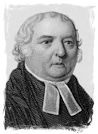
 Samuel Marsden (1764-1838), apostle of New Zealand, son of a tradesman,
was born at Horsforth, a village near Leeds [other
sources give place of birth as Farsley, Yorkshire, England],
on 28 July 1764. He was educated at Hull grammar school, and then took
part in his father's business. Being a lad of good ability and exemplary
character, he was adopted by the Elland Society, and placed at St. John's
College, Cambridge, where he studied with assiduity and gained the friendship
of the Rev. Charles Simeon. Before his university education was completed
he was ordained, and by a royal commission, dated 1 Jan. 1793, appointed
second chaplain in New South Wales. He arrived in the colony on 2 March
1794, and took up his residence at Parramatta, where, and at Sydney
and Hawkesbury, he had charge of the religious instruction of the convicts.
In 1807 he returned to England to report on the state of the colony
to the government, and to solicit further assistance of clergy and schoolmasters.
While in London he obtained an audience of George III, who presented
him with five Spanish sheep from his own flock, and these sheep became
the progenitors of extensive flocks of fine-woolled sheep in Australia.
Samuel Marsden (1764-1838), apostle of New Zealand, son of a tradesman,
was born at Horsforth, a village near Leeds [other
sources give place of birth as Farsley, Yorkshire, England],
on 28 July 1764. He was educated at Hull grammar school, and then took
part in his father's business. Being a lad of good ability and exemplary
character, he was adopted by the Elland Society, and placed at St. John's
College, Cambridge, where he studied with assiduity and gained the friendship
of the Rev. Charles Simeon. Before his university education was completed
he was ordained, and by a royal commission, dated 1 Jan. 1793, appointed
second chaplain in New South Wales. He arrived in the colony on 2 March
1794, and took up his residence at Parramatta, where, and at Sydney
and Hawkesbury, he had charge of the religious instruction of the convicts.
In 1807 he returned to England to report on the state of the colony
to the government, and to solicit further assistance of clergy and schoolmasters.
While in London he obtained an audience of George III, who presented
him with five Spanish sheep from his own flock, and these sheep became
the progenitors of extensive flocks of fine-woolled sheep in Australia.
On his return to New South Wales in 1809 he turned his attention to the state of New Zealand, and finding he could not persuade the Church Missionary Society to do much for him, he at last, in 1814, at his own risk, purchased the brig Active, in which he sent two missionaries to those islands. On 19 Nov. Marsden, accompanied by six New Zealand chiefs who had been staying with him at Parramatta, made his first voyage to New Zealand. He was received with cordiality by the natives, and found no difficulty in procuring land for a mission-station. This was the first of seven voyages which he made to New Zealand between 1814 and 1837. No one ever exerted more influence over the native chiefs than himself, and he must be regarded as one of the most important of the settlers and civilisers of the country.
As chaplain in New South Wales he endeavoured, with some success, to improve the standard of morals and manners. He established orphan schools and female penitentiaries, and made Parramatta a model parish. Unfortunately the governors did not always give him assistance or help, and in 1817 he had to bring an action for defamation of character against the governor's secretary for an article published in the 'Government Gazette.' In 1820 a commission was sent out from England to investigate the state of the colony and to inquire into Marsden's conduct, but the charges made against him, were in no instance substantiated. At Parramatta he set up a seminary for the education of New Zealanders, but this was given up in 1821. His salary as chaplain was raised to 400£ a year in 1825; later on, when Sydney was erected into a bishopric in 1847, he became minister of Parramatta parish. He paid a last visit to the Maoris, in his usual capacity of peace-maker, in 1837. He died at the parsonage,Windsor, on 12 May 1838, and was buried at Parramatta, where some Maoris subscribed a marble tablet to his memory. On 21 April 1793 he married Miss Ellen Tristan [most sources say Elizabeth Fristan]. She died at Parramatta in 1835.
[Nicholas's Narrative of a Voyage to New Zealand, performed in the years 1814 and 1815, in company with the Rev. S. Marsden, 2 vols., 1817; A Short Account of the Character and Labours of the Rev. S. Marsden, Parramatta, 1844; J.B. Marsden's Memoirs of S. Marsden, 1859, with portrait; Rusden's Hist. of New Zealand, i, 102, 152; Bonwick's Romance of the Wool Trade, 1887, pp. 82-6.]
From Dictionary of National Biography. London: Smith, Elder, & Co., 1893.
>> More Samuel Marsden