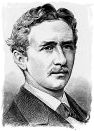
 After many perilous and harrowing experiences, Alexander Mackay, a young Scotsman, at
last reached his destination on the shores of Lake Victoria, in Central Africa—Uganda,
described by the great explorer, Henry M. Stanley, as "the pearl of Africa."
The young Scotch missionary was eager to win as a Christian the powerful King M'tesa [or Mutesa],
who ruled over the country called Uganda and over the people known as Waganda [or Baganda]. Soon
after his arrival at the capital, he wrote in his diary of an important appearance
at the king's court:
After many perilous and harrowing experiences, Alexander Mackay, a young Scotsman, at
last reached his destination on the shores of Lake Victoria, in Central Africa—Uganda,
described by the great explorer, Henry M. Stanley, as "the pearl of Africa."
The young Scotch missionary was eager to win as a Christian the powerful King M'tesa [or Mutesa],
who ruled over the country called Uganda and over the people known as Waganda [or Baganda]. Soon
after his arrival at the capital, he wrote in his diary of an important appearance
at the king's court:
"Sunday, January 26, 1879. Held service in court. Read Matthew 11:1-30, about Jesus and John the Baptist. The spirit of God seemed to be working. I never had such a blessed service."
The young missionary's favorite Bible character was John the Baptist, and he reveled in Matthew 3:3 and other passages which tell of the prophet's commission to prepare the way for the coming of the Saviour.
"Behold, I will send my messenger, and he shall prepare the way before me," is the way Jesus stated it, quoting from Malachi.
In the words of the angel, "He shall go before him ... to make ready a people prepared for the Lord."
In the words of Zacharias, "Thou shalt go before the face of the Lord to prepare his ways; to give knowledge of salvation ... to give light to them that sit in darkness."
As announced by John the Baptist himself, "The voice of one crying in the wilderness, Prepare ye the way of the Lord" (Matthew 3:3).
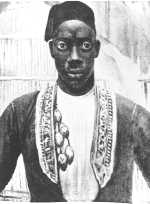 To King M'tesa
[photo of Kabaka Mutesa I, who reigned from 1856 to 1884] the missionary said: "When, in ancient days, the people failed
to keep the commandments of God and continued in their sinful ways, God determined
to send His only Son to earth to redeem sinners and sent John the Baptist to prepare
the people for His coming. I am here, O King, to prepare a way for the coming of God's
Son and I want you to join me in pointing the people of this land to the Lamb of God,
who alone can take away the sin of the world."
To King M'tesa
[photo of Kabaka Mutesa I, who reigned from 1856 to 1884] the missionary said: "When, in ancient days, the people failed
to keep the commandments of God and continued in their sinful ways, God determined
to send His only Son to earth to redeem sinners and sent John the Baptist to prepare
the people for His coming. I am here, O King, to prepare a way for the coming of God's
Son and I want you to join me in pointing the people of this land to the Lamb of God,
who alone can take away the sin of the world."
The white man, however, was not the only person who appeared before the king and his chiefs and the great men of state. Into the audience chamber walked a tall, swarthy Arab in flowing robes and a red fez, followed by a number of black men, who deposited on the floor their bales of cloth and guns, "I have come," said the Arab, pointing to the bales on the floor, "to exchange these things for men and women and children. I will give you one of these links of red cloth for one man, one of these guns for two men and one hundred of these percussion caps for one woman.
The missionary knew that the king was accustomed to sell his own people, as well as captives, as slaves. He could see that the cruel and ambitious king was especially eager for the guns and ammunition, for they would enable him to conquer and enslave his enemies. Should the missionary risk the king's disfavor, and even hazard his own life, by opposing this traffic in human lives? He remembered that, though it cost him his head, John the Baptist did not hesitate to reprove a king. Nerved by this courageous example, the white man declared:
"O King M'tesa, the people of this land made you their king and look to you as their father. Will you sell your children, knowing that they will be chained, put into slave-sticks, beaten with whips; that most of them will die of mistreatment on the way and the rest be taken as slaves to some strange country? Can you be a party to these crimes, even for the sake of some guns? Will you sell scores or hundreds of your people, or your captives, whose bodies are so marvelously created of God, for a few bolts of red cloth which any man can make in a few days?"
The Arab slave-dealer scowled. If only he could plunge his dagger into the white man's heart! No man had ever dared talk to the king like this before and the chiefs stirred uneasily, wondering if M'tesa would imprison the bold foreigner or perhaps put him to death. Instead, he dismissed the angry Arab and announced, "The white man is right. I shall no more sell my people as slaves."
With joyful, grateful heart the missionary went to his hut. Later the same day he wrote in his diary: "Afternoon. The King sent a message with present of a goat, saying it was a blessed passage I read today."
"A blessed passage!" said M'tesa, the heathen king of Uganda, thinking of what the missionary had said about preparing a way for God's Son.
"A blessed passage!" agreed Alexander Mackay, to whom the passage had long been a favorite. Indeed, the purpose of his life, as he conceived it, was to be a Christian road-maker, preparing a way for the coming of Christ.
I. The Road-Maker's Call to Make a Highway for the Gospel in Africa
Alexander Mackay was born in Rhynie, Aberdeenshire, October 13, 1849. He was a bright, earnest lad and early surrendered his heart to Christ. His father and mother agreed in hoping that he would become a minister or a missionary. He loved the long winter evenings when, the father being away preaching, the mother told exciting stories of Carey and Martyn, Moffat and Livingstone.
Very early the lad began to show unusual interest in mechanics. When a small boy he often went among the masons as they were building the Free Church of Rhynie, and it was considered prophetic of his future career that, when they jocularly asked him, "Well, laddie, gaen to gie us a sermon the day?" He would reply, "Give me a trowel, so can preach and build same time."
The villagers were one day startled to see Mr. Mackay, the minister of the Free Church, and his thirteen-year-old son gazing down at the road, while the father drew marks in the dirt with his walking stick.
"Fat's the minister glowerin' at, wi' his loon Alec, in the dust o' the turnpike?" the villagers inquired of one another.
If they had been near enough, they would have heard the father saying: "You see, Alec, this is the Zambesi River, and here, running into it from the north is the Shire. Here is where Livingstone was surrounded by infuriated savages. There he met a slave caravan of eighty-four men, women and children and managed to free them."
That was all very thrilling to young Alec, but the next day he walked four miles to the nearest railway station, watched the train come to a stop, followed every movement as the engineer used his long-nosed oil-can and felt the bearings with his hands to see if they were hot; then Alec trudged homeward as soon as the train had departed. When he got back to Rhynie he had walked eight miles in order to look at a railway engine for two and one half minutes! He liked to linger around the blacksmith's shop and the carding-mill, and spent considerable time in the attic at his little printing press.
Thirteen years went by, during which he completed a two year's teaching course, learned much about ship-building in the docks of Aberdeen, made a thorough study of engineering, and went to Germany for further study. He had read avidly all he could find about his hero, David Livingstone, and on the anniversary of that great man's death had written in his diary: "Livingstone died—a Scotsman and a Christian—loving God and his neighbor, in the heart of Africa. 'Go thou and do likewise.'"
But how could he ever go to Africa? What could an engineer do there? As he was pondering these questions in Berlin on the night of December 12, 1875, he picked up a copy of the Edinburgh Daily Review which home-folks had sent him and read a letter that sent a mighty thrill through his being. Because of its author, the place of its composition, the story of its transmission, its contents and its consequences, this was one of the most remarkable letters ever penned. It was written by the daring explorer, Henry M. Stanley, in Ulagalla, Uganda, April 12, 1875, at the request of King M'tesa. More than seven months transpired before it appeared in the Daily Telegraph of London and then in other papers. When one thinks of its history in transit, the wonder is that it ever reached England at all.
It is the story of a pair of boots, owned and worn by a Frenchman, Colonel Linant de Ballefonds, to whom Stanley entrusted the letter. Marching northward from Uganda, the Frenchman and his caravan were proceeding along the bank of the River Nile, when they were suddenly attacked near Gondokoro by a band of savage tribesmen. Having killed the Frenchman, they heartlessly left his body lying unburied on the sand, where it was later discovered by some English soldiers who happened to pass that way. Before burying the Frenchman, they pulled off his long knee boots and in one of them found Stanley's letter, stained with the dead man's blood. They forwarded it to the English General in Egypt, who sent it on to the newspaper office in London.
This was the letter which attracted Mackay's attention that cold December night in 1875. In part it read as follows:
"King M'tesa of Uganda has been asking me about the white man's God ... Oh that some practical missionary would come here! M'tesa would welcome such. It is the practical Christian who can cure their diseases, build dwellings and turn his hand to anything—this is the man who is wanted. Such a one, if he can be found, would become the saviour of Africa."
How marvelous, thought Mackay, that the king of Uganda desires a missionary and wants one who can "turn his hand to anything!" Being just that sort of person, both by interest and training, and having long cherished a desire to follow in the footsteps of Livingstone and Stanley, this was for him a call from on high. Immediately he wrote to the Church Missionary Society: "My heart burns for the deliverance of Africa, and if you can send me to any of those regions which Livingstone and Stanley have found to be groaning under the curse of the slave-hunter, I shall be very glad."
Within four months Mackay, along with seven other young missionary volunteers, was on a ship bound for Zanzibar and Uganda, saying: "I go to prepare the way by which others more readily can go and stay and work." He had given his best, his all, to the high task of being a road-maker for Christ in the Dark Continent.
II. Making a Road through the Jungles of Heathen Superstition
After securing large supplies of necessary equipment, the missionaries set out from Zanzibar on an overland journey of eight hundred miles to the south end of Lake Victoria. Mackay was smitten down with a severe attack of fever and returned to the coast, while the others went ahead to the Lake and put together the Daisy, the boat in which they planned to sail across to Uganda.
Having recovered, Mackay undertook to build a wagon road from the coast to Mpwapwa, two hundred and thirty miles inland, and finally succeeded, despite manifold difficulties. He writes: "Imagine a forest of lofty, slender trees, with a cop between of thorny creepers, so dense below that a cat could scarcely creep along; and branched and intertwined above like green unraveled hemp. Through it winds a path, as if it had followed the trail of a reptile, and almost losing itself here and there, where the creeping wild vine and thorny acacia have encroached upon it. Now the densest jungle has yielded to the slashing strokes of a score of Snider sword bayonets and a road wide enough for two wagons to pass each other has been constructed, the nullahs [gullies, ravines] being bridged over, boulders removed and rough places made smooth."
This was to Mackay something more than an ordinary road. His vision is indicated by a letter he wrote to his father as he sat one night exhausted as the road was nearing completion. "This," he states, "will certainly yet be a highway for the King Himself; and all that pass this way will come to know His Name."
The jungle through which the missionary had cut his road was symbolic of the dark and perilous jungle of heathen superstitions in which he found himself after travelling eight hundred miles overland and crossing Lake Victoria, which was larger in area than his native Scotland and famed as the source of the Nile River. The people lived in abject fear of the sorcerers and sought by means of offerings and charms to ward off the evils which constantly threatened to engulf them. Every person wore charms on his body and every house had charms hung on the door. Every calamity—such as famine, earthquake, war, plague, smallpox—had its particular god, who must be propitiated by methods prescribed by the sorcerers or charmers. A Waganda would usually wear a number of charms: one to ward off disease, another to cure snake bite, another to prevent being hit by lightning, and others for similar purposes.
Mackay sought to teach the Waganda from God's word the evil of practicing or trusting in witchcraft. He also sought to give practical demonstrations on the impotence of their charms. One day he bought a very potent charm and said to a crowd of people: "Since I bought this charm, it is mine and I can do with it as I please, can't I?"
"Yes, indeed," they answered.
"Will it burn?" he asked.
"Oh, no. But you better not try it. The god will be very angry."
By means of a small lens and some wood, Mackay soon had a blazing fire. "Now let us see if there is magic power in this thing," he remarked, putting the charm into the fire. It was soon reduced to ashes, whereupon half the crowd ran away in terror, while the rest remained, expecting every moment to see some terrible judgment fall on him.
Upon the death of the king's mother, Namasole, Mackay was requested to build three magnificent coffins, the first of wood, the second of copper and the third of wood; the second one to encompass the first, and the third to encompass the other two. He undertook to do this in order to increase his influence with the king and people. He also hoped to have opportunity in this connection to point out the futility of belief in wizards and to emphasize the gospel message of eternal life in Christ.
When, after many days of hard work, he produced the three coffins, beautifully finished and lined, the people were highly pleased and the fame of the White-Man-of-Work ascended to new heights. On the day of the funeral, about $75,000 worth of cloth was buried in the grave.
A little later at a baraza—a council of the king and his court—a discussion arose concerning burial customs in various parts of Africa. Some told of burying scores of living virgins with a dead king, while others told how human lives were offered as sacrifices on such occasions. Masudi, an Arab, began to describe how, when M'tesa's grandfather died, his father had thousands of victims slaughtered at the grave.
"Don't mention such things," said Mackay. "They are too cruel to be spoken about before the M'tesa of today." Turning to the king, he spoke of the magnificent coffins in which Namasole was buried and of the vast quantity of valuable cloth buried with her. Then he continued: "But all that fine cloth and all those coffins will one day be rotten. So in Christian countries we say it matters little in what way the body is buried, for it too will decay. But it matters what becomes of the soul. Your people live all their lives in fear of witches and wizards, and at death they are still the children of terror. Let me have only an old bark cloth and nothing more of this world's goods, and I would not exchange my place for all the wealth and greatness of your two chief men, the katikiro and Kyambalango. Why is this? Because all their greatness will pass away and their souls are lost in the darkness of belief in wizards and charms, while I know that my soul is saved by Jesus Christ, God's Son, and therefore I have spiritual riches that never perish."
Thus the missionary sought to clear up the dense jungle of heathen superstition and make a way for the coming of Christ, the Lord.
III. The Road-Maker's Tools in Road Building
Having built a workshop, Mackay set up his forge and anvil, vice and lathe, and grindstone. Soon the chiefs and their slaves crowded around to hear the bellows roar and watch the foreigner at his work. After hammering a red-hot hoe into shape, he plunged it into a tub of water. A cloud of steam arose, then he placed his foot on the pedal of the grindstone and set the edge of the hoe against the Whirling stone, as the sparks flew high.
"It is witchcraft," exclaimed the chiefs. "Mazunga-wa-Kazi is a great wizard."
Mackay noticed that they called him Mazunga-wa-Kazi which means White-Man-of-Work. They gave him this name because to them it was strange that any man should work with his own hands. "Women are for work," said the chiefs. "Men go to talk with the king, and to fight and eat." Pausing a few minutes, the White-Man-of-Work told how
"...the Carpenter of Nazareth
Made common things for God,"
thereby making all labor forever noble.
Realizing that the Waganda were suffering fearful fevers caused by drinking the infected waters of the marsh, Mackay announced that he was going to dig a well on the hillside not far from his house. The natives thought that the clever white man had suddenly lost his mind. "Water comes from the sky, not from the ground," they said. As the hole went deep into the earth, one man had a flash of inspiration and exclaimed: "White man's country is on the other side of the world. He is digging a tunnel through the earth so he can make quick trips to his home country." All the people readily accepted this as the true explanation. Several days later, he struck water. "Mackay is a great wizard," the people cried. "The king must come to see this." When King M'tesa arrived in state, his eyes rolled in astonishment at the sight of the marvelous well.
Mackay had brought out with him the printing outfit he had used as a boy. He printed some large letters on sheets of paper and began to teach a group of eager people to read and write Suahili. He also spent considerable time translating and printing portions of the New Testament. These he used in his school and distributed to earnest inquirers.
Whether making a hoe, or digging a well, or teaching school, Mackay never lost sight of his ultimate goal. "O God," he prayed, "give me a burning zeal for souls. Am I not here the link between dying men and the dying, saving Christ?" Again he said: "Whatever our methods, our business is to prepare the way for the entrance of the gospel into the remotest corners of the continent." The words came often to his lips because they were seared upon his heart:
"Prepare ye the way of the Lord."
IV. Obstacles in the Road-Maker's Path
One day a slave brought to the missionary a letter which he had written with a pointed piece of spear-grass for a pen and ink made of soot mixed with banana juice. This was the message: "Bwana Mackay, Sembera has come with compliments and to give you great news. Will you baptize him, because he believes the words of Jesus Christ?"
This was "great news" indeed for the missionary, for Sembera was his first convert. Others soon followed in open confession of Christ, among them being three of the king's pages, named Mukasa, Kakumba and Lugalama. Mukasa changed his name to Samweli (Samuel) and Kakumba took the name of Yusufu (Joseph). For a time the missionary had high hopes of winning even the king, who listened attentively to his messages each Sunday and even requested baptism.
But these lofty hopes were rudely shattered. The missionary road-maker had great boulders in his path. Fierce opposition began to emerge, due in part to the presence of an influential party of Mohammedan traders, who hated all non-Moslems and Mackay in particular, for he lost no opportunity to condemn their traffic in slaves. The difficulty of the situation was enhanced by the arrival of a company of Frenchmen who, with all of heathen Africa waiting to be Christianized, deliberately undertook to subvert Mackay's Mission. They openly denounced Mackay, called his religion a pack of lies, and joined with the Mohammedans in spreading malicious reports concerning him. Moreover, they sought to win the king by guile, by flattery, and by keeping quiet concerning his many vices, whereas Mackay told M'tesa plainly of his crimes and refused to baptize him unless he would give up polygamy, witchcraft, slave trading, plundering adjacent tribes, and other abominable cruelties. Thus the king was turned against Mackay, for he loved his heathen customs and gloried in his 300 wives. Henceforth he preferred the smooth, diplomatic message of the Frenchmen, rather than the uncompromising gospel of a second John the Baptist.
Mackay writes in his diary: "February 1, 1881. Meantime, every crime and form of uncleanness is rampant in the country. Each day reveals fresh tales of iniquity, cruelty and oppression. One army has been sent east to murder and plunder, while another army has been sent west for the same purpose. Not even the natives can call it war; they all say it is for robbery and devastation."
Again he writes: "This is the fifth time in the course of two years that a great army has been sent by M'tesa into Busoga, not to war, but avowedly to devastate and murder, and bring back the spoil—women, children, cattle and goats. The most heart-rending of Livingstone's narratives of the slave-hunters by Arabs and Portuguese on the Nyassa and Tanganyika shores, dwindle into insignificance compared with the organized and unceasing slave-hunts carried on by the king of Uganda. We are sorely down cast. The king seems daily to become more hopelessly sunk in every form of vice and villainy. But is any case too hard for the Lord?"
The heavy-hearted missionary continued at length to describe the incredible depravities of barbarism. M'tesa not only repeatedly sent his armies to plunder and enslave adjacent countries; he also sent out teams of armed men to seize and kill mercilessly his own people, particularly the poor. They had committed no crime, nor any offense whatever. It was merely the King's pleasure that a certain number be butchered each day.
Sometimes victims were saved up for several weeks for a kiwendo; that is, a great slaughter of human beings for the purpose of securing a blessing either for the living king or a departed king. Mackay writes in his diary: "February 6, 1881. Two years ago the king gave orders for a kiwendo and two thousand innocent people were slaughtered in one day. Less than a year ago a similar atrocity was committed. Two thousand poor peasants were caught, fastened in forked sticks, kept in pens and murdered on the set day, as an expiatory offering to the departed spirit of the former king, Suma. Now another kiwendo is about to take place, because the king is ill and a sorcerer has told him that only a great slaughter can heal his sickness."
Risking his life, Mackay wrote the king a letter, pleading that he spare the lives of these innocent people, but his plea was scornfully disregarded.
All Uganda was in breathless suspense one day. Throughout the land went the cry, "King M'tesa is dead." Who would be chosen by the chiefs as his successor? At length a great cheer went up from the palace. "M'wanga has eaten Uganda!" the populace shouted.
The new king, M'wanga, had all the barbaric vices of his father, King M'tesa, and others besides. A vain and vicious lad of eighteen, he despised the Christian followers of Mackay and longed to display his power. When his palace burned down one day, this modern Nero put the blame on the Christians and began to persecute them, as did that other Nero when Rome burned. Three Christian boys were caught by order of the king. They were Seruwanga, Yusufu, and Lugalama, the oldest fifteen, the youngest twelve. A mob soon gathered and helped to build a fire. Armed with great curved knives, the executioners arrived.
This is a scene of heroism which should be placed alongside the noblest instances of martyrdom in the annals of the Christian Church. The head executioner was Mujasi, a Mohammedan. "Do you admit being followers of Jesus Christ?" asked Mujasi fiercely. The two younger boys nodded assent, but Seruwanga's boldly answered, "Yes, and I am not ashamed of it." "You believe you will rise from the dead!" shouted Mujasi. "I shall burn you and see if this is so!" A hideous roar of laughter came from the mob. As Seruwanga's arms were cut off and his bleeding body was cast into the fire, no sound came from his lips, save words of testimony and of prayer. Yusufu was next mutilated and consigned to the flames.
Then took place the saddest scene of all. As the executioner approached the twelve-year-old Lugalama, the boy cried out: "Please do not cut off my arms. I will not struggle! Only throw me into the fire!" Surely this is one of the saddest prayers ever uttered on this sad earth — "Only throw me into the fire!" The butchers did their ghastly work and the bleeding, tortured boy was committed to the flames...
The Mohammedans gloried in this bloody business but could not be content while the hated missionary remained untouched. Hearing of dire plots against his life, Mackay went to his Bible and to his knees for consolation and strength. The passage he read was Isaiah 51. "With such a promise," he says, "and such a refuge, and such a God, who shall be afraid?"
With such a promise! "I, even I, am He that comforteth you."
With such a refuge! "I have covered thee in the shadow of mine hand."
With such a God! "I, even I, am ... the LORD thy maker, that hath stretched forth the heavens, and laid the foundations of the earth."
A little later the news came that Bishop Hannington, stricken with fever and carried in a litter, was at the side of the lake, on the way to help Mackay in the Mission. "Send at once and kill him!" shouted the wild king. So his soldiers captured the Bishop and threw spears into his brave heart, as he knelt before them praying for the salvation of the land he had finally reached but was destined not to enter. The martyr's last words were these, "Tell your king I give my life for the people of Uganda. I have bought this road with my life."
One day the king ordered Apolo Kagwa to commit an unmentionable abomination. When he refused, the King flew into a rage, beat him with a stick, knocked him down and abused him cruelly. The bloody passions of his nature were aroused and he cried: "Seize and burn all the Christians!" His executioners immediately went forth and seized scores of men and boys. These were tortured with all the ingenuity of barbarism. Finally all had their arms cut off and were burned to death in a slow fire. During this terrible persecution about two hundred Christians were tortured and burned. The head executioner said to King M'wanga that he had never before killed people who showed such bravery and calmness in the face of death, as did the Christians. "Even in the fire," he said, "they prayed aloud to God."
"Our hearts are breaking," wrote Mackay. "Many of our Christians are killed, the rest dispersed. Our lives are threatened and each day may be our last. We are lonely and deserted, sad and sick."
Like Paul, he was "perplexed, but not unto despair; cast down, but not destroyed." After a season on his knees, he knew that he was "not forsaken" and rose up to continue his work. He saw that obstacles must first be cleared out of the way and then the gospel chariot would ride to victory. September 12, 1886, he wrote: "The command, 'Prepare ye the way of the Lord,' was given before that other, 'Go into all the world and preach the gospel to every creature.' We must condescend to clear the ground and level it, before we can plow and sow and reap. In olden days we made no attempt to remove boulders and level the earth. But with the advent of the science of road-building, England spends hundreds of millions of pounds yearly bringing low the hills and filling up the valleys; now the wheels of commerce and travel are free to run. So it will be in the work of driving the Lord's chariot. When we have prepared the way of the Lord and made his paths straight; when every valley shall be filled and every mountain and hill shall be brought low; when the crooked shall be made straight and the rough ways shall be made smooth, then the Word of God will be given free course to run."
Thus for the hundredth or the thousandth time his mind reverted to the metaphor of road-building and he was reassured by the conviction that, if he built well, the highway would surely bear sacred traffic by and by, even the feet of the Saviour coming into the land of Uganda and the foot steps of a host of glad pilgrims on the way to the Celestial City.
V. The Road-Maker Lays Down His Tools
While down on the shore of Victoria Lake engaged in building a steam launch for his missionary work, Mackay was signally cheered by a visit from Henry M. Stanley, whose letter in the Edinburgh Daily Review fourteen years earlier had thrilled his soul into action as a volunteer to answer the call of King M'tesa. The two men had many things of mutual interest to discuss, particularly Stanley's famous visit with Livingstone eighteen years earlier and Stanley's remarkable journey of 999 days across the continent and down the entire length of the mighty Congo. But the chief topic of conversation was Uganda and King M'tesa. Stanley was eager to know of the progress of the Mission but Mackay wanted first to hear further details of what took place when Stanley made his visit to King M'tesa fifteen years earlier, resulting in the famous letter urging missionaries to go to Uganda. This is the gist of Stanley's amazing recital.
When he reached the capital of Uganda, a great ovation and many surprises awaited him. To the accompaniment of noisy salutes from numerous guns, the waving of flags, the beating of drums and the sound of trumpets, he was conducted to the royal palace and welcomed by M'tesa, the most powerful king in Africa, ruling over about four million people, in contrast with most African kings who ruled over a few hundred or a few thousand.
For several months Stanley went almost daily to the palace for a baraza and discussed many subjects in response to questions put to him. One day he was asked to tell of the white man's God. As he told of the Father God who, of His great love, sent His Son to earth to teach, to heal and to die for sinful men, he noticed that the king and his chiefs were listening with an interest surpassing even that they had shown in the wonderful things he had told them of his explorations or about the marvels of civilized nations. On subsequent occasions he was frequently asked to tell more about the white man's religion.
Just before Stanley departed, the king called him to a special baraza of chiefs and officers, and addressed the court as follows: "As you well know, when the Mohammedans came I gave up the religion of our fathers and took that which was better. Now a white man, Stanley, has come with a book much older than the Koran and tells us of Jesus, the Son of God. Shall we believe in Jesus or in Mohammed?"
"Let us take that which is best," answered one of the chiefs. "But how can we know which is best and which is true?" asked the katikiro, or prime minister.
"Listen to me," said the king, "and I will answer the katikiro's question. The Arabs and the white men behave exactly as they are taught in their books, do they not? The Arabs come here for ivory and slaves; as we all know they do not always speak the truth, and they buy slaves, putting them in chains, beating them and taking them far away to sell. But when white men are offered slaves, they say: 'Shall we make our brothers slaves? No. We are all sons of God.' When the explorers Speke and Grant came here, they behaved well. Indeed I have not heard a white man tell a lie yet. I say that the white men are greatly superior to the Arabs and I think, therefore, that their book must be a better book than Mohammed's. Now I ask you, which shall we accept?"
Seeing clearly what the king wanted, they all replied, "We will take the white man's book."
M'tesa begged that white men be sent to teach him and his people the good way. "Stanley," he said, "say to the white people when you write them, that I am like a man sitting in darkness, or born blind, and that all I ask is that I may be taught how to see.
Having told this story of his experiences at the court of King M'tesa fifteen years before, Stanley said: "Now, Mackay, tell me just what happened when you finally reached Uganda in response to my letter telling of M'tesa's plea for missionaries."
The great explorer was much saddened by Mackay's account of the way M'tesa had gone back to heathen cruelties and of the still more barbarous acts of King M'wanga. "You are worn out and need a change and a long rest," said Stanley. "Come with me to the coast and to England." But the invitation was declined, due to the lack of missionary reinforcements. So Stanley departed. Later he said: "God knows if ever man had reason to be lonely and sad, Mackay had, when, after murdering his Bishop, and burning his pupils, and strangling his converts, and clubbing to death his dark friends, M'wanga turned his eye of death on him. And yet the little man met it with calm blue eyes that never winked. It is worth going a long journey to see one man of this kind, working day after day without a syllable of complaint or a moan, and to hear him lead his little flock in singing and prayer to show forth God's kindness in the morning and His faithfulness every night."
Just a few months after Stanley's visit, Mackay did lay down his tools and take a rest. Worn out under the terrific strain of the days of persecution, he was attacked by the African giant Mukunguru, or tropical fever. After lingering for a few days, he died February 8, 1890, at the early age of forty-one. "Being dead, he yet speaketh." And the Church today needs desperately to hear the voice of this hero of the Cross sounding across the years: "The continental idea of 'every man a soldier' is the true watch word for Christian missions. The conversion of the heathen must become the work of the Church and not merely a small branch of its work. If Christianity is worth anything, it is worth everything."
VI. The Cost of Making a Road for God
What it cost the martyrs of Uganda to "prepare a way for the Lord" has been indicated. It also cost the missionaries a heavy price. When the offices of the Church Missionary Society held a farewell service April 25, 1876, for the eight missionaries going out to Uganda, Mackay reminded them that quite probably one of the eight would fall within six months and others later. "But," he added, "when such news comes, do not be cast down but send others immediately to take the vacant places." Those were prophetic words, for in less than two years he wrote home to say that of the eight, two had died of tropical disease, two had been murdered by the natives, and two had returned to England in broken health.
A number of recruits subsequently came out to fill the vacant places. Two of these died on the way, several re turned in broken health, and Bishop Hannington was murdered. A little later Bishop Parker died on his way to the field. A glimpse of what it cost Mackay is indicated by his words: "I am almost entirely broken down with fatigue and anxiety and want of sleep. What sadness and melancholy come over me at times, and I find myself shedding tears like a child! Still I plod on, teaching, translating, printing, doctoring and carpentering. Praise God! St. Matthew's Gospel is now published complete in Luganda and rapidly being distributed." In addition to distributing Gospels secretly to earnest inquirers around him, the brave missionary set his little printing press to work and printed a letter which he sent to the Christians who were scattered abroad. This is part of his message:
"In days of old, Christians were hated, hunted, driven out and persecuted for Jesus' sake, and thus it is today. Beloved brethren, do not deny our Lord Jesus and He will not deny you on the last great day. Do not cease to pray exceedingly for our brothers who are in affliction and for those who do not know God. May God give you entrance to eternal life through Jesus Christ our Lord."
On the other side of the letter were words from the fourth chapter of First Peter: "Beloved, think it not strange concerning the fiery trial which is to try you ... but rejoice, inasmuch as ye are partakers of Christ's sufferings; that, when His glory shall be revealed, ye may be glad also with exceeding joy."
Alexander Mackay might have made much money and doubtless lived a much longer life, if he had given up his missionary career to accept a proffered post as an engineer of the British East Africa Company or a high position in the army of General Gordon in Egypt. He declined both offers and labored on at the task to which Christ had called him. When friends at home and the officers of the Church Missionary Society urged him to take a furlough, he wrote: "What is this you write—'Come home?' Surely now, in our terrible dearth of workers, it is not the time for anyone to desert his post. Send out only our first twenty men and I may be tempted to come to help you to find the second twenty."
If any today are prone to hesitate to answer the missionary summons, let them read the last messages of Alexander Mackay. After Bishop Parker's death many voices were raised in England against the policy of the Church Missionary Society in continuing to send workers to the Nyanza Mission. The fact that so many had died, the insolence and tyranny of the native king, and the bitter antagonism of the slave-dealers, were to many indications that it was the will of God that the mission should be abandoned.
The suggestion came to Mackay at a time when he was quite alone, and when the memory of the death of Bishop Parker was vivid in his mind. His answer, written in the earnestness of a man who as a final argument was about to lay down his life, is as follows: "Are you joking? If you tell me in earnest that such a suggestion has been made, I can only answer, Never. Tell me, ye faint hearts, to whom ye mean to give up the mission. Is it to murderous raiders like M'wanga, or to slave-traders from Zanzibar, or to English and Belgian dealers in rifles and gunpowder, or to German spirit sellers? All are in the field, and they make no talk of giving up their respective missions."
A little later, to the faint-hearted, Mackay sent another message: "Please do not reply to my statement of our requirements as to men and a bishop with the word impossible. That word is unknown in the vocabulary of engineers. Surely, then, if those who build only temporary structures, because their materials are perishable, have expurgated the word from their vocabulary, how can it at all remain in the vocabulary of those who are engaged in building the Church of God and laying the foundation of that kingdom which shall endure forever?" No wonder Stanley called this man "the finest missionary since Livingstone."
After a life of great hardship; after having slept many times "in all sorts of places," he says --"a cow-shed, a sheepcote, a straw hut not larger than a dog-kennel, a hen-house and often in no house at all;" after distressing attacks of fever and diarrhea; after being almost poisoned on one occasion and narrowly escaping death from the fangs of a huge serpent on another; after being so hungry he had to "drive the wolf from the door," he says, "by taking the glass off lanterns, silvering them and selling them to the natives as mirrors, so as to buy food;" after seeing his converts tortured and burned or driven into hiding; after these and other ordeals, he died homeless on the shore of Lake Victoria when still a young man.
Was it worth while? Was it worth the cost?
Writing in 1922, Basil Matthews says: "Today the Prime Minister of Uganda is Apolo Kagwa, who as a boy was kicked and beaten by King M'wanga for being a Christian; and the King of Uganda, Kaudi, M'wanga's son, is a Christian. At the capital there stands a beautiful church. On the place where the boys were burned to death there stands a cross, put there by seventy thousand Waganda Christians in memory of the young martyrs."
Was it worth the cost?
Slave-raiding and slave-trading have been abolished; innocent people are no longer butchered to appease the gods; and the torture and burning of human beings to satisfy a mad king's lust for blood has ceased forever in Uganda. Mackay did not live to see these marvelous triumphs but with the eye of faith he asserted: "The conquest of Africa has already cost many lives; but the end to be gained is worth the price paid. Let us not forget that the redemption of the world cost infinitely more."
Alexander Mackay was the one who built the road, saying: "This will certainly yet be a highway for the King Himself; and all that pass this way will come to know His name."
VII. The Road-Maker Goes Home
During his last days Mackay translated the 14th chapter of John into Luganda.
"Prepare ye the way of the Lord" — such was the vision that fired his soul.
"I go to prepare a place for you" — such was the hope that cheered his lonely toiling.
For fourteen years without a furlough, he had given his utmost to the building of a highway for the gospel and in preparing a way for the coming of his Lord. And all the while his Lord was preparing a place for him. Now the preparations were completed, and, after his fourteen years of exile and heroic service, he went Home at his Master's bidding.
+Used with permission. From Blazing the Missionary Trail by Eugene Myers Harrison. Chicago, Ill.: Scripture Press Book Division, ©1949.
>> More Alexander Mackay