The preaching hall in Pernambuco was crowded with attentive listeners. One of these was Herculano, a Brazilian of giant proportions. His eyes were riveted on the speaker, who, with impassioned zeal, proclaimed the mighty truths of a majestic text: "The blood of Jesus Christ His Son cleanseth us from all sin."
When the service was over, Herculano said, "Missionary, I've never heard anything like this before but I like your message about the cleansing blood of Jesus. That is what I need." When the missionary suggested a visit to his house for the purpose of further discussion, he readily assented and a meeting was arranged for the following day.
The next morning the missionary was informed that it would be an act of extreme recklessness to visit Herculano. Said his informant: "Herculano is a giant in wickedness as well as in size, and is interested, not in Christianity, but in robbing or killing you. Moreover, the district in which he lives is a veritable den of thieves and murderers. Even a policeman will not go there alone and strangers who have ventured to enter have never been heard of again. The missionary knelt in prayer of renewed consecration to his Master, then set out on his journey. At the appointed place Herculano met him and guided him to his small adobe hut. When they reached the place, every living thing vanished in haste. Herculano's wife, children, dogs and cats were terrified at his presence and fled as for their lives.
The missionary sat on an old kerosene box, looked into the bloodshot eyes of his auditor and said: "Although warned that it would probably mean death to come to this place, I have fulfilled my promise. I am here because I am more concerned about your soul than about my own life." Then in simple language he told of the gospel of salvation, of God's love, of Christ's death and of Calvary's cleansing fountain.
"The cleansing blood—that is what I need!" exclaimed Herculano. But even as he spoke his face blanched and his enormous frame trembled violently. His unregenerate nature was aroused and he was engaged in a fierce conflict. He was struggling with a savage impulse to seize the missionary and strangle him. The missionary was skilled in dealing with souls. He knew that the soul-winner's final resort and most potent weapon is prayer. "I then slipped to my knees," relates he, "and the big giant knelt beside me. Then, with trembling voice and eyes overflowing with tears, I began pleading with God on behalf of this poor soul."
Soon he heard a body fall prostrate to the floor and a choked voice, expressing an agony of sorrow and despair, cried out for mercy and forgiveness: "O God! save a poor, degraded, miserable sinner! Wash me in the cleansing blood of Jesus!" Such was the piteous, continual cry of this man as he rolled in agony on the floor. Finally Herculano rose up, saying he was assured the Lord had heard and saved him. He then related some of the highlights of his career. He was the hired assassin of an influential politician; because of his crimes he had spent seventeen years on Convict Island; recently released, he had gone back to making his living by murder and had already carried out orders to assassinate a man.
The cleansing blood of Jesus!
That is what I need!
Wash me in the cleansing blood of Jesus!
"The blood of Jesus Christ, God's Son,"
That was the text that transformed Herculano from a vicious savage to a gentle saint. It was that same stupendous text that wrought a stupendous history in the life of Solomon L. Ginsburg, the Firebrand of Brazil, who was instrumental in Herculano's conversion.
I. The Blood of Jesus Christ Tells of the Fulfillment of Ancient Prophecy
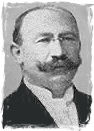 Solomon Ginsburg was born near Suwalki, Poland, on August 6, 1867.
His father was a Jewish rabbi. When he was six years old he was
sent to live with his mother's people in Koenigsberg, because
he could secure much better educational opportunities in Germany
than in Poland. At his father's insistence he returned home at
the age of fourteen to find practices and plans which were very
distasteful. He revolted against the pharisaical strictness which
decreed, for instance, that no match could be lighted on a Sabbath
day and no handkerchief could be carried in one's pocket. Mr.
Ginsburg wanted his son to follow in his steps and become a rabbi.
He had already arranged for Solomon to marry the only daughter
of a wealthy Jewish couple, who would assure his support for
seven years or more while mastering Hebrew, the Talmud and other
rabbinical studies.
Solomon Ginsburg was born near Suwalki, Poland, on August 6, 1867.
His father was a Jewish rabbi. When he was six years old he was
sent to live with his mother's people in Koenigsberg, because
he could secure much better educational opportunities in Germany
than in Poland. At his father's insistence he returned home at
the age of fourteen to find practices and plans which were very
distasteful. He revolted against the pharisaical strictness which
decreed, for instance, that no match could be lighted on a Sabbath
day and no handkerchief could be carried in one's pocket. Mr.
Ginsburg wanted his son to follow in his steps and become a rabbi.
He had already arranged for Solomon to marry the only daughter
of a wealthy Jewish couple, who would assure his support for
seven years or more while mastering Hebrew, the Talmud and other
rabbinical studies.
Young Ginsburg's dissatisfaction with this entire arrangement was intensified when he learned that the girl was scarcely twelve years old. He determined to flee, but, being closely guarded, it was only after every preparation had been made for the wedding feast that he was able to escape. He was then fifteen years of age. He wandered through Poland and Germany for some time, then took passage at Hamburg on a sailing vessel carrying horses to London. There he secured employment as assistant bookkeeper in the large dry goods store of his uncle, a typical orthodox Jew.
One Sabbath afternoon while passing along Whitechapel Street he was accosted by a converted Jew, who said: "I wish to invite you to go with me to a service at the Mildmay Mission. I am going to speak on the 53rd chapter of Isaiah." Instantly young Ginsburg recalled an incident that took place in Poland. His father was celebrating the Feast of the Tabernacle, living in a tent or booth he had set up close to the house.
One day Solomon picked up a copy of the Prophets, turned to the book of Isaiah and, quite by accident, began to read the 53rd chapter. As he read, his interest was kindled and, turning to his father, asked, "To whom does the prophet refer in this chapter?" A profound silence came over the rabbi. Not being answered, Solomon repeated his question; whereupon his father snatched the book out of his hand and deliberately slapped him in the face. "I felt quite chagrined," says Solomon in his autobiography, "but in the providence of God it served its purpose, for, when the Jewish missionary asked me to go and hear him explain that very chapter, I went out of curiosity to see if he had a better explanation than the one my father had given."
He listened with fascinated interest as the speaker called attention to the wonders of the life of Jesus and showed how every prophecy was fulfilled in Him. He could not grasp it all, but he did understand that Isaiah 53 was a divinely given picture of the coming Messiah and that its prophecies had their exact and revealing fulfillment in the drama that took place on Golgotha's brow.
II. The Blood of Jesus Christ Reveals the Hideousness of Sin and Effects a Wondrous Deliverance
Ginsburg secured a copy of the New Testament and as he read it, he was soon convinced that Jesus Christ was the promised but rejected Messiah of Israel. He saw Jesus as the Messiah, not his Messiah. He saw the relationship between the sufferings of Christ and the sufferings of the Jewish race, but he did not see his involvement and his need. "For the first time," he relates, "I realized the reason for the terrible history of the Jews, the sufferings and persecutions they had gone through and were still enduring."
He commenced regular attendance upon the Saturday afternoon meetings in the Wellclose Square Mission and continued his avid reading of the New Testament. It was a notable day when his reading brought him to the scene at Calvary. Concerning this he wrote "Oh! how I wept when I came to the crucifixion scene and read those awful words, 'His blood be on us and on our children!' It seemed that I had taken an active part in the murder of the Innocent One. I realized that I must cast in my lot with Jesus and plead for forgiveness for the part I had in that great crime of Calvary."
This, however, was not easy to do. He had heard his uncle condemn and curse the Jews who had abandoned their faith. He knew that, to take his stand for Christ, would mean that he would lose his job, that he would be driven from the home where he had spent so many happy days, and would suffer the terrors of boycott and excommunication. For three months he waged a fearful battle. In the intensity of the struggle he was unable to eat or sleep for some days. When it seemed as though his health and reason would give way, deliverance came. At the Wellclose Mission he heard Reverend John Wilkinson preach a powerful sermon on the text: "He that loveth father or mother more than me is not worthy of me." He emphasized especially the last phrase, "not worthy of me"- not worthy of Jesus.
Ginsburg returned to his room and paced the floor until past midnight. Early in the morning he made the great surrender and God's great sunrise dawned upon his enraptured soul. His experience was similar to that of John Wesley, who said: "I felt that I did trust Christ, Christ alone, for salvation and that my sins, even mine, were washed away." Said Ginsburg: "I knew that I was forgiven and accepted. I felt my load was lifted. I knew that my sins were washed away by the precious blood of Jesus."
I was forgiven and accepted!
My load was lifted!
My sins were washed away!
III. The Blood of Jesus Christ Calls for Consecration and Suffering
Early the next morning after his conversion, Solomon told his uncle at the breakfast table of his new-found Saviour and of his joy in Christ. His uncle's reaction was alternately one of sadness and violent rage. Solomon decided to make his public confession of faith at the Mission and invited his uncle and a number of friends to be present. They came and tried to dissuade him from carrying out his intention. Failing in this they walked out in a boisterous manner and slammed the door. After the meeting Solomon joined several of the Mission workers in "a delightful time of prayer and consecration." When he returned to his uncle's house about midnight, he was greeted with a shower of curses, broom sticks and hot water, and was driven from home. "Although I had only a few shillings," he said, "in my heart I was happy for being permitted to suffer for my Saviour." The story of his conversion and persecutions spread widely and a crowd of over three thousand attended the service when he was baptized.
He forthwith became a member of the Bible class taught before breakfast each Sunday morning by a layman, Mr. Badenoch. Here he secured spiritual enrichment and fellowship. Mr. Badenoch not only instructed the class; he also made the study of the Bible a stimulus to active witnessing for Christ. "After breakfast," says Ginsburg, "we would meet again and go into the highways and byways of London and call the wanderers in." How blessed it would be if every young convert could come under the tutelage of a man such as Mr. Badenoch!
One Sunday morning Ginsburg took several of the members of the Bible Class with him to witness to his people, the Jews, in East London. When he began to tell of Jesus, the Jews assaulted him and he had an experience similar to that of Paul at Lystra. He was beaten unmercifully and kicked until he seemed to be dead. When he regained consciousness he found himself in a garbage box, some of his bones broken, his body covered with bruises and his clothes soaked with blood. "Oh, but those were glorious times!" says Ginsburg.
One day he was overjoyed to meet another uncle, recently arrived in London and to receive from him news of his loved ones far away. "I have come," said he, "to tell you that, as I have no children, you are to inherit my wealth and also I am going to take you back home." "That is great," Ginsburg replied, "and I am ready to start home with you at any time." "But there is one condition to your going home and being my heir, and that is, you must renounce Jesus and Christianity." When he demurred, the uncle said, "Come back in one week and give your final answer. If you remain stubborn in your apostasy, you will be excommunicated and disinherited."
After a week of struggle under the assaults of Satan, he returned to find both of his uncles and a group of elderly Jews with flowing white beards. When asked for his decision he told of hearing the explanation of Isaiah 53, of being convinced that Christ was the Messiah, the Son of God, and of his joy in Christ's love and service. One of the Jews then began to read the words of excommunication: "Cursed shall you be by day, cursed by night; cursed when standing and cursed when lying down; cursed when eating and cursed when drinking" --and so on through a long list of imprecations. As he listened, Solomon cried unto the Lord, and it seemed that he was gazing upon Christ on the cross with outstretched arms, with these shining words written above His head: "He hath redeemed us from the curse of the law, being made a curse for us." His heart was filled with joy unspeakable and full of glory. Upon leaving the place, "I was so happy," says Ginsburg, "I did not know what I was doing. I walked right into the arms of a big policeman, who asked me if I was drunk. I replied, 'No, sir, but I am very happy.'"
In connection with work among children Ginsburg became acquainted with Miss Carrie Bishop, a trained nurse, through whose influence he was led to a new degree of consecration and to enter the Regions Beyond Mission College for special training. During a vacation period he was employed for the purpose of visiting the boats coming in from Europe and watching for girls who were being smuggled into England for white slavery, instead of for the honorable occupations which they thought awaited them. When the white slavers learned how he was depriving them of their victims, they waylaid him and gave him such a severe beating that it took several months to recover.
One day while he and another young convert were engaged in evangelistic calling, they were accosted by a young man who urged them to go to the fifth floor of a certain factory where a group of employees, all Jews, were seriously interested in Christianity. Not suspecting a trap, they went as directed and were promptly attacked by a large number of men armed with hammers, stones and knives. His companion escaped but he was severely beaten, after which they dropped him, head first, over the banister and down a spiral staircase. They expected that his neck would be broken but he managed to break his fall by grasping the railing and so escaped. Once again he suffered for his faith in Christ and once again he was convinced that his life had been miraculously spared for some divine purpose.
That purpose became increasingly clear to him as he prayed over the desperate needs of India, Jamaica, South America and other mission fields which came to his notice. As he prayed, the neglected people of Brazil "seemed to loom up with outstretched arms" and to appeal to him to come over and help them. He concluded that this was a clear token of the divine will for his life and he solemnly surrendered his consecrated all to the evangelization of Brazil. Mrs. Kalley, formerly a missionary in Brazil, provided passage money plus one hundred pounds. Beyond that he had no promise of support. When his ordination and farewell service was held, Hudson Taylor of the China Inland Mission was one of the participating ministers.
Ginsburg went to Oporto, Portugal, for concentrated language study. By diligent application he made splendid progress. His goal was to learn one hundred new words each day. In his eagerness to evangelize the people he wrote and published a tract in Portuguese, entitled, Soa Pedro Nunca Foi Papa! ("Saint Peter Was Never Pope.") After selling three thousand of these tracts he wrote another, The Religion of Rags, Bones and Flour, in which he exposed the priests for their exploitation of faked relics. He soon learned of a Jesuit plot against his life and fled the country. His stay in Portugal afforded opportunity to learn of the superstitious practices and malevolent influences of the Roman Catholic Church in a land where it is predominant. Many years later he said: "Rome ruined Portugal, and is ruining Brazil today. Brazil is being degraded by the craftiness and intrigues of the Roman Church just as has been the case with all people, nations and tribes that have come under its baneful influence."
He reached Rio de Janeiro June 10, 1890.
IV. The Blood of Jesus Christ is a Fountain of Cleansing for All Mankind
Eager to commence witnessing, Ginsburg went to the Public Square on Sunday afternoon, stood up on a borrowed stool and began to sing: "There is a fountain filled with blood..." He began to preach and soon he had an audience of five thousand. And what was the theme of this, his first public testimony in Brazil? It is inferred in the shouted remark from a man in the crowd: "You talk only of Jesus; tell us something about the Virgin Mary." It is expressly stated that he preached "Christ and Him crucified" and that he urged his auditors to faith in His blood. He was convinced that faith in Mary was an egregious delusion but that faith in the blood of Jesus Christ was efficacious for the cleansing of all sin.
He supported himself by selling Bibles and other religious literature. One day he endeavored to sell a Bible to a shop owner, who became angry and kicked him out of his store. Picking up his books, the missionary returned to the store and said to the owner: "In treating me as you have and damaging my books, you have violated the law. If you do not buy this book, I shall call the police and tell them what you have done." The man bought the book!
For eight months he had his headquarters at Pernambuco, where he took charge of the mission activities of a Mr. Fanstone, a Canadian who had gone on furlough, and traveled widely through the district holding open-air services. One of his best helpers was Reverend George Nind, a Methodist missionary who supported himself by teaching music. He created a singular impression as he came each Sunday afternoon, dressed in his tall hat and Prince Albert coat, and led the singing. One afternoon a group of drunken rowdies created a disturbance, assaulted the two missionaries and dragged them to prison. When they were released, they found the church hall crowded with praying Christians and sympathetic unbelievers. "The Lord gave us that night many souls," says Ginsburg. "It certainly was a great reward for the little we suffered." The trials and triumphs of the Book of Acts were being re-enacted!
In the lives of his converts he found the joy and inspiration he needed in the face of accumulated trials. One of these was a poor mail carrier. During his earlier life as a slave his legs had been injured and he walked with difficulty. Nevertheless, he walked a distance of about seventy-five miles on each mail delivery. Soon after his conversion, which occurred when he was fifty years old, he begged to be taught to read. "Why do you want to learn to read?" asked Ginsburg. He replied: "First, I want to read with my own eyes the letter of my Father in Heaven; then also, as I walk along the road delivering mail from farm to farm, I want to be able to deliver my Father's letter to those who do not know Him yet." Great was his joy when he was able to read and explain the New Testament to groups of listeners on the farms along his route. Through the zealous seed-sowing of this humble believer many were led to the Redeemer and several congregations were started.
After contact with the Baptist stalwarts, Dr. Z. C. Taylor and Dr. W. B. Bagby, Ginsburg was baptized in Bahia in November, 1891, and thenceforward associated himself with the Southern Baptist Mission. It was in Bahia that the Baptists had purchased an old Jesuit prison, in which many men of God had suffered and died for conscience' sake, and had transformed it into a great center of spiritual light. It was used to house a thriving young church and a publishing concern.
It was a day of gladness when Ginsburg's fiancée, Miss Bishop, arrived from England to share his arduous, lonely life. But their joy was of short duration. Because of inadequate income, he had to take his bride into undesirable quarters in the old Jesuit prison. There she contracted yellow fever and, just five months after reaching Brazil, she breathed her last. During her last moments a wonderful smile played across her face and she whispered in her husband's ear, "Do not weep for me. I am happy, for I am going home."
Typical of many experiences in his life is the story of a Bible and a song. One day a singular delegation arrived from Amargosa, saying that the people of their city had expelled the local priest on account of his immoral life and were awaiting the coming of a missionary to explain to them the teachings of the Protestants. A few days later Ginsburg was on his way to Amargosa, traveling by boat and train. He occupied his time, as usual, in selling Bibles, distributing tracts and telling individuals "about Jesus and His power to save." He felt a special concern for a young man to whom he had sold a Bible. That night the meeting was a pronounced success. It began at seven and lasted till three in the morning. A large audience was present to hear him expound the Scriptures, answer their numerous questions and sing hymns. The following chorus, which he played on his Bilhorn organ and taught the people to sing in Portuguese, was immensely popular:
"Oh, the blood of Jesus cleansed me.
Oh, the blood of Jesus cleansed me.
Happily will I sing praises to my King,
To my Lord Jesus, who saved me."
The young man who had bought a Bible was present and learned this song. Returning to his town he was afraid to keep the Bible in his possession, so he went to a brother of his, a baker, and said: "Marcellino, an American persuaded me to buy this book. But the priests strictly forbid us to read it, so I suggest that you throw it into the fire." Encouraged by his older brother, the young fellow told how the missionary preached on "the blood of Jesus Christ that cleanses from all sin". He also sang the chorus he had learned at the meeting. Unknown to others, the baker was hungering for the Bread of Life. He was deeply sin-conscious and was longing for cleansing. He came to the Fountain of Blood and led a rich brother of his to the same Fountain. The two brothers spread abroad the message of "free grace and dying love," led hundreds to Christ, and established dozens of preaching places in the vast interior of Brazil.
The cleansing blood of Jesus was the theme of the
missionary's sermon.
The cleansing blood of Jesus was the theme
of the missionary's song.
The cleansing blood of Jesus was the efficacious
message for needy hearts everywhere.
V. The Blood of Jesus Christ is a Mighty Incentive to Heroic Service
In 1893 Ginsburg was married to Miss Emma Morton. Shortly thereafter they commenced their missionary labors in Campos, where, at that time, there were thirty believers. That little handful of seed, through the blessing of God upon the indefatigable labors of the Ginsburgs and others, has multiplied until the Campos Mission (Southern Baptist) alone reports over one hundred and thirty congregations and twice as many preaching places.
Ginsburg set his heart on building a church in Campos. But where was the money to come from? Certainly little could be expected from a few families of destitute Christians. He decided to put to use one of his missionary principles: Ask the Lord and tell the people about the needs. He began to tell the citizens of his desire to build a chapel but he did not ask for donations. A few days later a Jesuit priest published an article denouncing the Protestants in bitter terms and announcing that any person who helped the Protestants build a church would be excommunicated. That article built the church! Every day Ginsburg received a number of letters containing contributions and many of the donors specifically requested him to publish their names, inasmuch as they would count it an honor to be excommunicated.
The work in Campos was now in flourishing state and Ginsburg turned prayerful efforts toward the lewd, worldly city of San Fidelis. As a matter of missionary principle, he believed that a courageous, positive attack is the best approach. Experience had demonstrated that where the people were indifferent, the work progressed very slowly, but that where the people were hostile and persecuted the gospel messengers, the work advanced rapidly.
Taking Mrs. Ginsburg and his inseparable folding organ, he went to San Fidelis. As he played and sang, a crowd of about a thousand assembled. Some of them threw stones and rubbish when he began to speak, others shouted indecent epithets, while others brandished daggers and clubs to the accompaniment of dark threats. At length he was arrested by the chief of police and confined over night in a place reeking with rats and vermin. The next day the chief offered to release him, if he would leave and never preach again in that town. Ginsburg was made of the same stuff as John Bunyan. Said Bunyan when offered a conditional pardon: "Release me today and I will preach tomorrow." Said Ginsburg: "If you release me, I will certainly continue my preaching."
Mrs. Ginsburg insisted on accompanying him when he was taken under heavy guard to Nictheroy, the Capital, although fierce fighting was going on there between government troops and a large number of revolutionists. Just as "Ann of Ava" defied frightful perils in her efforts to secure Judson's release from prison, so Mrs. Ginsburg, "brave as a lion," walked the streets of Nictheroy while the bombs were exploding over her head. Finally, she reached the ear of the Governor and secured favorable action. Soon after his release, the Firebrand of Brazil returned to San Fidelis to face the mob and stones, just as did Paul in returning to Lystra. The gospel gained signal triumphs in San Fidelis and soon a flourishing church was established.
Many attempts were made to end Ginsburg's life, but the Lord delivered him out of them all. On one occasion while he was enduring much persecution and many hazards in Macahe, the rumor spread abroad that he had been assassinated. One day he received the following telegram from a distressed acquaintance in Campos: "It is reported here that you have been assassinated. Please inform me if this is true." He replied: "Rumor rather exaggerated." A sense of humor was one of his many missionary qualifications.
His energy and his vision were amazing. One of his activities was the publication of a fortnightly paper, The Good News. Through the medium of this paper, he learned of the work of a colporter named Nelson, who was laboring heroically in the Amazon Valley, preaching the gospel and supporting his family by selling books. On the basis of repeated invitations, he set out on a journey of several thousand miles to the Amazon region. He found Nelson and his family living in a dark, damp room, under going many hardships in trying to win souls. Both he and his wife had suffered a double siege of yellow fever, from which they had miraculously recovered. Ginsburg preached, Nelson played the violin and sang, and the Holy Spirit blessed the meetings. Nelson had formerly been a cowboy and had a voice that was suitable to wide open spaces. At a convention in Rio, Ginsburg once said: "The quickest way to evangelize South America is to put Brother Nelson on top of the Andes and let him preach!" Ginsburg was the first person to baptize converts in the Amazon River and to organize an evangelical church in that region.
An Assassin Converted
Returning from the Amazon, he began a series of open-air services in Nazareth. The local priest hired a bandit to assassinate him and got his accomplices—the mayor, the judge and the police—to leave town so there would be no one to appeal to, in case the nefarious plot became known. The plot did become known and Ginsburg was urged not to hold the meeting, but he declared: "I prefer dying to running away. I am ready to shed my blood for that Dear One who shed His blood for me." He preached for an hour, expecting every minute that something desperate would take place but nothing happened. He called for a song and then began preaching again. He boldly attacked the Church of Rome and exposed the confessional, the immorality of the priests and the evils associated with the doctrine of purgatory. Still nothing happened and he closed the meeting disappointed, for he knew that persecution would aid the cause.
Two months later the hired assassin was soundly converted and, with tears flowing freely, confessed to the believers what had happened. On the day he was to have assassinated the missionary, he drank some liquor to stimulate his courage. He came to the meeting both armed and nerved for his bloody assignment. However, the drink overpowered him and put him to sleep! Said Ginsburg, "Here is one good job that alcohol accomplished. It saved my life."
For some years (1900 to 1909) he labored in the Pernambuco field, associated with Dr. W. E. Entzminger. In Pernambuco a beautiful and spacious church edifice was erected. All of the money, except $1,500 given by the W. M. U. of South Carolina, was contributed by the Brazilians. Every Sunday morning the church would be crowded with believers and, at the close, Ginsburg would urge them not to return to the night service. How many ministers in the U.S.A. ever do a thing like that? Ginsburg urged the morning audience not to come out in the evening but to go out witnessing to their neighbors and thus leave room in the church for the many outsiders who wanted to hear the gospel. Because so many were out doing evangelistic calling in the homes on Sunday afternoon and evening, the church was crowded every Sunday night with audiences of eight hundred to a thousand.
Hundreds were saved and each believer was a torch-bearer. Many moved to other places and carried a fervent testimony that stirred up bitter persecution. Church edifices were burned, believers were flogged and their homes set on fire. But these and other outrages only increased the spread of the gospel. In many instances the persecutors could not help admiring the testimony and faith of the Christians, and many of them later were converted and became leaders in the churches.
Incident With a Priest
By this time Ginsburg was well known and thoroughly hated, especially by the priests. One day on a train an elderly priest sat down beside him, not knowing who he was. He, however, knew the priest—a man of immoral life commonly reported to have about eighty children scattered among the homes of his parish. The passengers were all agog to see what would happen. A lively conversation ensued, in the course of which the priest made a violent attack upon the character of "Solomao," as Ginsburg was called.
"Are you personally acquainted with this man Solomao?" he asked.
"Oh, yes," the priest replied, "I know him well."
"What does he look like?"
"He is a very ugly man. His face is eaten up by smallpox and by a bad disease."
As he continued in a very loud voice repeating vicious falsehoods that were in circulation, the passengers laughed heartily, which the priest interpreted to mean that he was making a good impression on the hearers by his attacks.
"Look here, Senor Padre," said Ginsburg finally, "I also know this Solomao and he is really not nearly so ugly as you make out. In fact, I am Solomao!" A roar of laughter went up from the passengers and great was the discomfiture of the priest. Soon thereafter Ginsburg moved into the area where this priest was vicar. One of the priest's illegitimate sons lived just across the street, and his children and the Ginsburg children became close friends. When Arvilla Ginsburg organized a Children's Society, one of the priest's grandchildren was made secretary of the Society and other grandchildren became charter members.
Ginsburg saw the great need of trained Brazilian leaders and organized a class of ten students for special study in Bible, theology and history. Similar efforts were made by others in Rio and other places. These humble beginnings developed eventually into the two great colleges and two splendid seminaries located in Pernambuco and Rio, and other institutions, which are today turning out a stream of outstanding Christian leaders.
While Ginsburg was conducting a meeting in Uptinga, a group of assassins boldly entered. The first one carried a scythe with which he struck and felled a man. The second assassin brandished a revolver. The third, wearing a mask, carried a long sword. He made a terrific slash at the missionary as he sat playing the organ by the light of a borrowed lamp. If the aim had been good, it would have decapitated him, but the sword struck the lamp instead. The place was instantly in total darkness and a great commotion ensued. When Ginsburg struck a match he found the place deserted.
The Noted Bandit, Silvino
Shortly after this he had another remarkable deliverance. In the northern section of the state of Pernambuco there was a band of bandits who were roving about and committing many atrocities. Their chief was Antonio Silvino, a daring and desperate criminal who had a well-founded reputation for quick and accurate shooting. An Italian monk, Celestino by name, told this bandit some wild stories about Ginsburg and hired him, on payment of fifty dollars, to kill the hated missionary. They found out that on a certain morning he was to visit the village of Moganga. He left Nazareth at two o'clock in the morning and about five o'clock he saw a man by the road, holding a double-barreled gun. Thinking the man was out hunting, Ginsburg stopped his horse, greeted the man in a friendly fashion, then rode on. The people of Moganga heard of the plot and were surprised to see him alive. A great crowd turned out for the evening meeting which lasted till almost midnight. Utterly exhausted, Ginsburg lay down in his hammock to sleep. Just then there was a knock at the door and a voice said, "I am Antonio Silvino and I want to see Senor Solomao."
Ginsburg's heart quailed within him. He had escaped the bandit in the early morning only to be tracked down at midnight! Thinking his end had come he fell on his knees and prayed for strength to give a good testimony in death as he had endeavored to in life. He stepped into the adjoining room where the visitor was waiting.
"Do you know who I am and why I have come here?" asked the bandit.
"Yes, you are Captain Antonio Silvino and you have been hired to kill me," replied Ginsburg.
"That is true," the bandit muttered.
Ginsburg closed his eyes and breathed a fervent prayer on behalf of his wife and children, whom he never expected to see again. At length the bandit chief looked up and, with tears and genuine admiration said: "The monk said you were a wicked, dangerous person and gave me money to kill you. Early this morning you spoke to me so kindly I decided not to shoot you at once but to find out more about you. I was present in disguise at the meeting tonight while you were singing and praying and preaching. Sir, I know now that you are doing a good work and I will not kill you. I had rather kill the man who told me such lies about you."
They talked and prayed the rest of the night. The bandit chief, who had killed sixty-six persons, was converted and the transformation in his life became the talk of the entire region. A reporter for a paper went to interview him and disgustedly reported: "All Antonio Silvino will talk about is the Bible and the Baptists." "It is simply wonderful," wrote Ginsburg, "what the Lord can do for a poor, degraded penitent sinner. The blood of Jesus is still efficacious and saves unto the uttermost."
After a month of travel he reached home and found a letter from a group of women in Americus, Georgia, saying: "Dear Brother Ginsburg, In our missionary meeting today we felt led to offer special prayers to our Heavenly Father to bless you and protect you from all danger." When he looked at the date of the letter, it was the very day he met the celebrated bandit, Antonio Silvino.
He was a man mighty in prayer, for by prayer he had seen many miracles performed. In the year 1911, while serving on the Bahia field, he led a crusade of prayer and evangelism and more than one thousand souls were gathered in. Needing a rest and desiring to see his family who had been in the States for several years, he decided to take a furlough. When he reached Lisbon and was about to embark for London, telegrams were posted telling of terrific storms raging in the dangerous Bay of Biscay. He had a stop-over ticket and could easily delay his journey, taking the next boat later. Should he go ahead or wait a week? He made it a matter of prayer. As he implored divine guidance he turned to the W.M.U. prayer calendar and found the following text: "He knoweth thy walking through this great wilderness; these forty years the Lord thy God has been with thee; thou hast lacked nothing" (Deut. 7:2). His heart at complete rest, he proceeded to London and thence to New York aboard the Malestic. If he had halted his journey in Lisbon, he would have been a passenger on the ill-fated Titanic, which struck an iceberg and sank on its maiden voyage.
Returning to Brazil after his furlough, he assumed important functions in connection with the Publishing House in Rio, which kept him occupied from daylight till far into the night. During his incarceration in Nictheroy some years before, he was unable to find a single book or paper to read, although there were about 500 prisoners in the penitentiary. He resolved to do something to alleviate the lot of the prisoners, whenever he could. Now the Publishing House began to supply seven hundred and fifty prisons with New Testaments, hymn books and the weekly religious paper. Rich blessings attended this ministry. A prisoner in Bahia was saved and, upon his release, walked three hundred miles to tell his relatives and friends of the sweetness and power of Christ's redeeming compassion. "Wonderful letters have come to us," Ginsburg states, "from these dungeons of sin and misery. The blood of the Lord Jesus is still powerful to save."
The blood of Jesus Christ was his laver of cleansing
in the days of his youth.
The blood of Jesus Christ was the theme of his message
down through the years.
The blood of Jesus Christ was the incentive to valiant
As the result of the blessing of the Spirit of God upon the heroic labors of Solomon Ginsburg and many other noble souls, both missionaries and nationals, Southern Baptists have for several years been organizing an average of one new church a week in Brazil, and certain other evangelical groups are also reaping a Pentecostal harvest.
The Firebrand of Brazil burned like heated phosphorous and at last burned out, April 1, 1927. Did it really burn out? Rather, its radiance was transferred to another sphere, where it will continue to shine with undiminished luster in the constellation of the missionary immortals.
+Used with permission. From Blazing the Missionary Trail by Eugene Myers Harrison. Chicago, Ill.: Scripture Press Book Division, ©1949.
>> More Solomon Ginsburg