 It
is a thickly-wooded solitude beside a graceful inlet of the Susquehanna.
The dense and matted vegetation stands as it has stood from the foundation
of the world. The silence of the wilderness is broken only by the
lapping of the mimic wavelets and the flapping of the wings of the
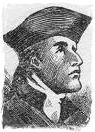
waterfowl. On the mossy bank near the water's edge sits a white man,
a mere youth — the palest of palefaces — with his Bible on his
knee. Have a good look at him; he is a man in a million; he did more
than any other to usher in the world's new day. He is the morning
star of the missionary movement. He is a tall spare youth, of almost
feminine face, and large, sad, lustrous eyes. It is a lovely evening
in the early summer of 1744; and, only a few yards from him, a colony
of beavers is building a dam across the stream. Looking up from the
open page before him, he watches the clever little creatures at their
task. They have no more idea that they are observed than he knows
that he is being watched by wolfish eyes concealed within the impenetrable
foliage. The red men, as silent and as sinewy as serpents, follow
him everywhere and mark his every step. It is well for him that they
do.
It
is a thickly-wooded solitude beside a graceful inlet of the Susquehanna.
The dense and matted vegetation stands as it has stood from the foundation
of the world. The silence of the wilderness is broken only by the
lapping of the mimic wavelets and the flapping of the wings of the
waterfowl. On the mossy bank near the water's edge sits a white man,
a mere youth — the palest of palefaces — with his Bible on his
knee. Have a good look at him; he is a man in a million; he did more
than any other to usher in the world's new day. He is the morning
star of the missionary movement. He is a tall spare youth, of almost
feminine face, and large, sad, lustrous eyes. It is a lovely evening
in the early summer of 1744; and, only a few yards from him, a colony
of beavers is building a dam across the stream. Looking up from the
open page before him, he watches the clever little creatures at their
task. They have no more idea that they are observed than he knows
that he is being watched by wolfish eyes concealed within the impenetrable
foliage. The red men, as silent and as sinewy as serpents, follow
him everywhere and mark his every step. It is well for him that they
do.
For, on his very first journey to the Forks of the Delaware, the insatiable curiosity of the Indians saved his life. He had been told of a particularly ferocious tribe, living far back in the forests of New Jersey, and he determined to take the gospel to them. When, towards evening, he saw the smoke of their camp fires, he pitched his tent and resolved to enter the settlement in the morning. He had been led to expect a hostile reception, but, to his indescribable astonishment, the whole tribe came out to meet him as, soon after sunrise, he approached the wigwams. The reverence that they exhibited almost took his breath away. He only learned later that, during the night that he had spent on the outskirts of the village, their sharp eyes had been constantly upon him. As soon as it was whispered that a white man was coming through the woods, a party of warriors had gone forth to kill him. But, when they drew near to his tent, they saw the paleface on his knees. And, even whilst he prayed, a rattlesnake crept to his side, lifted its ugly head as if to strike, flicked its forked tongue almost in his face, and then, without any apparent reason, glided swiftly away into the brushwood. 'The Great Spirit is with the paleface!' the Indians said; and they accorded him a prophet's welcome.
But we have digressed. We left David Brainerd sitting under a broad-leafed basswood tree, watching the beavers in the river below. Something has frightened the beavers now, and they have vanished; perhaps they caught a glimpse of the white man or of the Indians among the trees. At any rate, they have gone; and, now that he has nothing to distract him, his eyes are fastened once more upon the Bible on his knee. It lies open at the page that is more thumbed than any other. To it he always turns in moments of great loneliness or great anxiety or great depression. He is reading from the seventh of John. In the last day, that great day of the feast, Jesus stood and cried, saying, If any man thirst, let him come unto Me and drink. Whilst David Brainerd, a youth of twenty-six, sat beside that lonely western stream, John Wesley, in the prime of life, was stirring England as England had never been stirred before. In some respects they were twin souls, although the one died at twenty-nine, whilst the other lived to be nearly ninety. One of Brainerd's biographers has said of him that 'he belonged to a class of men who seem to be chosen of heaven to illustrate the sublime possibilities of Christian attainment; men of seraphic fervor of devotion; men whose one overmastering passion is to win souls for Christ and to become wholly like Him themselves.' To this heroic class John Wesley also belonged. He recognized his spiritual kinship. 'What can be done,' he asked his English Conference, 'what can be done to revive the work of God where it has decayed?' And he answered his own question by replying: 'Let every preacher read carefully the Life of David Brainerd!' To-day, Wesley's Journal and Brainerd's Journal stand side by side among our choicest classics of devotion. In his early days John Wesley devoted himself to the evangelization of the Red Indians: David Brainerd spent all his ministerial days among them. Mr. Wesley used to say that, whenever the cravings of his soul became so intense that no satisfaction could be found, even at earth's purest fountains, he invariably found comfort in that sublime proclamation: If any man thirst, let him come unto Me and drink!
'Come!' cried the Saviour in the temple courts.
'Come unto Me!'
'If any man thirst, let him come unto Me and drink!'
John Wesley and David Brainerd never saw each other's faces; it may be that, until after Brainerd's death, Mr. Wesley never so much as heard his young contemporary's name; the Atlantic rolled between them, and their fields lay far apart; but, in their affection for the Saviour's stupendous proclamation at the Feast of Tabernacles, their twin hearts beat as one.

David Brainerd only lived to be twenty-nine; yet, during that brief career of his, he assumed three separate and distinct relationships towards the text.
There was a time when the text irritated him. It is his own word. He was reared in a Puritan home in Connecticut, and was left an orphan at fourteen. As a little boy he was extraordinarily serious, and startled his elders by asking the most grave and searching questions. 'I was from my youth somewhat sober and inclined to melancholy,' his Journal tells us, 'but do not remember anything of conviction of sin, worthy of remark, till I was seven or eight years of age.' Then began a period of darkness and distress which, though varying in intensity, lasted until he was a youth of twenty-one. At about that age he was walking one morning in a solitary place when, as he says, he was brought to, a sudden stand. He felt like a man reeling on the edge of a precipice. 'It seemed to me,' he says, 'that I was totally lost.' Mr. Stoddart's, Guide to Christ fell into his hands; but, as he says, it only irritated him. He felt angry with the author. For, although the book described with scientific accuracy the terrible distress which he was himself experiencing, it did not satisfactorily explain to him the way of deliverance. It told him to come to Christ. 'If any man thirst, let him come unto Me and drink!' But what, precisely, did Mr. Stoddart mean? What, precisely, did the Saviour mean? 'Whilst I was in this distressed, bewildered and tumultuous state of mind, I was irritated,' he writes, 'through not being able to find out what faith was. What was it to believe? What was it to come to Christ? I read the calls of Christ to the weary and the heavy-laden, but could find no way that He directed me to come in. I thought that I would gladly come, if I only knew how. Mr. Stoddart's book told me to come to Christ, but did not tell me anything that I could do that would bring me to Him. For, he significantly adds, 'I was not yet effectually and experimentally taught that there could be no way prescribed, whereby a natural man could, of his own strength, obtain that which is supernatural, and which the highest angel cannot give.'
And so the text, coming to him the first time, brought no comfort. It only awoke 'a great inward opposition.' It irritated him.
Happily, the text repeated its visit. God gives second knocks. Again the Saviour stood and cried, as He cried on the great day of the feast, If any man thirst, let him come unto Me and drink. And this time the text captivated him. Again, it is his own word. It was a Sunday evening — the evening of July 12, 1739. He was walking in the same solitary place. 'At this time,' he says, 'the way of salvation opened to me with such infinite wisdom, suitableness and excellency that I wondered that I should ever have desired any other way of salvation. I was amazed that I had not dropped my own contrivances and complied with this lovely, blessed and excellent way before. If I could have been saved by my own duties, or any other way that I had formerly conceived, my whole soul would now have refused it. I wondered that all the world did not see and comply with this way of salvation.'
'If any man thirst' — it is the only condition.
'Let him come unto Me' — it is the only command.
'Let him come unto Me and drink!' — it is the only
satisfaction that a thirsty man desires.
And David Brainerd was a thirsty man. You can scarcely find a paragraph in his Journal in which the symbolism of the parched tongue does not occur. 'I felt my soul hungering and thirsting.' 'I hungered and thirsted, but was not refreshed and satisfied.' 'My soul longed for God, the living God.' 'I thirsted night and day for a closer acquaintance with Him.' Such phrases punctuate every page.
'I longed!' 'I longed!' "I longed!'
'I thirsted!' 'I thirsted!' 'I thirsted!'
'If any man thirst, let him come unto Me and drink!'
Brainerd thirsted: Brainerd came; Brainerd drank! He left that solitary retreat of his that day singing in his soul the song that, a century later, Horatius Bonar reduced to language:
I heard the voice of Jesus say,
'Behold, I freely give
The living water; thirsty one,
Stoop down, and drink and live.'
I came to Jesus, and I drank
Of that life-giving stream;
My thirst was quenched, my soul revived,
And now I live in Him.
'Unspeakable glory seemed,' he says, 'to open to the view and apprehension of my soul. I do not mean any external brightness, for I saw no such thing. It was a new view of God such as I had never had before. I stood still, wondered and admired. I had never before seen anything comparable to it for excellency and beauty; it was widely different from all the conceptions that ever I had had of God or things divine. I felt myself in a new world, and everything about me appeared with a different aspect from what it was wont to do. My soul was captivated and delighted. I rejoiced with joy unspeakable.'
'That,' says President Jonathan Edwards, in pointing to this entry in the Journal, 'that is the story of Brainerd's conversion. It was not a mere confirmation of certain moral principles: it was entirely a supernatural work, turning him at once from darkness to marvellous light, and from the power of sin to the dominion of holiness.' 'The change he then experienced was,' the President says again, 'the greatest change that ever he knew.' It transfigured his whole life.
And so the text that, on its first appearance, irritated him, came again, and, at its second coming, captivated him. 'I was completely captivated!' he joyously exclaims.
But there was a third phase. The words that first irritated and then capitulated him, at length animated his whole being.
As soon as the burning thirst of his own soul had been divinely slaked, it occurred to him that such thirst was no monopoly of his. The text as good as said so.
'If any man thirst!'
'Any man!' 'Any man!' "Any man!'
'If any man thirst, let him come unto Me and drink!'
Brainerd seemed to be looking out upon a thirsty world. His lot was cast in an age that knew nothing of missionary enterprise. Our great societies were yet unborn. For the evangelization of the world no prayers were offered and no money given. It was through reading Brainerd's Life, in accordance with Mr. Wesley's counsel, that William Carey caught his vision and threw open the doors of a new day. It was Brainerd's biography that made Henry Martyn a missionary. Brainerd was a leader, a pathfinder, a pioneer; he blazed the trail. 'His story,' as Mr. J. M. Sherwood says, 'proves him to be one of the most illustrious characters of modern times; it has done more to develop and mould the spirit of modern missions, and to fire the heart of the Christian church, than that of any other man since the apostolic age. One such personage, one such character, is a greater power in human history than a finite mind can calculate.'
He longed to tell the whole wide world of the Saviour's cry: 'If any man thirst, let him come unto Me and drink!' But how could he? China, India, Africa — all these were out of the question. He thought of the heathen that haunted the prairies and forests of his own land. He was scarcely more than a boy, and he felt the fascination that youth has always felt for the distinctive and picturesque features of Indian life. He thought of the canoes and the wigwams; the mats and the moccasins, the frayed leggings and the feathered head-gear, the bows and the quivers, the scalping-knives and the tomahawks, the pow-wows and the peace-pipes; he thought of these, and he thought, above all, of the man himself. He thought of the Indian's haughty and taciturn demeanor, of his lithe and agile movement, of his simple but dignified eloquence, of his courage and resourcefulness of the warpath, and of his poetic and imaginative accomplishments in time of peace. David Brainerd made up his mind that the Indian was well worth winning, and he devoted his young life to the conquest.
He was not mistaken in supposing that others were thirsty as well as he. Again and again in his Journal he speaks of the hunger of the tribes for the message that he took them. He tells how an Iroquois woman confessed that, from the moment at which she first heard him, her whole heart had cried out for the gospel. To a great assembly of tattooed warriors he preaches on 'Herein is love, not that we loved God, but that He loved us, and sent His Son to be the propitiation for our sins.' 'There were scarce three in forty,' he says, 'that could refrain from tears, and the more I discoursed of the love and compassion of God in sending His Son to suffer for the sins of men, the more they wept.' And he tells of another occasion on which, when he uncovered the communion-table and explained the significance of the sacred mysteries, the whole company was dissolved in tears.
And so this frail young consumptive, racked with his cough and never free from pain, passed from tribe to tribe, telling everywhere the story of the Cross. Groping his way through dense and trackless forests, he spent most of his days in the saddle, startling the creatures of the wild as he broke upon their age-long solitudes. Most of his nights he spent beneath the open sky. Frail as was his frame, he exposed himself to perils and privations of every kind. Yet, as Mr. Sherwood says, he never wavered in his purpose, never regretted his choice, and never paused in his task until, after five brief but strenuous years, he rode back to New England to die.
And the text, still holding its old place in his heart, was ever on his tongue. It ever impelled him to fresh conquests. Here are a few extracts from the Journal:
Feb. 15, 1745. This evening I was much assisted in meditating on that precious text: Jesus stood and cried, If any man thirst, let him come unto Me and drink! I longed to proclaim such grace to the whole world of sinners.
Feb. 17, 1745. On the sunny side of a hill in the wilderness, I preached all day, to people who had come twenty miles to hear me, on Jesus stood and cried, If any man thirst, let him come unto Me and drink! I was scarce ever enabled to offer the free grace of God to perishing sinners with more plainness.
April 22, 1745. Preached, with freedom and life, from Jesus stood and cried, If any man thirst, let him come unto Me and drink!
August 5, 1745. Preached to the Indians from Jesus stood and cried, If any man thirst, let him come unto Me and drink! Some, who had never been affected before, were struck with deep concern; others had their concern greatly deepened.
He died on October 9, 1747. He was not yet thirty, but he had no regrets. 'Now that I am dying,' he exclaimed, 'I declare that I would not for all the world have spent my life otherwise!' Near the end, Miss Edwards, to whom he was betrothed, and who followed him into the unseen about four months later, entered the sickroom with a Bible in her hand. 'Oh, that dear book!' he cried, 'that lovely book! I shall soon see it opened! The mysteries in it, and the mysteries of God's providence, will all be unfolded!' Thus he clung to the promise of the text to the last. He was radiantly confident that the thirst of the soul — the thirst for knowledge and illumination — the thirst that had been only partially quenched in this world — would be abundantly satisfied in the realms of everlasting light.
From A Casket of Cameos, or, More Texts That Made History by F.W. Boreham. Philadelphia: Judson Press, ©1924.
>> More David Brainerd