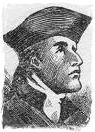
 David Brainerd, missionary, was born at Haddam, Connecticut,
April 20, 1718. His father, Hezekiah, was one of His Majesty's counsel
for the colony, and his maternal grandfather was the son of Rev. Peter
Hobart, first minister of the gospel at Hingham, England, who came
to New England during the persecution of the Puritans, and settled
at Hingham, Massachusetts. David was left an orphan at fourteen years
of age, was always thoughtful beyond his years and inclined to morbid
conscientiousness. When he was seven or eight years old, his religious
experiences were marked, but did not continue. Six years afterward
they returned upon him with great power, resulting as he believed in
his conversion to God. At the age of twenty he was again the subject
of especial religious impression, and his new baptism stirred his soul
to its inmost depths. He preserved the record of these experiences
in detail, in his account of his early life and conversion.
David Brainerd, missionary, was born at Haddam, Connecticut,
April 20, 1718. His father, Hezekiah, was one of His Majesty's counsel
for the colony, and his maternal grandfather was the son of Rev. Peter
Hobart, first minister of the gospel at Hingham, England, who came
to New England during the persecution of the Puritans, and settled
at Hingham, Massachusetts. David was left an orphan at fourteen years
of age, was always thoughtful beyond his years and inclined to morbid
conscientiousness. When he was seven or eight years old, his religious
experiences were marked, but did not continue. Six years afterward
they returned upon him with great power, resulting as he believed in
his conversion to God. At the age of twenty he was again the subject
of especial religious impression, and his new baptism stirred his soul
to its inmost depths. He preserved the record of these experiences
in detail, in his account of his early life and conversion.
In September, 1739, he entered the freshman class at Yale College, "but," as he says, "with some reluctancy, fearing lest I should not be able to lead a life of strict religion, in the midst of so many temptations." The "Great Religious Awakening" (1739-45) however, which arose and spread over the country visited New Haven, and Brainerd found himself deeply interested in it. His standing as a scholar was good, but other college experiences of his have actually had more regard paid to them than did that fact. The college authorities set themselves in opposition to the "revival movement," so-called, and forbade the students to attend upon the services connected with it. Several religious young men, however, associated themselves together for mutual conversation and assistance in spiritual things, and it was in the company of two or three friends in the college hall, that Brainerd was heard about this time to say, in answer to an inquiry concerning one of the college tutors, "he has no more grace than this chair." This was repeated to the college rector, Rev. Dr. Thomas Clap, and as Brainerd, while he confessed the impropriety of his language, declined to make a public confession and to humble himself before the whole college for what he had said only in private conversation, and as he had gone once to the separate meeting in New Haven, when forbidden by the Rector, the young culprit forthwith found himself expelled from the college. His personal feeling under the indignity, as witnessed by his diary, seems to have been of the most praise worthy character, and his bearing under what was a trial so severe that he apparently never recovered from it, was that of a Christian gentleman. But nothing availed with the college dignitaries, who refused him readmission and rejected his prayer to be allowed to graduate with his classmates, although urged to grant it by a council of Congregational ministers. Brainerd's biographers have attributed much of the dejected and semi-morbid frame of mind that characterized portions of his subsequent career to the absolutely indefensible and discreditable action of the college governors.
Being resolute to take up the Christian ministry, he was licensed to preach by the Danbury (Conn.) association of Congregational ministers, on July 20, 1742, and in November the same year he was asked by the American correspondents of the Scottish Society for Propagating Christian Knowledge, to visit New York and confer with them concerning entry upon missionary labor among the Indians of North America. This arrangement was perfected and Brainerd began his work with the Stockbridge (Mass.) Indians, at a place named Kaunameek, twenty miles from the village of Stockbridge, April 1, 1743. Here he labored for a year. On November 3, 1744, in a letter addressed to the correspondents who had employed him, he gives ample account of his labor among the Indian people and of the reasons which induced him, after conference with the correspondents, to turn over the work among them to Rev. Mr. Sergeant, of Stockbridge, into whose bounds they agreed to remove, while he (Brainerd) should transfer his labors to the Delaware Indians.
He now received urgent invitations to settle in the ministry at Millington, Connecticut, and at Easthampton, Long Island. But both these overtures were declined and he proceeded to the forks of the Delaware river near the present site of Easton, Pennsylvania, having been ordained by the Presbytery of Newark, June 11, 1744. He appears to have labored diligently at this station for a year during which period he paid two visits to Indians of the Susquehanna, but without the eminent and signal success which subsequently attended his exertions in his third field of labor. Much of his work was apostolic pioneering.
His health began to fail, and his mind acquired the habit of contemplating death as a relief from his trials of body and soul. But he says: "God scarce ever lets these thoughts be attended with terror and melancholy: they are attended frequently with great joy."
In June, 1745, he began the labors among Indians at Crossweeksung, New Jersey, near the present town of Freehold in that state, which have gone far to make his name immortal among missionary workers. They continued for a year and consisted of faithful and earnest preaching among scattered Indian families, who from the first rejoiced at his advent among them, with the most pronounced and satisfactory results. Brainerd's record of these efforts and the impression from them is minute and attests a religious work which for genuineness and power has not often been surpassed. In less than a year, it is asserted, he had baptized seventy-seven persons, of whom thirty-eight were adults, and the lives of most of these people were permanently reformed.
But under these exertions, and the journeys by which they were attended, Brainerd's health broke down, and the end came during a trip to New England undertaken by the direction of his physicians who were conscious that consumption had fastened itself upon his system. He reached Northampton, Massachusetts, in July, 1747, and was kindly cared for at the house of Rev. Jonathan Edwards, to whose daughter, Jerusha, he was betrothed. Being still advised to open air exercise, he next visited Boston, Massachusetts, but sank still lower in health while there. Reviving sufficiently to reach Dr. Edwards's house once more, he remained there until the end. Brainerd had some means of his own, derived from his father, and these were freely consecrated to the great work of his life, a portion of them being spent in the education of a young man for the Christian ministry. His "Life," compiled from his diary, was written by Rev. Jonathan Edwards (1749), and a second edition was edited by Sereno Edwards Dwight at New Haven, Connecticut, in 1822. A third edition was edited by Rev. J. M. Sherwood at New York, 1884. John Wesley also published an abridgement of Brainerd's Life, in England. (See also Sparks's "American Biography," and Sprague's "Annals of the American Pulpit.") He died October 9, 1747.
From The National Cyclopædia of American Biography... New York: James T. White & Company, 1892. Vol. 2.
>> More David Brainerd