Born: April 20, 1718 Haddam, Conn.
Died: October 9, 1747 Northampton, Mass.
Life Span: 29 years, 5 months, 19 days
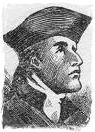 He was only 29 when he died...his gravestone simply says, "A
faithful and laborious missionary to the Stockbridge, Delaware and
Susquehanna tribes of Indians." But in truth David Brainerd's
life sacrifice reached out and touched the whole world, challenging
more people into Christian service than perhaps any other man that
ever lived. The mere mention of the name, Brainerd, automatically
triggers the mind to think of dedication in a way that perhaps has
never been equaled. He would travel 15,000 miles on horseback. One
small compelling book — David Brainerd's Journal which
he kept from June 19, 1745, to June 19, 1746, plus his diaries of
his days before and after this time are still used of God today
to inspire and convict the Christian world in the matter of Christian
service.
He was only 29 when he died...his gravestone simply says, "A
faithful and laborious missionary to the Stockbridge, Delaware and
Susquehanna tribes of Indians." But in truth David Brainerd's
life sacrifice reached out and touched the whole world, challenging
more people into Christian service than perhaps any other man that
ever lived. The mere mention of the name, Brainerd, automatically
triggers the mind to think of dedication in a way that perhaps has
never been equaled. He would travel 15,000 miles on horseback. One
small compelling book — David Brainerd's Journal which
he kept from June 19, 1745, to June 19, 1746, plus his diaries of
his days before and after this time are still used of God today
to inspire and convict the Christian world in the matter of Christian
service.
David was the sixth of nine children born into the home of Hezekiah and Dorothy (Mason) Brainerd. Details of his childhood are scanty, but he grew up in a country house just above the west bank of the Connecticut River, two miles outside of Haddam. His father was a country squire, a local justice of the peace, and a Christian, as was his mother. His father died when he was nine and the death of his mother in March, 1732 brought additional great grief to 14 year old David, who was by then seeking to find what conversion was all about. From ages 15 to 19 he lived with his sister Jerusha who had just married Samuel Spencer. In April, 1738, he returned to Haddam to live and to study with the pastor of his youth, Phineas Fiske. Brainerd soon became a serious student of the Bible, and ignored the other pleasures in which most young people were participating. Fiske died in the fall, and Brainerd, like Luther, continued desperately seeking peace with God. By February, 1739, he was setting aside whole days of secret fasting and almost incessant prayer as he strove for acceptance with God.
Finally on July 12, 1739, as he returned to his secret place of prayer, God spoke to him as light dawning, and he had a glorious salvation experience. Now he wondered why all the world could not see "this lovely, blessed, and excellent way." He states as he was walking in a dark thick grove, unspeakable glory seemed to open to the view and apprehension of his soul. He was then 21 years of age.
In September, 1739, David entered Yale University. It was a terribly cold winter and a bout with the measles laid him aside that first year. Trying to catch up only caused greater maladies and by August, 1740, he was weak and spitting up blood. Consumption or tuberculosis of the lungs was the plague of colonial New England. He returned to Yale on about November 6, 1740, to see a marked spiritual change in the school. George Whitefield had visited Yale on October 27th, and it seemed a pentecostal flame had hit the school. Gil Tennent of New Jersey had also preached with great power in March of 1740 in New Haven. Brainerd and two other students were soon distinguished for their zeal and visited many other students "for conversation and prayer." On April 19, Ebenezer Pembertson visited Yale and gave a stirring address about missionary work to the Indians. The next day, on his 23rd birthday, Brainerd vowed "to be wholly the Lord's, to be forever devoted to his service."
The Great Awakening was now at its peak, and despite Jonathan Edwards' efforts to keep everything in decency and order, things got out of hand. Tennent had preached his impassioned sermon, The Danger of an Unconverted Ministry, simply reinforcing Whitefield's sentiments. People began to turn against their ministers and hold "separate" meetings.
So as a result, as Brainerd entered his third year at Yale in the fall of 1741, a rule was made, "Voted, that if any student of this College shall directly or indirectly say, that the Rector, either of the Trustees or Tutors are hypocrites, carnal or unconverted men, he shall for the first offense make a public confession in the Hall, and for the second offense be expelled." Soon in a private conversation, when asked what he thought about a certain tutor, David replied, "He has no more grace than this chair." This charge was harsh, and based only on one prayer of the leader, which David called, "unusually pathetical." Actually, the man was quite spiritual. A freshman overheard and reported the conversation. When Brainerd refused to publicly confess this, which he felt was a private matter, he was expelled in February, 1742. Afterwards he sought forgiveness, wrote out a full and complete confession, and had others intercede for him...but to no avail. The authorities would not reinstate him.
On April 20th (24th birthday) Brainerd wrote, "...I hardly ever so longed to live to God and to be altogether devoted to Him; I wanted to wear out my life in his service and for his glory..." He waged a constant fight against the bitterness of his disappointment over his expulsion from Yale. In June he began to spend some days in fasting and prayer. He was at a loss as to what the Lord wanted him to do. On July 29, 1742, he was licensed to preach as a Presbyterian at Danbury, Connecticut. He spent the summer with another young bachelor friend — Joseph Bellamy. They worshipped and preached in a barn which served as a meeting house for Bellamy's small congregation in Woodbury, Connecticut. Brainerd's first sermon was on July 30th at Southbury, Connecticut, using I Peter 4:8 as his text and his first message to the Indians was soon after, on August 12, near the Connecticut-New York border. He traveled as an itinerant preacher for several months. In September, 1742, he had to leave New Haven quickly for unlawful preaching.
On November 19th, he received a summons from Pemberton of New York City, to come and discuss the question of ministry to the Indians in those parts. On November 25 he met with the commissioners of the Scotch Society. As part of his examination, he delivered a sermon, most probably in Pemberton's church. He was grieved for the congregation, "that they should sit there to hear such a dead dog as I preach." He felt he was totally unworthy to preach to others so much better than himself.
He preached from place to place in the winter, including a farewell sermon to his family and friends in a home in East Haddam on February 1, 1743. He then served as a supply preacher at East Hampton, Long Island, New York for six weeks. On his last Sunday there, March 13th, although he could hardly stand up, he preached for an hour and a half. The congregation pressed him to stay permanently. But the next day, he left for work among the Indians. He said later, "I never, since I began to preach, could feel any freedom to enter into other men's labours and settle down in the ministry where the gospel was preached before." He felt he had to preach where Christ was not named nor known. He left for his life's work March 25, 1743.
He was assigned to Stockbridge, Massachusetts, and arrived there March 31, 1743, and began his ministry the next day. He was stationed 20 miles west between Stockbridge and the Hudson River at a place called Kaunaumeek, 18 miles south east of Albany. Without conversation, or company, he was very lonely even though the Indians were cordial to him. On April 20th (25th birthday) he spent the day fasting alone in the woods in prayer. His diet was hasty-pudding, boiled corn, and bread baked in ashes. His lodging was a heap of straw, laid upon boards in a log room without any floor. He traveled one and one half miles each way daily on foot in order to see the Indians. A Stockbridge Christian became his interpreter and friend. Brainerd learned to pray with the Indians in their language. They translated Psalms and hymns, and started an "English" school. By the first of August he had completed building his hut and had a better place to sleep. But other problems mounted. He had to go or send ten or more miles for bread to eat and it would turn moldy and sour before he could eat all of it. The presence and worldly conversation of some irreligious Dutchmen oppressed him more than all the difficulties of his wilderness life. He made four brief trips to New York during this time, his last one including a stop at New Haven to observe the commencement exercises of September 14, 1743 in which he should have been included. One final attempt to have him reinstated with Jonathan Edwards and Aaron Burr interceding was to no avail. Stopping at Bellamy's he became seriously ill. Recovering sufficiently he returned to his station, Kaunaumeek, on October 4th.
On the day after Christmas, he wrote, "Was very much fatigued with my journey, wherein I underwent great hardships; was very much exposed and very wet by falling into a river." The ordination of a friend, Samuel Hopkins, that week left him depressed as he could not understand the accompanying levity, celebration and food. In January, 1744, he spent the middle of the winter alone in his little hut, yet they were happy hours. On Sunday March 11, he preached his last sermon at Kaunaumeek, as he was now seeking new tribes to win to Christ.
He again received a call to East Hampton, to be the pastor. Suffering weakness and headache, he died inwardly to two attractive calls, writing, "Resolved to go on still with the Indian affair, if divine providence permitted; although I had before felt some inclination to go to East Hampton." His other call to Millington was likewise turned down.
The commissioners instructed him to go to Pennsylvania. He again had a serious sick spell for three days, and went home to Haddam for the first time in 15 months. Now 26 years of age, he left home again. He left Kaunaumeek, April 30.
Spending some days at Salisbury, Connecticut, he left May 7th arriving on May 13th at present day Easton, Pennsylvania, within the forks of the Delaware River.
Brainerd was well received by the Indians and usually taught them in the chief's house. Traveling some 70 miles back to New York, Brainerd was ordained on June 11, 1744, by the Presbytery of New York. On June 19th he left friends and benefactors to seek again God's chosen ones in the remote wilderness.
By the end of the summer some 40 Indians were listening to his message. He was plagued with pain, and had difficulty controlling his legs after long hours on horseback. He also had to cope with Tattamy, his interpreter, who was totally unfamiliar with the white man's Bible. In July a flicker of heart interest by the Indians caused him to work hard preaching and translating. One time he was asking the Lord to take him home. Then he heard the Indians intended to have an idolatrous feast and dance. Desire to live surged back into him as he used his only weapon — prayer, and the Indians changed their plans.
During this time he lived much of the time with the Hunter family at a place known as Hunter's Settlement. Brainerd was the supply minister to the whites there, along with his ministry to the Indians. The rest of the summer he lay in "illness and uselessness." The first week of August he preached to the Indians twice, although "obligated to sit down the whole time." By September he was somewhat recovered and took a three week vacation. It was a journey of recuperation and pleasure, of visiting home and friends back in New England.
He now had a desire to go westward to reach the Indians on the Susquehanna River. Brainerd, an associate Eliab Bryam, Tattamy and two other Indians left on October 2. His horse fell down and broke her leg, so Brainerd killed her, and continued to the nearest house 30 miles away on foot. The picture of the two young ministers alternately riding their one horse must have been intriguing. They were well received by the Indians, spent a few days there, and then returned the 70 miles where a new horse was given to Brainerd on October 12.
Resuming his life, sick and lonely, alternately cheerful and dejected, he began to build a house for himself with the help of others. Moving into his new quarters he spent December 6 in prayer and fasting, "to implore the blessing of God on myself, on my poor people, on my friends, and on the church of God." Beginning at Christmas he went through a terrible month of despondency. Things brightened up on Sunday, February 17, 1745, when he preached to a group of white people coming from scattered frontier homes to have Communion. He greatly appreciated his friends, both white and Indian, and on March 7 he left them for a five week trip to New England. In March and April, he rode more than 600 miles searching New Jersey, New York and Connecticut to find a companion, and the support for the same. This goal was not realized, for none was, "qualified or disposed for this good work." So he returned alone to the Forks of the Delaware to continue his work. On April 20 (27th birthday) he was at the Abington Presbyterian Church, between Philadelphia and Neshaminy for a three-day ministry.
Weak in body, Brainerd and Tattamy left May 8th for their first major trip to the interior Indians along the Susquehanna River. By passing the original contact they had made the previous October, they reached Shamokin, the headquarters for several tribes of Indians, stopped off at other settlements and returned home, the roundtrip taking 22 days. The 340 mile journey left Brainerd weak and dejected, depressed and disillusioned about the prospects among the Indians in that area. Except for Tattamy and his wife, who both were growing spiritually, he considered his past year almost a failure. He returned May 30.
He then heard about a group of Indians at a place called Crossweeksung (9 miles southeast of Trenton) in New Jersey, about 80 miles southeast of the Forks of Delaware. He arrived June 19, 1745. He spent two weeks there with a good deal of conviction, tears and interest amongst the Indians. Upon his return to the Forks, these Indians also seemed to be much more responsive to his ministry. On July 21 he baptized Tattamy and his wife, his first converts among the Indians. He went back to Crossweeksung and experienced the most glorious week in his life. On August 8 the power of God came down on his little group of 65 as he preached. The sudden and unexpected seizer of the Indians was followed by earnest prayers. Many genuine conversions took place. News traveled, and soon other Indians were coming to hear the young white preacher. Members of the careless white community began to show up also, and get converted. On August 25, he baptized 25 of the Indians and the years of prayer and suffering were beginning to bear some fruit.
He decided to make one last effort to evangelize the Indians along the Susquehanna River and spent the month of September (9-28) attempting this, but with no apparent success. Back at Crossweeksung on October 5, he was overjoyed at the difference to the response of the Gospel. Others were saved and baptized. Christmas had a new meaning to both preacher and hearer, and after two years of barrenness Brainerd rejoiced greatly as he reaped some spiritual fruit.
On January 31, 1746 another milestone was reached — Brainerd engaged a schoolmaster for the Indians and a dozen primers were passed out. In February he visited his "parish" back at the Forks being "under great weakness and some pain." Some evangelists (Indian converts) from Crossweeksung went with him. He encouraged some of his former friends at the Fork to move to Crossweeksung. Back at this site he had a very ill week in mid-March. He encouraged the Indians to develop spring planting at a settlement at Cranberry, 15 miles distant, which they did. His attempt to colonize the converts as farmers was not successful. There were now about 150 who followed him and his directions. On April 20 (28th birthday) he preached the Easter story from Luke 24 to the Indians. On April 27th another milestone was reached — the Indians took the Lord's Supper. He settled down at Cranberry on May 3rd, and a place of worship was established known as Bethel. He was tempted to stay here. However back in his heart were the pagan Indians of the Susquehanna River area where he had already failed three times to make any headway.
Finally on August 12, he left his friends at Cranberry and with six Indian evangelists attempted his fourth trip to the Susquehanna River area. He had never gone further west than Shamokin before, but now he desired to go an additional 100 miles to a site near present day Lockhaven, Pennsylvania. He recorded such things as "...sweat much in the night, so that my linen was almost wringing wet all night, was exceedingly weak, so that I could scarcely ride; it seemed sometimes as if I must fall off from my horse, and lie in the open woods..."
This trip finally broke his health completely, and he had to curtail much of it. Many might ask, "why did he go on this journey despite his great weakness and ill health?" He simply could not confine himself to one spot, when so many men were dying without Christ everywhere. Back at Shamokin on September 6, he clung to his life, "coughing and spitting blood." On September 20 he arrived back at Cranberry. Brainerd now realized that the tuberculosis of his lungs was going to destroy his body. He felt somewhat guilty in that he had recklessly injured his health and aggravated his illness. But in reality, his zeal and outdoor life probably prolonged his days, since his problem had started several years prior while at Yale. On October 6, he had his last blessed day at Cranberry, having the Lord's Supper with 40 of his converts and baptizing two adults. His final harvest was now 85 Indians. November 3 was his last day as pastor of his flock in Cranberry. He spent the long winter in Elizabethtown, New Jersey with Jonathan Dickinson. Rallying in health he made one last visit to his Indian converts on March 18-20, 1747, and bid them goodbye for the last time. On April 20 (29th birthday) he spent the day mostly in bed at the Dickinsons. He left for New England the next day, not realizing that his 59 year old host would pass on two days before Brainerd. Brainerd was invited to Jonathan Edwards' house, by probably both the preacher and his 17 year old daughter, Jerusha, whom Brainerd had greatly admired even as a young teen-age girl. He visited his kin-folk at Haddam, (May 1) bidding farewell to his favorite sister, Jerusha Spencer, little realizing that he would get news of her death in two more months. Arriving at the Edwards' home on May 28, he was vastly better and cheerful. David's petition in family prayer was usually "that we might not outlive our usefulness." Jerusha was his nurse for 19 weeks, devoting herself with great delight because she looked on him as an eminent servant of Jesus Christ. He wrote letters signing them, "your dying brother". He took his last horseback ride and prayed with the family for the last time on August 11th. A room on the first floor was set aside for him the following week as he could not climb steps. He went to church for the last time September 2nd. Edwards described his last days — swollen feet — constant pain — discharge of purulent matter — broken whispers — agonies of body. His last Sunday, October 4th, he recorded this touching conversation with Jerusha, in appreciation of her constant companionship and love.
"Dear Jerusha...though, if I thought I should not see you, and be happy with you in another world, I could not bear to part with you. But we shall spend a happy eternity together."
On Wednesday he discussed his Indian work with his brother John, who succeeded him at Bethel, and on Friday, October 9, it was all over. His last words were "He will come, and will not tarry. I shall soon be in glory; soon be with God and His angels." He was buried on Monday with Jonathan Edwards conducting the funeral. Four months later, grieving Jerusha, in her 18th year, took sick and in five days, on February 14, 1748, joined David in heaven and was buried next to him.
John Wesley said, "Let every preacher read carefully over the life of David Brainerd," and distributed his life story to all his societies. F. W. Robertson, Ion Keith Falconer, Robert Murray McCheyne, A. J. Gordon, Francis Asbury, Jim Elliott, Thomas Coke, William Carey and Henry Martyn all were motivated to service through Brainerd, amongst others.
Used with permission, 7/13/99. From one of 49 booklets by Ed Reese in his Christian Hall of Fame series.
>> More David Brainerd