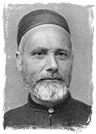
 James
Gilmour, of Mongolia, the son of James Gilmour and Elizabeth Pettigrew his
wife, was born at Cathkin [Scotland] on Monday, June 12, 1843. He was the third
in a family of six sons, all but one of whom grew up to manhood. His father
was in very comfortable circumstances, and consequently James Gilmour never had the struggle
with poverty through which so many of his great countrymen have had to pass.
Cathkin, an estate of half a dozen farms in the parish of Carmunnock, is only
five miles from Glasgow, and was owned by Humphrey Ewing Maclae, a retired
India merchant, who resided in the substantial mansion-house on the estate.
There were also the houses of a few residents, and a smithy and wright's workshops,
for the convenience of the surrounding district. James Gilmour's father was
the occupant of the wright's shop, as his father had been before him.
James
Gilmour, of Mongolia, the son of James Gilmour and Elizabeth Pettigrew his
wife, was born at Cathkin [Scotland] on Monday, June 12, 1843. He was the third
in a family of six sons, all but one of whom grew up to manhood. His father
was in very comfortable circumstances, and consequently James Gilmour never had the struggle
with poverty through which so many of his great countrymen have had to pass.
Cathkin, an estate of half a dozen farms in the parish of Carmunnock, is only
five miles from Glasgow, and was owned by Humphrey Ewing Maclae, a retired
India merchant, who resided in the substantial mansion-house on the estate.
There were also the houses of a few residents, and a smithy and wright's workshops,
for the convenience of the surrounding district. James Gilmour's father was
the occupant of the wright's shop, as his father had been before him.
His brother John, one of three who survived him, furnished the following interesting sketch of the family life in which James Gilmour was trained, and to which he owed so much of the charm and power which he manifested in later years:—
"Our grandfather, Matthew Gilmour, combined the trades of mason and wright, working himself at both as occasion required; and our father, James Gilmour, continued the combination in his time in a modified degree, gradually discarding the mason trade and developing the wright's. Grandmother (father's mother) was a woman of authority, skill, and practical usefulness among the little community in which she resided. In cases requiring medical treatment, she was always in request; and in order to obtain the lymph pure for the vaccination of children she would take it herself direct from the cow. She was also a neat and skilful needlewoman.
"Matthew Gilmour and his wife were people of strict integrity and Christian living. They walked regularly every Sunday the five miles to the Congregational Church in Glasgow, though there were several places of worship within two miles of their residence. I have often heard the old residents of the steep and rough country road they used to take, for a short cut when nearing home, tell how impressed they have been by the sight of the worthy couple and their family wending their way along in the dark winter Sabbath evenings by the light of a hand-lantern. Our parents continued the connection with the same body of worshippers in Glasgow as long as they resided in Cathkin, being members of Dr. Ralph Wardlaw's church. It was under his earnest eloquence, and by his wise pastoral care, we were trained.
"The distance of our home from the place of worship did not admit of our attending as children any other than the regular Sabbath services; but we were not neglected in this respect at home, so far as it lay in our parents' ability to help us. We regularly gathered around our mother's knee, reading the impressive little stories found in such illustrated booklets as the Teacher's Offering, the Child's Companion, the Children's Missionary Record (Church of Scotland), the Tract Magazine, and Watts' Divine Songs for Children. These readings were always accompanied with touching serious comments on them by mother, which tended very considerably to impress the lessons contained in them on our young hearts. I remember how she used to add: 'Wouldn't it be fine if some of you, when you grow up, should be able to write such nice little stories as these for children, and do some good in the world in that way!' I have always had an idea that James's love of contributing short articles from China and Mongolia to the children's missionary magazines at home was due to these early impressions instilled into his mind by his mother. Father, too, on Sabbath evenings, generally placed the 'big' Bible (Scott and Henry's) on the table, and read aloud the comments therein upon some portion of Scripture for our edification and entertainment. During the winter week-nights some part of the evening was often spent in reading aloud popular books then current, such as Uncle Tom's Cabin.
"Family worship, morning and evening, was also a most regular and sacred observance in our house, and consisted of first, asking a blessing; second, singing twelve lines of a psalm or paraphrase, or a hymn from Wardlaw's Hymn-book; third, reading a chapter from the Old Testament in the mornings, and from the New in the evenings; and fourth, prayer. The chapters read were taken day by day in succession, and at the evening worship we read two verses each all round. This proved rather a trying ordeal for some of the apprentices, one or more of whom we usually had boarding with us, or to a new servant-girl, as their education in many cases had not been of too liberal a description. But they soon got more proficient, and if it led them to nothing higher, it was a good educational help. These devotional exercises were not common in the district in the mornings, and were apt to be broken in upon by callers at the wright's shop; but that was never entertained as an excuse for curtailing them. I suppose people in the district got to know of the custom, and avoided making their calls at a time when they would have to wait some little while for attention. Our parents, however, never allowed this practice or their religious inclinations to obtrude on their neighbours; all was done most unassumingly and humbly, as a matter of everyday course.
"While James was quite a child the family removed to Glasgow, where our father entered into partnership with his brother Alexander as timber merchants. During this stay in Glasgow mother's health proved very unsatisfactory, and latterly both she and father having been prostrated and brought to death's door by a malignant fever, it was decided to relinquish the partnership and return to their former place in the country. James was five years old at that time. When he was between seven and eight he was sent with his older brothers to the new Subscription School in Bushyhill, Cambuslang, a distance of two miles. Here he remained till he was about twelve, when he and I were sent to Gorbals Youths' School in Greenside Street, Glasgow. We had thus five miles to go morning and evening, but we had season-tickets for the railway part of the distance, namely, between Rutherglen and Glasgow. Thomas Neil was master of this school. We were in the private room, rather a privileged place, compared with the rest of the school, seeing we received the personal attentions of Mr. Neil, and were almost free from corporal punishment, which was not by any means the case in the public rooms of the school — Mr. Neil being, I was going to say, a terror to evildoers, but he was in fact a terror to all kinds of doers, from the excitability of his temper and general sternness.
"Here James usually kept the first or second place in the class, which was a large one; and if he happened to be turned to the bottom (an event which occurred pretty often to all the members of the class with Mr. Neil), he would determinedly endeavour to stifle a mournful 'cry,' thus demonstrating the state of his feelings at being so abased. But he never remained long at the bottom; like a cork sunk in water, he would rise at the first opportunity to his natural level at the top of the class. It was because of his diligence and success in his classes while at this school, I suppose, more than from any definite idea of what career he might follow in the future, that after leaving he was allowed to prosecute his studies at the Glasgow High School, where he gained many prizes, and fully justified his parents' decision of allowing him to go on with his studies instead of taking him away to a trade. At home he prosecuted his studies very untiringly both during session and vacation.
"After entering the classes of the Glasgow University he studied in an attic room, the window of which overlooked an extensive and beautiful stretch of the Vale of Clyde. I remember feeling compassion for him sometimes as he sat at this window, knowing what an act of self-denial it must have been to one so boisterous and full of fun as he was to see us, after our work was over of an evening, having a jolly game at rounders, or something of that sort, while he had to sit poring over his books.
"James was not a serious, melancholy student; he was indeed the very opposite of that when his little intervals of recreation occurred. During the day he would be out about the workshop and sawmill, giving each in turn a poking and joking at times very tormenting to the recipients. If we had any little infirmity or weakness, he was sure to enlarge upon it and make us try to amend it, assuming the role and aspect of a drill-sergeant for the time being...
"There was a pond or dam in connection with the sawmill. In this James was wont to practise the art of swimming. I remember he devised a plan of increasing his power of stroke in the water. He made four oval pieces of wood rather larger than his hands and feet, tacking straps on one side, so that his hands and feet would slip tightly into them. But my recollection is that they were soon discarded as an unsuitable addition to his natural resources. He was fond of hunting after geological specimens, getting the local blacksmith to make him a pocket hammer to take with him on his rambles for that purpose. He seldom cared for company in these wanderings among the mountains, glens, and woods of his native place and country. He would start early in the morning, and accomplish feats of walking and climbing during the course of a day. Indeed, none of his brothers ever thought of asking James to go with them in their little holiday trips, knowing that anything not the conception of his own fancy was but very rarely acceptable to him; and he was never one who would pander to your gratification merely to please you.
"James was fond of boating. Once he hired a small skiff near the suspension-bridge at Glasgow Green, and proceeded with it up the river. Having gone a good way up, the idea appears to have taken him to endeavour to get the whole way to Hamilton, where, father having retired from business in 1866, our parents were now residing. This proved to be a very arduous task, as in a great many places on that part of the Clyde there is not depth of water to carry a boat. He managed, however, to accomplish the task by divesting himself of jacket, stockings, and shoes, and pulling the boat over all such shallow and rocky places (including the weir at Blantyre Mills, where the renowned African missionary and explorer, Dr. Livingstone, worked in his boyhood), until he reached the bridge on the river between Hamilton and Motherwell, a distance of eleven miles or more from Glasgow in a straight line, and much more following the numerous bends of the river. Here he made the boat secure and proceeded home, a distance of a mile, very tired and ravenously hungry. The great drawback to his satisfaction in this feat was his fear of the displeasure the boat owner might feel at his not having returned the same night, and the rough usage to which he had subjected the boat in hauling it over the rocky places. He was much delighted, when he arrived with the boat down the river during the day, to find that the man was rather pleased than otherwise at his plucky exploit, telling him that he only remembered it being attempted once before.
During part of the time James attended college at Glasgow University, the classes were at so early an hour that he could not take advantage of the railway, and so had to walk in the whole way. This was an anxious time for his mother, who was ever most particular in seeing to the household duties herself, and always careful that her children should have a substantial breakfast when they went from home. I remember some of those winter mornings. Amidst the bustle of making and partaking of an early breakfast so as to be on the road in time, mother would press him to partake more liberally of something she had thoughtfully prepared for him; he would ejaculate: 'Can't take it — no time and if she still insisted he would add in a solemn manner 'Mother, what if the door should be shut when I get there?' which, being understood by her as a scriptural quotation, was sufficient to quench her solicitations.
To avoid the worry of getting up so early, it was decided after a time that he should take advantage of an unlet three or four apartment house in a tenement which belonged to father in Cumberland Street, Glasgow. So a couple of chairs, table, bed, and some cooking-utensils were got together, and James entered into possession, cooking his own breakfast, and getting his other meals there or outside as his fancy or inclination prompted. Here I think he enjoyed himself very much. He had plenty of quiet time for study, and he could roam about the city and suburbs for experience, recreation, and instruction, visiting mills and other large manufacturing industries as he was inclined.
"After our parents had removed to Hamilton, James took lodgings in George Street, a regular students' resort when the old college was in the High Street. It is now removed to the magnificent pile of buildings at Gilmorehill, in the western district of the city. The site of the old one in the High Street which James attended is now occupied by the North British and Glasgow and South-Western Railway Companies."
James Gilmour left England to begin his Mongolian lifework in February 1870, and then commenced keeping a diary, from which we shall often quote, and which he carefully continued amid, oftentimes, circumstances of the greatest difficulty until his death. He gives the following reasons for this practice at the time when he was living in a Mongol tent learning the language, hundreds of miles away from his nearest fellow-worker:
"I think it a special duty to my friends, specially my mother, to keep this diary, and to be particular in adding my state of mind in addition to my mere outward circumstances. In my present isolated position, which may be more isolated soon, any accident might happen at any moment, after which I could not send home a letter, and I think that by keeping my diary punctually and fully my friends might have the melancholy satisfaction of following me to the grave, as it were, through my writing."
The Rev. H. R. Reynolds, D.D., for thirty-three years the honoured President of Cheshunt College, recalled some of his early recollections of James Gilmour.
"Though brusque and outspoken in manner, he was in many respects reserved and shy, and very slow to show or accept confidence. We all felt, however, that underneath a canny demeanour there was burning a very intense enthusiasm, and that a character of marked features was already formed, and would only develop along certain lines, settled, but not as yet fully disclosed to others.
There was not a particle of make-believe in his composition. He shrank from praise, and was obviously anxious not to appear more reverential or wise or devoted than he knew himself to be. He even used, because it was natural to him, a rugged style of expression when speaking of things or persons or institutions which for the most part uplift our diction and generally induce us to adorn or make careful selection of our vocabulary. He rapped out expressions which might have suggested carelessness or irreverence or suppressed doubt, but I soon found that there was an intense fire of evangelistic zeal and an almost stormy enthusiasm for the conversion of souls to Christ.
"Some special services were held at Cheshunt Street Chapel, in which Gilmour took part, and the part was at least as demonstrative, perhaps more so, except the music, as that of the modern Salvation Army ensign or commissioner. He started from the chapel entrance, on the Sunday evening, when considerable numbers were as usual parading the country street, and bare-headed approached every passer-by with some piquant, vigorous inquiry, or message or warning. In the main, his bold summons was, 'Do you believe on the Lord Jesus Christ?' The entire population in the thoroughfare was stirred, and uncomplimentary jeers mingled with some awestruck impressions that were then produced.
"During the year 1869 he had those interviews with the late Mrs. Swan, of Edinburgh, which led to his choice by the London Missionary Society, at her instance, to reopen the long-suspended mission in Mongolia. For a while he remained in Peking preparing himself by familiarity with the people, their ideas, their language, and religion, for those almost historic bursts into the great desert and across the caravan routes to the huge fairs, and the renowned temples, to the living lamas and famous shrines of the nomadic Mongols, incessantly acting the part of traveling Hakim, itinerant book vendor, and fiery preacher of the Gospel of Christ."
James Gilmour was ordained as a missionary to Mongolia in Augustine Chapel, Edinburgh, on February 10, 1870, and, in accordance with Nonconformist custom, he made a statement about the development of his religious life from which we take the following extract :
"My conversion took place after I had begun to attend the Arts course in the University of Glasgow. I had gone to college with no definite aim as to preparing for a profession; an opportunity was offered me of attending classes, and I embraced it gladly, confident that whatever training or knowledge I might there acquire would prove serviceable to me afterwards in some way or other.
"After I became satisfied that I had found the 'way of life,' I decided to tell others of that way, and felt that I lay under responsibility to do what I could to extend Christ's kingdom. Among other plans of usefulness that suggested themselves to me was that of entering the ministry. But, in my opinion, there were two things that every one who sought the office of the ministry should have, namely, an experimental knowledge of the truth which it is the work of the minister to preach, and a good education to help him to do it; the former I believed I had, the latter I hoped to obtain. So I quietly pursued the college course till I entered on the last session, when, after prayerful consideration and mature deliberation, I thought it my duty to offer myself as a candidate for the ministry.
"Having decided as to the capacity in which I should labour in Christ's kingdom, the next thing which occupied my serious attention was the locality where I should labour. Occasionally, before, I had thought of the relative claims of the home and foreign fields, but during the summer session in Edinburgh I thought the matter out, and decided for the mission field; even on the low ground of common sense I seemed to be called to be a missionary. Is the kingdom a harvest field? Then I thought it reasonable that I should seek to work where the work was most abundant and the workers fewest. Labourers say they are over-taxed at home; what then must be the case abroad, where there are wide stretching plains already white to harvest, with scarcely here and there a solitary reaper? To me the soul of an Indian seemed as precious as the soul of an Englishman, and the Gospel as much for the Chinese as for the European; and as the band of missionaries was few compared with the company of home ministers, it seemed to me clearly to be my duty to go abroad.
"But I go out as a missionary not that I may follow the dictates of common sense, but that I may obey that command of Christ, 'Go into all the world and preach.' He who said 'preach,' said also, 'Go ye into and preach,' and what Christ hath joined together let not man put asunder.
"This command seems to me to be strictly a missionary injunction, and, as far as I can see, those to whom it was first delivered regarded it in that light, so that, apart altogether from choice and other lower reasons, my going forth is a matter of obedience to a plain command; and in place of seeking to assign a reason for going abroad, I would prefer to say that I have failed to discover any reason why I should stay at home."
On February 22, 1870, James Gilmour embarked at Liverpool upon the steamship Diomed, and thus fairly started on the work of his life. Among his extant correspondence is a long letter which describes the voyage to China, and the way in which he utilised the opportunities it afforded for trying to do his Master's will.
"We sailed from Liverpool, and my father saw me off. The passengers were few — nine or ten. We had a cabin each. There was a Wesleyan medical missionary named Hardey going out to Hankow. We soon drew together. The doctor of the ship was a young fellow from Greenock, and had been at Glasgow College when I was there last. Among the 1200 we had not stumbled upon each other. The married man was something or other in the Consular service. A young lady passenger was the daughter of a judge in China. A young man was going out to try his fortune in China: his qualifications were some knowledge of tea and a love of drink. Another decent young fellow was going out to China as a tea-taster. Another young fellow was going out to Australia via Singapore. Thus, you see, I was the only parson on board; and as the ship's company was High Church, and I a Dissenter, it may be seen that we did not fit each other exactly. Some of the passengers were so High Church that one of them told me he thought we Dissenters were sunk more deeply in error than the Papists.
"The captain was a sensible kind of rough seaman, and I at once volunteered my services as chaplain, and was accepted, though with some caution. He evidently thought me too young to be trusted with a sermon; the Church of England prayers I might read, and he put into my hands a book with a sermon for any Sunday and holyday in the year. I took the book and said I would look through it. The Bay of Biscay was calm when we crossed it, but on Sunday morning we were tumbling about off the Rock of Lisbon. As I could hardly keep my legs, I did not think we should have had service; but we crowded into the smoking-saloon (we were afraid to venture below, for sickness), and I read prayers. Next Sunday I read a sermon from the book. All the Sundays after that I gave them my own, and, as I was under the impression that they had not heard much plain preaching, did my best to let them hear the gospel pure and simple. I have suspected they did not quite like it. It was hinted to me that they complained of my preaching. The next Sunday came, and, under the impression it might be the last time I would have the opportunity, I made the most earnest and direct appeal to them I possibly could. I was not a little thankful and astonished when, soon after, in place of being asked to shut up, I was thanked for it, and assured it was the best I had given them, and told that it was a waste of, etc., etc., for me to go out as a missionary — I should have stopped at home. After that I had no trouble with the passengers, and we got on well together.
"As for the men, from captain to cabin-boy there were about sixty. Among these was one earnest Christian man, a German and a Baptist. He was a quartermaster. He was a little peculiar in appearance, and spoke English not quite smoothly. On one occasion, when some of the passengers were laughing at something he had done and said, the captain happened to pass, and, seeing what was up, remarked that the man was a first-rate fellow — he never caught him idle. If you except this man, the captain, and the boy, the whole ship's company swore like troopers. So universal was the vice that the men, I almost think, were hardly aware that they did swear. I was puzzled. Sometimes when I went out in the morning I would hear a volley of oaths coming from the mouth of a man who had been talking quite seriously with me overnight.
"Few of the men came to the service, and as they would not come to us we went to them. Hardey and I, usually in the evenings, conducted short little services in the forecastle as often as we thought desirable. We were always well received and listened to respectfully. I think I may say safely that all on board had repeated opportunities of hearing the gospel as plainly as I could put it, and a good many had something more than mere opportunities. After it was dark I used to go out and get the men one by one, as they sat in corners during their watch in the night. All they had to do was to be within call when wanted, and many a good long talk I have had with a good many of them. Of course, my object in accosting them was religious conversation, and this I usually succeeded in having; but on many occasions, that we might be quite on a footing of equality, I had in return to listen to their yarns. The man on the look out was a frequent victim.
I was always sure to find a man there, generally alone, and never asleep. The man, also, was changed at regular intervals, so that I knew exactly when I would find a fresh man. When I talked to the look-out man, I used to keep a sharp look-out myself, lest by distracting his attention I should get him into trouble. Many a good hour have I stood at the prow as we passed through the warm Indian Ocean, till my clothes were wet with the dew of night; and then I would find my way down to my cabin about midnight..."
From James Gilmour of Mongolia by Richard Lovett. London: Religious Tract Society, [n.d.]. Chapter 1.
>> More James Gilmour