Born at Cathkin, Scotland, June 12, 1843.
Died in Tientsin, China, May 21, 1891.
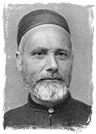 1. Early Life. James Gilmour was the third of six sons born to James and Elizabeth Pettigrew Gilmour on the Cathkin estate of a half dozen farms in the parish
of Carmunnock, about five miles from Glasgow, Scotland. His ancestors were godly people.
The grandfather Gilmour and his wife walked regularly every Sunday to Glasgow to
worship in the Congregational church. Their faithfulness, seen in the return on dark
wintry evenings wending their way homeward by the light of a hand-made lantern, made
a deep impression upon the community. James' parents maintained the same strict
integrity and godliness. His mother delighted in gathering her sons about her in the
evening and reading to them missionary and religious stories and making comments upon
them. It is supposed that here was planted the desire that led the missionary later
to write his interesting accounts of the mission field. Family worship was so strictly
adhered to that neighbors would have to wait until the blessed hour was passed before
they could be served. Inasmuch as James' father was in comfortable circumstances, the
lad did not pass thru the ordeal of poverty that some missionaries have. He had good
school privileges, first at Cambuslang and then at Glasgow, applied himself not so
much because of love for learning but because he willed to do so, and earned for
himself many prizes. Still he was a boy full of fun and games and noted for his
teasing. He loved the wild and would wander alone among the hills, woods, and glens,
delighted with nature and what it gave back to him.
1. Early Life. James Gilmour was the third of six sons born to James and Elizabeth Pettigrew Gilmour on the Cathkin estate of a half dozen farms in the parish
of Carmunnock, about five miles from Glasgow, Scotland. His ancestors were godly people.
The grandfather Gilmour and his wife walked regularly every Sunday to Glasgow to
worship in the Congregational church. Their faithfulness, seen in the return on dark
wintry evenings wending their way homeward by the light of a hand-made lantern, made
a deep impression upon the community. James' parents maintained the same strict
integrity and godliness. His mother delighted in gathering her sons about her in the
evening and reading to them missionary and religious stories and making comments upon
them. It is supposed that here was planted the desire that led the missionary later
to write his interesting accounts of the mission field. Family worship was so strictly
adhered to that neighbors would have to wait until the blessed hour was passed before
they could be served. Inasmuch as James' father was in comfortable circumstances, the
lad did not pass thru the ordeal of poverty that some missionaries have. He had good
school privileges, first at Cambuslang and then at Glasgow, applied himself not so
much because of love for learning but because he willed to do so, and earned for
himself many prizes. Still he was a boy full of fun and games and noted for his
teasing. He loved the wild and would wander alone among the hills, woods, and glens,
delighted with nature and what it gave back to him.
2. University Life. At first when James attended Glasgow University he lived at home. Because some of his classes came too early for train service he walked to school in the morning. Later he furnished a small house which belonged to his father in the city, and prepared his breakfast and other meals as he thought best. He was especially bright in Latin and Greek, the secret of his success being in his "unspeakable value" placed on time. He never willfully lost an hour. Though having money he was very economical. He had a horror for intoxicants. Once he called on a classmate who had beer in his room. Young Gilmour quietly raised the window and as he poured it out on the street said, "Better on God's earth than in His image." His early religious training bore fruit in conversion in his University life. He selected missionary service because the workers abroad were fewer than at home, and "to me the soul of an Indian seemed as precious as the soul of an Englishman, and the Gospel as much for the Chinese as the European." The moral effect of the brightest student deciding for missions was very great indeed. When he offered himself as a missionary to the London Missionary Society he was sent to Cheshunt College for further training. While he retained his love for fun, he studied his Bible with such great earnestness that his soul became all aflame with love for the perishing heathen. His light shone brightly at home, too. He would go out evenings alone and conduct open-air services or talk to laborers by the roadside or in the field.
3. Missionary Appointment. After Cheshunt College Gilmour entered upon studies of missions and the Chinese language at Highgate. While here, thru a misunderstanding the students rebelled against the directors of the Mission Society. Gilmour spoke for the student body, was looked upon as a ringleader and with disfavor, though afterwards the directors acknowledged that the students were right in their position. At last he was assigned to open the long-considered field of Mongolia and set sail from Liverpool February 22, 1870. He was made chaplain of the ship on which he sailed. At nighttime he talked to every member of the crew while on watch, and laid the matter of salvation so clearly before them that he afterwards wrote, "All on board had repeated opportunities of hearing the Gospel as plainly as I could put it."
4. On Slope of Volcano. As soon as Gilmour reached Peking, on May 18, 1870, he began study of the Chinese language. Within a month, however, he was disturbed by the massacre of thirteen French Catholic missionaries at Tientsin, the port city for Peking. He wrote, "We are all living on the slope of a volcano that may put forth its slumbering rage at any moment." Though lion-hearted and not thinking of leaving the field, the situation was so grave that he wrote again, "Our death might further the cause of Christ more than our life could do." A massacre of all foreigners was planned, but a great downpour of rain the first day it was to begin shut the Chinese in their homes and when they could go out again the excitement was gone and there was no disturbance.
5. Mongolia. At the time Gilmour went to the field, Mongolia embraced that vast territory between China proper and Siberia, stretching from the Sea of Japan on the east to Turkestan on the west, a distance of about 3,000 miles; and from Asiatic Russia on the north to the Great Wall of China on the south, a distance of about 900 miles. In the center is the great desert of Gobi. If one turns to a map he will see Kalgan over 100 miles northwest of Peking, on the border between China and Mongolia. Still farther northwest about 900 miles is the town of Kiachta. This route was marked by a large trade, — exchange of China tea for salt, soda, hides and timber, — all borne hither and thither between China and Russia by caravans of camels or oxcarts. West of this ancient caravan route are wandering tribes almost knowing no government or fearing no power. In the winter they live in rude huts or tents; during the heated summers they seek the best pastures they can command for their flocks. Terrible dust storms sweep over the land. Religion, where it has gained a foothold in the southeastern part, is Buddhism; it is estimated that over half the male population are priests of Buddha. Many temples of impressive splendor in gold and colors, seen from afar, and great reverence for sacred places by the people, impress the missionary on every hand. To carry the Gospel to the nomadic bands of this great land, the missionary of necessity adopts a roving life and puts up with its hardships.
6. Long Loneliness. Having decided that the proper way to learn the language and start the work was to go into the heart of the proposed field, Gilmour, in company with a Russian postmaster, left Kalgan, to which point he had come, on August 27, 1870, for the first trip across the great plain to Kiachta. The journey took a month. Here he was detained because his passport would not be accepted by either Russian or Chinese, until he could obtain another from Peking. He found a home with a Scotch trader. He went among the people asking the names of articles and thus gathered a vocabulary. He hired a teacher; but the teacher was so slow that the restless nature of the missionary felt life had reached its greatest stagnation. His feelings were like Elijah's under the juniper tree: he understood better than ever the loneliness of Christ with no one about who understood Him! But he did not lose sight of the purpose in coming to the land. Before the close of 1870 he left Kiachta to share the tent of some Mongol engaged in prayer. He arranged with this devout man, who had welcomed him, to share the hospitality of his home. The man lived alone, attended by two lamas that lived in adjoining huts. Here Gilmour spent three months, acquired the language rapidly and gained real insight into the hearts and minds of the natives. He found them exceedingly simple in thought. To illustrate, he taught that God was everywhere and without form. The Mongol was puzzled to understand how, if God had not form, Jesus could sit at his right hand; further, if God is everywhere, how could one keep from walking on him? Within one year he could read the Bible in Mongolian slowly and at sight, and write the language imperfectly.
7. The Gospel and Medicine. During the summer of 1872 Gilmour, in company with Mr. Edkins, visited the sacred city of Woo Tai Shan, a famous place of Mongol pilgrimage. These people tried the fiery-hearted missionary greatly. Drunkenness, hopeless indebtedness, and a desire to borrow were characteristics that greatly disturbed him. Debts never distressed them, but rather their inability to borrow more. Amidst these discouragements he comforted himself as he once wrote, "All our good work will be found, there is no doubt of that. All I am afraid of is that our good work will amount to little when it is found!" He was concerned that in the judgment no heathen can be justified in "pitching into us for not pitching into them more savagely, for not, in fact, taking them by the cuff of the neck and dragging them into the kingdom." No hardship was too great for him. He would walk to save the expense of a camel. His tent was dwelling, chapel, and dispensary. For he followed the example of the Master in healing the sick as far as he was able; and the few simple remedies he found a very great help to him in his work. Yet at the end of 1874, after four years of labor, he could not report one convert, not even one who could be classed as interested in Christianity. The people did not have even a sense of need of what the Gospel supplies. Had one asked Gilmour about not having conversions he would likely have said that it was his business to sow the seed and God's to give the increase in His own good time.
8. His Romantic Marriage. In 1872 Mr. Meech, of Peking, had married a Miss Prankard, of London. Gilmour frequented this home, saw a picture of Miss Emily Prankard hanging on the wall and heard the family speak of her frequently. In his lonely hours in the desert he had taken the matter of a suitable companion to the Lord and asked Him to send one that would help in his work. Gilmour, though he had not seen the lady or written her a line before, wrote her a letter in January, proposing marriage. Later, in the spring, he went up country and returned about July, to find he was an accepted man. He had written his parents at the time he made the proposal but that letter was delayed. Imagine their surprise when they received a letter from an unknown lady in London, telling of her engagement. Some thought he was running a great risk, but he assured them that he was at ease, for he had asked the Lord to provide. When the bride-to-be visited his parents they were much pleased and said she would suit him well. Her first glimpse of her husband was from a boat near Tientsin as he stood on a lighter coming out to meet her. He was dressed in an old overcoat and had a large woolen comforter around his neck, — for it was cold, — not the usual method to make a favorable impression. She landed on Thursday and the following Tuesday, December 8, 1874, they were married. He afterwards wrote, "She is a jolly girl, as much, perhaps more, of a Christian and a Christian missionary than I am."
9. Home Life. Companionship meant much to Gilmour. Circumstances were such that their first year was spent almost entirely in Peking. He made occasional trips to fairs at important centers, but not until April 7, 1876, did Mr. and Mrs. Gilmour take a tour into Mongolia proper. It covered a period of 156 days, during which time she picked up the language rapidly and accurately. The experience, however, was more than novel; dust storms and the continuous round of millet and mutton as food tried her greatly. While she was happy to endure for the work's sake, it was a great relief to get back to Peking again. Gilmour turned his attention to preparing two publications, one on striking incidents from Daniel, and the other the story of salvation, both published by the Religious Tract Society for him. These vacations from the plain were decidedly necessary, for the loneliness of the desert was too great a strain to endure all the time.
10. Encouragements. Once Rev. Lewis and Gilmour visited Hsiao Chang, five days distant from Tientsin. The district was famine stricken. They preached to audiences of from 130 to 300, people who were eager to learn to sing Gospel songs. Gilmour declared the service of song was a most powerful method of introducing Christ. His discourses were simple, full of illustrations from his own life, and with such earnestness and directness as gave them great force. When during the winter he was in Peking, he would hunt out the homes of Mongols and talk with them about Jesus. He peddled the Bible and often had opportunity to read to groups that gathered about him. They came from various parts of Mongolia and thus the Gospel was sent into almost every part of the country. However, in his ability to dispense medicine was his greatest power among the natives, though many amusing requests came to him. "One man wants to be made clever, another fat, another cured of insanity, or of tobacco, or of whiskey, or of hunger or tea. Most men want medicine to make their beards grow, while almost every man, woman and child wants to have his or her skin made as white as that of a foreigner." After ten years of work Gilmour was thoroughly convinced that medicine introduced him to many who would otherwise have held themselves aloof.
11. Among the Mongols. In 1882 the Gilmours took furlough to England, a much-needed rest for all of them. While home he published his famous book, "Among the Mongols." Even to the present the book sells well. So interesting was it that one critic wrote, "Robinson Crusoe has turned missionary, lived years in Mongolia, and wrote a book about it." Concerning the author the critic said, "If ever on earth there lived a man who kept the law of Christ, and could give proof of it, and be absolutely unconscious that he was giving it to them, it is this man whom the Mongols called 'our Gilmour.'" While at home his main message was to pray more for the missionaries. "Unprayed for I feel very much as if a diver were sent down to the bottom of a river, with no air to breathe, or as if a fireman were sent up to a blazing building and held an empty hose; I feel very much like a soldier who is firing blank cartridges at an enemy." He would not ride a car or bus on Sunday, but once walked twelve miles to hear Spurgeon preach and then walked home, footsore but happy.
12. His First Convert. At the end of 1883 Gilmours were back in Peking. In the early part of 1884 he started out afoot without any medicine, on one of his most remarkable Mongolian journeys. The Mongols were surprised to note this foreigner, having all his belongings on his back, going about the country like their own beggar lamas. It was on this spiritual journey that he found his first convert. He was one day in a mud hut, pressing the claims of Christ upon a lama. A layman entered, stirred the fire that would not burn, and simply increased the volume of smoke in the room. So dense was the smoke that though the layman was but two yards from Gilmour he could not see him. Finally the layman said that for months he had been a learner of Jesus Christ and he was now ready to trust the Savior. The smoke had settled lower. Gilmour was lying on his back on the platform while the Mongols were crouched near the door. The missionary says of the occasion, "The place was beautiful to me as the gate of heaven, and the words of the confession of Christ from out the cloud of smoke were as inspiring to me as if they had been spoken by an angel from out the cloud of glory." Gilmour and the convert traveled for nearly twenty-three miles together, talking, and then in a lonely place in the road knelt and prayed together and then separated. This led him to the conviction that personal work was most effective, and forsaking all else, — secular papers and books, even the bedside of his sick wife at times, — he gave himself over to inquiries from early morning till late at night.
13. Mrs. Gilmour's Death. Affliction finally took hold of Mrs. Gilmour, the disease sure of its prey, no matter how long it would be in securing it. Six weeks before the end came they talked over spiritual things, lest later she might not be able to speak of them. In simple, childlike faith, on September 19, 1885, she passed away and the eleven years of happy married life were brought to an end.
14. Phases of His Work. Tobacco, opium, and whiskey were the three great evils of the Mongolians and against them Gilmour presented Christ with great power. He made abstinence from all three conditions of church membership. Opposition was strong, but he stood his ground, declaring that "to leave Christians drinking whiskey and smoking tobacco would be preaching forgiveness of sin thru Christ to men who were still going on in the practice of what their consciences told them was sin." Imagine his embarrassment when he had to acknowledge to a deputation of Mongolians, favorably-disposed to Christianity, who came to him to know if it were true that a certain missionary in Peking smoked after he preached, that this was true. These men left and never returned to hear him. Still he was undaunted. Christ he would preach and leave the results with his Lord. He went afoot to save expense and was barred from decent inns because he was a tramp. He hired a donkey to carry his baggage, to give him respectability. An agent of the Bible Society and a native quarreled. This spread and met Gilmour everywhere he went, and people told him they did not want a religion that was not better than their own. Alone he pressed forward, sowing in tears as few missionaries ever are called upon to do; lonely and alone, is it any wonder that he had seasons of depression and urged the church at home to pray for him, and help him with her sympathy? He was willing to be all things lawful in order to win some trophies of the cross. He became a vegetarian to win some of higher moral standards; he dressed like a shopkeeper; ate porridge, native fashion, in the street in order to win souls for Christ. His living expenses averaged about six cents per day. Some think he shortened his usefulness by such methods, but none were as capable of judging what was best as he who was on the field and understood conditions.
15. His Work. Upon reaching a new city he pitched his tent on a main thoroughfare, and from early morn till late at night healed the sick, preached and talked to inquirers. During one eight months' campaign he saw about 6,000 patients, preached to nearly 24,000 people, sold 3,000 books, distributed 4,500 tracts, traveled 1,860 miles and spent about $200, and added, sadly, that but two openly confessed Christ. He longed for a helper on his field, but the Society was unable to supply him. At last, when one did come, the first thing he did was to send Gilmour home on furlough. When the faithful missionary reached England in 1889 he was so thin of body and the marks of struggle so prominent in his face, that his friends did not know him. How delighted he was to be with his motherless boys, who had been sent home after their mother's death to be educated. His book, "Gilmour and His Boys," has touched many a heart.
16. The End. In due time he returned to Mongolia again. He continued his work along the same lines. In April, 1891, he returned to Tientsin to attend the North China District Committee of the London Missionary Society. They honored him by making him chairman and he served them well. During the time he was the guest of Dr. Roberts. Suddenly he was stricken with typhus fever of a very malignant type. On May 21, 1891, he fell asleep, to be forever at rest with the Lord. When news of his death circulated in far-away Mongolia, strong, grown-up men wept like children when they were told that "their Gilmour was dead."
| Chronology of Events in Gilmour's Life | |
|---|---|
| 1843 | Born at Cathkin. Scotland. June 12. |
| 1862 | Entered Glasgow University. |
| 1867 | Offered himself to London Missionary Society. |
| 1869 | Entered Highgate Missionary Society. |
| 1870 | Ordained in Augustine Chapel. Edinburgh, February 10; Sailed from Liverpool on Diomed for Mongolia, February 22. |
| 1870 | Arrived at Peking, May 18; Massacre of 13 French Catholics, June 22; Journey from Peking to Kiachta, August 5 to September 28. |
| 1874 | Married to Miss Prankard, December 8. |
| 1876 | 156 days' journey with wife In Mongolia, begun April 7. |
| 1882 | Furlough to England, Spring to September 1883; Published "Among the Mongols," April. |
| 1884 | His first convert, March 1. |
| 1885 | Mrs. Gilmour died, September 19. |
| 1886 | Two oldest children went to England, March 23. |
| 1889 | Second furlough to England, April 4, to May 14,1890. |
| 1891 | Died in Tientsin. May 21. |
From Christian Heroism in Heathen Lands by Galen B. Royer. Elgin, Ill.: Brethren Publishing House, 1915.
>> More James Gilmour