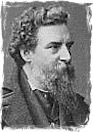
 He
was 'a broth of a boy,' his biographer tells us. He lived chiefly
on boots and boxes. Eager to know what lay beyond the ranges, he
wore out more boots than his poor parents found it easy to provide.
Taunted by the constant vision of the restless waters, he put out
to sea in broken boxes and leaky barrels, that he might follow in
the wake of the great navigators. He was a born adventurer. Almost
as soon as he first opened his eyes and looked around him, he felt
that the world was very wide and vowed that he would find its utmost
edges. From his explorations of the hills and glens around his village
home, he often returned too exhausted either to eat or sleep. From
his ventures upon the ocean he was more than once brought home on
a plank, apparently drowned. 'The wind and the sea were his playmates,'
we are told; 'he was as much at home in the water as on the land;
in fishing, sailing, climbing over the rocks, and wandering among
the silent hills, he spent a free, careless, happy boyhood.' Every
day had its own romance, its hairbreadth escape, its thrilling adventure.
He
was 'a broth of a boy,' his biographer tells us. He lived chiefly
on boots and boxes. Eager to know what lay beyond the ranges, he
wore out more boots than his poor parents found it easy to provide.
Taunted by the constant vision of the restless waters, he put out
to sea in broken boxes and leaky barrels, that he might follow in
the wake of the great navigators. He was a born adventurer. Almost
as soon as he first opened his eyes and looked around him, he felt
that the world was very wide and vowed that he would find its utmost
edges. From his explorations of the hills and glens around his village
home, he often returned too exhausted either to eat or sleep. From
his ventures upon the ocean he was more than once brought home on
a plank, apparently drowned. 'The wind and the sea were his playmates,'
we are told; 'he was as much at home in the water as on the land;
in fishing, sailing, climbing over the rocks, and wandering among
the silent hills, he spent a free, careless, happy boyhood.' Every
day had its own romance, its hairbreadth escape, its thrilling adventure.
Therein lies the difference between a man and a beast. At just about the time at which James Chalmers was born in Scotland, Captain Sturt led his famous expedition into the hot and dusty heart of Australia. When he reached Cooper's Creek on the return journey, he found that he had more horses than he would be able to feed; so he turned one of them out on the banks of the creek and left it there. When Burke and Wills reached Cooper's Creek twenty years later, the horse was still grazing peacefully on the side of the stream, and looked up at the explorers with no more surprise or excitement than it would have shown if but twenty hours had passed since it last saw human faces. It had found air to breathe and water to drink and grass to nibble; what did it care about the world? But with man it is otherwise. He wants to know what is on the other side of the hill, what is on the other side of the water, what is on the other side of the world! If he cannot go North, South, East and West himself, he must at least have his newspaper; and the newspaper brings all the ends of the earth every morning to his doorstep and his breakfast-table. This, I say, is the difference between a beast and a man; and James Chalmers — known in New Guinea as the most magnificent specimen of humanity on the islands — was every inch a man.

But his text! What was James Chalmers' text? When he was eighteen years of age, Scotland found herself in the throes of a great religious revival. In the sweep of this historic movement, a couple of evangelists from the North of Ireland announce that they will conduct a series of evangelistic meetings at Inverary. But Chalmers and a band of daring young spirits under his leadership feel that this is an innovation which they must strenuously resist. They agree to break up the meetings. A friend, however, with much difficulty persuades Chalmers to attend the first meeting and judge for himself whether or not his project is a worthy one.
'It was raining hard,' he says, in some autobiographical notes found among his treasures after the massacre, 'it was raining hard, but I started; and on arriving at the bottom of the stairs I listened whilst they sang "All people that on earth do dwell" to the tune "Old Hundred," and I thought I had never heard such singing before — so solemn, yet so joyful. I ascended the steps and entered. There was a large congregation and all intensely in earnest. The younger of the evangelists was the first to speak. He announced as his text the words: "The Spirit and the Bride say, Come; and let him that heareth say, Come; and let him that is athirst come; and whosoever will, let him take the water of life freely." He spoke directly to me. I felt it much; but at the close I hurried away back to town. I returned the Bible to the friend who, having persuaded me to go, had lent it to me, but I was too upset to speak much to him.'
On the following Sunday night, he was, he says, 'pierced through and through, and felt lost beyond all hope of salvation.' On the Monday, the local minister, the Rev. Gilbert Meikle, who had exercised a deep influence over his early childhood, came to see him and assured him that the blood of Jesus Christ, God's Son, could cleanse him from all sin. This timely visit convinced him that deliverance was at any rate possible. Gradually he came to feel that the voices to which he was listening were, in reality, the Voice of God. 'Then,' he says, 'I believed unto salvation.'
'He felt that the voices to which he was listening were, in reality, the Voice of God.' That is precisely what the text says. 'The Spirit and the Bride say, Come.' The Bride only says 'Come' because the Spirit says 'Come'; the Church only says 'Come' because her Lord says 'Come'; the evangelists only said 'Come' because the Voice Divine said 'Come.' 'He felt that the voices to which he was listening were, in reality, the Voice of God, and he believed unto salvation.'
The Spirit said, Come!
The Bride said, Come!
Let him that is athirst come!
'I was athirst,' says Chalmers, 'and I came!'
And thus a great text began, in a great soul, the manufacture of a great history.
Forty years later a thrill of horror electrified the world when the cables flashed from land to land the terrible tidings that James Chalmers, the most picturesque and romantic figure in the religious life of his time, had been killed and eaten by the Fly River cannibals. It is the evening of Easter Sunday. It has for years been the dream of his life to navigate the Fly River and evangelize the villages along its banks. And now he is actually doing it at last. 'He is away up the Fly River,' wrote Robert Louis Stevenson. 'It is a desperate venture, but he is quite a Livingstone card!' Stevenson thought Chalmers all gold. 'He is a rowdy, but he is a hero. You can't weary me of that fellow. He is as big as a house and far bigger than any church. He took me fairly by storm for the most attractive, simple, brave and interesting man in the whole Pacific.' 'I wonder,' Stevenson wrote to Mrs. Chalmers, 'I wonder if even you know what it means to a man like me — a man fairly critical, a man of the world — to meet one who represents the essential, and who is so free from the formal, from the grimace.' But I digress. As Stevenson says, Mr. Chalmers is away up the Fly River, a desperate venture! But he is boisterously happy about it, and at sunset on this Easter Sunday evening they anchor off a populous settlement just round a bend of the river. The natives, coming off in their canoes, swarm onto the vessel. With some difficulty, Mr. Chalmers persuades them to leave the ship, promising them that he will himself visit them at daybreak. The savages, bent on treachery and slaughter, pull ashore and quickly dispatch runners with messages to all the villages around. When, early next morning, Mr. Chalmers lands, he is surprised at finding a vast assemblage gathered to receive him. He is accompanied by Mr. Tomkins — his young colleague, not long out from England — and by a party of ten native Christians. They are told that a great feast has been prepared in their honor, and they are led to a large native house to partake of it. But, as he enters, Mr. Chalmers is felled from behind with a stone club, stabbed with a cassowary dagger, and instantly beheaded. Mr. Tomkins and the native Christians are similarly massacred. The villages around are soon the scenes of horrible cannibal orgies. 'I cannot believe it!' exclaimed Dr. Parker from the pulpit of the City Temple, on the day on which the tragic news reached England, 'I cannot believe it! I do not want to believe it! Such a mystery of Providence makes it hard for our strained faith to recover itself. Yet Jesus was murdered. Paul was murdered. Many missionaries have been murdered. When I think of that side of the case, I cannot but feel that our honored and noble-minded friend has joined a great assembly. James Chalmers was one of the truly great missionaries of the world. He was, in all respects, a noble and kingly character.' And so it was whispered from lip to lip that James Chalmers, the Greatheart of New Guinea, was dead, dead, dead; although John Oxenham denied it.
Greatheart is dead, they say!
Greatheart is dead, they say!
;Nor dead, nor sleeping! He lives on! His name
Shall kindle many a heart to equal flame;
The fire he kindled shall burn on and on
Till all the darkness of the lands be gone,
And all the kingdoms of the earth be won,
And one!
A soul so fiery sweet can never die
But lives and loves and works through all eternity.
Yes, lives and loves and works! 'There will be much to do in heaven,' he wrote to an old comrade in one of the last letters he ever penned. 'I guess I shall have good mission work to do; great, brave work for Christ! He will have to find it for I can be nothing else than a missionary!' And so, perchance, James Chalmers is a missionary still!
Now, underlying this brave story of a noble life and a martyr-death is a great principle; and it is the principle that, if we look, we shall find embedded in the very heart of James Chalmers' text. No law of life is more vital. Let us return to that evangelistic meeting held on that drenching night at Inverary, and let us catch once more those matchless cadences that won the heart of Chalmers! 'The Spirit and the Bride say, Come; and let him that heareth say, Come; and let him that is athirst come; and whosoever will, let him take the water of life freely.'
'Let him that is athirst come!' 'I was athirst,' says Chalmers, 'so I came!'
'Let him that heareth say, Come!' James Chalmers heard; he felt that he must say; that is the connecting link between the evangelistic meeting at Inverary and the triumph and tragedy of New Guinea.
'Let him that heareth, say!' — that is the principle embedded in the text. The soul's exports must keep pace with the soul's imports. What I have freely received, I must as freely give. The boons that have descended to me from a remote ancestry I must pass on with interest to a remote posterity. The benedictions that my parents breathed on me must be conferred by me upon my children. 'Let him that heareth, say!' What comes into the City of Mansoul at Ear Gate must go out again at Lip Gate. The auditor of one day must become the orator of the next. It is a very ancient principle. 'He that reads,' says the prophet, 'must run!' 'He that sees must spread!' With those quick eyes of his, James Chalmers saw this at a glance. He recognized that the kingdom of Christ could be established in no other way. He saw that the Gospel could have been offered him on no other terms. What, therefore, he had with such wonder heard, he began, with great delight, to proclaim. Almost at once he accepted a Sunday school class; the following year he began preaching in those very villages through which, as a boy, his exploratory wanderings had so often taken him; a year later he became a city missionary, that he might pass on the message of the Spirit and the Bride to the teeming poor of Glasgow; and, twelve months later still, he entered college, in order to equip himself for service in the uttermost ends of the earth. His boyish passion for books and boxes had been sanctified at last by his consecration to a great heroic mission.
'Let him that is athirst come!' 'I was athirst,' says Chalmers, 'and I came!'
'Let him that heareth say, Come!' And Chalmers, having heard, said 'Come!' and said it with effect. Dr. Lawes speaks of one hundred and thirty mission stations which he established at New Guinea. And look at this! 'On the first Sabbath in every month not less than three thousand men and women gather devotedly round the table of the Lord, reverently commemorating the event which means so much to them and to all the world. Many of them were known to Chalmers as savages in feathers and war paint. Now, clothed and in their right mind, the wild, savage look all gone, they form part of the Body of our Lord Jesus Christ and are members of His Church. Many of the pastors who preside at the Lord's Table bear on their breasts the tattoo marks that indicate that their spears had been imbrued with human blood. Now sixty-four of them, thanks to Mr. Chalmers' influence, are teachers, preachers and missionaries.' They, too, having listened, proclaim; having received, give; having heard, say; having been auditors, have now become orators. They have read and therefore they run. Having believed with the heart, they therefore confess with the mouth. This is not only a law of life; it is the law of the life everlasting. It is only by loyalty to this golden rule, on the part of all who hear the Spirit and the Bride say Come, that the kingdoms of this world can become the kingdoms of our God and of His Christ. It is the secret of world-conquest; and, besides it, there is no other.
'The Spirit and the Bride say, Come; and let him that heareth say, Come; and let him that is athirst come; and whosoever will, let him take the water of life freely.'
I have somewhere read that, out in the solitudes of the great dusty desert, when a caravan is in peril of perishing for want of water, they give one camel its head and let him go. The fine instincts of the animal will lead him unerringly to the refreshing spring. As soon as he is but a speck on the horizon, one of the Arabs mounts his camel and sets off in the direction that the liberated animal has taken. When, in his turn, he is scarcely distinguishable, another Arab mounts and follows. When the loose camel discovers water, the first Arab turns and waves to the second; the second to the third, and so on, until all the members of the party are gathered at the satisfying spring. As each man sees the beckoning hand, he turns and beckons to the man behind him. He that sees, signals; he that hears, utters. It is the law of the life everlasting; it is the fundamental principle of James Chalmers' text and of James Chalmers' life.
'Let him that is athirst come!' 'I was athirst,' says Chalmers, 'so I came!'
I heard the voice of Jesus say,
'Behold, I freely give
The living water; thirsty one,
Stoop down, and drink, and live.'
I came to Jesus, and I drank
Of that life-giving stream;
My thirst was quenched, my soul revived,
And now I live in Him.
'And now I live in Him.' The life that James Chalmers lived in his Lord was a life so winsome that he charmed all hearts, a life so contagious that savages became saints beneath his magnetic influence. He had heard, at Inverary, the Spirit and the Bride say, Come! And he esteemed it a privilege beyond all price to be permitted to make the abodes of barbarism and the habitations of cruelty re-echo the matchless music of that mighty monosyllable.
From A Handful of Stars: Texts That Have Moved Great Minds by F.W. Boreham. New York: Abingdon Press, ©1922.
>> More James Chalmers