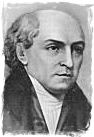
 The
westering sun, slanting through the tops of the taller trees, is beginning
to throw long shadows across the green and gently-undulating fields. The
brindled cattle, lying at their ease and meditatively chewing the cud in
these quiet Northamptonshire pastures, are disturbed by the sound of footsteps
in the lane. Some of them rise in protest and stare fixedly at the quaint
figure that has broken so rudely on their afternoon reverie. But he causes
them no alarm, for they have often seen him pass this way before. He is the
village cobbler. This very morning he tramped along this winding thoroughfare
on his way to Northampton. He was carrying his wallet of shoes — a fortnight's
work — to the Government contractor there. And now he is trudging his way
back to Moulton with the roll of leather that will keep him busy for another
week or two. The cattle stare at him, as well they may. The whole world would
stare at him if it had the chance to-day. For this is William Carey, the
harbinger of a new order, the prophet of a new age, the maker of a new world!
The cattle stare at him, but he has no eyes for them. His thoughts are over
the seas and far away. He is a dreamer; but he is a dreamer who means business.
Less than twenty years ago, in a tall chestnut tree not far from this very
lane, he spied a bird's nest that he greatly coveted. He climbed — and fell!
He climbed again — and fell again! He climbed a third time, and, in the
third fall, broke his leg. A few weeks later, whilst the limb was still bandaged,
his mother left him for an hour or two, instructing him to take the greatest
care of himself in her absence. When she returned, he was sitting in his
chair, flushed and excited, with the bird's nest on his knees.
The
westering sun, slanting through the tops of the taller trees, is beginning
to throw long shadows across the green and gently-undulating fields. The
brindled cattle, lying at their ease and meditatively chewing the cud in
these quiet Northamptonshire pastures, are disturbed by the sound of footsteps
in the lane. Some of them rise in protest and stare fixedly at the quaint
figure that has broken so rudely on their afternoon reverie. But he causes
them no alarm, for they have often seen him pass this way before. He is the
village cobbler. This very morning he tramped along this winding thoroughfare
on his way to Northampton. He was carrying his wallet of shoes — a fortnight's
work — to the Government contractor there. And now he is trudging his way
back to Moulton with the roll of leather that will keep him busy for another
week or two. The cattle stare at him, as well they may. The whole world would
stare at him if it had the chance to-day. For this is William Carey, the
harbinger of a new order, the prophet of a new age, the maker of a new world!
The cattle stare at him, but he has no eyes for them. His thoughts are over
the seas and far away. He is a dreamer; but he is a dreamer who means business.
Less than twenty years ago, in a tall chestnut tree not far from this very
lane, he spied a bird's nest that he greatly coveted. He climbed — and fell!
He climbed again — and fell again! He climbed a third time, and, in the
third fall, broke his leg. A few weeks later, whilst the limb was still bandaged,
his mother left him for an hour or two, instructing him to take the greatest
care of himself in her absence. When she returned, he was sitting in his
chair, flushed and excited, with the bird's nest on his knees.
'Hurrah, mother; I've done it at last! Here it is, look!'
'You don't mean to tell me you've climbed that tree again!'
'I couldn't help it, mother; I couldn't, really! If I begin a thing I must go through with it!'
On monuments erected in honour of William Carey, on busts and plaques and pedestals, on the title pages of his innumerable biographies, and under pictures that have been painted of him, I have often seen inscribed some stirring sentence that fell from his eloquent lips. But I have never seen that one. Yet the most characteristic word that Carey ever uttered was the reply that he made to his mother that day!
'If I begin a thing I must go through with it!'
If you look closely, you will see that sentence stamped upon his countenance as, with a far-away look in his eye, he passes down the lane. Let us follow him, and we shall find that he is beginning some tremendous things; and, depend upon it, he will at any cost go through with them!

It is not an elaborately-furnished abode, this little home of his. For, although he is minister, school-master and cobbler, the three vocations only provide him with about thirty-six pounds a year. Looking around, I can see but a few stools, his cobbler's outfit, a book or two (including a Bible, a copy of Captain Cook's Voyages and a Dutch Grammar) besides a queer-looking map on the wall. We must have a good look at this map, for there is history in it as well as geography. It is a map of the world, made of leather and brown paper, and it is the work of his own fingers. Look, I say, at this map, for it is a reflection of the soul of Carey. As he came up the lane, looking neither to the right hand nor to the left, he was thinking of the world. He is a jack-of-all-trades, yet he is a man of a single thought. 'Perhaps,' he says to himself, 'perhaps God means what He says!' The world! The world! The World! God so loved the world! Go ye into all the world! The kingdoms of the world shall become the kingdoms of our God and of His Christ! It is always the world, the world, the world. That thought haunted the mind of Carey night and day. The map of the world hung in his room, but it only hung in his room because it already hung in his heart. He thought of it, he dreamed of it, he preached of it. And he was amazed that, when he unburdened his soul to his brother-ministers, or preached on that burning theme to his little congregation, they listened with respectful interest and close attention, yet did nothing. At length, on May 31, 1792, Carey preached his great sermon, the sermon that gave rise to our modern missionary movement, the sermon that made history. It was at Nottingham. "Lengthen thy cords' — so ran the text — 'lengthen thy cords and strengthen thy stakes, for thou shalt break forth on the right hand and on the left; and thy seed shall inherit the Gentiles and make the desolate cities to be inhabited.'
'Lengthen thy cords!' said the text.
'Strengthen thy stakes!' said the text.
'Expect great things from God!' said the preacher.
'Attempt great things for God!' said the preacher.
'If all the people had lifted up their voices and wept,' says Dr. Ryland, 'as the children of Israel did at Bochim, I should not have wondered at the effect; it would only have seemed proportionate to the cause; so clearly did Mr. Carey prove the criminality of our supineness in the cause of God!' But the people did not weep! They did not even wait! They rose to leave as usual. When Carey, stepping down from the pulpit, saw the people quietly dispersing, he seized Andrew Fuller's hand and wrung it in an agony of distress. 'Are we not going to do anything!' he demanded. 'Oh, Fuller, call them back, call them back! We dare not separate without doing anything!' As a result of that passionate entreaty, a missionary society was formed, and William Carey offered himself as the Society's first missionary.
'If I begin a thing I must go through with it!' he said, as
a schoolboy.
'We dare not separate without doing something!' he cried,
as a young minister.
'Lengthen the cords! Strengthen the stakes!'
'Expect great things! Attempt great things!'
I can never think of William Carey without thinking of Jane Conquest. In the little hamlet by the sea, poor Jane watched through the night beside the cot of her dying child. Then, suddenly, a light leapt in at the lattice, crimsoning every object in the room. It was a ship on fire, and no eyes but hers had seen it! Leaving her dying boy to the great Father's care, she trudged through the snow to the old church on the hill.
She crept through the narrow window and climbed the belfry
stair,
And grasped the rope, sole cord of hope for the mariners in
despair.
And the wild wind helped her bravely, and she wrought with
an earnest will,
And the clamorous bell spake out right well to the hamlet
under the hill.
And it roused the slumbering fishers, nor its warning task
gave o'er
Till a hundred fleet and eager feet were hurrying to the
shore;
And the lifeboat midst the breakers, with a brave and gallant
few,
O'ercame each check and reached the wreck and saved the
hapless crew.
Upon the sensitive soul of William Carey there broke the startling vision of a world in peril, and he could find no sleep for his eyes nor slumber for his eyelids until the whole church was up and doing for the salvation of the perishing millions. It has been finely said that when, towards the close of the eighteenth century, it pleased God to awaken from her slumbers a drowsy and lethargic church, there rang out, from the belfry of the ages, a clamorous and insistent alarm; and, in that arousing hour, the hand upon the bell rope was the hand of William Carey.
'We dare not separate without doing something!'
'Lengthen the cords! Strengthen the stakes!'
'Expect great things! Attempt great things!'
'Here am I; send me, send me!'
Now the life of William Carey is both the outcome and the exemplification of a stupendous principle. That principle was never better stated than by the prophet from whose flaming lips Carey borrowed his text. 'Thine eyes,' said Isaiah, 'Thine eyes shall see the King in His beauty: they shall behold the land that is very far off.' The vision kingly stands related to the vision continental; the revelation of the Lord leads to the revelation of the limitless landscape. What was it that happened one memorable day upon the road to Damascus? It was simply this: Saul of Tarsus saw the King in His beauty! And what happened as a natural and inevitable consequence? There came into his life the passion of the far horizon. All the narrowing limits of Jewish prejudice and the cramping bonds of Pharisaic superstition fell from him like the scales that seemed to drop from his eyes. The world is at his feet. Single-handed and alone, taking his life in his hand, he storms the great centers of civilisation, the capitals of proud empires, in the name of Jesus Christ. No difficulty can daunt him; no danger impede his splendid progress. He passes from sea to sea, from island to island, from continent to continent. The hunger of the earth is in his soul; there is no coast or colony to which he will not go. He feels himself a debtor to Greek and to barbarian, to bond and to free. He climbs mountains, fords rivers, crosses continents, bears stripes, endures imprisonments, suffers shipwreck, courts insult, and dares a thousand deaths out of the passion of his heart to carry the message of hope to every crevice and corner of the earth. A more thrilling story of hazard, hardship, heroism and adventure has never been written. On the road to Damascus Paul saw the King in His beauty, and he spent the remainder of his life in exploiting the limitless landscape that unrolled itself before him. The vision of the King opened to his eyes the vision of the continents. In every age these two visions have always gone side by side. In the fourteenth century, the vision of the King broke upon the soul of John Wickliffe. Instantly, there arose the Lollards, scouring city, town and hamlet with the new evangel, the representatives of the instinct of the far horizon. The fifteenth century contains two tremendous names. As soon as the world received the vision kingly by means of Savonarola, it received the vision continental by means of Christopher Columbus. In the sixteenth century, the same principle holds. It is, on the one hand, the century of Martin Luther, and, on the other, the century of Raleigh, Drake, Hawkins, Frobisher, Grenville and the great Elizabethan navigators. All the oceans of the world became a snowstorm of white sails. The seventeenth century gave us, first the Puritans, and then the sailing of the Mayflower. So we come to the eighteenth century. And the eighteenth century is essentially the century of John Wesley and of William Carey. At Aldersgate Street the vision of the King in His beauty dawned graciously upon the soul of John Wesley. During the fifty years that followed, that vision fell, through Wesley's instrumentality, upon the entire English people. The Methodist revival of the eighteenth century is one of the most gladsome records in the history of Europe. And then, John Wesley having impressed upon all men the vision of the King, William Carey arose to impress upon them the vision of the Continents.
'We must do something!' he cried.
'Lengthen the cords! Strengthen the stakes!'
'Expect great things! Attempt great things!'
'The King! The King! The Continents! The Continents!'
Having gazed upon these things, our eyes are the better fitted to appreciate the significance of the contents of the cobbler's room. There he sits at his last, the Bible from which he drew his text spread out before him, and a homemade map of the world upon the wall! There is no element of chance about that artless record. There is a subtle and inevitable connection between the two. In the Bible he saw the King in His beauty: on the map he caught glimpses of the far horizon. To him, the two were inseparable; and, moved by the Vision of the Lord which he caught in the one, and by the Vision of the limitless landscape which he caught in the other, he left his last and made history.
'Lengthen the cords! Strengthen the stakes!'
'Expect great things! Attempt great things!'
'Do something! Do something!'
It was at Nottingham that Carey preached that arousing sermon: it was in India that he practiced it ... on November 11, 1793 ... William Carey sailed up the Hooghly, landed at Calcutta, and claimed a new continent for Christ! And, like a statesman and a strategist, he settled down to do in India the work to which he had challenged the church at home.
'Lengthen the cords!'
'Strengthen the stakes!'
He [managed] an indigo factory; made himself the master of a dozen languages; became Professor of Bengali, Sanskrit and Mahratta at a salary of fifteen hundred a year; all in order to engage more and still more missionaries and to multiply the activities by which the Kingdom of Christ might be set up in India. His work of translation was a marvel in itself.
'If I begin a thing I must go through with it!' he said that day with the birds'-nest resting on his lap.
'Do something! Do something!' he said in his agony as he saw the people dispersing after his sermon.
And in India he did things. He toiled terribly. But he sent the gospel broadcast through the lengths and breadths of that vast land; built up the finest college in the Indian Empire; and gave the peoples the Word of God in their own tongue.
Just before Carey died, Alexander Duff arrived in India. He was a young Highlander of four-and-twenty, tall and handsome, with flashing eye and quivering voice. Before setting out on his own life-work he went to see the man who had changed the face of the world. He reached the college on a sweltering day in July. 'There he beheld a little yellow old man in a white jacket, who tottered up to the visitor, received his greetings, and with outstretched hands, solemnly blessed him.' Each fell in love with the other. Carey, standing on the brink of the grave, rejoiced to see the handsome and cultured young Scotsman dedicating his life to the evangelisation and emancipation of India. Duff felt that the old man's benediction would cling to his work like a fragrance through all the great and epoch-making days ahead.
Not long after, Carey lay a-dying, and, to his great delight, Duff came to see him. The young Highlander told the veteran of his admiration and his love. In a whisper that was scarcely audible, the dying man begged his visitor to pray with him. After he had complied, and taken a sad farewell of the frail old man, he turned to go. On reaching the door he fancied that he heard his name. He turned and saw that Mr. Carey was beckoning him.
'Mr. Duff,' said the dying man, his earnestness imparting a new vigour to his voice, 'Mr. Duff, you have been speaking about Dr. Carey, Dr. Carey, Dr. Carey! When I am gone, say nothing about Dr. Carey -- speak only of Dr. Carey's Saviour.'
Did I say that, when our little cobbler startled the cattle in the Northamptonshire lane, he was thinking only of the world, the world, the world! I was wrong! He was thinking primarily of the Saviour, the Saviour, the Saviour — the Saviour of the World!
And yet I was right; for the two visions are one vision, the two thoughts one thought.
The King, the King, the King!
The Continents, the Continents, the Continents!
The Saviour, the Saviour, the Saviour!
The World, the World, the World!
As a lad, Carey caught the vision of the King in His beauty; and, as an inevitable consequence, he spent his life in the conquest of the land that is very far off.
From A Bunch of Everlastings, or, Texts That Made History by F.W. Boreham. New York: Abingdon, ©1920.
>> More William Carey