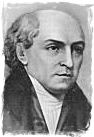
 William Carey, D.D. (1761-1834), orientalist and missionary, was born
17 August 1761 at Paulerspury, Northamptonshire, [England], where his
father, Edmund Carey, kept a small free school, to the educational benefit
of the boy. At fourteen he was apprenticed to a shoemaker at Hackleton,
and becoming religiously affected joined the Baptist connexion in 1783.
In 1786 he was chosen minister of the Baptist congregation at Moulton.
He had lately married, on so slender an income that meat was a rarity
at his table. He was now working at Greek, Latin, and Hebrew, chiefly
with a view to the interpretation of the scriptures. After holding a
ministry at Leicester from 1789 he joined in the movement which culminated
in the formation of the Baptist Missionary Society, and was (with a
Mr. Thomas) chosen to be the first Baptist missionary to India.
William Carey, D.D. (1761-1834), orientalist and missionary, was born
17 August 1761 at Paulerspury, Northamptonshire, [England], where his
father, Edmund Carey, kept a small free school, to the educational benefit
of the boy. At fourteen he was apprenticed to a shoemaker at Hackleton,
and becoming religiously affected joined the Baptist connexion in 1783.
In 1786 he was chosen minister of the Baptist congregation at Moulton.
He had lately married, on so slender an income that meat was a rarity
at his table. He was now working at Greek, Latin, and Hebrew, chiefly
with a view to the interpretation of the scriptures. After holding a
ministry at Leicester from 1789 he joined in the movement which culminated
in the formation of the Baptist Missionary Society, and was (with a
Mr. Thomas) chosen to be the first Baptist missionary to India.
Carey and his family and colleague arrived in Bengal early in 1794, and speedily discovered that Calcutta was not the place for a needy missionary to live in. The small funds they had brought swiftly vanished, and absolutely destitute they set out in an open boat to seek for a refuge. They found it after a forty miles' voyage in the house of a Mr. Short, who afterwards married Mrs. Carey's sister. At first the missionary's intention was to make his living by farming; but on being offered the superintendence of Mr. Udney's indigo factory near Máldah he gladly accepted the post. His letters home at this period express his distress at the postponement of his evangelising mission, owing to the difficulties presented by the various languages and dialects spoken in Bengal. Carey set himself with determination to overcome this obstacle. In 1795 he established a church near the factory, and there he preached in the vernacular.
After five years' work at Máldah, varied by journeys to Bhutan and Dínájpúr, Carey removed to Serampúr, a Danish colony, where the Danish governor encouraged the missionaries, as the East India Company, for political reasons, was unable to do. The Baptist missionary establishment of Serampúr, afterwards famous for its active influence, consisted in 1799 of Carey and three young missionaries, together with their families. A school and printing press were the first requisites, and a Bible in Bengáli was at once put in hand and duly appeared, together with other versions of the scriptures, in Mahratta, Tamil; in altogether twenty-six languages, besides numerous philosophical works.
In 1801 Carey was appointed professor of Sanskrit, Bengáli, and Mahratta in the newly founded college of Fort William, and, continuing the pursuit of linguistics and proselytes, published a Mahratta grammar in 1805, and opened a mission chapel in Calcutta in the same year. There was, however, a strong feeling against over-zealous proselytising as a political danger, and Carey was cautioned to abstain from preaching or distributing tracts for a while, although the government assured him that they were well satisfied with the character and deportment of his missionaries, against whom there were no complaints. In spite of such official curbs the mission grew steadily, and in 1814 had twenty stations in India. Dr. Carey—he had now received the diploma of D.D.—actively superintended the work of the mission and its press.
Besides the Indian versions of the scriptures, in which he took a vigorous part, he published grammars of Mahratta (1805), Sanskrit (1806), Punjábi (1812), Telinga (1814), Bhotanta (1826?); dictionaries of Mahratta (1810), Bengáli (1818, 3 vols. ; 2nd ed. 1825; 3rd ed. 1827-30), Bhotanta (1826), and had prepared materials for one of all Sanskrit-derived languages; but these were destroyed in a fire which occurred in 1812 at the press at Serampúr. He also edited the 'Ramayana,' in 3 vols., 1806-10, and his friend Dr. Roxburgh's 'Flora Medica,' for he was an excellent botanist, &c.
After being weakened by many attacks of fever he was struck with apoplexy July 1833, and lingered in a feeble state till 9 June 1834. He was thrice married, and left three sons, one of whom was Felix Carey.
[Memoir of William Carey, D.D., by (his nephew) Eustace Carey, 1836, at the end of which H. H. Wilson contributes a notice of Carey's oriental works; Ann. Reg. 1835.]
From Dictionary of National Biography. London: Smith, Elder, & Co., 1887.
>> More William Carey