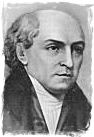
 William
Carey, "the father and founder of modern missions," was born
at Paulersbury, Northamptonshire, England, August 17, 1761. It is believed
that his early ancestors were of considerable social prominence; yet at
the time of his birth his father, Edmund Carey, was a journeyman weaver
with a moderate income; but in 1767 he obtained the twofold office of schoolmaster
and parish clerk.
William
Carey, "the father and founder of modern missions," was born
at Paulersbury, Northamptonshire, England, August 17, 1761. It is believed
that his early ancestors were of considerable social prominence; yet at
the time of his birth his father, Edmund Carey, was a journeyman weaver
with a moderate income; but in 1767 he obtained the twofold office of schoolmaster
and parish clerk.
William was taught by his father, and soon began an eager pursuit for knowledge, books of science, history, and travel being of especial interest to him. When very young he had great fondness for botany, and many were the specimens he brought home as a result of quests amongst the lanes and haunts of Whittlebury Forests.
Physical ailments unfitted him for outdoor occupations; and at the age of seventeen he was apprenticed to a shoemaker, and thus linked, says Dr. George Smith, to a succession of scholars and divines, poets and critics, reformers and philanthropists, who have used the shoemaker's life to become illustrious.
A revolution took place in William Carey's life at his eighteenth year. Though brought up as a strict Churchman, as became the son of the parish clerk, he had fallen, through association with dissolute companions, into error; but owing to the efforts of a fellow-workman, he became converted, and from this time to the close of his life he was a devout student of the Scriptures. On June 10, 1781, he married Dorothy Plackett, his employer's sister-in-law. Mrs. Carey had little sympathy with her husband's tastes, but he always treated her with noble tenderness. Domestic and business troubles followed him closely. In her second year his little girl was taken from him; he himself was stricken with fever; starvation was staring him in the face, when his brother, only a youth, came to his relief, and, with the aid of friends, secured for him a little cottage in Piddington, where Carey, besides continuing his shoemaking, opened an evening school.
Attending the meetings of the association at Olney, Carey met the future secretary of the missionary society, Andrew Fuller. As a result of this meeting, Carey began to exercise his gifts as a preacher. The Dissenters in his native village soon sent for him to preach for them. His mother went openly to hear him, and declared if he lived he would become a great preacher; his father, being the parish clerk, heard him clandestinely on one occasion, and, though a reserved man, expressed himself as highly gratified.
Soon after Carey united with the church at Olney, and was by that body formally set apart for the work of the ministry. A field of action soon offered in Moulton, where he, after many preliminaries, was ordained pastor of the Baptist church.
Here his income was only ten pounds per annum; and after failing to increase it by teaching, he resumed his shoemaking in connection with the ministry. During the time of his pastorate in Moulton, Mr. Carey brooded continually over the condition of the world, and became convinced that the spreading of Christianity was a responsibility which all the converted ought to assume.
In April, 1789, Carey was called to the pastorate of Harvey Lane Church at Leicester. Here he was brought into association with men of culture, and books were freely placed at his disposal. The course of events was now rapidly moving toward the formation of the missionary society. At the annual meeting of the association held at Nottingham, Carey was one of the preachers. He chose for his text Isa. 54:2-3, which was paraphrased as follows: "Expect great things from God," "Attempt great things for God." The impression made by the discourse was so decided that the following resolution was passed: "That against the next meeting at Kettering, a plan should be prepared for the purpose of forming a society for propagating the gospel among the heathen.
The meeting was duly held on October 2, and a collection of thirteen pounds made; so the great missionary enterprise was duly inaugurated. At this time a ship surgeon, John Thomas, who had been in India, and had preached to the Hindus, had just returned to England, and was trying to establish a fund in London for a mission to Bengal. Carey suggested that it might be desirable for the society to co-operate, and a resolution was passed to send Mr. Thomas and Mr. Carey into India as missionaries. Many difficulties arose before their final departure, June 13, 1793, when Mr. and Mrs. Thomas and their child, Mr. Carey and his family, consisting of wife and three children, embarked. After a voyage of five months they arrived at Calcutta, November 9.
Thomas's knowledge of India was an advantage to Carey; but his lack of judgment, and the debts he had incurred in his residence there, estranged from the missionaries some European Christians who had otherwise been their friends. Calcutta being found too expensive as a place of residence, they removed to Bandel for a time. But no facilities for missionary work were afforded them there; so they returned to Calcutta, where they underwent vicissitudes of all kinds until June, 1794, when Mr. George Udny, at Malda (a former friend of Mr. Thomas), offered the management of two indigo manufactories respectively to Carey and Thomas. The factory which Carey was to superintend was at Mudnabatty; and besides a salary of 200 rupees per month, he was promised a commission upon the sales. Carey at once communicated with the secretary of the society that he should not need more supplies, and expressed the hope that another mission be begun elsewhere. The duties at the factory allowed time for the work of the mission.
Mr. Carey made such progress in the study of Bengalee as to be able to preach intelligibly to the natives. He started a school, and worked vigorously at translation. In the midst of his great work he lost his little son Peter, and finally was himself prostrated with the fever, which lasted several months. Carey remained in Mudnabatty until Jan. 10, 1800, when, with his wife and four children, he joined a little colony of missionaries, who, through his influence, had come to India and settled at Serampore, a little village founded by the Dutch in 1755.
The missionaries found a home in a large house in the middle of the town, purchased from a nephew of the Danish governor. They lived in perfect unity, "and what one had was another's," and thus began the great missionary enterprise at Serampore.
The name of the first Hindu convert was Krishnu Pal, and the baptism of this native was a most memorable scene. Carey going down into the river, taking first his son Felix and baptizing him, using English words; then Krishnu went down and was baptized, the words being in Bengalee. All was silence and attention. The governor could not restrain his tears, and every one seemed to be impressed with the solemnity of this sacred ordinance.
Feb. 7, 1801, saw the issuing of Carey's translation of the New Testament. On the completion of this great undertaking, a special meeting was convened for the purpose of giving thanks unto God. The publication of the Bengalee New Testament naturally directed attention to Mr. Carey. The eminent scholarship it disclosed pointed him out at once as the teacher who might fittingly occupy the Bengalee chair in the government college at Fort William. His first position was that of teacher of Bengalee, afterwards of Sanscrit and of Mahratta, with a salary of £600 per annum.
From teacher he became professor. As professor of the three Oriental languages his emoluments rose to £15,000. But the whole of this income, with the exception of some £40 needed for the support of his family, he devoted to the interests of the mission.
Carey held his position of professor until 1830, within four years of his death, and proved himself more than equal to his office, winning the esteem and affection of students and colleagues alike. It was not to be expected that the Serampore labors would be allowed to proceed without political interference. Serious difficulties arose, threatening not only the existence of the press, but of the mission itself. As the time drew near for the renewal of the East India Company's charter, the friends of missions directed their efforts toward securing the introduction of clauses permitting the free entrance of missionaries into India, and liberty to propagate the Christian religion. The bill passed the Commons, July 13, and was accepted by the Lords, and entrance was granted.
The new chapel at Calcutta was duly opened, Jan. 1, 1809, and Carey conducted the week-day services there. And while his professional engagements and his literary pursuits detained him often in Serampore and Calcutta, yet he eagerly seized any opportunity that arose for itinerating, with a view to extending Christianity.
In 1807 Mrs. Carey died, having long suffered from insanity; and in the following year Carey married Miss Charlotte Rumohr, of noble Danish descent. She entered heartily into all the concerns of the mission, and was a great help to her husband until her death, which occurred in 1820.
Besides translating the Bible into seven different languages, Mr. Carey wrote grammars and elementary books of all the languages he had acquired. The improvement upon native paper for press purposes, by manufacturing it so as to be proof against destruction by insects, was an immense advantage gained by the ingenuity of the missionaries, and the importation of a steam-engine of twelve horse-power for working their paper-mill was a striking evidence of the enterprise of these men.
No memoir of William Carey would be complete which did not record his benevolent endeavors to improve the social condition of the natives of India. The first reform he helped to effect was the prohibition of the sacrifice of children at the great annual festival at Gunga Sangor. Another reform to which Carey gave his determined attention was the abolition of burning widows on the pile of their dead husbands.
The benevolent institutions for instructing the children of indigent parents originated in the philanthropic sympathies of Carey; and in the year 1817 no less than forty-five schools had been established. A leper hospital was founded, and a vernacular newspaper published.
Carey possessed in not a few branches of natural history a knowledge so scientific that it was more than sufficient to command respect. His practical knowledge of botany and agriculture resulted in very material benefit to India, and lays that country under a debt of obligation which can never be discharged.
In 1817 was begun the missionary training institute, which afterwards grew to a college, and was placed upon the same basis as other colleges of Europe.
For forty-one years William Carey was spared to labor for the good of India. He outlived nearly all who were associated with him in his prolonged residence, unbroken by any return to England. He died June 9, 1834.
During his lifetime, Carey's great attainments called forth honorable recognition. Brown University in the United States conferred upon him the degree of D.D. The Linnaean, Horticultural, and Geological Societies admitted him to their memberships; and men of high position, such as the Marquis of Wellesley and Lord Hastings, extolled his worth. But he cared little for worldly praise; his great desire "to be useful in laying the foundation of the Church of Christ in India" was surely accomplished, and he wished for "no greater reward," "no higher honor."
From Great Missionaries of the Church by Charles Creegan and Josephine Goodnow. New York: Thomas Y. Crowell, ©1895.
>> More William Carey