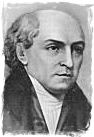
Born in Paulerspury, England, August 17, 1761.
Died at Serampur, India, June 9, 1834.
 The
glorious gospel torch did not fall from the hand of Schwartz till five
years after William Carey had found a place as a missionary in that land
where even now "eight hundred precious souls each hour sink into Christless
graves."
The
glorious gospel torch did not fall from the hand of Schwartz till five
years after William Carey had found a place as a missionary in that land
where even now "eight hundred precious souls each hour sink into Christless
graves."
"There are no beginnings" says Dr. George Smith, "this side of Eden." Carey has been called "the father of modern missions;" but we have seen that others were before him. Dr. Pierson traces his missionary lineage to Eliot; "for it was his life and work that moved and molded David Brainerd, ... Jonathan Edwards, Adoniram Judson, as also William Carey, and others who followed him. Yet this stream of holy influence, which watered so many trees of life, Eliot himself traces to its spring in the home of Hooker." The Puritan exile Hooker "reappears in Eliot, Eliot in Edwards, Edwards in Carey, Carey in Judson, and so on without end."
But although these secret springs burst forth here and there, the great church as a body seemed oblivious to the needs of the heathen world. The Master's voice of missionary entreaty was seldom heard. There was no Student Volunteer Movement then, with the very flower of a great nation determined to fulfil their heaven-born mission to their generation; there was no United Christian Endeavor Society to spring forth to the rescue of precious perishing souls; no Layman's Missionary Movement to waken a slumbering church; no entire denomination with avowed purpose of sounding the gospel trumpet to the ends of the earth in this generation.
Nevertheless, as in other instances before and since, a fire from heaven fell upon the heart-altar of this man. It consumed the dross through a long-continued burning of trial-fires; then sent forth the purified temple, in which the Holy Shekinah dwelt, that before it the god Dagon might fall on his face, and his captives be set free...
William Carey was a strong link in the golden chain let down from heaven to save the world. Born in a humble weaver's cottage, he experienced the value of the discipline of poverty in forming a sturdy character.
"When a boy he was of a studious turn," as described by his sister Mary, "and fully bent on learning, and always resolutely determined never to give up any portion or particle of anything on which his mind was set, till he had arrived at a clear knowledge and sense of his subject. He was not allured or diverted from it; he was firm in his purpose and steady in his endeavor to improve." Of his reading he said: "I chose to read books of science, history, voyages, etc., more than any others. Novels and plays always disgusted me."
He took great delight in nature, her insects, her birds, her plants and flowers. He learned gardening of his uncle, and finally became "one of the most eminent horticulturists in Asia."
At seventeen, at Hackleton, nine miles from Paulerspury, he was apprenticed at the trade from which he later merged a "consecrated cobbler." In the library of his employer he found a New Testament commentary and in it first saw the characters of the Greek language. What mystery did they hold? How could he know? He would find them out; and in mastering his first Greek lesson, he set himself an example in becoming the wonderful linguist of the Orient. Little did he then dream of the new tongues in which he was to speak. Indeed, his mother tongue needed training before Greek or Bengali would be of much benefit.
Of this need, let Carey himself tell: "My master was an inveterate enemy to lying, a vice to which I was awfully addicted." Of this vice he was cured by an incident connected with this same employer. While out on an errand, collecting, an ironmonger offered him the gift of a shilling or a sixpence. He chose the shilling, but found it was a brass one. He made some purchases for himself, however, using a shilling of his master's in payment. "I well remember," he afterward wrote, "the struggles of mind which I had on this occasion, and that I made this deliberate sin a matter of prayer to God as I passed over the fields home. I then promised that if God would but get me clearly over this, or in other words, help me through with the theft, I would certainly for the future leave off all evil practices; but the theft and consequent lying appeared to me so necessary that they could not be dispensed with." And so lie he did. But "a gracious God did not get me safe through. My master sent the other apprentice to investigate the matter. The ironmonger acknowledged having given me the shilling, and I was therefore exposed to shame, reproach, and inward remorse. ... I was quite ashamed to go out; and never till I was assured that my conduct was not spread over the town did I attend a place of worship."
What a blessing it was that in this crucial hour, Carey's reputation did not fall upon telltale tongues! The young man who learned of the theft was the son of a Dissenter, a then hated Baptist. Young Carey was a "churchman" of the popular established Church of England, and as he said, "had always looked upon Dissenters with contempt." He felt himself too good to enter the little Baptist church in the village, and "had enmity enough in his heart to destroy it." His fellow workman, however, was a converted young man, and instead of jesting over William's faults, tried earnestly to help him to overcome them. He loaned him good literature and labored to lead him to the Saviour.
Carey, preferring to save himself, as many do when new truths are brought home to their consciences, became all the more zealous in carrying out the forms of religion. He determined to attend church and prayer-meeting regularly. He read and meditated much. But none of this either changed or satisfied his heart. At last he saw himself a lost man, and was "brought to depend on a crucified Saviour for pardon and salvation." At the age of twenty-two he was baptized and united with the church he had despised.
Allowing business considerations instead of religious principle to guide him, Carey was united in unhappy wedlock before he was twenty. At what time is it so necessary that one know the secret of divine guidance as when a companion for life is to be chosen! This great secret he knew not then. Mrs. Carey had little interest in her husband's religion; but it is said, to his high honor, "he always treated her with noble tenderness."
Carey's first sermon was preached at Hackleton. His mother went to hear him and declared her confidence that, if spared, he would become a great preacher. The father, ashamed to be seen at a Baptist meeting, listened once outside, and was frank enough to confess himself highly pleased. It was Carey's shed shoe shop here that Scott the commentator called "Carey's College."
It was probably while Carey was an apprentice that he read Captain Cook's "Voyages Around the World," which awakened his interest in heathen lands. As early as 1782 he prayed in his family and in public for the heathen.
Before he was ordained, an incident occurred to which reference is often made. It is thus introduced by J. W. Morris, the biographer of Fuller:
"Before the end of 1786, Mr. Carey, accompanied by another minister of the same age and standing with himself, went to a ministers' meeting at Northampton. Toward the close of the evening, when the public services were ended, and the company engaged in a desultory conversation, Mr. Ryland, senior, entered the room, and, with his accustomed freedom, demanded that the two junior ministers, Mr. Carey and his friend, should each propose a question for general discussion. Mr. Carey pleaded several excuses, but a question was imperiously demanded. At length he submitted, 'Whether the command given to the apostles to "teach all nations," was not obligatory on all succeeding ministers to the end of the world, seeing that the accompanying promise was of equal extent?'"
This is the first time Carey had ventured to lay bare the burden of his heart in public, though he had frequently urged the subject in private. As soon as Dr. Ryland could command sufficient composure to reply, he exclaimed, "Young man, sit down; when God is pleased to convert the heathen world, He will do it without your help or mine."
He also said that nothing could be done before another Pentecost; and it is claimed that he called Carey "a most miserable enthusiast" for asking such a question. The cause of earth's perishing millions had evidently not rested very heavily upon Mr. Ryland's conscience up to this time.
Carey was very much mortified and abashed; but the load was in no wise lifted from his heart. His friend, the devoted Fuller, sympathized with him, and "offered several encouraging remarks, and recommended it to him to pursue his inquiries;" though he too confessed that when the subject was first mentioned to him he felt to exclaim, "If the Lord should make windows in heaven, then might this thing be!"
When ordained as pastor at Moulton, Carey was obliged to continue his shoemaking for a living, as the church was very poor. It was in his little shop there that Mr. Fuller saw the famous map he thus describes: "I remember, on going into the room where he employed himself at his business, I saw hanging up against the wall a very large map, consisting of several sheets of paper pasted together by himself, on which he had drawn with a pen a place for every nation in the known world, and entered into it whatever he had met with in reading, relative to its population, religion, etc." To Carey that map of the world spoke of millions waiting for the tidings of salvation. Why should not every world-map still speak of the same?
Carey added the fuel of facts to the fire that was burning in his soul, until material for a pamphlet was prepared. But he had no money with which to publish. Poverty followed him from place to place, grasping him with her gaunt fingers as if to train his sinews for the contest before him.
Neither hands nor brains were idle, however. On his cobbler's bench was a book. To his store of Greek were added French, Dutch, Latin, and Hebrew. "With little teaching, he became learned; poor himself, he made millions rich; by birth obscure, he rose to unsought eminence; and seeking only to follow the Lord's leading, himself led on the Lord's host."
Though he had frequently to change his location, "no sooner had he established his bench again than he would go out in search of some little patch of ground, covered with weeds and briers, where he would dig, early and late, until in a few months, with the help of the Almighty, he would show you a small section of Eden coming back again.
A deep impression was made upon the little assembly of Baptist ministers, when the association met at Clipstone in 1791, by a sermon from Fuller on "The Pernicious Influence of Delay in Matters of Religion." Such solemnity brooded over the congregation that Carey was moved to urge immediate action in behalf of the heathen world. "Such was the effect of his earnestness, that had it not been for Sutcliff's counsels recommending further consideration, a society had then and there been started." They went far enough, however, to request Carey to publish what he had written on the subject.
Another year's delay brought the opportunity for the pent-up yearnings of years to pour forth. The occasion was an annual meeting at Nottingham; the preacher, William Carey. He chose the well-known text Isa. 54:2,3, and gave to missions for all time to come the inspiring motto, "Expect great things from God: attempt great things for God."
Let the man who a half dozen years before had told Carey to sit down, tell the effect of this new stone in the foundation of modern missions: "If all the people had lifted up their voice and wept," said Dr. Ryland, "as the children of Israel did at Bochim, I should not have wondered at the effect; it would have only seemed proportionate to the cause, so clearly did he prove the criminality of our supineness in the cause of God."
But how slow is humanity to hear and heed the divine voice! Again the ministers were about to disperse, no doubt with a feeling of thankfulness for the blessing received, when Carey, in desperation of spirit, seized Fuller by the arm, and exclaimed beseechingly, "And are you, after all, going again to do nothing?" This brought matters to a crisis, and a resolution was passed that at the next meeting at Kettering "a plan be prepared for the purpose of forming a society for propagating the gospel among the heathen."
During this year Mr. Carey succeeded in publishing his pamphlet, bearing the title, "An Inquiry into the Obligations of Christians to Use Means for the Conversion of the Heathens." Good Deacon Potts contributed ten pounds for the purpose. A date not to be forgotten came at last, October 2, 1792. After the services of the day were ended, a dozen ministers gathered in Mrs. Beeby Wallis's parlor, where the following preamble prefaced the resolutions they passed:
"Desirous of making an effort for the propagation of the gospel among the heathen, agreeably to what is recommended in Brother Carey's late publication on that subject, we whose names appear to the subsequent subscription, do solemnly agree to act in society for that purpose."
How grand the purpose! How momentous and far-reaching the decision! The twelve ministers contributed £13 2s. 6d. Thus the step which proved the turning-point in missionary organization was taken, and the great Baptist Missionary Society was organized.
The year Carey was baptized, 1783, Dr. John Thomas of London, went to India in the employ of the East India Company as a surgeon. As he gazed upon the vast hosts moving on in solemn procession into the valley of death, he placed his own neck under the yoke of his Master, and began laboring to deliver them. On returning to England in 1785, he received baptism and license to preach, and again went forth to Hindustan to seek and to save the lost.
His quiet labors were encouraged and largely supported by two Christian philanthropists, Mr. Charles Grant, a director of the East India Company, and Mr. Udny, of Malda, India. After several years spent in preaching and trying to translate the New Testament into Bengali, he returned to London to seek funds and a fellow worker for his mission field. We have seen how, through these years, God had been preparing the man for the hour.
He who sat on the cobbler's watch-tower had caught sight of God's signals, and in a communication to the infant society, recommended Dr. Thomas to the consideration of the directors. Due inquiry was made, the doctor submitting an account of his labors. "The result being satisfactory, Dr. Thomas was invited to go out under the patronage of the society, the committee engaging to furnish him with a companion, 'if a suitable person could be obtained.'" The matter was under advisement at a meeting held January 10, 1793, in Mr. Fuller's study, at which Mr. Carey was present. So impressed were they with the representations submitted by Dr. Thomas that Mr. Fuller remarked: "There is a gold-mine in India, but it seems as deep as the center of the earth. Who will venture to explore it?" An answer and a man were in waiting. "I will venture to go down," was the immortal reply of William Carey; "but remember that you," addressing the members of the committee, "must hold the ropes." "This," said Mr. Fuller afterward, "we solemnly engaged to do, pledging ourselves never to desert him as long as we should live."
What more fitting finish to this picture could an artist suggest than that which took place! and what visitor could have more surprised the little company than did the one who came! for at a late hour of the night Dr. Thomas himself, who had come from London, entered the room. Mr. Carey, beholding his future colleague, arose from his chair, and they fell upon each other's necks and wept. Not without tears was the work begun; not without tears will it be done.
Thus the first two Englishmen to enter the Orient for God and not for gold, were chosen for their place. Of the many perplexities that might have prevented less determined men from going, we can not speak particularly, the most serious being the refusal of Mrs. Carey to go. Her home was more to her than were the heathen or her husband and she would remain with her treasure. But Carey had learned to obey the voice of duty. God was trying him whether he loved any other more than Him. He bore the test, and actually started without wife and babies. A letter he wrote on the way bore this message to her:
"If I had all the world, I would freely give it all to have you and the dear children with me, but the sense of duty is so strong as to overpower all other considerations. I could not turn back without guilt on my soul. ... Tell my dear children I love them dearly, and pray for them constantly. Be assured I love you most affectionately.
A merciful providence, which seemed to have wrecked the entire expedition, came about thus: the captain of the East India Company's vessel was threatened because he had taken Mr. Carey aboard, and he promptly set the missionaries ashore. With tear-filled eyes they saw the ship depart without them and with heavy hearts they returned to London. Carey sat down to write to his wife, and Dr. Thomas went into a coffeehouse, where, using his own words, "to the great joy of a bruised heart, the waiter put a card into my hand, whereon were written these life giving words, 'A Danish East Indiaman, No. 10 Cannon Street.' No more tears that night!" They soon found the ship Maria, which took not only them, but Mrs. Carey, her children and sister, with them to India. They sailed June 13, landing at Calcutta November 10, 1793.
The Moravian method of self-support in missions was known to Carey, and he wished to practice it. "At Bandel, on the Hugli, at Calcutta itself, and amid the tiger swamps of the Sunderbund tracts to the east of Calcutta, he made three attempts to preach and toil with his hands at the same time."
"I am in a strange land alone," he wrote, "no Christian friend, a large family, and nothing to supply their wants. ... Bless God, I feel peace within, and rejoice in having undertaken the work. I anxiously desire the time when I shall so far know the language as to preach in earnest to these poor people."
"After seven months of hardships unknown to any other missionary in India before or since," he obtained a position that gave the desired self-support.
"In the sadness and bewilderment and trial of faith which marked his first years in India, the founder of modern missions turned ever to the words with which Isaiah was sent to comfort the captive Jews"— Isa. 51:2-6. "It has been a great consolation to me," wrote he, "that Abraham was alone when God called him."
When a place of dire extremity had been reached, unexpected succor came. A friend of Dr. Thomas, Mr. Udny, who had helped to support him during his earlier labors, offered the missionaries the management of two indigo factories. The proposition was gladly accepted. The factory Mr. Carey was to superintend was at Mudnabutty, where he "perfected his knowledge of Bengali, wrote a grammar of that vernacular, translated the New Testament into it, learned Sanskrit, mastered the botany of the region, corresponded with Schwartz and Guericke in the far south, set up a printing-press, and planned new missions." Here he remained over five years.
After five years' residence in India, Mrs. Carey became insane. Thus one of the saddest afflictions that can enter a home fell to the lot of William Carey. Death released her in December, 1807.
It was in March, 1799, that Mr. Carey saw for the first time a widow burned alive with her dead husband; and from this time he ceased not to use his influence, by appeals both there and in England, until the horrible rite was abolished by law.
This same year four colleagues came, two of whom became little less successful than Carey himself. One was Joshua Marshman, who had read five hundred books before he was eighteen years of age, and when seeking admission to church-membership, was met with the objection that he "had too much head knowledge of religion" to have much "heart knowledge" of it. Another was William Ward, a printer and editor, to whom Carey had said on leaving England, six years before: "If the Lord bless us, we shall want a person of your business to enable us to print the Scriptures. I hope you will come after us."
The hostility of the East India Company would not allow the establishment of a mission in their territory. Carey's work, having been connected with manufacturing, had not been interfered with; but these newcomers were advised not to land at Calcutta. However, God has said "the wrath of man shall praise" Him. Providentially, a Danish colony had been planted at Serampur, about sixteen miles above Calcutta. Its governor, Colonel Bie, had enjoyed the friendship of Schwartz and extended to the lonely missionaries a friendly welcome to his "city of refuge." He resisted all attempts to deprive them of protection, declaring that "if the British government still refused to sanction their continuance in India, they should have the shield of Denmark thrown over them if they would remain at Serampur." And there they remained; and there Carey joined them. Thus "to Ziegenbalg and Schwartz, Carey, Marshman, and Ward owed their home in Serampur."
On a visit here, Dr. Thomas was permitted to render medical assistance to a Hindu carpenter named Krishnu, who had a dislocated arm. This man was led to renounce his idols and his caste, and was baptized December 28, 1800. "The missionaries, as may be readily imagined, were greatly moved with gratitude and joy; for at length, after long years of trying toil, Thomas and Carey were permitted to see the first-fruits of their labor. 'Brother Carey,' said Ward, 'has waited till hope of his own success has almost expired.'" Krishnu came from the Sunderbunds, "where Carey began life as a missionary farmer." He became a most useful preacher, and was faithful till death.
Poor Dr. Thomas was so overjoyed that his mind for a time gave way, and he had to be confined at the mission at the time of the baptism. On regaining mental balance his health was much broken, and he died a few months later, his life an unselfish offering to India. His work was cut short, but it became an encouragement to Judson, who after four years' absence from America, wrote to Luther Rice, in 1816, "If any ask what success I meet with, ... tell them to look at Bengal, ... where Dr. Thomas had been laboring for seventeen years before the first convert, Krishnu, was baptized."
The year 1801 saw the great task of issuing the New Testament in the Bengali accomplished. At the same time Mr. Carey was appointed to a chair in Fort William College, with a salary of six hundred pounds, later raised to one thousand five hundred pounds; but he lived on less than fifty, devoting the rest to the mission.
What but missions would a man like Carey plan for his sons? In 1805 he would have sent Felix to China, but contented himself by planting him at Rangun, Burma. Felix, however, was not a William Carey nor an Adoniram Judson. He soon became interested in political affairs and accepted a civil position at Ava. "My son," said his father, "set out as a minister of Christ; but alas! he has dwindled down to a mere British ambassador."
Dr. Carey gave forty-one years of service to India, and lived to see much fruit of his labor. Besides the first complete translation of the Bible into the Bengali by his hand, and into the Chinese by Dr. Marshman, they printed Scripture portions in forty languages and dialects. They established a college to train native ministers and Christianize educated Hindus, a medical mission, and a leper hospital, besides at least thirty large mission stations.
Ably indeed were Carey's labors supported by his coworkers, Marshman and Ward, and strong was the threefold brotherhood. For near a fourth of a century they toiled, wept, and prayed together. Mrs. Marshman — called "the first woman missionary to India" — and her husband early opened a boarding-school, which soon became popular and remunerative. Mr. Marshman's great work of translating and printing the Bible in Chinese tells of his high capabilities and interest in all men. Mr. Ward had charge of the printing house and was author of a number of valuable books. He visited England and America, and secured several thousand pounds for the college that was established at Serampur for training workers.
Ere the close of life, the penniless preacher of Hackleton had contributed to the enlightenment of India more than two hundred thousand dollars; while the three families, who had had all things common, living at the same table at a cost little above one hundred pounds a year, had contributed the magnificent sum of four hundred fifty thousand dollars.
But the prejudice, enmity, misrepresentation, and bitter opposition nearly always manifest toward God's most devoted heroes was not lacking here, neither in the home land. Their publishing work was threatened by the government. "We are much in the situation," wrote Carey in that crisis, "in which the apostles were when commanded not to teach nor preach any more in this name!" Spies were sent to attend their meetings and secure copies of their tracts. Information thus obtained was laid against them; but in answer to prayer the hand of God turned aside the assaults of the enemy, and His work went on.
Carey did not lose his fondness for gardening and flowers. Often when he could no longer walk, the aged missionary was borne in a chair into his garden, one of the finest in the East. He once expressed his joy, in writing home, over a little daisy that had wandered from England to a corner of his garden. Upon this, James Montgomery wrote "The Daisy," a stanza of which is:
"Thrice welcome, little English flower!
To me the pledge of hope unseen!
When sorrow would my soul o'erpower
For joys that were or might have been,
I'll call to mind how fresh and green
I saw thee waking from the dust,
Then turn to heaven with brow serene,
And place in God my trust."
It is said of Carey that "so tender was his sympathy with and fondness for plants, that he would never pluck a flower."
His last work was to revise his Bengali Bible. When it was completed, he said: "My work is done." "There is scarcely anything for which I desired to live a little longer so much as for that."
"It must have been a touching sight," writes Bishop Walsh, "to see Dr. Wilson, the metropolitan of India, standing by the death-bed of the dying Baptist and asking for his blessing. It bore witness to the large-heartedness both of the prelate and of the missionary, and was a scene that did honor alike to the living and to the dying."
A visit of Mr. Duff, who has been called "the apostolic successor of Carey," is thus described by Dr. Culross, in "Men Worth Remembering": "On one of the last occasions on which he saw him — if not the very last — he spent some time talking chiefly about Carey's missionary life, till at length the dying man whispered, 'Pray.' — Duff knelt down and prayed, and then said good-by. As he passed from the room, he thought he heard a feeble voice pronouncing his name, and turning, he found that he was recalled. He stepped back accordingly, and this is what he heard, spoken with a gracious solemnity: 'Mr. Duff, you have been speaking about Dr. Carey, Dr. Carey; when I am gone, say nothing about Dr. Carey — speak about Dr. Carey's Saviour.'"
From The Advanced Guard of Missions by Clifford G. Howell. Mountain View, Calif: Pacific Press Publishing, ©1912.
>> More William Carey