God's creation articles
 |
Can any hide himself in secret places that I shall not see
him? saith the LORD. Do not I fill heaven and earth?" Jeremiah 23:24
Have you wondered why certain animals are called hares and others are called rabbits when they look so much alike? Although they are closely related, there are differences. Hares have nests above ground; their babies are fully covered with fur; their eyes are already open when they are born; they can hop around within just a few minutes.
Most rabbits have underground nests; their babies have no fur at all; their eyes are closed when they are born; they don't venture outside for about three weeks. Both rabbits and hares are silent animals, but in serious danger they can let out loud screams.
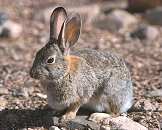
There are about 80 species of rabbits, but today we will just consider a few of the cottontails. It is natural for us to see all cottontails as lovable as they are so inoffensive and quietly go about their business, eating inner bark of saplings and shrubs, as well as clover and various grasses, fruit and other foods. This is one of God's creatures that has no desire to harm any living thing and just takes care of its own needs. Incidentally, the cottony underpart of their tails, which is almost always showing, accounts for their name.
All cottontails are timid, with short bodies, small roundish faces, large ears (but nowhere as big as a jack rabbit's), large, placid eyes and most have soft, tannish fur. But two kinds, both referred to as swamp marsh rabbits, don't have underground nests. These live above ground and at times build large nests among the low branches of bushy trees.
Many rabbits live on marshy land, but others prefer arid deserts. Two of these are the pygmy and the nuttall — both cottontails. The nuttall is considerably larger than the pygmy and not as shy. The pygmy is really tiny, weighing less than a pound and goes about its business mostly at night. A resident of the desert close to the mountains of California and Oregon, it cares for itself and raises its young where food and water are scarce, summers are very hot and winters are extremely cold.
A shrub which grows only in those areas has the name "rabbit brush." The pygmy particularly likes to make its home under this shrub, where it is not exposed to some enemies that are numerous in the more lush desert sagebrush.
These little animals are clever at hiding themselves, but they are always under the watchful care of God, their Creator. As the beginning Bible verse says, we are never out of His watchful care either. Have you thanked Him for this love and care and accepted the invitation to become one of His own children by accepting His Son, the Lord Jesus, as your Saviour?
Copied with permission from Messages of God's Love. More articles in The Wonders of God's Creation (Volume 1-4) by Sidney R. Gill, also published by Bible Truth Publishers, Addison, IL 60101.
>> More God's Creation Articles