children of the Bible
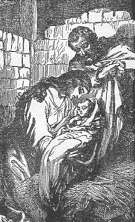
In the beginning before the heaven and earth were made, Jesus the Word, was with God, and He was God. But when the fulness of the time was come, the Lord Jesus laid aside His glory and came into this world — the world that was made by Him — and He was born a babe in Bethlehem. The name Jesus means Saviour and He came to save His people from their sins. He was Immanuel, which means God with us, and yet He was born in the stable of an inn, with a manger where oxen fed as a cradle, "because there was no room for them in the inn."
Away in a manger, no crib for a bed,
The little Lord Jesus laid down His sweet head;
The stars in the sky looked down where He lay,
The little Lord Jesus, asleep on the hay.
 Had
Jesus only been the son of an earthly king, what a great to-do there would
have been at His birth; but even though He was the Son of God whose coming
had been foretold by the Old Testament prophets, it seems as if none would
have noticed the actual birth of Jesus if the angel of the Lord had not appeared
to some shepherds "keeping watch over their flock by night," and
told them that a Saviour, Christ the Lord, was now lying a baby in a manger
in Bethlehem.
Had
Jesus only been the son of an earthly king, what a great to-do there would
have been at His birth; but even though He was the Son of God whose coming
had been foretold by the Old Testament prophets, it seems as if none would
have noticed the actual birth of Jesus if the angel of the Lord had not appeared
to some shepherds "keeping watch over their flock by night," and
told them that a Saviour, Christ the Lord, was now lying a baby in a manger
in Bethlehem.
No sooner was the good news told the shepherds, than "there was with the angel a multitude of the heavenly host praising God, and saying, Glory to God in the highest, and on earth peace, good will toward men." Then the shepherds left their flocks to seek Jesus. And having seen Him, they spread the good tidings abroad. Many "heard" and "wondered," but alas we do not read that many went to worship Him.
As a Jewish child the ordinance of circumcision was performed upon Jesus when He was eight days old. Then after a certain number of days, according to the law of Moses, Mary and Joseph brought Jesus to Jerusalem to present Him to the Lord and to offer a sacrifice. As they came into the Temple bringing the little child in their arms, there was a just and devout man named Simeon who took Jesus up in his arms and blessed God: for in Jesus he saw God's salvation, and "a light to lighten the Gentiles, and the glory of thy people Israel." And the aged prophetess, Anna, "gave thanks likewise unto the Lord and spake of Him [Jesus] to all them that looked for redemption in Jerusalem."
If there were few who knew of Jesus' birth, God did not allow them to remain in ignorance of this great event. For soon there came wise men from the east to Jerusalem, and they earnestly asked, "Where is He that is born King of the Jews? for we have seen His star in the east, and are come to worship Him." This question troubled Herod and "all Jerusalem with him." These strangers had, at the sight of "His star," left their homes, and had taken a long journey because they wanted to worship Him. And Herod called "all the chief priests and scribes of the people together," and these all agreed in saying, that Bethlehem was the city in which Christ was to be born, for it was foretold by the prophet Micah.
Yet although all these men knew this, we do not read that any of them went to Bethlehem, to seek Jesus. But the wise men, guided by the star, went there; and there they worshiped Him, and presented before Him the gifts they had brought. And then they returned to their own homes. After all this, how could any person in Israel say that they had not heard of His birth? Why, then, did they not all seek Him?
Though Israel did not seek Jesus to worship Him, King Herod sought the young child to destroy Him. While God in His love to us sent His Son into the world, this wicked man sought to murder Him. Herod sent his cruel soldiers to kill all the children of Bethlehem from two years old and under, but the child Jesus was not slain. For before the soldiers came, an angel had warned Joseph to take Mary and the young child and to flee with them into Egypt.
And He was gone — the Son of God was gone. He had departed from Israel, and was fled to a strange country. What a solemn day this was in Israel's history! Yet we do not read of any tears being shed to mourn His departure and it would appear that none noticed when He fled. Was He missed at all? Was He sought after by any? Did no one anxiously cry, "Oh, that I knew where I might find Him?"
Then Herod, the enemy of the Lord, died. Israel sent no swift messenger to bring Him back from Egypt, but God called His Son out of Egypt. As none had noticed when He fled, so no one seems to have noticed His return. Joseph was afraid to return with Jesus to Bethlehem, so he returned into Galilee, to their own city of Nazareth. And the child Jesus was brought up, and there He lived for nearly thirty years, unnoticed and forgotten by Israel.
It is important to say a few words about the "holy child Jesus." For He was as much the Son of God when He lay a little child in His mother's arms, as He was when he had grow up, and had become the man Christ Jesus. The wonder of it all! The Lord Jesus Christ, the Son of God, who was with God before the heaven and earth were made, who was God, was born a little baby. And as He grew up, He had the feelings of a child, He was in all points tempted like as we are, yet He was without sin. And from the moment of His birth, until He ascended up to Heaven after His resurrection, it was His delight to do the will of God. He never ceased to serve His God. He was holy; the only holy child, the only holy man, that ever walked this earth.
And when He could walk up and down the hills of Nazareth, He acted in obedience, as a good son. He never said a naughty word, He never told a lie. He never said an unkind word, He never called another boy bad names. He did not despise His mother. He did not go with wicked boys to do evil. He did always those things that pleased the His Father.
The last recorded event in the childhood of Jesus relates to his parents going to Jerusalem every year at the feast of the Passover. For when Jesus was twelve years old, He was taken by His mother, and Joseph, to this feast. It was a long journey of about seventy miles for them to travel from Nazareth, their dwelling-place, to Jerusalem. In those days there were not the smooth roads we have now; and as the family were poor, they no doubt walked all the way, and had not many comforts on the road.
Joseph and Mary stayed a week in Jerusalem, and then prepared to return to their home. After they had gone a short distance on the way they missed Jesus. At first they thought He was with some of their friends behind, or that He was in the company of some of those who had gone on before. But as evening came on, when travelers put up their tents to rest themselves for the night, they became more concerned that they could not find Him. Fearing He had been left in the great city, Mary and Joseph hastened back to the place, and sought for Him three days in vain. How sad must have been her heart when she thought Mary had lost her dear son, and when he was so far away from home! At last she found Him; but where? It was in the temple. Jesus was there, not gazing on the beautiful building, or the costly things within it — He was found among the doctors, or learned men of the Jews "both hearing them and asking them questions." We are not told what Jesus asked, or what He answered, though we do know He spoke so wisely and modestly that they were astonished at what they heard. They had never listened to such a child before.
When Mary had found her blessed Son, she said to Him, "Why hast Thou thus dealt with us? behold, Thy father and I have sought Thee sorrowing." Then Jesus replied, "How is it that ye sought Me? wist ye not [or, Do you not know] that I must be about My Father's business?" While He was always obedient to His mother, and to Joseph, yet He wished them to remember that He had come to do the will of His Heavenly Father.
We may be sure that Jesus spoke to His mother in a loving and proper manner. He did not refuse to return to His home. He soon left the temple, and went with her to Nazareth, where, as a child, He was still "subject to her;" that is, He loved and obeyed her as a dutiful son. He lived in her lowly home, shared her humble fare, and was the companion and kind friend of those who lived in the little town.
After this, all that is told us of the childhood of Jesus is that "He increased in wisdom and stature, and in favor with God and man."
Is it not wonderful that Jesus, who, as the Scriptures say, is "God over all, blessed for ever," should come into the world that He had made; that He should come in our nature; that He should be the "Babe of Bethlehem," the "Man of Sorrows," and at last die a painful and shameful death, and by His death atone for our sins? Surely it was all in love and mercy for us.
Oh the deep, deep love of Jesus! And now He sits exalted at the right hand of God, and "He is able also to save to the uttermost, all that come unto God by Him." Won't you come beloved one and receive the Lord Jesus as your Saviour?
Even as a child, you can learn of Him and live for Him. "The holy child Jesus" is the brightest and most perfect example for each of us to follow. We may try to imitate the early piety of Moses and Samuel, or the zeal of young Josiah, or the meekness and charity of the little captive maid; but in Jesus there is everything that is lovely, wise, and good. He is the safest and best pattern. They were all sinners by nature and practice; but His nature was pure and holy, and His whole life was without the least stain. Won't you follow in His steps?
Born among cattle, in poverty sore,
Living in meekness by Galilee's shore,
Dying in shame as the wicked ones swore:
Jesus, wonderful Lord!Wonderful, wonderful Jesus!
He is my friend, true to the end;
He gave Himself to redeem me—
Jesus, wonderful Lord!
From The Children of the Bible. Chicago: Moody Press, [ca. 1900]. Edited.
>> More Children of the Bible