children of the Bible
Josiah became king of Judah when he was only eight years old. His grandfather Manasseh, and his father Amon, had forsaken the worship of the true God. Nearly all the priests had become evil, and served at the altars of idols; and the people also were wicked and corrupt.
We may picture to ourselves the young king Josiah. His dress was of a fine linen, of a purple color; for silk was not in use among the Jews in those days. On his head was a broad stout band, called a diadem. This was a kind of crown, shining with gold and costly pearls. There were also pearls and gems around his neck and arms. In this splendid dress he sat on a high throne, perhaps the one made by Solomon, which was wholly of gold and ivory. In his right hand he held a scepter, or staff, overlaid with gold, as a sign of his kingly power. His house was a beautiful palace, which had lovely gardens, and groves, and fountains of water. Every day the choicest food was spread upon his table. When he rode abroad it was in a fine chariot, drawn by horses, which were then scarce, and only used by royal persons. If he went a long journey, servants ran before him to tell the people that he was coming. The greatest persons in the land came out to meet him, and bowed to the ground when they came nigh to him. Guards and other servants waited on him at all times, ready to attend to his will. Now, though all this is not told us in the Bible about Josiah, we know that thus kings were honored in the East, and we may well suppose that the youthful prince thus began his reign.
There was no greater person in the kingdom than Josiah. He could do what he pleased, and there was no one to call him to an account. How was it, then, that he did not live a wicked life like his father? It was because "his heart was tender, and he humbled himself before God." He also had a true friend in Hilkiah, the high priest, who led him in the ways of the Lord.
In the twelfth year of his reign he sent men through the land to break down
the altars and images of the false gods. And as the temple of the true God
had fallen into decay, he had it repaired, and gave much money for this purpose.
He made a great feast when the temple was again built up, and offered a present
of forty thousand lambs and kids for sacrifice, besides oxen and calves. 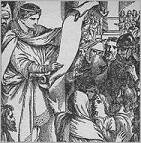 While they were cleansing the temple, a copy of the law of God was found, which
he caused to be read to all the people. In these ways he showed his deep
concern for the honor and worship of God; and he was made a great blessing
in his own day, and a bright example for every following age. Josiah was
slain in battle, though he died in peace with God.
While they were cleansing the temple, a copy of the law of God was found, which
he caused to be read to all the people. In these ways he showed his deep
concern for the honor and worship of God; and he was made a great blessing
in his own day, and a bright example for every following age. Josiah was
slain in battle, though he died in peace with God.
Although the readers of this book are not kings or queens, there is much in the conduct of Josiah which deserves their notice. Though they have not his royal state, they should have his pious spirit. To enable them to know what that spirit was, they may observe these three things—
1. In Josiah is seen the piety of a youth:
"While he was yet young, he began to seek after the God of David his
father." The Lord claims the first and best of all we have and all we
are; and He has a right to all.
2. Josiah showed his love to the Word of God. What should we be if the Bible were lost, and not a copy to be had? Should we show the same love and zeal for the holy book as the young king did, if, after it had been lost for some years, it were put again into our hands? You should praise God that you have the Bible, and pray that His Holy Spirit may impress your hearts with the truth it contains, so that you may become "wise unto salvation."
3. Seek to have a humble and tender heart. If you ask God to give you a "new heart," He will grant your desire.
From The Children of the Bible. Chicago: Moody Press, [ca. 1900]. Edited.
>> More Children of the Bible