children of the Bible
Joseph was the second youngest son of his father Jacob, and he was his favorite. I suppose we all want the people we love to look nice, so Jacob showed his love for Joseph by giving him a coat of many colors. This may seem rather strange to you, but you must remember that at the time when Joseph was born, colored things cost a lot of money. So robes of several colors were worn by royal persons, or were given to people as a mark of high honor.
When Joseph's brothers saw him dressed more grandly than they were, they began to hate him. Now remember as you think about Joseph and his brothers, that our hearts are like a garden. Whatever kind of seeds you put in the garden, they will come up, "for whatsoever a man soweth, that shall he also reap." Galatians 6:7. If you put in good seeds, you will have pretty flowers; but if you put in the seeds of weeds or poisonous plants, then weeds and bad plants will grow up. God through His Word, the Bible puts very good seeds into our hearts which grow up into beautiful fruit of goodness, gentleness, truth. But there is someone else who is watching and waiting to drop bad seeds in our hearts; and that is our enemy, the devil. The seeds which he plants are envy, hatred, malice, and every bad thought.
The devil put the seed of hate into the heart of Joseph's ten brothers; and because they did not at once pray to have it taken away, the seed took root, and grew quickly.
Joseph used to go with his brothers to take care of the sheep and goats. They were shepherds living in Hebron, and so they had plenty of opportunity to punish him for being their father's favorite. As they gave way to their evil thoughts towards Joseph they could not even make themselves "speak peaceably unto him." This means that they could not say "Peace," which was the usual greeting or farewell among the Hebrews, instead of our "How do you do? or "Good-bye."
One day Joseph made them more angry than ever. He told them that during the night he had dreamed a strange dream. He dreamed he was in a field of wheat with his brothers. They were all binding the wheat into sheaves, and when they had each made a sheaf, Joseph dreamed that his brothers' sheaves all bowed down to the one he had made.
When he told his brothers this dream, they were very angry, and the evil thoughts which they had allowed to grow in their hearts, made them hate their brother even more.
"And his brethren said to him, Shalt thou indeed reign over us? or shalt thou indeed have dominion over us? And they hated him yet the more for his dreams, and for his words." Genesis 37:8.
Not long afterwards Joseph dreamed again, and this time he dreamed that the sun and moon and eleven stars bowed down before him. This surprised the boy so much that he told his father about it. Jacob was surprised too, but he was not angry, for he knew that his son could not help his dreams. Perhaps he may have remembered that he too had had a wonderful dream when he was quite a young man, and may have thought that in some strange way, God would make his favorite child's dream come true. So all he said was, "Shall I and thy mother and thy brethren indeed come to bow down ourselves to thee to the earth?" Genesis 37:10.
But this second dream had a very different effect on Joseph's brothers; they called him the dreamer, and watched for the time when they could punish him.
What a difference it makes whether we like people or not. I might even say that we go through the world looking through two kinds of spectacles — the spectacles of jealousy, or the spectacles of love. If you are angry with your brother or sister or friend, does not everything that they do seem wrong? You cannot see any good or any beauty in anything they say or do; you are looking through the spectacles of jealousy and hatred. It is the same sort of feeling which made Joseph's brethren think badly of everything about him. Oh, do not give way to it.
In your own strength you can do nothing. That evil spirit will grow and grow till it blinds your eyes to all the good that is in other people, till it makes you close your ears to all kind things that may be said about them, and makes your tongue only speak evil of them.
Pray then to God, whenever you feel upset with any one. Pray earnestly that God will help you to forgive and to love the person offending you, even as Jesus forgives and loves you. Then when you look at your brother or sister or friend through the spectacles of love, you will be surprised to find what a lot of good there is in them.
I told you that the sons of Jacob were shepherds; but in order that you understand the rest of Joseph's history, I should like to tell you a little about the way in which shepherds lived in those days.
When they had a great many sheep and goats to take care of, they used to lead them from place to place to find fresh pasture ground. The shepherd sat in a tent during the day and slept during the night if his flock were safe from wild beasts and robbers. If there was any danger near, he would watch them all night, as the Eastern shepherds were doing when they heard the angels on the night of our Lord's birth.
So when Jacob's flocks had eaten all the grass near Hebron, his sons took them away little by little until they were many miles from home, near Shechem. Joseph did not go with them this time, but stayed at home with his father and his little brother Benjamin.
By-and-by Jacob wanted to hear how his ten sons were doing, and so he told Joseph to go and see where his ten brothers were, and to bring him back word how they and the flocks were doing.
Now Joseph was an obedient boy; and although he must have known very well that his elder brothers hated him, he started off at once to do as his father had told him. Putting on his coat of many colors, Joseph bade farewell to his father, little thinking how many years it would be before he saw his dear face again. He wandered a long way looking for his brothers, when one day a man met him and said, "What seekest thou?"
Joseph told him that he was looking for his brothers, and begged him to tell him if he knew where they were. Hearing that his brothers had said they were going to Dothan, Joseph went after them, and by-and-by saw them a long way off. When I tell you that Hebron, where Jacob lived, was about seventy miles from Dothan, you will see what a long journey Joseph had to take.
From the hilly ground where they were keeping their flocks, the brothers caught sight of a figure coming toward them. They knew the long colored robe, even before they could see the face of the wearer, and they said to each other, "Behold this dreamer cometh."
Now watch how the bad seed had grown. At first they were sulky with him and would not say "Peace" when they met him; next, they called him names; and now, as he came walking towards them alone and tired from his long journey, they plotted to kill him and said "we shall see what will become of his dreams."
But Reuben, the eldest of them all, had some pity left. He did not forget that it is an elder brother's duty to take care of the younger ones, but he did not have courage enough to face them all, and say that he would not allow them to harm the boy. He wanted to keep friends with them, and yet save Joseph.
Now there were many deep holes, or tanks, dug at Dothan, to catch the rain, and as Reuben looked round he caught sight of one of these.
"Let us not kill him," he said to his brothers, "but cast him into this pit that is in the wilderness," and leave him there. And as he spoke, he made up his mind that when his brothers had moved on, he would get Joseph out of the pit and send him home safely to his father.
They all agreed with Rebuen's suggestion. They took poor Joseph and pulled off the fine robe which had offended them so much, and threw him into the deep hole to starve to death. Far from being frightened after their wicked deed, they sat down close by to eat their food; all, at least, but Reuben, who went away for a time, perhaps to think what he could do to save his poor brother.
Soon a number of people appeared in sight. Camels were walking with them, laden with spices and balm and myrrh, which were to be sold in Egypt. Then Judah, another brother, was a little softer than the others, said, "Let us sell him to the Ishmaelites, and let not our hand be upon him; for he is our brother and our flesh."
So they called to the merchants and asked if they would buy a boy. When the Ishmaelites said they would gladly do so, they pulled Joseph out of the pit, and sold him to them to be a slave, for twenty pieces of silver.
Presently, after the long stream of camels had passed out of sight, Reuben came back. Looking into the pit he found it empty, and was in great sorrow. He had only meant to do a little wrong, but now he had become a sharer in a great sin. So does one wicked thought or act lead to another.
You put a snowball at the top of a hill, give it a gentle touch and it goes down slowly at first. But soon it goes quicker and quicker, till your little feet can no longer keep by the side of it; and the ball goes on and on, getting larger and larger till it gets to the bottom.
So it is with our sins. We give way to a little one perhaps, and do not mean to do any more, but sins grow bigger and bigger, and soon we find we are doing all sorts of bad things that we never meant at first. But there is Someone who can help us. It is the Lord Jesus. He is the only One who can save us from our sins and the only One who can give us strength not to sin again.
Next the brothers had to think what they could say to their poor father when they went home without his favorite son. No doubt the old man was glad to hear the bleating of the sheep when his sons reached home. Can you not see him going out to meet them? How soon his joy must have turned to sorrow when he missed Joseph's dear face.
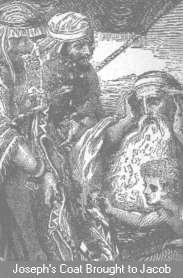 His heart
was sad indeed when they held up the coat which he knew so well,
all stained with blood and said,
His heart
was sad indeed when they held up the coat which he knew so well,
all stained with blood and said,
"This have we found: know now whether it be thy son's coat or no[t]."
You see they did not tell a lie, but they did act one which is just as bad. They dipped the coat in blood in order to deceive their father, and they let him be the one to say, "An evil beast hath devoured him."
Perhaps they thought that they were not sinning as much as if they had told the lie; but it is just as bad to act a lie as to tell one. Whatever we do that is meant to deceive, is just as false as if we had said what was not true. We need to remember that "Lying lips are abomination to the LORD: but they that deal truly are His delight." Proverbs 12:22.
Poor Jacob wept for his favorite son! His other sons and daughters tried to comfort him, but he said that he should never be happy again, but should grieve for Joseph till he died.
I wonder which you would rather have been- one of those brothers living with their father at home, with the sin on their hearts, or poor Joseph, sold as a slave amongst strangers, in Egypt, but never forgetting his God or his father? I hope you would have chosen the better part. It is hard to suffer trouble or pain, but God gives us strength to bear it. If we know that He loves us, and we love Him, then we can be happy in our hearts, whatever misfortunes may happen to our bodies.
One thing you may be sure of, which this picture of Joseph's early life shows very plainly. God permits everything that happens to us; and however bad it may seem, good will come of it, if we trust Him. "For it is God which worketh in you both to will and to do of His good pleasure." Philippians 2:13. "And we know that all things work together for good to them that love God, to them who are the called according to His purpose." Romans 8:28.
You will be able by-and-by to read how well Joseph got on in the strange land; how his dreams came true, and how, instead of saying, "I told you so," as we might have done, he was kind and forgiving to his brethren, when they were in his power. But he was a man when all that happened, and I only wanted to tell you about his early life now.
From The Children of the Bible. Chicago: Moody Press, [ca. 1900]. Edited.
>> More Children of the Bible