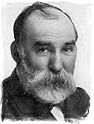
 The
subject of this sketch, D. W. Whittle, was born in Chicopee
Falls, Massachusetts, [United States], November 22, 1840. He
was named for the statesman whom his father greatly admired — Daniel
Webster. There were three other boys in the family and before
the outbreak of the war they had all joined the crowds of young
men who were leaving New England for the Western states and
had settled in Chicago. Mr. Whittle went into the Wells Fargo
Bank as cashier. He soon became interested in the Tabernacle
Sunday-school, the largest in the city, and in the course of
time became its superintendent.
The
subject of this sketch, D. W. Whittle, was born in Chicopee
Falls, Massachusetts, [United States], November 22, 1840. He
was named for the statesman whom his father greatly admired — Daniel
Webster. There were three other boys in the family and before
the outbreak of the war they had all joined the crowds of young
men who were leaving New England for the Western states and
had settled in Chicago. Mr. Whittle went into the Wells Fargo
Bank as cashier. He soon became interested in the Tabernacle
Sunday-school, the largest in the city, and in the course of
time became its superintendent.
It would be hard to say just when he experienced his first deep interest in religious things; born of a sweet and lovely Christian mother, he probably learned while still a child what God's love and grace in the heart may mean; but it was characteristic of him that he made a definite surrender at a definite time of his heart and life to God. At midnight one night when he was acting as night watchman in the bank, he says: "I went into the vault and in the dead silence of that quietest of places I gave my life to my Heavenly Father to use as He would." This act was also characteristic of him in the way it was done; quietly and alone he settled the question with God.
It was through his work in the Tabernacle Sunday-school that he met the woman who was to become his wife — Miss Abbie Hanson. She was also a New Englander by birth.
In 1861 he joined the 72d Illinois Infantry, enlisting in Company B as second lieutenant, but it was not until 1862 that the regiment was ordered South, and on the night before he left, August 22d, he and Miss Hanson were quietly married, only to part the next day for over a year.
Mr. Whittle served throughout the remainder of the war; he became Provost Marshal on Gen. O. O. Howard's staff; was with Sherman on his march to the sea and was wounded at Vicksburg. At the close of the war he was breveted "Major" and the title was never dissociated from his name.
It was when he was sent home wounded from Vicksburg, having been shot in his sword arm while leading a charge in place of his wounded captain, that he first met the man who was to so greatly influence his life — Mr. D. L. Moody. The following is the incident in Major Whittle's own words:
"A big meeting of some kind was being held in the Tabernacle, and with some help I was able to attend, although I was still weak from loss of blood and with my arm in a sling. I was called upon to speak and as I got slowly to my feet, feeling shy and embarrassed and weak, a strong voice called out— 'Give him three cheers, boys,' and they were given with a will, for every heart was bursting with patriotism in those days and the sight of a wounded soldier in a blue uniform stirred the blood. And how that kindly thought and that ringing cheer stirred my blood; how grateful I was to them — and the one who called out, 'Give him three cheers' was Dwight L. Moody, and that is what his friendship meant to me from that moment onward; stimulating, encouraging, appreciating in a twinkling the whole situation — the young soldier's embarrassment, his need of a friendly word of help; and he was even then the born leader — 'Give him three cheers,' and they cheered."
After the Civil War Major Whittle went into the Elgin Watch Company, and it was largely due to the influence of D. L. Moody who was already in evangelistic work that he gave up his business and became an evangelist. He always had with him a gospel singer and the first one associated with him was Mr. P. P. Bliss whose tragic death in the terrible Ashtabula disaster ended a most happy relationship.
Major Whittle wrote his first hymn in 1875 — "Christ is All." He gave it to Mr. Bliss to set to music and after his death the words were found among his papers and later set to music by Mr. James McGranahan who succeeded Mr. Bliss as Major Whittle's singing companion.
The greater number of his earlier hymns were set to music by Mr. McGranahan — "The Crowning Day," "Showers of Blessing," and "I Know Whom I Have Believed" were among these. They made several trips to Great Britain together as well as extensive trips in this country, and were very closely associated until about 1890 when Mr. McGranahan's health began to fail and Mr. Geo. O. Stebbins took his place. His exquisite music is known and loved by all those who know gospel hymns; one of his most beautiful songs was composed for Major Whittle's words "Beyond Our Sight."
Nearly all of the Major's words were written under the nom de plume "El Nathan"; to some of his later hymns he signed his own name, and the music to most of these was written by his daughter, Mary Whittle Moody; "Moment by Moment," "Be Still Sad Heart," "Blessed Hope," and "Still Waiting," are among these.
In speaking of his hymns he once said, "I hope that I will never write a hymn that does not contain a message — there are too many hymns that are just a meaningless jingle of words; to do good a hymn must be founded on God's word and carry the message of God's love." He also felt that the dignity of a gospel hymn deserved the best he could give, not only in material but in construction, and no rules of metre or rhythm were disregarded; he admired greatly the old church hymns and considered them a standard for all hymn writers. He composed about two hundred hymns. Mr. Moody said, "I think Major Whittle has written some of the best hymns of this century."
The last words he wrote have never been set to music; they were composed and dictated a few weeks before his death, during a night made sleepless by intense pain. The musical chiming of a little clock by his bedside made him think of the Old Testament high priest of whose approach one was warned by the [sound of the bells on the hem of his robe]. Below we give this beautiful poem.
"Swift, with melodious feet,
The midnight hours pass by;
As with each passing bell so sweet,
I think, 'My Lord draws nigh.'"I see Heaven's open door,
I hear God's gracious voice;
I see the blood-washed 'round the throne,
And with them I rejoice."It may be that these sounds
Are the golden bells so sweet
Which tell me of the near approach
Of the Heavenly High Priest's feet."Not every night is thus;
Some nights with pain are drear.
Then I join my moan with creation's groan
And the chimes I do not hear."But the Lord remains the same;
Faithful He must abide;
And on His word my soul I'll rest,
For He is by my side."Some midnight sleepless saints,
Made quick by pain to hear,
Shall join the glad and welcome cry,
'The Bridegroom draweth near.'"Then I shall see His face
His beauteous image bear;
I'll know His love and wondrous grace,
And in His glory share."So sing my soul in praise,
As bells chime o'er and o'er,
The coming of the Lord draws near,
When time shall be no more."
Major D. W. Whittle died March 4, 1901, at Northfield, Massachusetts.
"Blessed are the dead which die in the Lord."
From Biography of Gospel Song and Hymn Writers by J. H. Hall. New York: Fleming H. Revell Company, ©1914.
>> More D. W. Whittle