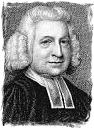
 I am sure that not one of us would have liked to have lived two hundred
years ago, when the brothers John and Charles Wesley were born.
I am sure that not one of us would have liked to have lived two hundred
years ago, when the brothers John and Charles Wesley were born.
England was in a terrible state at that time. In the towns it was not safe to go out after dark. It was before the days of the police, and the few old night watchmen were quite unable to deal with the highwaymen and ruffians who walked the streets, attacking and robbing, and sometimes murdering, those they came across. The curfew bell rang at sunset, and, after that, no decent person cared to be out.
There were no restrictions whatever as to the sale of intoxicating drinks, and in London every gin shop invited the passer-by to "come in and get drunk for a penny, or dead drunk for twopence." Of course drunkenness and immorality were rampant. The magistrates tried to keep order by inflicting very heavy penalties, but even these did not stop crime. Hanging was the punishment for even small offences, such as stealing 5s., robbing a hen roost, or writing a threatening letter. One morning twenty young thieves were hanged in Newgate. Even children were hanged. We read of one little lad of nine who was executed in this way for some small offence.
In the country villages there was hardly anyone who could read or write. There were no schools, except a few Grammar Schools founded by Edward VI and Queen Elizabeth.
The amusements of the people were cruel and debasing; bull-baiting, bear-baiting, and cock-shying, were some of the scenes they delighted in. On Shrove Tuesday cocks were tied to a stake and battered to death, as people nowadays play for coconuts. On holidays the public were allowed to go through Bethlehem Hospital in London, on paying 2d., and amuse themselves by teasing the lunatics.
In the Church, matters were in a very low state. The clergy frequently did not live in their parishes, and the services were neglected, and the people unvisited and uncared for.
It was a time of almost universal darkness and degradation.
It was then that John and Charles Wesley were born, and they "changed the face of all England." I quote from a most interesting account of the Wesley family, by Lady M'Dougall, in her delightful book, Songs of the Church. She says: "If ever a woman might rejoice that she has brought sons into the world, that woman was Susanna Wesley! Her sons, John and Charles, changed the face of England. They were the channel through which God's blessing flowed to the ends of the earth. Through them came revival to the Church of Christ. Hospitals, churches, the visitation of men and women in prison, missions to the heathen, the doing away of the slave trade, all these were the blessed results of their lives and work."
The father of John and Charles Wesley was the Rev. Samuel Wesley, Rector of Epworth, in Lincolnshire. There, on a very small income, these two godly parents brought up their large family of nineteen children, ten of whom (three sons and seven daughters) lived to grow up. John was born on June 17, 1703. Charles was born four years later, on December 18, 1707.
Susanna Wesley was a strict but loving mother. One of the windows in the Lady Chapel of Liverpool Cathedral is dedicated to her— "To Susanna Wesley and all devoted mothers." She had her own ideas about the bringing up of children. She never allowed them to cry or scream. They were taught to cry softly if they cried at all. She had a strange way of beginning their education. She never attempted to teach them the letters of the alphabet until they had reached their fifth birthday. Then Mrs. Wesley put all her usual household duties aside for the day. No one was allowed to come into the room where she and her little pupil were, from 9 till 12, and from 2 till 5. During these six hours everyone of her children, except two, successfully learned all the letters of the alphabet. After this she taught them to read the first chapter of Genesis. In a few days the difficulties of reading had vanished, and all future work was easy and pleasant. She was always most anxious for the spiritual welfare of her children. It was her habit to have one or more of them in her room each evening for a quiet talk and prayer. "On Thursday I talk with Jacky, and on Saturday with Charles." The children loved these quiet times with mother; and who can tell the results of that holy mother's teaching and prayers?
Soon after the family had gone to live at Epworth Rectory the house caught on fire. It was near midnight on February 9, 1709. The Rector, his wife, seven children, and the maid, all got safely out of the burning house; but one child — a lovely boy six years old — lay sleeping on, unconscious of his danger. His father tried to rescue him, but he was thrice driven back by the flames. Finding he could not help him, the father knelt in the hall, and in an agony of prayer commended his soul to God. Meanwhile the child awoke, and seeing the room full of light, and thinking the morning had come, called to the maid to get him up. But presently he saw streaks of fire running along the top of the room. He jumped out of bed and ran to the door, but all he saw was a roaring sea of flame. Climbing on a box by the window, he was seen from the garden below. "I will run and bring a ladder," said one, but there was not time. So one man (a light one) stood on another man's shoulders, and, the house being low, they managed to reach the child and lift him down. Another moment, and the burning roof fell in. All the world knows that the child thus marvelously saved from a fearful death was none other than John Wesley. He never forgot his deliverance, and under one of his portraits he had a picture drawn of a house in flames, with the motto, "Is not this a brand plucked out of the burning?"
It is interesting to read of the two brothers, John and Charles, going to Oxford at an early age, and — grieved at the careless lives of other young men — forming themselves, with a few more, into a little band, pledged to live pure lives, to attend Holy Communion frequently, to visit the poor, the sick, and the prisoners in the jail; to fast, and pray, and study God's Word. They were nicknamed "The Holy Club," and "Methodists," but they persevered in spite of much ridicule and persecution; and their influence spread. From Oxford, Charles returned home to visit his dying father, who laid his hand upon his son's head and said: "Be steady. The Christian faith will surely revive in this kingdom. You shall see it, though I shall not."
The same year John and Charles sailed for Georgia, a colony in North America, hoping to be missionaries to the Indians. A great storm arose and broke over the ship. The English were full of fear, but the Moravian Christians who were on board were calm and helpful to all about them. John Wesley was much impressed by their fearlessness and courage; and felt, "These people have something to which I, as yet, have not attained." On their return to England the brothers associated themselves a great deal with the Moravian Christians, from whom they learned the way of God more perfectly. They began at once to travel from place to place, preaching the necessity of repentance towards God, and of faith in Jesus Christ. Their plain speaking was not liked by some of the bishops and clergy, and by 1738 most of the pulpits within the English Church were closed to them. Then they preached in the fields, the streets, the jails, anywhere and everywhere, and the poorer people heard them gladly.
It is impossible, in this short talk to you today, to describe the wonderful labours, journeys, and life of John Wesley. For nearly fifty years he travelled, for the most part on horseback, all over England, north, south, east, and west. Eight thousand miles was his usual record, and he preached on an average one thousand times a year; that is about three times every day. He visited Cornwall thirty-one times; and every part of the kingdom is described in his journal — Northumberland, Yorkshire, Lancashire, Berkshire, and London. He also visited Ireland, Scotland, the Channel Isles, and Holland. Everywhere he preached to the multitudes who gathered round him "Christ crucified," and proved Him to be "the power of God unto salvation" to countless precious souls.
"Brutal, ignorant, corrupt," such is the description of the beginning of the eighteenth century, when John and Charles Wesley were born, but by the grace of God, when they died a glorious national reformation had been effected, and the whole Church of Christ had been revived and refreshed.
There is one fact with regard to these brothers that is of great interest. Both were ordained clergymen of the Church of England, and although, through the jealousy of the bishops and clergy, they were both soon excluded from their pulpits, yet John and Charles Wesley never left the Church of England. In 1790, only one year before the death of John Wesley, he wrote: "I declare once more that I live and die a member of the Church of England, and that men who regard my judgment and advice will never separate from it."
For several years Charles Wesley united with his brother John in his great work of preaching the Gospel, but after his marriage in 1749 he travelled less and resided at Bristol for some years. During the last part of his life his home was in Great Chesterfield Street, Marylebone, London; Charles Wesley died on March 29, 1788, at the age of eighty-one, and was buried in Marylebone Churchyard, for he too had said: "I have lived and I die in the communion of the Church of England, and I will be buried in the churchyard of my parish church." A few days before Charles Wesley died, he called his wife to his bedside and asked her to write at his dictation. These were the lines he gave her. For fifty years Jesus Christ had been the subject of his sermons and his songs, and he may be said to have died with a hymn to Christ upon his lips.
"In age and feebleness extreme,
Who shall a sinful worm redeem?
Jesus, my only hope Thou art
Strength of my failing flesh and heart,
O could I catch a smile from Thee,
And drop into eternity."
Three years after the death of his brother Charles, John passed to his reward, on March 2, 1791, in the eighty-eighth year of his age. In 1876 a monument was placed in Westminster Abbey to the memory of the Wesley's, with this inscription:
| JOHN WESLEY, M.A. BORN JUNE 17, 1703. DIED MARCH 2, 1791. CHARLES WESLEY, M.A. BORN DECEMBER 18, 1707. DIED MARCH 29, 1788. "I LOOK UPON ALL THE WORLD AS MY PARISH." "GOD BURIES HIS WORKMEN, BUT CARRIES ON HIS WORK." |
Charles Wesley will always be known as the sweet singer of Methodism. As a hymn writer he was unique. In his early years he wrote hymns daily, and he continued writing all his life through. He is said to have written no less than 6500 hymns, and nearly all rise to the highest degree of excellence. His hymns were the expressions of his heart. They show his strong belief in God and his earnest desire for the salvation of his fellow-men. No other verses equal them for simplicity, purity, and power. Charles Wesley wrote his hymns at all times, and in all places — on the road, on horseback, on a stage coach, in a boat. Some thought struck him, and, with his divine gift, he immortalized it in a hymn.
I will read the first lines of some of his hymns, and I think you will be surprised how familiar to you they are, and I know you love them all. He wrote that sweet child's hymn, the first prayer lisped by so many baby lips: "Gentle Jesus, meek and mild."
He wrote the Christmas hymn without which no Christmas Service would be complete: "Hark! the herald angels sing."
He gave us that solemn Advent hymn: "Lo, He comes with clouds descending."
And also the glad triumphant Easter one: "Christ the Lord is risen to-day! Hallelujah!"
And also one of our best Ascension hymns: "Rejoice, the Lord is King."
He also wrote: "O for a heart to praise my God"; "Soldiers of Christ, arise"; "O for a thousand tongues to sing;" "Lord Divine, all love excelling"; "O Love Divine how sweet Thou art."
"Come, O Thou Traveller Unknown," has been thought by some to be Charles Wesley's finest poem. Dr. Watts said he would willingly sacrifice all his writings if he might have composed that one hymn.
But the masterpiece of all Charles Wesley's hymns, the most priceless and precious one of all is, "Jesu, Lover of my Soul." The Rev. Henry Ward Beecher said of it: "I would rather have written this hymn than have the fame of all the kings that ever sat on the earth." Long as the English language remains will this tenderest and finest of all heart-hymns shed the fragrance of the name of Jesus far and wide, and help trembling souls to trust in Him. There is no hymn that is more often whispered into the dying ear. Millions of anxious souls have breathed this prayer when coming to the Saviour for the first time: and this hymn has been the means of enabling them to find in Christ their Refuge and their Friend. We can have no better wish than that this precious hymn of Charles Wesley's may be our song all through the land of our pilgrimage and our glorious Death-song at the last.
It is one of the four best loved hymns of the English people. When The Sunday at Home in 1887 invited votes on the most popular hymns, these were the four that headed the list, and in this order:
"Rock of Ages"; "Abide with Me"; "Jesu, Lover of my Soul "; and "Just as I am."
The circumstance of the writing of this hymn is interesting. The story goes that Charles Wesley was roused from his sleep one night by a terrible storm. Being unable to rest he got up, put on his dressing-gown, and, opening his casement window stood looking out upon the stormy scene. Suddenly a bird, exhausted by the wind, and hotly pursued by a hawk, flew through the open window right into Charles Wesley's breast for protection. Having saved the bird and placed it in security, he turned to his desk and wrote this immortal hymn, so realistic and descriptive of the fear and intense longing of the anxious soul to find safety and rest.
For our soul needs shelter; and the Only One Who can be a refuge for the soul is Jesus. He is our Hiding-place, our Haven of Rest. Listen to these words of the prophet Isaiah (32:2): "A man shall be as an hiding place from the wind, and a covert from the tempest . . . as the shadow of a great rock in a weary land."
We have no time to say anything about this wonderful hymn in detail, but I would have you notice one point about it. I have spoken of this in the case of other hymns, but the thought will bear repeating. Notice in it the personal and persistent use of me, and my, and I, in it:
"Let me to Thy bosom fly."
It is the prayer of the individual soul for succour, to the Saviour Himself; the call, as of a drowning man, that insists on being heard, and that can take no refusal; the cry of the terrified, and frail, and helpless bird, pursued by the cruel hawk, that is eager for its life.
Dear friends, are you "Safe in the arms of Jesus"? Have you "hidden" yourselves in Him?
Oh that these questions may go straight home to your hearts. If you are not in Christ, Oh, may God the Holy Spirit awaken you to see your danger. I will read the hymn to you, and then we will sing it together, on our knees, as our closing prayer.
Prayer Other refuge have I none; Wilt Thou not regard my call? Thou, O Christ, art all I want; Plenteous grace with Thee is found, |
The grace of our Lord Jesus Christ, and the love of God the Father, and the fellowship of the Holy Ghost, be with us all evermore. Amen.
From Bright Talks on Favourite Hymns... by J.M.K. London: The Religious Tract Society; Chicago: John C. Winston Co., [1916?].
>> More Charles Wesley