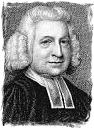
 Charles
Wesley, in the number of his compositions, greatly exceeds any other hymn-writer
in the English language. To the Wesleyans of every name throughout the
Christian world, he is the Father of Sacred Song. Thomas Jackson, his biographer,
says:
Charles
Wesley, in the number of his compositions, greatly exceeds any other hymn-writer
in the English language. To the Wesleyans of every name throughout the
Christian world, he is the Father of Sacred Song. Thomas Jackson, his biographer,
says:
"It is as a writer of devotional poetry, that Mr. Charles Wesley will be permanently remembered, and that his name will live in the annals of the Church. In the composition of hymns adapted to Christian worship, he certainly has no equal in the English language, and is perhaps superior to every other uninspired man that ever lived. It does not appear that any person besides himself, in any section of the universal Church, has either written so many hymns, or hymns of such surpassing excellence." "During the last fifty years [1841], few Collections of Hymns, designed for the use of evangelical congregations, whether belonging to the Established Church, or to the Dissenting bodies, have been made, without a considerable number of his compositions, which are admired in proportion as the people are spiritually-minded. His hymns are, therefore, extensively used in secret devotion, in family-worship, and in public religious assemblies. Every Sabbath-day, myriads of voices are lifted up, and utter, in the hallowed strains which he has supplied, the feelings of penitence, of faith, of grateful love, and joyous hope, with which the Holy Ghost, the Lord and Giver of life, has inspired them; and are thus in a course of training for the more perfect worship of heaven." "As long as the language in which they are written is understood, and enlightened piety is cherished, the hymns of this venerable man will be used as a handmaid to devotion."
Charles Wesley was born, December 18, [1707], in the humble rectory of Epworth, Lincolnshire. His father, Samuel Wesley, was the Rector of the parish. His mother, Susannah, was a daughter of the Rev. Samuel Annesley, LL.D., one of the most eminent divines among the Dissenters, and whose father was a brother of Arthur, the first Earl of Anglesea. Charles was the youngest, save one (Kezia), of nineteen children, of whom only ten survived their infancy, — seven daughters and three sons, Samuel, John, and Charles.
Such was the improvidence, in some respects, of the father, so numerous were his dependents, and so small his income, that their condition was exceedingly straitened, and their struggles with poverty seldom intermitted. They had scarcely any intercourse with Dissenters, and were rigidly attached to the Church of England. The father had become extensively known as a ready writer of poetry, and the mother was a strenuous Jacobite.
The utmost method and system prevailed in the household, and both he and his brother, John, were trained to strict habits of regularity. The first eight years of his life were passed at home under the tuition of his mother. John, five years his senior, had been sent (1714) to the Charterhouse School in London; and, two years later (1716), Charles was entered at Westminster School, of which his eldest brother, Samuel (then about twenty-five years old, and by whom he was at first supported there), was one of the teachers.
While the boy was thus laying the foundation of his later eminence, Garret Wesley, or Wellesley, a gentleman of large fortune residing at Daugan, Ireland, and who was M. P. for the county of Meath, having no issue, wrote to the Rev. Samuel Wesley, of Epworth, offering, if he had a son named Charles, to adopt him as his heir. As the boy was yet too young to answer for himself, his Irish patron, for several years, contributed to his support. At length, Mr. G. Wesley in person made the offer to the boy, who, on consideration, gratefully declined it. Where-upon Mr. Wesley bequeathed his estates with his name to his cousin, Richard Colley, who, in 1746, was raised to the peerage as Baron Mornington; his son, Garret, in 1760, was created Earl of Mornington, and was the father of Arthur, the renowned Duke of Wellington.
Charles, in 1721, was admitted as one of the King's scholars in St. Peter's College, and his expenses were borne by the foundation. His stay at Westminster was prolonged ten years, during which he was thoroughly fitted for the University. In 1726, being in his eighteenth year, he was elected to Christchurch College, Oxford, as his brother, John, had been five years before. The latter, having now graduated, had just obtained a fellowship in Lincoln College. "My first year at college," says Charles, "I lost in diversions; the next I set myself to study." "He pursued," says John, "his studies diligently, and led a regular, harmless life; but, if I spoke to him about religion, he would warmly answer,— 'What? would you have me to be a saint all at once?' and would hear no more." John left Oxford in August, 1727, and did not return until November, 1729. Early in his third year, Charles entered (1729) upon a methodical and serious mode of life. "Diligence," he says, "led me into serious thinking; I went to the weekly sacrament, and persuaded two or three young students to accompany me, and to observe the method of study prescribed by the statutes of the University. This gained me the harmless name of Methodist. In half a year [after this] my brother left his curacy at Epworth, and came to our assistance. We then proceeded regularly in our studies, and in doing what good we could to the bodies and souls of men."
Charles Wesley, it thus appears, was the first "Methodist." This was in the spring of 1729, to which date, therefore, the rise of "Methodism," as a great ecclesiastical movement, and a religious denomination, is to be traced. Charles began it, and John controlled and shaped it. Besides the two brothers Wesley, the little band included only William Morgan and Robert Kirkham. Charles took his degree of B.A. the same year, and presently began to take pupils — still prosecuting his studies for orders. His father died April 25, 1735, and the family home at Epworth was broken up. Charles had graduated, M.A., in 1732, and had continued his work as a tutor. When John, in 1735, concluded to go to Georgia as a missionary, Charles was induced to accompany him as secretary to Governor Oglethorpe. Though he had "exceedingly dreaded entering into holy orders," his scruples were now overcome, and he was ordained, in September, a deacon, by the Rev. Dr. John Potter, Bishop of Oxford, and, the Sunday following, priest, by the Rev. Dr. Edmund Gibson, Bishop of London.
Mr. Wesley embarked October 14, 1735, and sailed from Gravesend, on the 22d, but did not leave Cowes until December 10, arriving, after a stormy passage, February 5, 1736, in the Savannah River. He was stationed at Frederica. After a stay of but little more than six months, he sailed from Charleston, August 16th, in the London Galley, for London. The vessel was compelled, September 24, to put in at Boston, Massachusetts, where he remained a month, reaching England, after a most perilous voyage, December 3, 1736.
The year following he spent at London, Oxford, and Tiverton, visiting friends, and waiting on the Board of Trade. In the spring of 1738, he was prostrated by severe illness. Heretofore he had espoused the doctrines of the Rev. William Law and had rested in a legal righteousness. During his illness, under the instructions of the godly Moravian, Peter Böhler (who had selected him as his English teacher), and those of his simple-minded host at London, Mr. Bray, a brazier, he was brought to renounce his self-righteousness, and to obtain joy and peace in believing, on Whitsunday, May 21, 1738. To this date he looked back ever afterwards, as the era of his conversion.
Recovered from his illness, he became at the close of July, a curate for Mr. Stonehouse, the Vicar of St. Mary's, Islington, who subsequently became a Moravian. Meeting with much opposition from a portion of the parish and his diocesan, he continued there only eight or nine months. Following the example of Whitefield, he now resorted to the fields, and, June 24, 1739, he preached to thousands at Moorfields. From this time forth, he gave himself, with all his powers, to the work of an evangelist — going everywhere, all over the kingdom and the principality of Wales, extending his labors into Ireland with manifold success and no small tribulation. In all these respects he vied with his elder and more noted brother, John, whom, in some respects, he excelled as a popular preacher.
On one of his tours he came to Bristol, July 31, 1745, where and when he formed the acquaintance of Marmaduke Gwynne, Esq., of Garth, sixteen miles from Brecon, South Wales, — a gentleman of fortune, of high social position, and a magistrate, who had been converted to Methodism, under the preaching of Howell Harris. Some two years later, Mr. Wesley, on his way to Ireland, visited Mr. Gwynne at Garth, and became enamored with his daughter, Sarah. Repeated visits of the itinerant preacher to Garth, and of Mr. Gwynne with his daughter to London, followed, resulting in Wesley's marriage, April 8th, 1749, to Miss Gwynne, by his brother, John. The bride was twenty-three years old, and her husband in his forty-first year. The marriage was in all respects suitable, congenial, and of happy results. Eight children were born to them, of whom only the youngest three, Charles, Sarah, and Samuel, survived their infancy.
At the close of 1756, Mr. Wesley ceased to itinerate, confining his labors mostly to Bristol, the home of his family, and London, to which he made frequent official visits. Mrs. Gumley [Miss Degge], the aunt of Lady Robert Manners, in 1771, presented Mr. and Mrs. Charles Wesley with a twenty years' lease of her town residence, richly furnished; which henceforth became their home. It was in Chesterfield Street, Marylebone, near Regent's Park, and three miles from "The Foundry," John's London home. In 1777, the lease of the Foundry expired, and the commodious City Road Chapel was built. In these two renowned localities, or in some other of the city chapels, Mr. Wesley, when not disabled by disease ordinarily preached twice on the Sabbath, during the remainder of his life. Though of a frail body, and a life-long victim of disease, he was spared to a good old age, — dying at his house in Chesterfield Street, Saturday, March 29, 1788, in his eightieth year. His remains were interred in Marylebone churchyard.
Like his brother, John, and the great hymnist, Watts, he was considerably below the middle stature, and, though stouter than John, not at all corpulent. He was shortsighted, abrupt, and impetuous, without affectation. His simplicity, integrity, frankness, and amiability were marked. In the words inscribed on the memorial Tablet, City Road Chapel, "as a preacher, he was eminent for abilities, zeal, and usefulness, being learned without pride, and pious without ostentation."
Charles Wesley was the son of a poet, and the younger brother of a poet. Yet he seems not to have practiced the divine art himself until long after the completion of his University career, and his entrance on the work of the ministry. His first hymn, so far as known, is his "Hymn for Midnight," beginning with
"While midnight shades the earth o'erspread,"
and written early in 1737, in his twenty-seventh year. The experience of divine grace, to which he ever afterwards referred as the date of his conversion and true regeneration, May 21, 1738, stirred up within him the gift of holy song. From that day until the very day of his death, this gift was in lively and almost constant exercise. He seemed to think, to speak, to write, in poetic numbers, with a facility and propriety of which there are to be found but few examples.
A compilation of seventy psalms and hymns was published by the brothers, John and Charles, anonymously, in 1738. None of these were composed by Charles Wesley; 33 were from the pen of Dr. Watts, and 13 from Tate and Brady's Version. A volume of 223 pages and 139 hymns, entitled, "Hymns and Sacred Poems," followed in 1839, the most of it original; fifty of the pieces were written by Charles, among which were:
"Christ, the Lord, is risen to-day," etc.,
"Hail the day that sees him rise," etc.,
and
"Hark! the herald angels sing," etc.
The following year (1740), another volume of 209 pages and 96 hymns, with the same title, made its appearance, in which were first issued:
"Christ! whose glory fills the skies," etc.,
"Depth of mercy, can there be," etc.,"
"Jesus, Lover of my soul!" etc.,
and
"Oh! for a thousand tongues to sing," etc.
The last of these hymns was written "On the Anniversary of" his "Conversion"; having, in the original, eighteen stanzas. An enlarged edition of the "Collection" of 1739, containing 96 hymns, was issued in 1741, and one, still larger, in 1743. The latter edition included several of Charles Wesley's hymns, among them his Ascension hymn, beginning with
"Our Lord is risen from the dead."
In 1741, he published, also, his 38 "Hymns on God's Everlasting Love," of which an enlarged edition was issued in 1756, to which the Church is indebted for that admirable hymn,
"Sinners! turn, why will ye die?" etc.
A fourth volume of 155 "Hymns and Sacred Poems" was brought out in 1742, in which appeared:
"Oh! for a heart to praise my God," etc.,
"Oh! that my load of sin were gone," etc.,
and
"Vain, delusive world! adieu!" etc.
"An Elegy on the Death of Robert Jones, Esq.," in about 600 lines, by Charles Wesley, bears the date, 1742, and was included (1744) in the third volume of Mr. Wesley's "Collection of [213] Moral and Sacred Poems from the most Celebrated English Authors," in which also appeared several other pieces from the pen of Charles. Eighteen "Hymns for the Nativity" appeared in 1744, including
"Come, thou long-expected Jesus!" etc.,
and
"Light of those whose dreary dwelling," etc.
His eleven "Hymns for the Watchnight" followed; also, his eleven "Funeral Hymns," a tract of 24 pages. The same year (1744) Mr. Wesley published his 33 "Hymns for Times of Trouble and Persecution," one of which was
"Ye servants of God! your Master proclaim," etc.
The "Hymns on the Lord's Supper" (1745) were one hundred and sixty-six in number, among which are found
"Happy the souls to Jesus joined," etc.,
"Jesus! we thus obey," etc.,
and
"Lamb of God! whose bleeding love," etc.
His seven "Hymns for Ascension Day," and his sixteen "Hymns for our Lord's Resurrection," appeared in 1746. The same year he produced 32 "Hymns of Petition and Thanksgiving for the Promise of the Father"; seven "Hymns for the Public Thanksgiving Day, October 9, 1746"; "Gloria Patri, etc., or [24] Hymns to the Trinity"; and 26 "Graces before and after Meat"; — all of them small tracts. "Hymns for those that Seek, and those that Have, Redemption in the Blood of Jesus Christ," commonly called "Redemption Hymns," came forth in 1747, and contained
"Come, sinners! to the gospel feast," etc.,
and
"Love divine, all loves excelling!" etc.
These were followed, in 1749, by two volumes of 455 "Hymns and Sacred Poems," all of them the production of Charles Wesley, including
"Jesus! let thy pitying eye," etc.,
"Jesus, Lord! we look to thee," etc.,
"Lo! on a narrow neck of land," etc.,
"O Love divine! how sweet thou art," etc.,
"Soldiers of Christ! arise," etc.,
and
"Thou hidden Source of calm repose," etc.
Seven "Hymns for New Year's Day, 1750," came out at the close of the year 1749, and a succession of such Hymns appeared from year to year. In the issue "for New Year's Day, 1750," he first produced his splendid Jubilee Hymn,
"Blow ye the trumpet, blow," etc.,
written, undoubtedly, for the Jubilee year, 1750.
Nineteen "Hymns occasioned by the Earthquake, March 8, 1750," speedily followed that event. Then came "An Epistle to the Reverend Mr. John Wesley," and "An Epistle to the Reverend Mr. George Whitefield," both in 1755; followed by seventeen "Hymns for the Year 1756: Particularly for the Feast Day, February 6"; and, in 1758, by forty "Hymns of Intercession for all Mankind," one of which is
"Lo! he comes, with clouds descending," etc.
Another volume of 43 "Funeral Hymns" was issued in 1759, among which is found that charming production,
"Come, let us join our friends above," etc.;
followed, the same year, by eight "Hymns on the Expected Invasion," and fifteen "Hymns to be used on the Thanksgiving Day, November 29, 1759, and after it." In 1761, appeared his 134 "Hymns for those to whom Christ is All in all." Two volumes, containing 2,030 "Short Hymns on Select Passages of the Holy Scriptures," all of them by Charles Wesley, were published in 1762. From this overflowing treasury, is derived
"A charge to keep I have," etc.
The next year (1763), he published his 100 "Hymns for Children"; and, four years later (1767), came forth a volume of 182 " Hymns on the Trinity"; and another of 188 "Hymns for the Use of Families, and on Various Occasions." In the autumn of 1770, he produced "A Hymn on the Death of the Rev. George Whitefield," and an "Elegy on the late Reverend George Whitefield, M.A." The removal of this apostolic preacher seems to have suggested the publication of a small volume of forty hymns, in 1772, with the title, "Preparation for Death, in several Hymns."
Nothing further appeared from his pen until 1778, when he published his "Prayer for the Life of the Rev., John Wesley." His latest productions were: thirteen "Hymns written in the Time of the Tumults, June 1780"; 32 "Hymns for the Nation" (1782), a tract of 47 pages and ten "Prayers for Condemned Malefactors" (1785), in 12 pages.
About a score of his hymns appeared in prose productions issued by himself and brother, at various periods; and about 2,000 more were left in manuscript (unpublished at the time of his death), some few of which have, from time to time, adorned the pages of Methodist and other periodicals. His "Poetical Version of nearly the whole Book of the Psalms of David," edited by the Rev. Henry Fish, was published in 1854. He is said to have written 7,000 hymns, of which, those that he published "would occupy about 3,000 closely-printed pages." Hence Montgomery says of him: "He was probably the author of a greater number of compositions of this kind, with less variety of matter or manner, than any other man of genius that can be named." "It is probable," he adds, "that the severer taste of his brother, the Rev. John Wesley, greatly tempered the extravagance of Charles, pruned his luxuriance's, and restrained his impetuosity, in those hymns of his, which form a large proportion of the Methodist Collection."
In his "Collection of Hymns for the Use of the People called Methodists," John Wesley says, in the Preface, dated, "October 20, 1779": "In these Hymns there is no doggerel; no botches; nothing put in to patch up the rhyme; no feeble expletives. Here is nothing turgid or bombast, on the one hand, or low and creeping on the other. Here are no cant expressions; no words without meaning." "Here are, allow me to say, both the purity, the strength, and the elegance of the English language; and, at the same time the utmost simplicity and plainness, suited to every capacity." This applies, of course, to the hymns of Charles Wesley, that are included in the "Collection" of 1780.
The Rev. Dr. Adam Clarke, in a letter to his wife, dated October 11, 1819, says: "I write this, my dear Mary, in a situation that would make your soul freeze with horror; it is on the last projecting point of rock of the 'Land's End,' upwards of two hundred feet perpendicular above the sea, which is raging and roaring most tremendously, threatening destruction to myself and the narrow point of rock on which I am now sitting. On my right hand is the Bristol Channel, and before me the vast Atlantic Ocean, There is not one inch of land, from the place on which my feet rest, to the vast American continent! This is the place, though probably not so far advanced on the tremendous cliff, where Charles Wesley composed those fine lines,
Lo! on a narrow neck of land,
Twixt two unbounded seas I stand," etc.
The point of rock itself is about three feet broad at its termination, and the fearless adventurer will here place his foot, in order to be able to say that he has been on the uttermost inch of land in the British empire westward and on this spot the foot of your husband now rests, while he writes the following words in the same hymn:
"O God! my inmost soul convert,
And deeply on my thoughtful heart
Eternal things impress;
Give me to feel their solemn weight,
And tremble on the brink of fate,
And wake to righteousness."'
The hymns of Wesley were very often suggested by incidents in his personal history. Thus,
"See how great a flame aspires," etc.,
was written "after preaching to the Newcastle colliers," in praise to God for the wonderful success of his work among these hardy sons of toil. "The imagery of the first verse," says Stevenson, "was suggested by the furnace-blasts and burning pit-heaps, which even now are scattered thickly over the district for some miles around Newcastle-on-Tyne, and which illuminate the whole neighborhood."
The latest effort of his muse was made on his dying bed. "Having been silent and quiet for some time," says Jackson, "he called Mrs. Wesley to him, and requested her to write the following lines at his dictation:
'In age and feebleness extreme,
Who shall a sinful world redeem?
Jesus! my only hope thou art,
Strength of my failing flesh and heart;
Oh! could I catch a smile from thee,
And drop into eternity.'"
From The Poets of the Church: A Series of Biographical Sketches of Hymn-Writers... New York: Anson D.F. Randolph & Company, ©1884.
>> More Charles Wesley