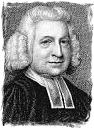
 Charles
Wesley, (1707-1788), divine and hymn-writer, eighteenth child, youngest and
third surviving son of Samuel Wesley (1662-1735), was born at Epworth Rectory,
Lincolnshire, [England], on 18 December 1707. A seven months' child, he was
reared with difficulty.
Charles
Wesley, (1707-1788), divine and hymn-writer, eighteenth child, youngest and
third surviving son of Samuel Wesley (1662-1735), was born at Epworth Rectory,
Lincolnshire, [England], on 18 December 1707. A seven months' child, he was
reared with difficulty.
In 1716 he entered Westminster school, under the care and at the cost of his brother Samuel, till he was elected king's scholar in 1721. Among his school-fellows was William Murray (afterwards first Earl of Mansfield). Wesley, who was captain of the school (1725), was Murray's protector from ill-usage on the score of his Jacobite origin. He showed dramatic ability and quickness in acquirement, and bore a high character, though his lively disposition got him into scrapes. John Wesley affirmed (in an unfinished sketch of his brother's life, written 1790, and meant for publication) that at this period Garrett Wesley or Wellesley (died 23 September 1728) of Dangan, Co. Meath, wrote to his father proposing to provide for Charles's education and adopt him as his heir. Money was accordingly paid for his schooling for some years, but Charles was unwilling to go to Ireland ...
In 1726 Charles entered Christ Church, Oxford, as a Westminster student, matriculating on 13 June. For the first year he was indisposed to pass from the tutelage of his brother Samuel to that of John, then fellow of Lincoln. 'He would warmly answer, "What, would you have me to be a saint all at once?" and would hear no more.' His application to study was coincident with John's removal from Oxford (1727). Study brought 'serious thinking' in its train. He began to attend the weekly sacrament. In January 1729 he began a diary, kept it regularly for twenty years, then intermittently till 1756; the discontinuance was ascribed by his brother to 'wrong humility.' By the spring of 1729 (six months before John's return to Oxford, in November) he had 'persuaded two or three young scholars to accompany me, and to observe the method of study prescribed by the statutes of the university. This gained me the harmless nickname of 'methodist' (letter to Thomas Bradbury Chandler, 28 April 1785). The bestowal of the nickname is assigned by John Wesley to 'a young gentleman of Christ Church.' Its meaning has been much discussed. Watson (Life of John Wesley, 1839, p. 12) has cited its use as a religious designation ('plain, pack-staff methodists') as early as 1639. Daniel Williams and his followers were described (1693) as 'new methodists in the great point of justification.' John Wesley thought there was an allusion to the 'medici methodici' (as opposed to empirics). But there is no reason for questioning the testimony of Charles. He was called a 'methodist' for advocating a system of study. The religious reference was not the primary one; the word meant little more than 'prig' (see PHILLIPS, New World of Words, 6th edit. 1706, ed. Kersey, where 'methodist' is glossed 'one that treats of a method, or affects to be methodical').
In 1730 Charles graduated B.A. and began to take pupils. He was an excellent scholar, an especially good Latinist. His plan of associated study and religious exercises assumed new proportions under his brother's [John Wesley] lead. He threw himself into the movement with conspicuous zeal. It was to Charles Wesley that George Whitefield first turned (1732) when he felt drawn to the methodist movement. Yet he looked forward to no career beyond that of a tutor, and 'exceedingly dreaded entering into holy orders.' This dread was partly due to introspective views of religion derived from mystical writers, whose influence he never entirely shook off. He graduated M.A. on 12 March 1732-3. His copy of Fell's 'Life' of Hammond, with the autograph date 1734, and the motto 'Longe Sequar,' has been preserved (WAKELEY, Anecdotes, 1870, p. 379). In face of the opposition of his brother Samuel, who thought him unfit for the work, he joined John in the mission to Georgia, going as secretary to James Edward Oglethorpe, the governor. On the advice of John Burton (1696-1771), he was ordained deacon by John Potter (1674?-1747), then bishop of Oxford, and priest by Edmund Gibson, bishop of London, in October 1735, just before starting.
Leaving his brother at Savannah, Wesley reached (9 March 1736) Frederica, St. Simon's Island, Oglethorpe's residence. From this date his 'Journal' becomes available. He was to minister to the colonists and convert the Indians. His stay was not long; his strictness made him enemies in a lax community; by his refusal to recognize lay-baptism, he prejudiced his efforts for moral reform; he did not get on with Oglethorpe, and even welcomed 'a friendly fever.' On 13 May he left for secretarial duties at Savannah. He was anxious to resign his post. Taking dispatches from Oglethorpe to the Georgia trustees and the board of trade, he left Savannah on 26 July in very unfit health for a stormy voyage in an unseaworthy vessel. After delays at Charlestown and Boston, he landed at Deal on 3 December 1736. He did not resign the secretaryship till 3 April 1738, when the state of his health and his brother's advice (that he should remain at Oxford) led him to give up the idea of the Georgia mission. He had previously made vain efforts to induce the ecclesiastical authorities to recognize Moravian co-operation. His intercourse with Zinzendorf began on 19 January 1737. He was able to aid Zinzendorf, through his acquaintance with Bishop Potter.
By Potter's advice, be joined (26 August 1737) the Oxford deputation with an address to the throne at Hampton Court. Shortly after, he consulted William Law on religious matters, without gaining satisfaction. In February 1738 he came under the influence of Peter Böhler, who learned English from him, during a visit at Oxford. Wesley does not seem to have learned German. The perusal of Luther on Galatians, which he met with in May, gave clearness to his religious ideas. Whit-Sunday (21 May 1738) he fixes as the date of his conversion; a similar experience reached his brother John on the following Wednesday. Full of new zeal, he resumed preaching on 2 July. On 24 July he became unlicensed curate to George Stonehouse of St. Mary's, Islington; he read daily prayers, preached constantly in London churches, visited Newgate, and held private meetings for exposition and devotion. On 20 October he first preached without notes. In interviews with Gibson, bishop of London, he defended himself against charges of irregularity; he annoyed Gibson by giving him formal notice (14 November) of his intention to rebaptise a woman who had received baptism from a dissenter. The Islington churchwardens, disliking his ministrations, questioned the legality of his position, and kept him forcibly from the pulpit. Stonehouse was obliged to end the engagement in May 1739. His frequent preaching for Henry Piers, vicar of Bexley, Kent, brought a summons to Lambeth and a censure (19 June) from Archbishop Potter. On 1 July he preached on justification before the University of' Oxford. A walk through a field, to preach on Kennington Common, brought an action for trespass, which cost him (29 July) nearly 20£.
He entered upon the itinerant ministry on 16 August 1739, riding to the west of England. Taking his brother's place at Bristol, he made this his headquarters, entering on his ministry at Weavers' Hall on 31 August. For the next seventeen years he pursued his evangelistic journeys, finding hearers up and down England and Wales, from the 'keelmen' of Newcastle-on-Tyne to the 'tinners' of Cornwall. His good sense appears in his remarks (1743) on the convulsive paroxysms which began in 1739; some were counterfeit, others could be controlled, the remainder he could not accept as divine signs. On two occasions be visited Ireland (9 September 1747 to 20 March 1748, and 13 August to 8 October 1748). He had to endure much rough usage, yet at Kinsale, he reports (8 September 1748), the 'presbyterians say I am a presbyterian; the churchgoers that I am a minister of theirs; and the catholics are sure I am a good catholic in my heart.' Except that he did not again cross to Ireland, his marriage (1749) made little change in his plans; his wife accompanied his journeys, riding behind him on a pillion. Her fine voice led the singing at his religious meetings. By a strong measure he frustrated his brother's unwise matrimonial project of the same year. Though he had encouraged lay preaching, and had himself (in July 1740, in the schoolroom at Kingswood, near Bristol, JACKSON, ii. 473) been the first to administer the communion to his followers, repelled from this rite at the Temple church, Bristol, he took alarm when the views of some lay preachers pointed to the severance of methodism from the church of England. The celebration of the eucharist by Charles Perronet, who had been his companion to Ireland, he denounced as a 'vile example' (Letter in TYERMAN, John Wesley, 1870, ii. 202). In the critical year 1755 he left abruptly the conference at Leeds, which, after three days' discussion of the question of separation from the church, decided (9 May) that, 'whether it was lawful or not, it was no ways expedient.' He attended the conference of 1756 (in August, at Bristol), but was not satisfied. Shortly afterwards he went on a mission to the north of England 'to confirm the methodists in the church.' After his return to Bristol on 6 November 1756 he took no further part in the itinerant ministry. It is said that he refused a benefice worth 500£ a year, and declined a fortune proffered him by a lady who had quarrelled with her relatives (MOORE, 1825, ii. 372).
When methodist preachers began to take the benefit of the Toleration Act, he would have had them leave methodism for dissent. As an alternative, he offered to use all his interest to obtain their admission to Anglican orders. He writes (27 March 1760) to John Nelson: 'Rather than see thee a dissenting minister, I wish to see thee smiling in thy coffin' (JACKSON, ii. 185). His health suffered; he was compelled in 1761 to retire from active duties to Bath. From 1762 the Wesley's diverged in their treatment of a point of doctrine. Both had preached 'perfection;' Charles now, in view of current fanatical claims, insisted on a gradual process, reaching a higher goal. No difference of opinion or of policy injured their mutual confidence or disturbed the frankness of their intercourse. Charles was always the champion of his brother's reputation, even when most suspicious of the aims of his followers.
In 1771 He removed with his family to London, occupying a leasehold house, 1 Chesterfield Street, Marylebone, which was given to him, furnished, for the remainder of the lease (over twenty years) by Mrs. Gumley. He preached in turn at the Foundery; after the opening (1 Nov. 1778) of City Road Chapel, he preached there twice every Sunday during church hours (contrary to his brother's custom), and reluctantly submitted to share this duty with others. His preaching powers were waning; occasionally, as of old, he could pour forth 'a torrent of impetuous and commanding eloquence,' but his usual delivery was subdued and slow, with frequent pauses (JACKSON, Life and Times, 1873, p. 314), and his sermons were sometimes interrupted by intervals of singing (JACKSON, ii. 433). He was assiduous in visiting condemned malefactors, including the notorious William Dodd. To his brother's ordinations, which began in 1784, be was vehemently opposed; there seems no ground for Jackson's opinion that 'he became less hostile' to the measures, though resolved to have no breach with his brother, but to leave in his hands the conduct of methodism. In 1786 he first met William Wilberforce at the house of Hannah More.
At the beginning of 1788 his strength entirely failed; by March he was unable to write. On his brother's advice he was attended by John Whitehead (1740?-1804). He died on 29 March 1788. Owing to the misdirection of a letter, the news did not reach his brother till 4 April, too late for attendance at the funeral. On 5 April he was buried, at his own express desire, in the churchyard of St. Marylebone, immediately behind the old church; the pall was borne by eight Anglican divine; the expenses of his funeral (13£ 16s. 6d.) were met by a private subscription (TYERMAN, John Wesley, iii. 225); a small obelisk marks his grave. In City Road Chapel (where he had declined burial, the ground being unconsecrated) is a marble tablet to his memory. His profile, with that of his brother, is on the tablet placed (1871) in Westminster Abbey on the initiative of Dean Stanley. His portrait (1771) by John Russell, in the Wesleyan Centenary Hall, has often been engraved. Another portrait (1784) is in Whitehead's 'Life,' engraved by J. Fittler, and again in Moore's 'Life' (1824), engraved by W. T. Fry.
He was of low stature but not slight, near-sighted, and abrupt and even odd in manner. Always absent-minded, he could read and compose at his ease, oblivious of his company. Like his brother, he wrote Byrom's shorthand. His manuscripts were always models of neatness. In other respects his more methodical habits in later life were probably due to the influence of his wife (WATSON, J. Wesley, p. 410).
In old age 'he rode every day (clothed for winter even in summer) a little horse, grey with age' (MOORE, 1825, ii. 369). Tender and sensitive, his family affections were strong; his warmth of temper never led him into angry heats; to his brother he looked up with a loving reverence, undisturbed by their differences. In defensive repartee he was as ready, though not so pungent, as his brother. He had no faculty for government. Though he had plenty of courage, he was swayed by conflicting feelings, with the result that his half-measures conveyed an impression of timidity.
He married (8 April 1749) Sarah (born 12 Oct. 1726; died 28 Dec. 1822), third daughter of Marmaduke Gwynne (died 1769) of Garth, Breconshire; the marriage, celebrated by his brother John, was a most happy one. His widow had an annuity of 100£ from John Wesley, on whose death it was commuted, at her request, for a capital sum. After the expenditure of this she was relieved from straits by an annuity provided by William Wilberforce in conjunction with two friends. The methodist body followed with an annuity, which was continued to the surviving children. Of Wesley's eight children, five died in infancy. Charles (1757-1834) and Samuel (1766-1837) are separately noticed. The surviving daughter, Sarah, a woman of great culture, who mixed in the best literary society of her day, died at Bristol, unmarried, on 19 Sept. 1828, aged 68.
John Wesley writes of his brother: 'His least praise was his talent for poetry; although Dr. Watts did not scruple to say that single poem, "Wrestling Jacob," was worth all the verses he himself had written' (Minutes of Conference, 1788). Yet among the many services rendered by Charles Wesley to the cause of religion, his work as a hymn-writer stands pre-eminent. Exercising an hereditary gift, he had early written verses both in Latin and English, but the opening of the vein of his spiritual genius was a consequence of the inward crisis of Whit-Sunday 1738. Two days later his hymn upon his conversion was written. He doubted at first whether he had done right in even showing it to a friend. The first collection of hymns issued by John Wesley (1737) contains nothing by Charles. From 1739 to 1746 the brothers issued eight collections in their joint names. Some difficulty has been felt in assigning to each his respective compositions. To John are usually given all translations from German originals, as it is doubtful whether Charles could read that language; and if this is not conclusive (as the originals might have been interpreted for him), a strong argument may be found in his constant inability to write on subjects proposed to him, and not spontaneously suggested by his own mind. All original hymns, not expressly claimed by John in his journals and other writings, are usually given to Charles. But it must be remembered that these were edited by John, who adapted his brother's pieces for public use, both by omission and by combination. Charles Wesley's untouched work is to be seen in publications issued in his sole name, and in posthumous prints from his manuscript. He is said to have written 6,500 hymns (Overton in JULIAN'S Hymnology, 1892, p. 1258); about five hundred are in constant use. Dealing with every topic from the point of view of spiritual experience, they rarely subside into the meditative mood. Rich in melody, they invite to singing, and in the best of them there is a lyrical swing and an undertone of mystical fervor which both vitalize and mellow the substratum of doctrine. Much attention has been directed to his sacramental hymns (1745), in which the real presence is expressly taught. Other points are noted in Warington's 'Echoes of the Prayer-book in Wesley's Hymns' [1876].
The following collections appear to contain exclusively his own hymns:
1. 'Hymns on God's Everlasting Love,' 2 parts, 1741.
2. 'For the Nativity,' 1744.
3. 'For the Watchnight,' 1744.
4. 'Funeral Hymns,' 1744, enlarged, 1759.
5. 'For Times of Trouble,' 1745, revised edition, same year; additional,
1746.
6. 'On the Lord's Supper,' 1745.
7. 'Gloria Patri ... to the Trinity,' 1746.
8. 'On the great Festivals,' 1746.
9. 'For Ascension Day,' 1746.
10. 'For Our Lord's Resurrection,' 1746.
11. 'Graces before and after Meat,' 1746.
12. 'For the Public Thanksgiving' 1746.
13. 'For those that seek and those that have Redemption,' 1747.
14. 'On his Marriage,' 1749.
15. 'On Occasion of his being prosecuted in Ireland,' 1749.
16. 'Hymns and Sacred Poems,' Bristol, 1749, 2 vols.
17. 'For New Year's Day,' 1750.
18. 'For the Year 1756,' 1756.
19. 'Of Intercession,' 1758.
20. 'For the Use of Methodist Preachers,' 1758.
21. 'On the expected Invasion,' 1759.
22. 'On the Thanksgiving Day,' 1759.
23. 'For those to whom Christ is all,' 1761.
24. 'Short Hymns on ... Passages of ... Scripture,' 1762, 2 vols.
25. 'For Children,' 1763.
26. 'For the Use of Families,' 1767.
27. 'On the Trinity,' 1767.
28. 'Preparation for Death,' 1772.
29. 'In the Time of the Tumults,' 1780.
30. 'For the Nation,' 1782.
31. 'For Condemned Malefactors,' 1785.
A few hymns were first printed separately. Other poetical publications were an 'Elegy,' Bristol, 1742, on Robert Jones of Fonmon Castle; an 'Epistle,' 1755, to John Wesley; and an 'Epistle,' 1771, to George Whitefield (written 1755). His poetical works, including many not before published, are contained in the 'Poetical Works of John and Charles Wesley,' 1868-72, 13 vols., edited by George Osborn. A large number of his hymns, still unpublished, were discovered in the Wesleyan archives in 1895. In prose Wesley published a few sermons, and 'A Short Account of the Death of Mrs. H. Richardson' [1741]; 5th ed. Newcastle-on-Tyne, 1743. His university sermon on 4 April 1742 ran through sixteen editions in seven years, and was translated into Welsh. A volume of 'Sermons,' 1816, issued by his widow, contains twelve (mostly early) sermons (with an additional one by John Wesley) and a 'Memoir,' probably by his daughter Sarah.
[Biographies of Charles Wesley are included in most of the biographies of John Wesley; of special value are those by Whitehead, 1793 (also issued separately), and by Moore, 1824-5. An independent Life, with much use of unpublished correspondence, was produced, 1841, 2 vols. (abridged as 'Memoirs,' 1848, 1 vol.), by Thomas Jackson, who also edited Charles Wesley's Journal (1736-56), 1849, 2 vols. with selections from his correspondence. Additional particulars are in the Life by John Telford [1886]. See also Forshall's Westminster School, 1884; Foster's Alumni Oxon. 1715-1886, iv. 1526 ; Julian's Dict. of Hymnology, 1892, which has been followed for the bibliography (articles 'Methodist Hymnody' and 'Wesley Family'); Green's Bibliography of the Works of John and Charles Wesley, 1896; authorities cited above, and references to art.]
From Dictionary of National Biography. London: Smith, Elder, & Co., 1899.
>> More Charles Wesley