The [in Bunhill Fields Cemetery, London, England] will already have attracted the visitor's attention. It must be pointed out that across the path on the east side is the head-stone of Samuel Say, who was a fellow student of Watts, and who also became a preacher. Almost in a line with Say's headstone there is quite a cluster of tombs of noted people, amongst them being the learned John Eames and Mr. William Cruden—not Alexander of Concordance fame.
HEAD-STONE INSCRIPTION
| ISAAC WATTS, D.D., Pastor of a Church of Christ
in London; successor of the Rev. Mr. Joseph Caryl,
Dr. John Owen, Mr. David Clarkson, and Dr. Isaac
Chauncey: after 50 years of feeble labours in
the Gospel, interrupted by 4 years of tiresome
sickness, was at last dismissed to rest, Nov.
25, A.D. 1748, age 75. 2 Cor. 5,8. "Absent
from the body, present with the Lord." Col.
3,4, "When Christ who is our life shall
appear, I shall also appear with Him in Glory." "In Uno Jesus Omnia." |
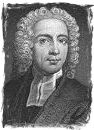 Who
is better known than Isaac Watts? His hymns are sung in every professed
Christian body, although it is to be feared many know not the meaning
of the words they sing. When advanced in years he is described as
a "little feeble old man, shy in manner yet rich in speech.
... Wherever he goes he is regarded with veneration and love, for
his mind is stored with knowledge and his heart is alive with tender
sympathies."
Who
is better known than Isaac Watts? His hymns are sung in every professed
Christian body, although it is to be feared many know not the meaning
of the words they sing. When advanced in years he is described as
a "little feeble old man, shy in manner yet rich in speech.
... Wherever he goes he is regarded with veneration and love, for
his mind is stored with knowledge and his heart is alive with tender
sympathies."
The date of his birth was July 17th, 1674, and thus he came into the world in the stormiest days of Nonconformity. His father kept a boarding-school at Southampton, but being a stedfast Dissenter and a deacon at a chapel in the seaport town he was often called upon to suffer. On more than one occasion he was placed in a prison-cell whilst his property was sequestrated. The sorrowing mother of Isaac often took her little child and sat on a cold stone by the prison walls, and one cannot wonder that the principles of Dissent soon became very dear to the future poet. His father was never a time-server, but stood firmly amidst sore tribulations, counting it a joy to suffer for righteousness' sake, and scorning the respectability and social standing which a connection with the Established Church would have brought him.
It is recorded that almost as soon as Isaac could lisp a word his oft-repeated request was for "A book! a book! Buy a book!" His early years must be passed over with a few words. The school which he attended was one where he was well instructed, and had he been willing to forsake the conventicle he would have been sent to one of the Universities, as several wealthy people were anxious to find the necessary money for this purpose.
While quite a child Watts showed much skill in writing rhymes, and when this gift was developed and sanctified he penned the hymns which are so valued by the Church of God. To complete his education he was placed under the care of Thomas Rowe, who in addition to his duties as pastor of the Independent Church in Girdlers Hall, London, kept an academy in which he trained many who became famous in their day and generation. On the return of Watts to his home his abilities were put to good use. It appears that the hymns sung at his father's chapel, whilst sound in doctrine, were very poor from a poetical point of view, and often gave offence to at least one member of the congregation. The young man was at last constrained to mention the matter to his preacher-father, who very sensibly invited him to try his own hand and endeavour to produce more pleasing lyrics. Isaac was not slow in acting upon this suggestion, and before long there were enough hymns to fill a volume.
The country around Southampton is well watered, and river and stream evidently inspired the poet, as is plainly seen in many of his hymns. It is quite easy to imagine the sweet singer roaming along the beautiful banks of the Itchen, which rises some twenty miles north of the famous port. At the old-fashioned village of Bishops Sutton the clear water gushes forth from the chalky earth. The brook soon increases in size owing to the many springs, and taking the form of a small river runs into a lake or large pond at Alresford. When it has forced its way through this it passes on towards Winchester and becomes full of trout and other fish. After leaving the ancient capital of England it grows larger still, and finally empties itself into Southampton Water. Think on this river, and then read:
There is a land of pure delight,
Where saints immortal reign;
Infinite day excludes the night,
And pleasures banish pain.There everlasting spring abides,
And never-withering flowers;
Death, like a narrow sea, divides
This heavenly land from ours.Sweet fields beyond the swelling flood
Stand dress'd in living green:
So to the Jews old Canaan stood,
While Jordan roll'd between.But timorous mortals start and shrink
To cross this narrow sea;
And linger shivering on the brink,
And fear to launch away.Oh! could we make our doubts remove,
Those gloomy doubts that rise,
And see the Canaan that we love
With unbeclouded eyes!Could we but climb where Moses stood,
And view the landscape o'er,
Not Jordan's stream, nor death's cold flood,
Should fright us from the shore."
[Note: When the author asked his friend, the late Mr. John Newton, who was so long the beloved minister of Hanover Chapel, Tunbridge, Wells, which hymn of Dr. Watts' he loved the most, the reply was, "There is a land of pure delight."]
When about 22 years of age he [Watts] was invited by Sir John Hartopp to take up his residence at Stoke Newington, in the north of London, and act as tutor to his son. To readers of Puritan literature, especially of the works of John Owen, the name of Hartopp will be familiar. This godly man, with his family, befriended the Lord's people as much as possible, and often incurred considerable risk and expense. Whilst with Sir John, Watts preached his first sermon, and he was soon chosen assistant-minister to Dr. Chauncey. The Church was Independent, and met for worship in Mark Lane; after some time had elapsed Watts was appointed pastor. This position he held for the long period of 46 years, although he was not able to preach regularly owing to grievous bodily affliction. His nervous system was in a shattered condition, and this entailed insomnia. For nights he was utterly unable to sleep, and the most powerful drugs had no more good effect upon him than water, whilst, on the contrary, they helped to wreck and shatter his poor body. Humanly speaking, he could not have lived but for the unremitting and loving care bestowed upon him by Lady Abney and her daughter.
In his own words, as spoken to the Countess of Huntingdon, he expressed his feelings: "I came to the house of my good friend, Sir Thomas Abney, intending to spend a single week beneath his roof, and I have extended my visit to thirty years." "I consider your visit, my dear Sir, as the shortest my family ever received," replied Lady Abney in the courtly style used at that period. Sir Thomas died eight years after Watts became a resident under his roof, but Lady Abney survived the poet for some twelve months. In the Abney Park Cemetery there is a monument to Watts, but his dust is resting in Bunhill Fields.
In addition to the Abneys and Hartopps, the poet was favoured to have many choice friends. Lady Huntingdon loved him for the truth's sake, and amongst others, introduced him to the godly Col. Gardiner, who was afterwards slain at Prestonpans. The Colonel was a tall, stately man, making a noble figure in his regimentals, whilst at this time Watts was feeble and palsied, and sadly wasted.
Col. Gardiner's regard for Dr. Watts may be easily gauged from a letter which he wrote to Doddridge:
"I have long been in pain lest that excellent person, Dr. Watts, should be called to heaven before I had an opportunity of letting him know how much his works have been blessed to me, and, of course, of returning to him my hearty thanks. I must beg the favour of you to let him know that I intended to have waited on him in the beginning of last May when I was in London, but was informed, and that to my great sorrow, that he was extremely ill, and therefore I did not think a visit would be seasonable. I am well acquainted with his works, especially with the psalms, hymns and lyrics. How often by singing some of these to myself, on horseback and elsewhere, has the wild spirit been made to flee away,
"'Where'er my heart in tune was found,
Like David's harp of solemn sound.'
I desire to bless God for the good news of his recovery; and entreat you to tell him that although I cannot keep pace with him here in celebrating the high praises of our glorious Redeemer, which is the great grief of my heart, yet I am persuaded when I join the glorious company above, where there will be no drawbacks, that none will out-sing me there, because I shall not find any that has been more indebted to the wonderful riches of divine grace than I:—
"'Give me a place at Thy saints' feet,
On some fallen angel's vacant seat;
I'll strive to sing as loud as they
Who sit above in brighter day.'"
In his young days Watts was frequently in the company of a homely old man who gave little or no sign that he had been the most exalted person in the land, or that he had been a fugitive from his mother country and often in deep poverty for the long period of twenty years. This was none other than Richard Cromwell, who succeeded his famous father, Oliver, as Protector, but who, after seven months and twenty-eight days, retired from his honourable but dangerous position, and hastened away to France. Here he lived at various places, and under assumed names—it being his custom to change his name each time he moved his home—for twenty years, during which time his much loved wife and daughter Dorothy died. He had lived with the former only a few years, whilst the latter was the only Cromwell "born in the purple," but through this long period poor Richard dared not place himself within the reach of Charles II. He, however, ventured to return to England in 1680, and died after much family trouble and strife in 1712, at the age of 85. To the end of his days he enjoyed remarkable health, and at the age of eighty could gallop a horse several miles with keen enjoyment. He was tall and fair-haired, making quite a striking contrast to his diminutive friend, Isaac Watts. The latter testified that Richard Cromwell was a man of much ability, and he missed no opportunity of being in the company of the old soldier and ex-Protector. It is probable that the influence of Cromwell may be seen in the numerous and various descriptions which he gives in his hymns of battles, fighting, armies, marching, and conflicts.
Watts died trusting alone in the merits, righteousness and blood of Christ, of which he had so often written. One sentence from his death-bed was: "I remember an aged minister say that the most learned and knowing Christians when they come to die have only the same plain promises of the Gospel for their support as the common and unlearned of the people of God; and so I find it. They are the plain promises which do not require labour or pains to understand them; for I can do nothing now but look into my Bible for some promise to support me, and live upon that."
His earthly course ended peacefully on Nov. 25th, 1748, aged 75 years, and his ransomed spirit went to the land of which he had written so many times, even "To mansions in the skies." When his terrible sleeplessness is remembered we see a special and pathetic meaning in this verse:
"There shall I bathe my weary soul
In seas of heavenly rest,
And not a wave of trouble roll
Across my peaceful breast."
Perhaps this is hardly the place to go fully into those doctrines held by him, which caused so many debates and disputes. It is, however, important to state that some things believed and preached by the "seraphic doctor" are entirely opposed to the Scriptures, and invariably have been looked upon with abhorrence by all who insist on dividing the true from the false and the precious from the vile. He sought to re-adjust the doctrine of the Trinity, and fell into error with respect to the Person and work of the Lord Jesus Christ and the personality and operations of the Holy Spirit, expressing notions which the Scriptures denounce and the experiences of God's people contradict. The author, however, having read carefully most of the available writings upon the subject, feels compelled to record his conviction that, whilst Watts sadly erred upon some fundamental doctrines, the claim of Belsham and other Socinian ministers, that he died believing in their pernicious teachings, cannot be maintained.
From Bunhill Fields: written in honour and to the memory of the many saints of God whose bodies rest in this old London cemetery by Alfred W. Light. 2nd ed. London: C. J. Farncombe and Sons, 1915.
>> More Isaac Watts