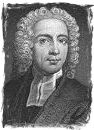
 Isaac
Watts (1674-1748), hymnwriter, was born at Southampton [England] on 17 July
1674. His grandfather, Thomas Watts, a commander of a man-of-war under Blake
in 1656, died in the prime of life through an explosion on board his ship.
His father, Isaac, occupied a lower position, being described as 'a clothier'
of 21 French Street, Southampton (1719). As deacon of the independent meeting,
he was imprisoned for his religious opinions in the gaol of Southampton at
the time of the birth of his son Isaac and in the following year (1675). In
1685 also he was for the same cause obliged to hide in London for two years.
In later years he kept a flourishing boarding-school at Southampton. He had
a liking for the composition of sacred verses. One or two of his pieces appear
in the posthumous works of his son (1779), and several others in that volume
are credited to him by Gibbons in his biography. He died in February 1736?,
aged 85. His wife was daughter of an Alderman Taunton at Southampton, and had
Huguenot blood in her veins.
Isaac
Watts (1674-1748), hymnwriter, was born at Southampton [England] on 17 July
1674. His grandfather, Thomas Watts, a commander of a man-of-war under Blake
in 1656, died in the prime of life through an explosion on board his ship.
His father, Isaac, occupied a lower position, being described as 'a clothier'
of 21 French Street, Southampton (1719). As deacon of the independent meeting,
he was imprisoned for his religious opinions in the gaol of Southampton at
the time of the birth of his son Isaac and in the following year (1675). In
1685 also he was for the same cause obliged to hide in London for two years.
In later years he kept a flourishing boarding-school at Southampton. He had
a liking for the composition of sacred verses. One or two of his pieces appear
in the posthumous works of his son (1779), and several others in that volume
are credited to him by Gibbons in his biography. He died in February 1736?,
aged 85. His wife was daughter of an Alderman Taunton at Southampton, and had
Huguenot blood in her veins.
Isaac Watts was the eldest of nine children of whom Richard lived to be a physician, Enoch was bred to the sea, and Sarah married a draper named Brackstone at Southampton. Watts received an excellent education at the grammar school from John Pinhorne, rector of All Saints, Southampton, prebendary of Leckford, and vicar of Eling, Hampshire: a Pindaric ode to Pinhorne, by Watts, describes the wide range of his classical teaching. His facility in English verse showed itself very early. The promise of his genius induced Dr. John Speed, a physician of the town, to offer to provide for Watts at the university; but, as he preferred 'to take his lot among the dissenters,' he was sent (1690) to an academy at Stoke Newington, under the presidency of Thomas Rowe, pastor of the independent meeting in Girdlers' Hall. The teaching in classics, logic, Hebrew, and divinity was excellent, as the notebooks of Watts show; and he owed to the academy his after habits of laborious analysis and accuracy of thought. Among his contemporaries were John Hughes, one of the contributors to the 'Spectator;' Samuel Say, who succeeded Calamy as pastor in Westminster; Daniel Neal; and Josiah Hort (afterwards bishop of Kilmore and Ardagh, and archbishop of Tuam).
Watts was admitted to communion in Rowe's church in December 1693. After leaving the academy (1694), he spent two years and a half at home, and commenced the composition of his hymns. The first of these, 'Behold the glories of the Lamb,' was produced as an improvement on the hymns of William Barton, and others then sung in the Southampton Chapel. Several other pieces followed: they were circulated in manuscript, and given out line by line when sung.
In October 1696 he became tutor to the son of Sir John Hartopp, bart., at Stoke Newington, and held the post five years, devoting all his leisure to Hebrew and divinity. He preached his first sermon on 17 July 1698, and in the following year was chosen assistant pastor to Isaac Chauncy in the chapel at Mark Lane. On 18 March 1702 he succeeded to the pastorate. The congregation was a distinguished one: Joseph Caryl and John Owen (1616-1683) had formerly ministered to it; it numbered among its members Mrs. Bendish, Cromwell's granddaughter; Charles Fleetwood, Charles Desborough, brother-in-law of Cromwell; as well as the Hartopps, and Sir Thomas and Lady Abney. It removed successively to Pinners' Hall (1704) and Bury Street, St. Mary Axe (1708). Watts, however, soon proved unequal to its single supervision. The intense study to which he had devoted himself had undermined his constitution and made him subject to frequent attacks of illness. As early as 1703 Samuel Price began to assist him, and was afterwards chosen co-pastor (1713). A visit to Sir Thomas arid Lady Abney at Theobalds in 1712 led to a proposal from them that Watts should reside permanently in their house; and the remainder of his days was spent under their roof, either at Theobalds or at Stoke Newington, to which Lady Abney removed (1735) after the death of Sir Thomas Abney (1722). The kindness of the Abneys gave him a sheltered and luxurious home. He drove in from Theobalds for his Sunday ministrations when his health permitted. In the fine house at Stoke Newington, which stood in what is now Abney Park Cemetery, some figures on the paneling, painted by Watts, were formerly shown, His attacks of illness increased as years went on: he only reluctantly consented to retain his pastorate, and had scruples as to taking any salary; but the congregation refused to break the connection with one so famous and beloved as Watts became.
Watts was one of the most popular writers of the day. His educational manuals -- the 'Catechisms' (1730) and the 'Scripture History' (1732) -- were still standard works in the middle of this century. His philosophical books, especially the 'Logic' (1725), had a long circulation; so also had his 'World to Come' (1738) and other works of popular divinity. The best of his works is 'The Improvement of the Mind' (1741), which Johnson eulogises. In two fields his literary work needs longer notice. His 'Horae Lyricae' (1706) gave him his niche in Johnson's 'Lives of the Poets.' It was a favourite book of religious poetry, and as such was admitted into a series of 'Sacred Classics' (1834), with a memoir of Watts from Southey's pen. But his poetical fame rests on his hymns. At the beginning of the eighteenth century the stern embargo which Calvin had laid on the use in the music of sacred worship of everything except metrical psalms and canticles had been broken by the obscure hymns of Mason, Keach, Barton; and others; and hymns were freely used in the baptist and independent congregations. The poetry of Watts took the religious world of dissent by storm. It gave an utterance till then unheard in England, to the spiritual emotions, in their contemplation of God's glory in nature and His revelation in Christ, and made hymn-singing a fervid devotional force. The success of Watts's hymns approached that of the new version of the Psalms. Edition followed edition. In the early years of this century the annual output of Watts's hymns, notwithstanding all the wealth of hymn production arising out of Methodism, was still fifty thousand copies. The two staple volumes, subsequently often bound together, were the 'Hymns' (1707; 2nd edit. 1709) and the 'Psalms of David' (1719). There are also hymns appended to some of his 'Sermons' (1721) and in the 'Horae Lyricae.' The 'Psalms of David' is not a metrical psalter of the ordinary pattern. It leaves out all the imprecatory portions, paraphrases freely, infuses into the text the Messianic fulfillment and the evangelical interpretations, and adjusts the whole (sometimes in grotesquely bad taste, as in the substitution of 'Britain' for 'Israel') to the devotional standpoint of his time. The total number of pieces in the various books must be about six hundred, about twelve of which are still in very general use ('Jesus shall reign where'er the sun,' Psalm lxxii.; 'When I survey the wondrous Cross;' 'Come, let us Join our cheerful songs;' and 'Our God, our help in ages past,' are in every hymn-book). The characteristics of his hymns are tender faith, joyousness, and serene piety. His range of subjects is very large, but many of them have been better handled since. He had to contend with difficulties which he has himself pointed out: the dearth of' tunes which restricted him to the metres of the old version, the ignorance of the congregations, and the habit of giving out the verses one by one, or even line by line; and he had the faults of the poetic diction of the age. The result is a style which is sometimes rhetorical, sometimes turgid, sometimes tame; but his best pieces are among finest hymns in English. Of another department of hymnology, Watts was also the founder. The 'Divine Songs' (1715), the first children's hymn-book, afterwards enlarged and renamed 'Divine and Moral Songs,' ran through a hundred editions before the middle of this century...
The Calvinism of Watts was of the milder type which shrinks from the doctrine of reprobation. He held liberal views on education. His tolerance and love of comprehension degenerated at times into weakness; as in his proposal to unite the independents and baptists by surrendering the doctrine of infant baptism, if the baptists would give up immersion. His learning and piety attracted a large circle, including Doddridge, Lady Hertford (afterwards Duchess of Somerset), the first Lord Barrington, Bishop Gibson, Archbishop Hort, and Archbishop Secker. The University of Edinburgh gave him an honorary D.D. degree (1728). He died on 25 Nov. 1748, and was buried at Bunhill Fields. A monument has been erected to him in Westminster Abbey; a statue in the park called often by his name at Southampton (1861); and another monument in the Abney Park cemetery, once the grounds of Lady Abney's house (1846). His portrait, painted by Kneller, and another drawn and engraved from the life in mezzotint by George White, are in the National Portrait Gallery, London. An anonymous portrait and a bust are in Dr. Williams's Library. There is a portrait of him in wig and gown and bands as a young man in the Above Bar chapel, Southampton. These are engraved in the 'Life' by Paxton Hood (cf. Bromley, Cat. of Engraved Portraits).
Besides those of Watts's publications already mentioned, the following are
the chief:
1. 'The Knowledge of the Heavens and Earth,' 1726.
2. 'Essays towards the Encouragement of Charity Schools among the Dissenters,'
1728.
3. 'Philosophical Essays,' 1733.
4. 'Reliquiae Juveniles,' 1734.
5. 'Works,' edited by Jennings and Doddridge, 1753.
6. 'Posthumous Works' (compiled from papers in possession of his immediate
successor), 1779.
7. 'A Faithful Enquiry after the Ancient and Original Doctrine of the Trinity,'
ed. Gabriel Watts, 1802.
A collective edition of Watts's 'Works,' as edited by Jennings and Doddridge, with additions and a memoir by George Burder, appeared in six folio volumes in 1810.
[Watts's Works; Memoirs by Thomas Gibbons, D.D., 1780; Milner's Life, 1834; Paxton Hood's Life, 1875 (Religious Tract Soc.); Julian's Dict. of Hymnology, arts. 'Watts,'' 'Psalters English,' and 'Early English Hymnology.']
From Dictionary of National Biography. London: Smith, Elder, & Co., 1899.
>> More Isaac Watts