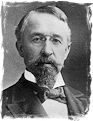
 The
subject of this sketch was born February 26, 1846, in Orleans County, New
York, [United States], where he spent the first twenty-three years of his
life on a farm. In 1869 he moved to Chicago, which marked the beginning of
his musical career. He became the musical director of the First Baptist Church
in 1870, a position he held till the autumn of 1874, when he resigned to
take up residence in Boston. During his residence in Chicago he became acquainted
with Dwight L. Moody and Ira D. Sankey; and also with P.P. Bliss and Major
D.W. Whittle, both of whom early joined the great evangelistic movement inaugurated
by Mr. Moody.
The
subject of this sketch was born February 26, 1846, in Orleans County, New
York, [United States], where he spent the first twenty-three years of his
life on a farm. In 1869 he moved to Chicago, which marked the beginning of
his musical career. He became the musical director of the First Baptist Church
in 1870, a position he held till the autumn of 1874, when he resigned to
take up residence in Boston. During his residence in Chicago he became acquainted
with Dwight L. Moody and Ira D. Sankey; and also with P.P. Bliss and Major
D.W. Whittle, both of whom early joined the great evangelistic movement inaugurated
by Mr. Moody.
Shortly after his move to Boston, Mr. Stebbins became the musical director in the church of which the late Dr. A. J. Gordon was pastor, remaining there until January, 1876, when he became the musical director of Tremont Temple, the pastor at that time being the late Dr. Geo. O. Lorimer.
In the summer of that year he had occasion to spend a few days with Mr. Moody at his home in Northfield, Massachusetts, and during his visit there Mr. Moody persuaded him to enter evangelistic work under his direction, which he did that autumn. Mr. Stebbins' first work in this connection was to organize the choir for the meetings that Moody and Sankey were to hold in the great building erected for them in Chicago, and which were to continue through October, November and December. During the remainder of the season he assisted other evangelists, and in the summer following he became one of the editors of "Gospel Hymns," and subsequently of the series of hymn books used by Mr. Moody during the remainder of his life. Afterwards he became the sole editor of "Northfield Hymnal."
Mr. Stebbins married Miss Elma Miller before commencing his musical career, and when he began his evangelistic work, she became actively involved, assisting him most efficiently in his singing, besides conducting meetings and giving Bible readings for ladies.
During the nearly twenty-five years of his association with Mr. Moody, he assisted him and Mr. Sankey in their work both in this country and abroad, besides working with other evangelists, among whom were Dr. Geo. F. Pentecost and Major Whittle.
In the autumn of 1890, he, with his wife and son, went with the former to India for a season of work among the English speaking inhabitants of that country; and during their stay there Mr. and Mrs. Stebbins and their son gave services of song in several of the principal cities of the country. On their return home they gave services of song also in Egypt and Palestine, and in Naples, Rome, Florence, Paris, and London.
From the beginning of Mr. Moody's work in Northfield, over thirty years ago, Mr. Stebbins has been one of the leaders of the singing at the summer conferences there, and is the only one now living having official connection with the work at every general conference. He is also the only surviving member of the original group of men Mr. Moody had associated with him in his evangelistic work; who were, beside himself, Mr. Sankey, Major Whittle, P.P. Bliss, and James McGranahan.
Regarding Mr. Stebbins' work, aside from his occupying important positions in churches and his leadership in the great movement with which he was connected for so many years, he was frequently engaged to lead the singing at international and state conventions of the Y.M.C.A., Sunday-school, Christian Endeavor, and other religious gatherings. Among these gathering were the two greatest of the Christian Endeavor conventions, one held in Madison Square Garden, New York City, at which there were thirty thousand delegates and one held in Boston when there were fifty thousand present. There was also the great Ecumenical Missionary conference held in Carnegie Hall, New York, and the fiftieth anniversary of the founding of the Young Men's Christian Association in this country, held in Boston.
During these years his voice was not only heard in leading others, but it was in constant demand in solo singing, and on many occasions in singing with Mr. Sankey and others.
Mr. Stebbins was well equipped in this department of his work, as well as in the others, as he studied the voice with some of the most celebrated teachers in this country (United States). Much as his voice was heard in different parts of the world, he will be remembered best by the music with which his name is associated, for that, if God continues to use it in the future as in the past, will long survive him and the memory of his public ministry.
Among his hymns that are most widely known, and which, it would seem, are most likely to endure, are "Saviour, Breathe an Evening Blessing," "There is a Green Hill Far Away," "Saved by Grace," "In the Secret of His Presence," "Take Time to be Holy," "The Homeland," and "O, House of Many Mansions."
George Stebbins died October 6, 1945. Only heaven itself can reveal in the fullest measure the great amount of good that Mr. Stebbins' gospel songs have accomplished in the world.
From Biography of Gospel Song and Hymn Writers by J. H. Hall. New York: Fleming H. Revell, ©1914.
>> More George Stebbins