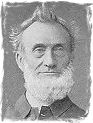
 George
Müller (1805-1898), preacher and philanthropist, born at Kroppenstadt
near Halberstadt, [Prussia] on 27 Sept. 1805, was the son of a Prussian exciseman.
Though a German by birth, he became a naturalised British subject, and for
over sixty years was identified with philanthropic work in England. When
four years of age his father received an appointment as collector in the
excise at Heimersleben. When ten years of age he was sent to Halberstadt
to the cathedral classical school to be prepared for the university. His
mother died when he was fourteen, and a year later he left school to reside
with his father at Schoenebeck, near Magdeburg, and to study with a tutor.
After two and a half years at the gymnasium of Nordhausen he joined the university
of Halle. Though he was intended for the ministry, Müller was a profligate
youth, but at the end of 1825 a change came over his disposition, and he
was thenceforth a man of self-abnegation, devoting himself exclusively to
religious work.
George
Müller (1805-1898), preacher and philanthropist, born at Kroppenstadt
near Halberstadt, [Prussia] on 27 Sept. 1805, was the son of a Prussian exciseman.
Though a German by birth, he became a naturalised British subject, and for
over sixty years was identified with philanthropic work in England. When
four years of age his father received an appointment as collector in the
excise at Heimersleben. When ten years of age he was sent to Halberstadt
to the cathedral classical school to be prepared for the university. His
mother died when he was fourteen, and a year later he left school to reside
with his father at Schoenebeck, near Magdeburg, and to study with a tutor.
After two and a half years at the gymnasium of Nordhausen he joined the university
of Halle. Though he was intended for the ministry, Müller was a profligate
youth, but at the end of 1825 a change came over his disposition, and he
was thenceforth a man of self-abnegation, devoting himself exclusively to
religious work.
For a brief period Müller gave instructions in German to three American professors, Charles Hodge of Princeton being one of them. In 1826 he resolved to dedicate himself to missionary work either in the East Indies or among the Jews in Poland. In June 1828 he was offered an appointment by the London Society for promoting Christianity among the Jews, and he arrived in London in March 1829 to study Hebrew and Chaldee and prepare for missionary service. But in 1830, finding that he could not accept some of the rules of the society, he left, and became pastor of a small congregation at Teignmouth, at a salary of 55£ a year. In the same year he married Mary Groves, sister of a dentist in Exeter, who had resigned his calling and 1,500£ a year to devote himself to mission work in Persia. Towards the close of the same year Müller was led to adopt the principle with which henceforth his name was associated, that trust in God, in the efficacy of sincere prayer, is sufficient for all purposes in temporal as well as in spiritual things. He accordingly abolished pew-rents, refused to take a fixed salary, or to appeal for contributions towards his support—simply placing a box at the door of the church for freewill offerings—and he resolved never to incur debt either for personal expenses or in religious work, and never to lay up money for the future.
After about two years in Teignmouth Müller went to Bristol, where he remained for the rest of his life. There he and others carried on a congregation, schools, a Scriptural Knowledge Institution, and other organisations, but the work among orphans was that by which he was chiefly known. The suggestion and the pattern of the Bristol orphanages were taken from the orphanages which Müller had visited in early life at Halle; these were erected in 1720 by a philanthropist named Francke, whose biography greatly influenced Müller. Beginning with the care of a few orphan children, Müller's work at Bristol gradually grew to immense proportions, latterly no fewer than two thousand orphan children being fed, clothed, educated, cared for, and trained for useful positions in five enormous houses which were erected on Ashley Down. These houses cost 115,000£, all of which, as well as the money needed for carrying on the work—26,000£ annually—was voluntarily contributed, mainly as the result of the wide circulation of Muller's autobiographical 'Narrative of the Lord's Dealings with George Müller' (London, pt. i. 1837, pt. ii. 1841; 3rd edit. 1845) which was suggested to him by John Newton's 'Life.' This book conveyed to people in all parts of the world knowledge of Müller's work, his faith, and his experiences. As a consequence, gifts of money and goods flowed in without direct appeal.
In 1838 the biography of the great evangelist, George Whitfield, helped to intensify Müller's religious fervour, and, after he had passed his seventieth year, he set out on a world-wide mission, which, with brief intervals at home, covered seventeen years. He travelled over much of Britain and of the continent of Europe, made several journeys to America, and visited India, Australia, China, and other parts to preach the gospel.
In the course of his life Müller received from the pious and charitable no less than 1,500,000£; he educated and sent out into the world no fewer than 123,000 pupils; he circulated 275,000 Bibles in different languages, with nearly as many smaller portions of Scripture; and he aided missions to the extent of 255,000£. He supported 189 missionaries, and he employed 112 assistants. The record of his life seems to associate itself more closely with primitive and puritan periods of history than with modern times.
Müller was found dead in his room on the morning of 10 March 1898.
Müller was twice married. His first wife died in 1870. In 1871 he married Miss Susannah Grace Sangar, who accompanied him in his missionary tours; she died in 1895. From 1832 till his death in 1866 Henry Craig assisted Müller. In 1872 Mr. James Wright, who married Müller's only child, Lydia, became his assistant, and the work is still being carried on under Mr. Wright's superintendence.
[The Lord's Dealings with George Muller (London), 5 vols. 1885; Annual Reports of Scriptural Knowledge Institution; Memoir of George Müller, reprinted from the Bristol Mercury, 1898; Pierson's George Müller of Bristol, with introduction by James Wright, 1899.]
From Dictionary of National Biography. London: Smith, Elder, & Co., 1901. Suppl. 3.
>> More George Müller